Matthew Lynn

Matthew Lynn is a financial columnist and author of ‘Bust: Greece, The Euro and The Sovereign Debt Crisis’ and ‘The Long Depression: The Slump of 2008 to 2031’

Macron and Merkel’s coronavirus rescue fund is a stitch-up

From our UK edition

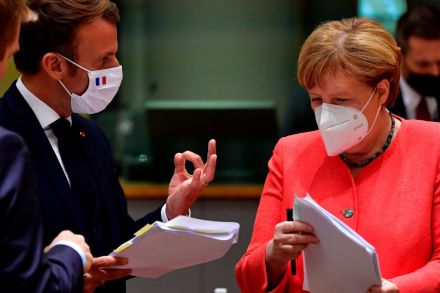
It is finally here. Die-hard European Union federalists have plotted for it for years. Economists and thinks tanks have argued for it. The Greeks and Italians have pleaded for it. And French presidents have made no end of grand speeches, full of references to solidarity and common visions, proposing it. The Germans have finally relented and agreed, at least in part, to share debt within the EU and the euro-zone, and bail-out the weaker members of the club. France’s president Macron and Germany’s chancellor Merkel last night agreed a 500 billion euro (£450bn) plan that will re-distribute fund from the stronger members to the weaker. There is a problem however. It will make a British exit without a deal a lot more likely.

Britain should break the taboo on ‘challenge vaccines’

From our UK edition

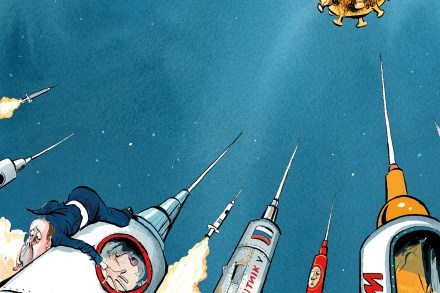
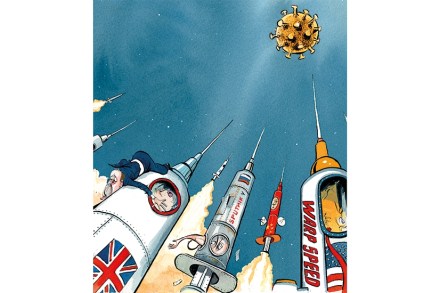
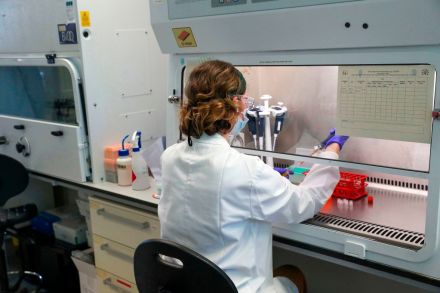
So far, so good: the Oxford university trials on a potential vaccine for Covid-19 is reported to be going well. It has been tested on more than a thousand people, and it looks to be safe. There is another, more important question, however, and one where an answer might take a frustratingly long time. Does it work?  It is too early to say. Right now, not enough of the people vaccinated have been exposed to the virus for any reliable results. Now the team are planning to move it into hospitals where the chances of exposure are significantly higher. The chances are that will give them more of an idea. But hold on. That's crazy. In fact, what we need is a 'challenge vaccine'.

Sunak’s furlough scheme is a victim of its own success

From our UK edition

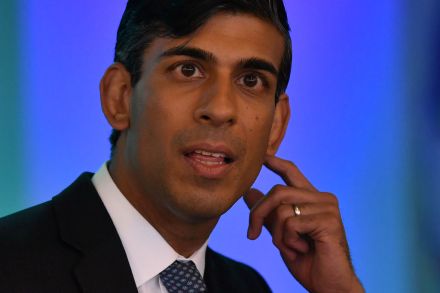
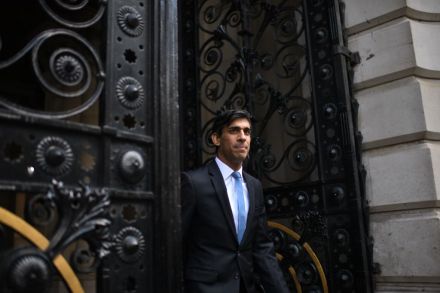
Who are we kidding? If you are still furloughed through July, August, and September, the chances are that your job isn’t on hold as you wait for lockdown to gradually be lifted or for your company to get back to normal levels of demand. In truth, you have probably been fired. It’s just that no one got around to telling you yet. Rishi Sunak's coronavirus job retention scheme, to give its full title, has in many ways been one of the most successful government projects we have seen for years. More than six million workers and half a million companies have taken it up. It has been brilliantly implemented by HMRC, who built the system in only a month, with hardly a hitch in the process (Who knew giving away free money was so easy? Maybe we should try it more often).

A German court has plunged the eurozone into fresh crisis

From our UK edition

An epidemic has been raging across the continent. The economy is in lockdown, and GDP is in freefall. But, hey, just when you thought things couldn't get any worse in the eurozone it now has a financial and currency crisis as well, and one that is being made worse by the week with the shambolic management of the European Central Bank by Christine Lagarde. Today, the German constitutional court has, at least in part, ruled against the ECB's bond-buying programme, which allows the central bank to print money and effectively bail out Italy, Spain, and probably quite soon France as well. You need to be a German lawyer – not usually among the most interesting people on the planet – to unpick the finer points of the ruling.

It’s no bad thing that the airline industry will never be the same again

From our UK edition

British Airways is laying off 12,000 staff. Virgin Atlantic is desperately looking for a buyer. Air France-KLM is being bailed out by the French and Dutch governments, Lufthansa is getting rid of planes, and Airbus is furloughing workers. The once mighty airline industry is in terminal trouble, with massive state support now required to keep it alive. Rishi Sunak hasn’t stepped in with his chequebook yet, but, heck, it is only Wednesday and it is probably somewhere on his ‘to-do’ list for the week. But hold on. Sure, we want to rescue most industries and bring them back to life as soon as practically possible.

Is the furlough scheme too generous to be stopped?

From our UK edition

You can get 80 per cent of your salary, and sometimes even 100 per cent, without actually working. Companies are getting virtually free loans, and can dump their often troublesome staff on the Treasury payroll, and entrepreneurs can get direct injections of cash from the state without actually having to launch any products. Sure we can understand why the Government has stepped in with so much cash. It needs to stop the economy collapsing, and a lot of businesses would have gone under already if that support was not available. But there's a catch. We’ve just created the biggest free lunch in history, and we shouldn’t be surprised if some people start to enjoy it.

Macron talks grandly about Europe – and then cuts a deal with Germany

From our UK edition

Emmanuel Macron is, for all his carefully polished image as a radical moderniser (and with the possible exception of not having multiple mistresses), a very traditional French president. He protects domestic industries, especially if they happen to manufacture cars or guns. He subsidises farmers, sends soldiers to small African states, and accumulates more and more debt. Oh, and also in keeping with tradition, he gives interviews to either the Financial Times or the Economist full of high-flown rhetoric about European solidarity before quietly doing a deal with Germany. This week it was the turn of the FT. In an interview with the paper’s new editor, he argued that Europe now ‘faced a moment of truth’.

Ursula von der Leyen and the EU owe Italy more than an apology

From our UK edition

Italy's hospitals have been overwhelmed. Its mortality rate is among the highest in the world. Its economy has cratered, its bond yields have soared. And it is starting to drown under the weight of its accumulated debts. But, hey, at least the EU commission president Ursula von der Leyen feels sorry about the way Italy has been treated, and is willing to apologise. But hold on. The truth is that Italy has been shamefully neglected by the rest of Europe and it is owed far more than a few crocodile tears.

Ursula von der Leyen’s ‘Marshall Plan’ is doomed

From our UK edition

Solidarity will be strengthened. Countries will find new ways to co-operate. And Brussels will support the economy, making sure the strong support the weak. European Commission president Ursula von der Leyen is set to unveil the EU's response to the coronavirus crisis, promising a ‘new Marshall Plan’ to prevent the continent plunging into deep recession. It is a nice idea. The financial help offered by Harry Truman’s secretary of state George C. Marshall to rebuild Europe after World War II is rightly credited with salvaging its shattered economy and laying the foundations for half-a-century of peace and prosperity. The trouble is, the reality is nothing close to the rhetoric.

The Bank of England’s big coronavirus gamble

From our UK edition

Ten billion here. Twenty billion there. At least we now know where Rishi Sunak is getting all the money from. As of today, the Bank of England has quietly started directly financing the government. Instead of selling gilts to fund the difference between what it raises in taxes and what it spends the Bank is simply going to increase the government's account, normally a relatively trivial £370 million, to what it discreetly describes as an 'unlimited amount'. How much might that be? No one knows, but the final number could easily have ten zeros at the end of it. What is known in the economics textbooks by the rather dramatic name of 'helicopter money' – where the government simply prints lots of cash and chucks it out of helicopters onto grateful citizens – has begun.

Anneliese Dodds isn’t the woman to steer Labour back to economic sanity

From our UK edition

In some ways we will miss John McDonnell. His reheated 1970s student union Trotskyism was always an easy target for a column. From free broadband, to nationalising great swathes of industry, to raising taxes to punitive levels, and banning just abut anything he disapproved of, he managed to come up with a constant stream of terrible ideas. But, hey, never mind. Now there is Anneliese Dodds. The new shadow chancellor may be painted in some places as representing a shift back towards the moderate centre. And yet while she may have endeared herself to working parents on lockdown everywhere with her daughter’s impromptu appearance on Sky News this morning, we should also get real about her very limited abilities.

Coronavirus has again exposed the euro’s fatal flaw

From our UK edition

Rising death rates. Economies closing down. People forced to stay at home. The coronavirus is a health, social and economic emergency for every country where it hits. But in Europe it has also mutated very quickly into something else as well, and which, while it may not be quite so threatening in the short-term, could well do even more damage in the years ahead. A currency crisis. Over the last couple of weeks the eurozone has been engulfed by a furious argument over ‘coronabonds’ – a joint eurozone financial instrument that could raise money to help deal with the crisis. The highly-indebted Southern economies, along with France, are in favour. Predictably, Germany and the Netherlands are against. You can argue about the rights and wrongs of that proposal.

Rishi Sunak has badly miscalculated his coronavirus bailout

From our UK edition

Ten billion? Twenty billion? Thirty billion? To borrow a phrase from the American senator Everett Dirksen when scrutinising the escalating costs of the military, ‘pretty soon you are talking about real money.’ Chancellor Rishi Sunak has already thrown huge sums of money at rescuing the economy. He may well spend a lot more over the next few weeks. You can argue about the rights and wrongs of that. But one thing is already becoming clear, and the more you pause to think about it the more worrying it becomes. It is already looking like he has hugely miscalculated the cost.

Self-employed workers richly deserve a coronavirus bail-out

From our UK edition

It will be impossible to calculate. There will be widespread fraud. And there is no mechanism for sending out the money. As the Chancellor Rishi Sunak scratches around for ways to bail out the UK’s five million self-employed in the same way he has done for employees he faces plenty of obstacles. No doubt his Treasury officials have come up with a list of reasons why any scheme he comes up with won’t work in practise, will prove too expensive, will break the IT system, or can’t be implemented until 2029 at the earliest. But hold on. That's crazy. In fact, the self-employed deserve their bail-out more than anyone. Sure, it is difficult. The self-employed don't have regular salaries in the way employees do.

Rishi Sunak’s wartime economy

From our UK edition

At least no one can say it isn’t bold. The United States is fiddling around with some possible cuts to payroll taxes. Most of Europe is stuck with some printed money from the ECB. But the UK is embarking on one of the most radical experiments in modern economic theory, and one that will no doubt be studied for decades to come. With his latest announcement today, a whole 48 hours after his last intervention, the Chancellor Rishi Sunak has effectively turned the UK into a wartime economy.

Tory taboos must be broken in the fight against coronavirus

From our UK edition

A £330 billion package of loans to business. A huge tax break to any company in the hospitality or leisure industry. Mortgage holidays to anyone who has been impacted by the coronavirus. People can accuse the Government of being behind the curve on delaying the spread of Covid-19 through the population. But it is hard to accuse it of not moving quickly enough to mitigate its financial impact.  Only last week, alongside a rate cut from the Bank of England, the Chancellor Rishi Sunak announced huge rises in Government spending. Today he followed that with a massive round of state intervention, more money for industry, and the hint of a rolling programme of bail-outs as companies run into trouble.

The eurozone’s coronavirus response has been dire

From our UK edition

A dramatic dawn cut in interest rates. A huge blast of public spending. And immediate cash help for companies that might find themselves temporarily in trouble as their customers stay at home and staff call in sick. We will find out over the next few weeks whether the British government has done enough to fight the coronavirus emergency it suddenly faces. But there can be no question it has at least done everything it can to fight the economic crisis that will surely follow. Likewise in the United States, the Federal Reserve has already sprung a cut in interest rates on the markets and may well make another move before the end of the month. President Trump has already announced a plan to cut payroll taxes, and is working on a stimulus package.

Sunak’s leaked tax plan sends precisely the wrong message

From our UK edition

It is too expensive. It mostly goes to Southerners who already have plenty of money. And it doesn’t even work very well, while the money would be better spent elsewhere. As the Chancellor puts the finishing touches to his Budget, the leaks suggest that the most generous tax relief for entrepreneurs will either be curbed, reduced or potentially even scrapped completely. But hold on. That's crazy. It's just about possible that there might be a worse message to send out about post-Brexit Britain – nationalising the banks, perhaps, or a three-day working week – but it is hard to think of one. In fact, entrepreneur’s relief has been a huge success. Instead of scrapping it, we should think about extending it.

Three ways to stop a coronavirus recession

From our UK edition

Supply chains are shutting down. Factories and offices are closing. Flights are being cancelled, conferences postponed and football and rugby games rescheduled. It remains to be seen how much of a blow the spread of the coronavirus turns into for the global economy. But one thing is now certain: it is going to lead to a sharp slowdown. And the real question now is this: how should governments and central banks respond? The medical response is already clear. Communities are put into lockdown. The infected are quarantined. Borders are closed where necessary. And treatment centres are braced for a vast increase in the number of patients. How well it works, and how quickly, remains to be seen. But at least a plan has been put in place. The economic response?

Gina Miller should leave the Bank of England’s new boss alone

From our UK edition

She’s back. With Brexit ‘done’ and with most of the country just grateful to have moved on from the whole saga, we might have thought we had heard the last of Gina Miller. Miller, who became something of a figurehead in the anti-Brexit movement, could quietly return to doing whatever it was she used to get up to. Not so. Now she is back on the attack, demanding a ‘review’ of the appointment of Andrew Bailey as Governor of the Bank of England. What’s her complaint this time? Apparently as head of the Financial Conduct Authority, Bailey presided over “a toxic cocktail of negligence, incompetence and indifference to the needs of ordinary depositors, investors and pensioners”.