
Martin Vander Weyer

Martin Vander Weyer

Martin Vander Weyer is business editor of The Spectator. He writes the weekly Any Other Business column.

Any other business | 6 August 2011

The greatest nation? This debt fiasco makes Washington look like a parish council I love America, and if you look at my Wikipedia entry — which I have neither the vanity nor the knowhow to bother to edit — you might suspect that I’ve been brainwashed to say so, because I am ‘a leading figure within the British-American Project’. I am indeed active in that excellent networking organisation, which has never been anything like the sinister Reaganite propaganda vehicle that Pilgerists and Guardianistas imagine it to be. And it has given me valuable insights into the national characters of movers and shakers from both sides of the pond who form its membership. The Brits, mostly arts graduates, tend to be argumentative free-thinkers with opinions about everything.
Any other business | 30 July 2011

Barely a flicker of growth, but Osborne mustfollow his instincts and stick to his guns Cut taxes now, or pile more taxes on to the bankers? Cut spending even faster to compensate for flagging tax revenues, or slow the cuts to ease the dole queues and boost confidence among consumers who still have public-sector jobs? Ban royal weddings, or at least the ones that cause the nation to stop work for a week and a half? Print more money, or tell Vince Cable to sod off and stop rocking the boat? George Osborne has a rich menu of choices as to how to respond to the news that second-quarter growth barely crawled into positive territory, at 0.2 per cent. But they’re all tough ones, and apparently he now has the Prime Minister breathing down his neck as well.

Any other business | 23 July 2011

Another Murdoch lesson: when the iceberg looms, it’s too late to change course The sixth most famous Murdoch in history, after Rupert, James, Wendi and Rupert’s parents Sir Keith and Dame Elisabeth (the latter still with us at 102, and presumably wondering what the boy will get up to next) was of course William McMaster Murdoch, First Officer of the Titanic. If space permitted, I’d expatiate on how cruelly this heroic Scotsman was misrepresented in the 1997 cinema epic in which he is seen taking a bribe and shooting two passengers before turning his gun on himself.

Any Other Business | 16 July 2011

Murdoch, Balls, Huhne and Satan: is it possible they’re all related? The debate about whether Rupert Murdoch and Satan are one and the same person has distracted attention from the worrying state of the economy. But gruesome statistics and forecasts are stacking up like the blizzard-stricken aircraft in Die Hard II, and waiting on the tarmac to greet them with a mad glint in his eye is shadow chancellor Ed Balls, the only man in Britain whose career prospects would catapult upwards out of a double-dip — and for my money, the only one who makes both Rupert and Satan look cuddly as puppies. What numbers are circling up there, or lurking down here unnoticed, while the hacking scandal fills every cranny of news space?

Any other business | 9 July 2011

Pound shops and possession orders: parables from the post-recession high street One of our fanciest local shops — until it closed, it sold upmarket furnishings and children’s clothes — has its windows plastered with ‘Possession Order’ notices. Rumour says the space has been re-let to Oxfam, against which neighbouring retailers are getting up a petition because they regard charity shops as unfair competition in such a tough market. That Yorkshire parable is the story of the national high street this summer, after a particularly dismal set of retail sales figures for May. Habitat and the fashion chain Jane Norman went into administration last week. Thorntons are closing 180 chocolate shops. Mothercare is one of several other famous names with closures looming.

Any other business | 2 July 2011

Why release emergency oil stocks? Because Opec never does the right thing Observers of oil politics have been wondering why the Paris-based International Energy Agency, which represents 28 member states including Britain, has suddenly decided to start releasing oil from its emergency reserves. What do they know that we don’t? This is a rare move for the IEA — the last time was after Hurricane Katrina. The amount of the release, 60 million barrels, is enough to fuel the world for about 19 hours, which sounds insignificant, but is also equivalent to 42 days of pre-war production from Libya, which is more relevant.

Any other business | 25 June 2011

Tony Hayward’s making the headlines, but Rothschild’s the one they’re betting on Remember Lasse Viren, the Finnish policeman who fell over halfway through the 1972 Olympic 10,000 metres final in Munich only to rise again, sprint past the leaders, and win gold in world record time? Well, he’s got nothing on Tony Hayward, the former chief executive of BP who stumbled so woefully in his handling of last year’s Gulf of Mexico oil-spill disaster that he seemed to have been howled right out of the stadium of big-corporate life. Less than a year after that global public humiliation, Hayward is back on his feet and fronting a new venture called Vallares which has just raised £1.

Any other business | 18 June 2011

Can capitalism care for the old and vulnerable? The collapse of the Southern Cross care homes group is a big story not just because 31,000 elderly residents are waiting to discover whether they still have anyone to look after them when it’s all over, but because it illuminates a pattern of financial engineering that prevailed in the boom years and could now unravel with very disruptive consequences. Southern Cross was bought in 2004 by the US private equity firm Blackstone, which tripled the number of homes, floated the company on the stock market and sold the last of its own shareholding in 2007, having made a 300 per cent return while four senior Southern Cross executives pocketed £35 million between them.

Any other business | 11 June 2011

The construction industry looks perky, and this time it’s not building state-funded follies Not exactly Flaming June so far, is it? Up north, we’ve had one day of blazing sunshine — and being northerners, we complained it was too hot. Down south, you’ve had a continuous drizzle of dismal economic indicators. Inflation is up; growth forecasts have been slashed, in the IMF’s case by a whole percentage point to 1.5 per cent for 2011. Manufacturing output has fallen back for the first time in two years. New car registrations were down 1.7 per cent year on year in May and retail sales were 0.3 per cent worse than in April — when mortgage approvals were at their lowest level since 1993.

Righteous anger

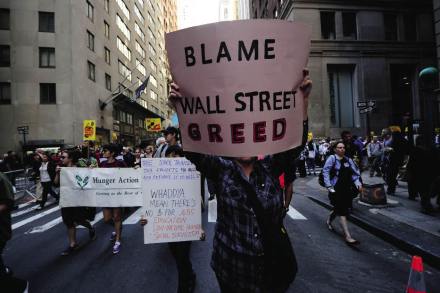
Can a documentary ever be as entertaining as a fictional feature film? And, if it can, does that mean it cannot be a serious contribution to public debate? Inside Job, director Charles Ferguson’s Oscar-winning account of the origins of the US subprime mortgage debacle and the 2008 banking crisis, is a case in point. It is compelling viewing — and as a guide to why the financial world went mad, it is more vivid than any screen drama I’ve seen (though the BBC’s The Last Days of Lehman Brothers felt pretty authentic), and easier to absorb than any of a shelf full of books on the subject. But that doesn’t mean it is an even-handed account of what happened: far from it.

Any other business | 4 June 2011

There’s always another disaster waiting to happen – so keep your eye on ETFs If we learned anything from the recent financial crisis, it is that when a thing looks too good to be true, it is. If a sector is attracting frenzied investor attention and pundits say spectacular growth must continue, it is surely heading for trouble — not next week, perhaps, but soon enough to allow a minority of sceptics to say ‘I told you so’. In markets, good ideas pursued to extremes mutate into disasters and, at any given moment, someone somewhere is concocting the next one. And so I draw your attention to Exchange Traded Funds, or ETFs.

Any other business | 28 May 2011

Another rail report chugs past like an empty freight train bound for the sidings Sir Roy McNulty’s report on the state of Britain’s railways chugged by last week like one of those unmarked freight trains that sometimes pass through stations. ‘Stand well back from the platform,’ says the announcer, making us wonder whether the wagons are full of explosives. But such is the inefficiency of our rail system that they’re more likely to be being shunted empty from one siding to another — which is what will happen to McNulty’s ‘Rail Value For Money Study’ if unions and other vested interests have their way.

Any other business | 21 May 2011

Another tale of the Great Seducer and my tip for the woman to succeed him When I was young I knew a man whose opening gambit with any pretty girl was, ‘Hello, shall we go straight to bed?’ He reckoned one in 20 said yes, so if he asked the question 20 times a day, he would never be lonely. All accounts of Dominique Strauss-Kahn, the IMF chief and would-be French presidential candidate who has been charged with sexually assaulting a New York hotel chambermaid, suggest a similar approach. In the late 1990s — during the tenure of ‘DSK’ as France’s minister of finance and not long after his third marriage — an attractive female journalist of my acquaintance was sent to interview him at the French embassy in London.

Any other business | 14 May 2011

The latest mis-selling scandal is one more symptom of a deeper problem The payment protection insurance (PPI) scandal is, by common consensus, the worst case of financial mis-selling until the next one. These policies were foisted by banks on personal borrowers, supposedly to cover repayments if they fell ill or lost their jobs or encountered some other misfortune. But in many cases borrowers were not aware they were being charged for the cover, or were told falsely that they were obliged to buy it. If they were self-employed or too old, they would never have been able to claim on it anyway.

Any other business | 7 May 2011

Warren Buffett isn’t always right – but he’s a $47 billion advertisement for optimism The legendary investor Warren Buffett has taken more flak than seems necessary for his lapse of judgment over his former lieutenant David Sokol, who bought shares in a company called Lubrizol before recommending it to Buffett as an acquisition for the Berkshire Hathaway conglomerate. Having been tipped as a potential successor if 80-year-old Buffett ever retires from running Berkshire, Sokol resigned abruptly in March. Buffett’s comment at the time, ‘Neither Dave nor I feel his Lubrizol purchases were in any way unlawful’, was widely regarded as inadequate.

Any other business | 23 April 2011

Glencore’s partners are not offering equityto you and me out of a sense of charity We’re all going to be investors in Glencore, whether we like it or not. If the flotation of this giant commodity and mining group goes ahead next month at the valuation currently indicated, it will leap straight into the upper reaches of the FTSE 100 — something that has not happened to any new share since the big privatisations of the 1980s. That means every major pension fund, and all those tracker funds and funds of funds that wealth managers love to stuff their clients into, will end up owning little bits of Glencore.

Any other business | 16 April 2011

Vickers’s half-time score: not half as badas bankers feared or bashers hoped ‘Not half as bad as it might have been,’ was the reaction of the first banker I spoke to on Monday about the interim report of Sir John Vickers’s Independent Commission on Banking. ‘And forcing Lloyds to sell off a few more branches won’t do a damned thing to promote competition.’ ‘Not half as bad’ for bankers seems to imply not half as good as it might have been for customers. The increased and ring-fenced capital requirements for retail banking mean borrowers could be charged more for loans, and are unlikely to be offered greater choice.

Any other business | 9 April 2011

Sunny spells, icy showers and an inflationary wind blowing from America Daffodils everywhere and the FTSE is back around 6,000. Builders are busy after the frozen winter, it’s ‘business as usual’ again in financial services, and although manufacturing lost momentum in March — exports remained strong, but nervous consumers depressed domestic demand — industry is generally perky. The British Chambers of Commerce expect first-quarter growth of 0.6 per cent or better, reversing the previous 0.5 per fall — and although recovery could be sluggish for the rest of the year, the trend will be in the right direction. So there’s room for optimism, of a cautious kind.

Any other business | 2 April 2011

Farewell to a charismatic old bruiser who never threw in the towel George Walker, the former boxer, gangster’s minder and ‘leisure tycoon’ who died last week, was a persuader — both in the sense that he could be, as he once told me, ‘a bit rough with people’, and in the sense that if he decided to charm you, he was hard to resist. Fortunately, I fell into the second category. I got to know him during the period between his ousting as chief executive of Brent Walker, the conglomerate of pubs, betting shops, yacht marinas and other forms of amusement he built in the Eighties boom on a mountain of debt, and his trial on fraud charges in 1994.

Any other business | 26 March 2011

Next, Osborne should tackle the plague of charity shops depressing our high streets The dramatic form of the modern, Brownian Budget speech requires a headline-grabber at the end to deflect commentators from analysis of the statistical soup and re-announced tax-tinkering that went before. But the politics of being ‘all in it together’ means that the rabbit in George Osborne’s hat was never going to be abolition of the 50 per cent top rate of income tax — and he made that pretty clear long before he got up to speak. So if you were planning to spend this weekend restocking your cellar with first-growth clarets (following Christopher Silvester’s excellent advice last week) on the strength of a sudden shrinking of your tax bill, you were misguided.