Martin Bright

A Bad Idea Meets Wikileaks

I've become something of a fan of Bad Idea magazine, which promotes the work of young journalists. It's a sight more lively than most of the dreary material pumped out by the mainstream press as it stumbles lazily into oblivion. People younger than me will have to invent new ways of doing this thing if any of us are going to survive. One approach is the investigative site Wikileaks, which has been responsible for publishing a stream of documents no one else has dared touch. So a Bad Idea article about Wikileaks was something I has to read, especially with the headline: Wikileaks - Protector Of Civil Liberties, Or Utterly Misguided? The article reports the case of Theodor Reppe, the owner of the Wikileaks server, whose home was raided by German police.

The Guardian and Libel

There is a very important piece in today's Guardian about the UK libel laws by my old friend Jo Glanville, editor of Index on Censoship. I urge you to read the article in full. She argues that the UK's "libel laws remain the most significant daily chill on free speech in the UK". She is right. There are a number of stories that the British press won't touch because the threat of being sued by welathy individuals would be so great. I can think of one such story that I would love to tell you about, but if I gave even the merest hint of the identity of the individual involved I would risk a very hefty libel suit. The meat of Jo's argument is this passage: "The key issue is costs. The use of "no win no fee" (conditional fee agreements, or CFAs) has turned libel courts into casinos.

New Deal of the Mind at 11 Downing Street

I don't think it's quite right for me to keep promoting New Deal of the Mind here on my Spectator blog. That should happen elsewhere and will. But just in case readers are interested, the launch meeting at Number 11 Downing Street was a fascinating affair. Cabinet Ministers Andy Burnham and James Purnell pledged their support as did opposition culture spokesman Ed Vaizey. It's probably best to let others who were there speak about this so check out Lynne Featherstone's report of the event. Lynne has been a great supporter of the initiative, designed to harness the innovative potential of the creative industries during the downturn.

The Left and Radical Islam

There is a part of me that hopes I never have to write another word about the troubled relationship between the British left and radical Islam. But I certainly wouldn't appreciate being told I could never write about it. This is what I find so mystifying about the campaign by Sunder Katwala, the Fabian Society's head honcho, to stop Nick Cohen criticising the left for its mealy-mouthed approach to the ideology of the Muslim Brotherhood and its south Asian offshoot Jamaat-i-Islami. He says he finds Nick's critcism of the Fabians "politically regressive and personally offensive". So, as a result Sunder has gone on the warpath. I find this very odd. I really like Sunder and always found him a friendly and thoughtful colleague when we worked together at the Observer.

Is the Left Waking From Its Slumber?

A rather impassioned piece on unemployment from Polly Toynbee in yesterday's Guardian made me realise that there are a number of people on the liberal-left in Britain thinking very hard about the implications of the global recession. "Has the horror of it all struck Westminster with full force?," asks Polly? I think they are beginning to, but the problem is that they are stuck in the politics of the late-1990s census, which had us all triangulating like mad. All the clamour for an apology from the Prime Minister stems from a desire for him to atone for all our sins. It was difficult not to embrace the market when the market seemed so cuddly. What we mistook for comforting girth turned out to be the flabby product of over-indulgence. But this is not the time for self-flagellation.

Whistleblowers United

Good to see three of my favourite whistleblowers - Katharine Gun, Brian Jones and Derek Pasquill - giving evidence to the Public Accounts Committee today. But it seems from the reporting that Carne Ross, former first secretary at the United Nations, rather stole the show by live video link from New York. Ross, it seems he suggested that there is still more to be found out about the Iraq War and said that the full papaer trail should be published. Funnily enough, Alistair Campbell didn't use the opportunity of the guest editorship of my old publication, the New Statesman, to enlighten us further. It was a bold, if rather curious move to get a propagandist turned spin doctor to try his hand at journalism.

My Long-Delayed Re-Entry

Many, many apologies for my absence from the blog. I have been deep in the inner crevices and interstices of government searching for an escape route from the recession. Have I found it? You will find out next week when the New Deal of the MInd finally sees the light of day. The coalition of people who believe that we must act now to prevent the loss of a generation of creative and entrepreneurial talent has been building steadily and we are beginning to reach critical mass. The University of the Arts (all the London art colleges) and the British Council in the form of its think tank Counterpoint, have both been fantastically supportive of the idea. One of my concerns was that tough-nut Labour MPs would be put off by the idea of supporting creative types.

Some Thoughts on Political History

The brutal truth about politics is that a whole career can often be telescoped into a single defining event. The judgement of history can be particularly cruel on  unlucky Prime Ministers. Ted Heath’s reputation is dominated by the 1972 miners’ strike, Jim Callaghan is synonymous with the “winter of discontent” and Anthony Eden, perhaps the most ill-starred of all post-war PMs, will be forever associated with a single word: “Suez”. All those years of vaulting ambition, grinding thankless work and genuine public service reduced, in the end, to those two damning syllables. And how thin sometimes is that line between success and failure. Who remembers John Major for his remarkable 1992 election victory rather that the crushing 1997 defeat?

Comic Relief At Its Best

I very much enjoyed Comic Relief tonight, especially the double act of Anjem Choudhary and Patrick Cordingly on Newsnight. That was comic genius. Why do serious programmes like Newsnight give clowns like Choudhary the time of day?

The Other Side of the New Deal

Apologies for missing a day of blogging, but I've been hard at work trying to figure out how my idea for a New Deal of the Mind might work in practice. There seems to be some momentum growing around the concept of harnessing this country's celebrated talent for creativity and innovation during the downturn. We are at severe risk of losing a generation of intellectual capital if we don't turn our attention to deciding what the army of unemployed will do during the recession. They can't be allowed just to sit it out. Like everyone else it seems, I have been reading up on Franklin D. Roosevelt's New Deal of the 1930s. I can recommend Anthony J. Badger's The New Deal: The Depression Years 1933-1940, which contains a brilliant chapter on welfare.

The History of the Hain-Brown Ideological Split

Every now and again I find myself reaching for Robert Peston's 2005 book, Brown's Britain. As we are now living in Brown's Britain (perhaps we have been for the past 11 or so years) it is a very useful work of reference. We all know by now that Peston was always there first. The book is particularly enlightening when Peston looks at Brown's early ideological battles within the party.  On page 157 of the paperback edition Peston looks at the what he calls a symbolic "punch-up" with the centre-left Tribune group. In essence this is the group that is most likely to seize control of the Labour Party when Brown eventually loses the leadership, although the Compass fraction (marginally closer to the centre ground) will also be a serious contender.

Sarah Churchwell Gets Under the Skin of Republican Philistines

I now get magazines sent to my home rather than my office, which means that I actually read them from time to time. The latest issue of The Liberal, for instance, contains a fascinating article by Sarah Churchwell about the home-spun language used by Sarah Palin and John McCain during the US presidential election. She demonstrates that the attempt to paint Barack Obama as an out-of-touch metropolitan intellectual failed, but it is a brilliant analysis of how powerful this particular discourse remains in the US culture wars. "The real winner of the 2008 election," she says, "may yet turn out to have been the English language".

The Complex Personality of Peter Hain

A good mini-scoop from the Independent on Sunday based on an article from Peter Hain. News stories based on articles by politicians are often the last refuge of a political journalist who has run out of road. But this piece by Jane Merrick and Brian Brady is an exception. The former Work and Pension Secretary is putting his head above the parapet on this one and issuing a rousing call for the Labour Party to return to its true values. He makes similar points in his interview in the Sunday Telegraph, although that newspaper chose to make a little less of them.

Harriet’s At It

My politics students at City University in London were delighted to have a visit from a master hack today. Kevin Maguire was an entertainining and marvellously indiscreet guest. The final question was straight and to the point: "What did Mr Maguire think Harriet Harman was up to?" Kevin thought for about a second before replying: "She's at it."  He also confirmed that Number 10 thought she was "at it" too. He made the point that Harriet Harman was an accomplished politician who had managed to win the Labour deputy leadership without the support of the unions. Her positioning on Fred Goodwin's pension and Post Office privatisation, was, he felt, a clear pitch for the leadership (and so did the people around Gordon Brown).

Didn’t He Do Well?

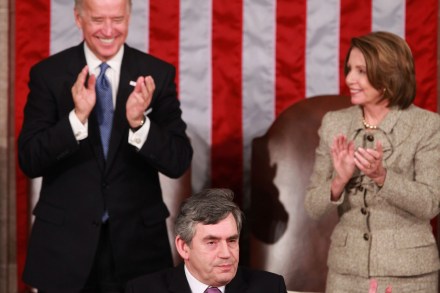
I have had some time to think about Gordon Brown's performance in Washington now and I would agree with an American liberal friend  I spoke to on the phone this evening that it was "not bad". This is someone who desperately wanted Obama to win and who, on balance, would probably not want a Tory government in Britain if he put his mind to it. In essence, Brown's speech to Congress just doesn't matter that much: not to Obama, not to the American public, not to the British public, not to Brown's chances of winning the next election. It mattered to Brown, of course, as a devoted student of American history and politics.

Hollywood Beckons

You will all be delighted to hear that today I finally signed away the rights to my life story. Stop laughing at the back! Longstanding followers of The Bright Stuff will remember that I (perhaps rather grandly) said I was leaving the New Statesman to work on a film project. The Spy Who Tried to Stop a War is the story of Katharine Gun, the GCHQ whistleblower who disclosed details of a joint US/UK operation to fix the vote at the United Nations for a second resolution to authorise war in Iraq. As the recipient of the original leaked document from the US National Security Agency asking for GCHQ's help I played a small part in the drama.

Fear and Loathing at the Heart of Government

There's some really fascinating stuff knocking around today. Rachel Sylvester's column in The Times is really quite extraordinary. She claims that in a conference call with Peter Mandelson and Ed Balls, the Prime Minister could not be persuaded to concentrate on domestic policy and kept returning to the international global crisis. Were there others involved in the call or is one of Balls or Mandelson briefing the Blairite Sylvester (hmm, I wonder)? Pete Hoskin over at Coffee House has suggested that the level of humility in Alistair Darling's interview in today's Telegraph and similar noises from Ed Balls suggest that perhaps Brown will go for a mea culpa of his own in America.

Convention on Modern Liberty

I was really sorry not to get along to the Convention on Modern Liberty at the weekend. I think this is an important development on the political landscape and I salute the organisers. I have been impressed by the energy of Henry Porter in getting this onto the agenda and the coalition is an interesting one. Henry's article in the Observer was correct to point out the role played by Jack Straw in the erosion of our liberties. Straw, argues Porter is "now carving out a historic role for himself as one of the enemies of democracy and civil liberties in the United Kingdom". I also enjoyed Suzanne Moore's take on the event: "The enemies of freedom have shown themselves to be not simply murderous bombers but smiling legislators who know what is best for us.

Gordon Brown’s Legacy Revisted

No one outside Downing Street can imagine how tense it must be getting in the bunker as the economic situation worsens and the period Gordon Brown has to turn things around shortens. My suspicion is that it is getting very tense indeed. I was informed on Friday that  No 10 was not happy with some of the things I have been writing on The Bright Stuff. We already know that people around the Prime Minster were concerned at the suggestion that they were studying footage of Obama's apologies. Officials have been unable to identify the person who was asking for this footage I am told. All very mysterious. But then again, would you put your hand up? Now they are unhappy at the suggestion that discussions of the "legacy" are off-limits.

Co-operative Capitalism: The Mother of Invention

I was interested to read Noreena's Hertz's take on "Co-Op Capitalism" in The Times. If what she calls "Gucci Capitalism" is going the way of the command economy then what will replace it, Hertz asks. "I believe that the conditions are in place for a new form of capitalism to arise from the debris -- co-op capitalism, with co-operation, collaboration and collective interest at its core," she adds. Wishful thinking, or is there something more to this? Hertz is not the first person to talk about a new form of co-operative capitalism. The music business entrepreneur and all-round good egg Ben Wolff regaled the audience at the We Are Names Not Numbers symposium earlier this month with his version of the concept. Maybe its time has come.