Luke McShane

Luke McShane is chess columnist for The Spectator.

No. 644

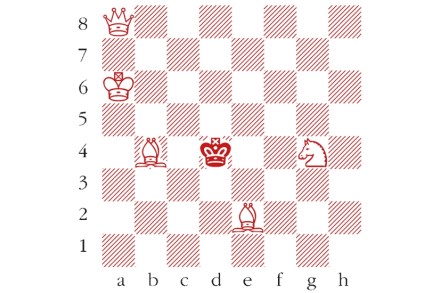
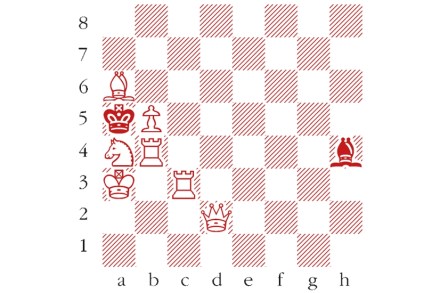
White to play and mate in two moves. Composed by Philip Hamilton Williams, Birmingham Post, 1890. Answers should be emailed to chess@-spectator.co.uk by Monday 15 March. There is a prize of £20 for the first correct answer out of a hat. Please include a postal address. Last week’s solution : 1 Qd5! Nc5+ 2 Ka2 and the threat Qd5-g8 is decisive. 1 Bxe6? Qa3+! soon led to a draw, because it’s stalemate if the queen is captured: 2 Kc4 Qb4+ 3 Kd5 Qd6+ etc. Or 1 Qe3? Nd4+ 2 Qxd4 Qa3+ is similar.

Armenian champions

In the 21st century, which country has won more international chess Olympiads than any other? Russia? USA? China? None of the above — it’s Armenia, which won gold three times (2006, 2008 and 2012). Despite a population of just 3 million, the country has a healthy number of top flight grandmasters, and Levon Aronian (the current world no. 5, and former world no. 2) has been its pre-eminent player for many years. So Aronian’s announcement that he will switch federations, representing the USA in future events, is significant. He will relocate to St Louis, which has become a major chess centre in recent years, with the backing of the American philanthropist Rex Sinquefield.

Play from home

Is working from home the future of a productive society, or a fleeting aberration? Nobody knows yet, but a significant minority (at the very least) have found it viable, and even desirable. The shift in perception creates possibilities that weren’t there before. Similarly, chess organisers are discovering a strong appetite for ‘play from home’ events, and I anticipate that we will see lots of new online tournament formats in the coming years. Last summer, Fide’s Online Olympiad was the first of its kind, and later in 2020 came the Online Olympiad for People with Disabilities, which I wrote about last week. February 2021 saw another new event — the Fide Online World Corporate Chess Championship.

No. 643

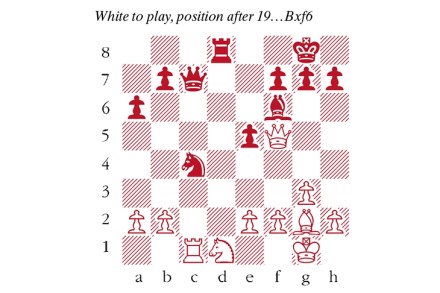
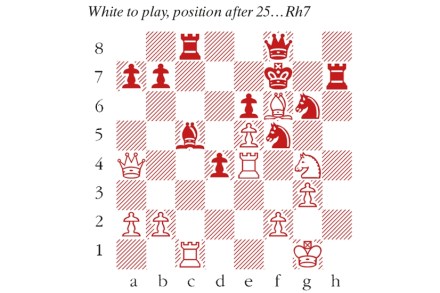
White to play. Garcia Ramos–Maurizzi, -Barcelona 2021. Black has just played Kg8-h7, to attack White’s queen by unpinning the knight on e6. Choose between 1 Qd5, 1 Qe3 and 1 Bxe6. Which do you prefer? Answers should be emailed to chess@spectator.co.uk by Monday 8 March. There is a prize of £20 for the first correct answer out of a hat. Please include a postal address and allow six weeks for prize delivery. Last week’s solution 1…Rb8! and White resigned, since 2 Rxb6 Bxg2+! wins easily.

No. 642

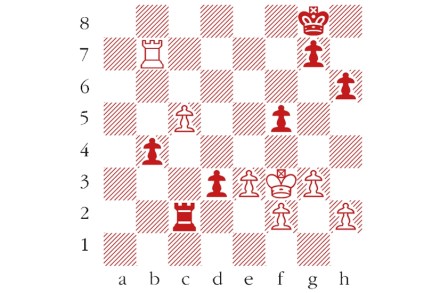
Black to play. Warakomski-–Korobov, February 2021. White has a pin on the b-file and 1…Bxg2+ 2 Kxg2 Bc5 3 Rb7 should suffice for a draw, despite the pawn deficit. But Korobov’s next move provoked instant resignation. What did he play? Answers to chess@spectator.co.uk by Monday 1 March, for a prize of £20 for the first correct answer out of a hat. Please include your address. Last week’s solution 1 Rc8! Now 1…Rxc8 or 1…Raa8 are both met by 2 Bd4 mate. Or 1…Bxc3 2 Rxd8+ leaves White with an easy win.

Synthetic diamonds

Diamonds are forever, they say. Likewise, brilliant games of chess have an everlasting sparkle. I will never tire of replaying the combination from Steinitz–von Bardeleben, Hastings 1895. So I’m a huge fan of tournaments which award brilliancy prizes, in recognition of these achievements. Fide recently organised an Online Olympiad for People with Disabilities. This excellent initiative was a reminder that the game is uniquely accessible, and saw 61 teams competing from 45 different countries. Many players overcame significant physical obstacles in order to take part. Vladimir Trkaljanov, who is visually impaired, was awarded the Gazprom Brilliancy prize, his game singled out from the shortlist by six out of 13 international judges.

No. 641

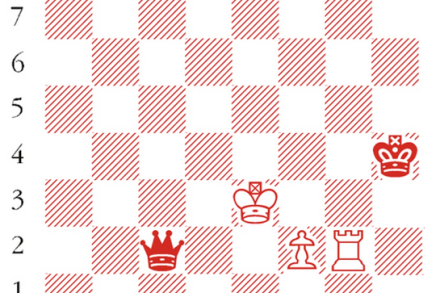
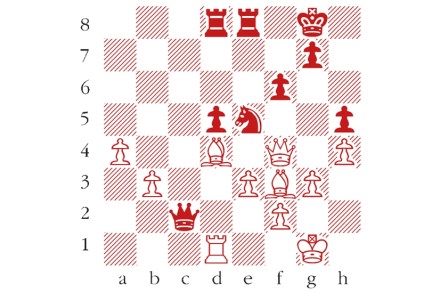
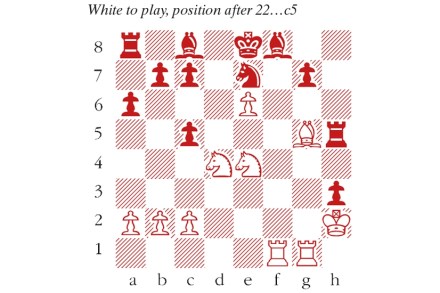
White to play. Carlsen–Vachier-Lagrave, Opera Euro Rapid 2020. Carlsen played 31 Bd4+ Rxd4 32 cxd4 Bxd4 which should be drawn, though he won in the end. Can you find the much s-tronger move which he missed? Answers to be emailed to chess@spectator.co.uk by Monday 22 February. There is a prize of £20 for the first correct answer out of a hat. Please include a postal address and allow six weeks for prize delivery. Last week’s solution 1 Qh1!, e.g.

He who hesitates…

If there was one ingredient which separated the two finalists of the Opera Euro Rapid, it was confidence. The third event of the Meltwater Champions’ Chess Tour, which concluded last weekend, saw Wesley So take on Magnus Carlsen in the final. That was the same match-up we saw in the final of the Skilling Open in November, and yet again So emerged as the victor. Wesley So has become a difficult opponent for the World Champion, since he also beat him in the 2019 Fischer-Random World Championship. Carlsen has looked out of sorts for months now. ‘I don’t trust myself,’ he said regretfully, after the match ended. ‘This shows in critical moments.’ The game below was typical of that hesitancy.

Papers please: what will immunity passports look like?

40 min listen

On this week's episode, we talk vaccine passports (1:10), Nord Stream 2 (14:55) and the appeal of chess (30:50).With entrepreneur Louis-James Davis, journalist James Ball, analyst Wolfgang Münchau, academic Kadri Liik, chess columnist Luke McShane and chess streamer Fiona Steil-Antoni.

Knights before bishops

In 2005 Steve Jobs gave a commencement address at Stanford University. The late Apple CEO kicked off with a story about a calligraphy course he took after dropping out of college in the 1970s. He was fascinated by the artistry of it, but what seemed like a whim of idle curiosity found a practical application ten years later when it came to designing typography for the Mac. Jobs’s tale of resurgent aesthetic ideas came to mind when I read an interview which Demis Hassabis, the CEO of artificial intelligence company DeepMind, gave to the Times last year. Hassabis is a brilliant technologist, but while growing up he was also one of the top-ranked junior chess players at international level.

No. 640

White to play and mate in two moves. Composed by Theodore Herlin, Schachzeitung 1852. Answers to be emailed to chess@spectator.co.uk by Monday 15 February. There is a prize of £20 for the first correct answer out of a hat. Please include a postal address and allow six weeks for prize delivery. Last week’s solution 1 Rxh7! and then Kxh7 2 Rd7+ Kg8 (or 2… Kh8 4 Nxg6+) 3 h7+ Kh8 4 Nxg6 mate.

How chess got cool

Ten years ago, comedian Matt Kirshen’s one-liner was voted the fifth-best at the Edinburgh Fringe. ‘I was playing chess with my friend and he said “Let’s make this interesting”. So we stopped playing chess.’ Not bad, as jabs go, and I’ve heard a few — as has any lifelong chess player. Well, times have changed. Late last year, Netflix TV series The Queen’s Gambit was watched by 62 million households in its first 28 days. Who’s laughing now? I suppose I can admit that the popularity of the series wasn’t entirely down to the chess. The wondrous eyes of Anya Taylor-Joy as heroine Beth Harmon surely played a part, and period styling works like catnip on TV audiences.

Double Dutch

Are you not entertained? The climax of this year’s elite Tata Steel tournament was as riveting as it was vulgar. After two weeks of sublime classical chess played over-the-board in the Dutch town of Wijk aan Zee, the winner was decided by two blitz games and an armageddon playoff — crash, bang, wallop. Surprisingly, neither Carlsen nor Caruana remained in contention. Instead, it was the Netherlands’ two top players, Anish Giri and Jorden van Foreest, vying for the title. Giri is a steady world-class player who already tied for first in 2018, losing out to Carlsen in the playoff. The Dutch no. 2, van Foreest, is less experienced, but his games have always fizzed with ideas. He seems to have fused that with some extra maturity, and, like Giri, was undefeated on 8.5/13.

No. 639

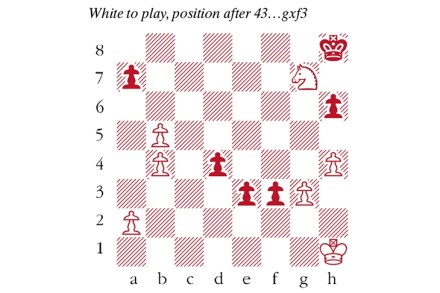
White to play. Giri-Wojtaszek, Wijk aan Zee 2021. On his last move, Black waited with 48… Ba1-b2, yielding White a decisive opportunity. Which move enabled Giri to break through? Answers should be emailed to chess@spectator.co.uk by Monday 8 February. There is a prize of £20 for the first correct answer out of a hat. Please include a postal address and allow six weeks for prize delivery. Last week’s solution: 1...Bc3+!

Remembering Kavalek

‘I began my escape from the communist Czechoslovakia 42 years ago, on Sunday, September 1, 1968. According to Wikipedia, I bought several crates of vodka with my winnings at the Akiba Rubinstein Memorial in the Polish spa of Polanica Zdroj, bribed the border guards and drove to West Germany.’ Thus began an article written by Lubomir Kavalek in the Huffington Post in 2010. How curious to write ‘according to Wikipedia’ about oneself! Was this, I speculate, a gentle hint to the reader that the story might be apocryphal? The Soviet tanks in Prague were decidedly real. Born on 9 August 1943, ‘Lubosh’ Kavalek had studied journalism, and was the reigning chess champion of Czechoslovakia when he defected.

No. 638

Kokkoris–Kavalek, Athens 1968. Kavalek’s next move initiated a beautiful forced mating sequence. What did he play? Answers should be emailed to chess@spectator.co.uk by Monday 1 February. There is a prize of £20 for the first correct answer out of a hat. Please include a postal address and allow six weeks for prize delivery. Last week’s solution 1 Bxe7! Kxe7 2 cxb6! Rxc1 3 b7 Rxf1 4 b8=Q and the queen prevailed.

History at Hastings

The Hastings International Chess Congress hasn’t skipped a year since the second world war, so I was delighted to learn that the tradition would be honoured by a strong online event which took place earlier this month, featuring a dozen top British players. For the second year running, the event was sponsored by Caplin Systems, makers of financial trading technology. (The Caplin British Online Championships were held last month and won by Michael Adams. Matthew Wadsworth and Matthew Turner secured qualifying spots for Hastings.) Reading that this year’s event would be a centenary caused me some puzzlement, because I was certain that the Hastings centenary took place in 1995 — I was there. My event, the Hastings Challengers, was played on Hastings pier.

No. 637

White to play. Howell — Adams, Caplin Hastings Online 2021. Adams’s last move, 35...Ba4-b3, gave Howell the chance for a tactical strike, gaining a decisive advantage. What was his next move? Answers should be emailed to chess@spectator.co.uk by Monday 25 January. There is a prize of £20 for the first correct answer out of a hat. Please include a postal address and allow six weeks for prize delivery. Last week’s solution 1 b4!

Missed opportunities

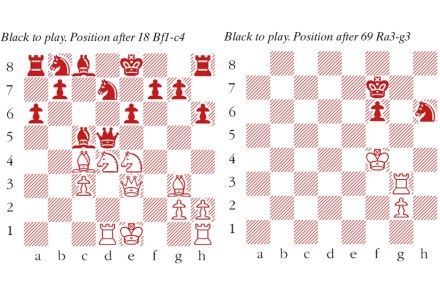
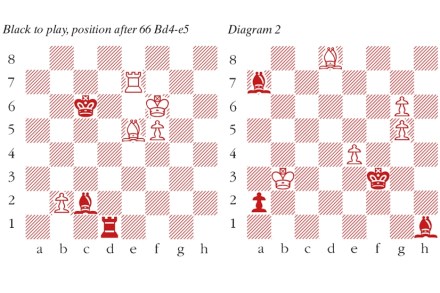
In game 1 of his Airthings Masters Final against Radjabov, Aronian’s pawn push 21 e4-e5 (shown in the first diagram) created a tactical explosion. This was rapid chess at its best — stylish and exuberant. And yet, as thrilling as this game was, it was a pity that the players had so little time to navigate the complications. If they had, each player might have unearthed an even deeper idea. In the first diagram, Radjabov had an improvement, as subtle as it is stunning: 21…d3!! 22 Qxd3 fxe3 23 Qg6+ reaches the same position as in the game, with one crucial difference; the missing pawn on f4 benefits Black, for reasons explained in the comment to 26…Bf5. The second diagram shows Aronian’s missed opportunity. The immediate 29 Ng5 allows 29…Qc4+.

No. 636

Gormally–Turner, Caplin Hastings Online 2021. Black looks safe, but Gormally’s next move forced a win of material. What did he play? Email answers to chess@spectator.co.uk by Monday 18 January. There is a prize of £20 for the first correct answer out of a hat. Please include a postal address and allow six weeks for prize delivery. Last week’s solution 1 Qg6+!! If 1…fxg6 2 Nxh6 mate, or 1...Nxg6 2 Nxh6 mate, or 1…Rxg6 2 Nxe7 mate.