Luke McShane

Luke McShane is chess columnist for The Spectator.

No. 709

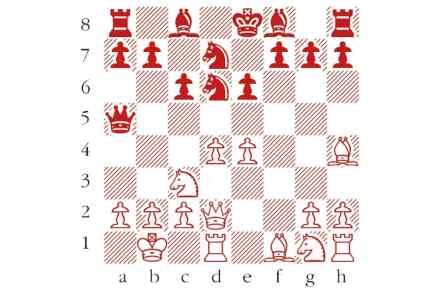
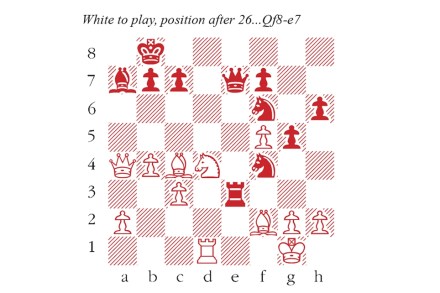
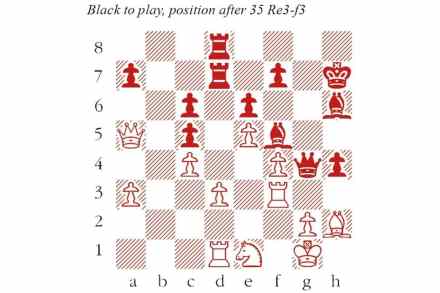
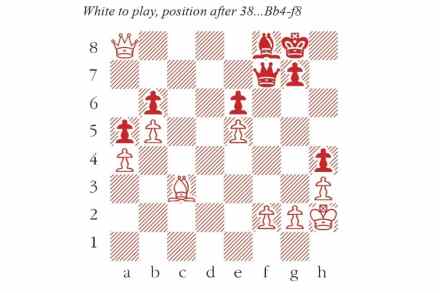
White to play. Miles-Pritchett, Lloyds Bank Masters 1982. Tony Miles found a powerful counter to the queenside threats. What did he play? Email answers to chess@spectator.co.uk by Monday 4 July. There is a prize of £20 for the first correct answer out of a hat. Please include a postal address and allow six weeks for prize delivery. Last week’s solution 1 Ke6! Wins, e.g. 1…Nc6 2 Kf6 Nd8 3 h7+ Kh8 4 Ke7 Nc6+ 5 Kf8. The game went 1…Nd3 and after 2 Kf6 Kh8 3 h7! Black resigned, e.g. 3…Nf4 4 g7+ and Kf7.

Maximum mischief

Forbidden things have a secret charm – that delicious paradox applies to the chessboard just as it does in life. Moves which appear to be unthinkable (for example, when the piece in question can be readily captured) can create a strong aesthetic effect. Composers of chess problems often make great play of this fact – so much so that it is a useful rule of thumb for a solver. If you spot a move which appears to be prevented for several reasons, there’s a good chance you have your solution. Once in a while, this pursuit of maximum mischief proves its worth in practical play as well.

No. 708

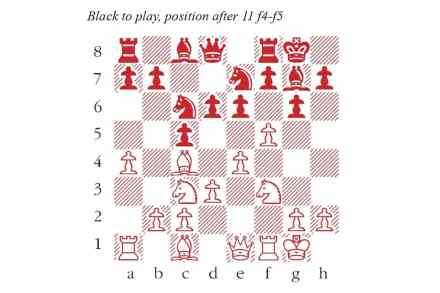
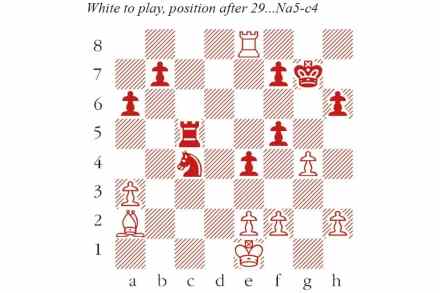
White to play. Rezasade-Movsesian, Bundesliga 2022. White was an underdog in this game, but found a subtle winning idea. What did he play? Answers should be emailed to chess@spectator.co.uk by Monday 27 June. There is a prize of £20 for the first correct answer out of a hat. Please include a postal address and allow six weeks for prize delivery. Last week’s solution 1 Qxh5+! Kxh5 2 Bf7#.

Cream of the Candidates

The Candidates tournament is underway in Madrid, where eight of the world’s best players vie for the right to challenge Magnus Carlsen in the World Championship. As the event began, Carlsen gave his judgment on each player’s prospects, dividing them into three tiers. Tier 1: Fabiano Caruana and Ding Liren are ‘the best and most consistent’. Tier 2: The ‘dark horses’ are Ian Nepomniachtchi, winner of the previous Candidates event, and Alireza Firouzja, whose meteoric rise last year took him to no. 2 in the world rankings (though since overtaken by Ding). Tier 3: The rest – Richard Rapport, Jan-Krzysztof Duda, Hikaru Nakamura and Teimour Radjabov. Of course, none of the latter players is an easy mark.

No. 707

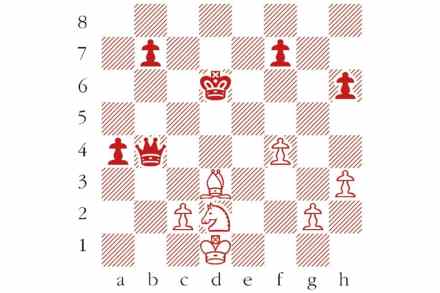
White to play. Trent-Carlstedt, Hamburg 2022. Lawrence Trent spotted a way to deliver a quick mate. Which move did he play? Answers should be emailed to chess@spectator.co.uk by Monday 20 June. There is a prize of £20 for the first correct answer out of a hat. Please include a postal address and allow six weeks for prize delivery. Last week’s solution : 1 Rc1! with the idea 1…Kb8 2 Kxb6 Ka8 3 Rc8# After 1…b5 or 1…Ka8 White plays 2 Kc7!

Have they spotted it?

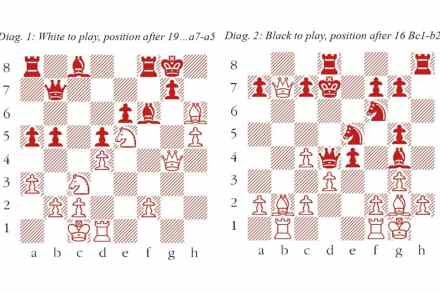
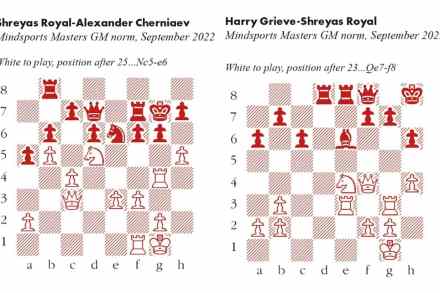
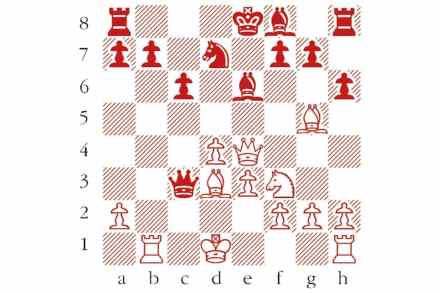
Returning to the board, Mamedyarov looks at Anand’s outstretched hand with bemusement. It can’t be a draw offer – that would be a rude way to do it, and besides, the tournament rules prohibit an early peace treaty. No, Anand is resigning! He looks crestfallen, like a child whose ice cream has fallen to the ground. Mamedyarov pauses before taking his hand, and now Anand looks puzzled by his opponent’s hesitation. Here is the position: Vishy Anand-Shakhriyar Mamedyarov Norway Chess, June 2022 (See left diagram) Anand had just played 22 Qd3-b5, which pressures e8 and b7. No sooner had he played it than he spotted the flaw – Black can win on the spot with the brilliant 22…Qxf3+!, since 23 Kxf3 Nh4 is mate.

El Ajedrecista

Gilberto Rodriguez Orejuela, ‘El Ajedrecista’, died in prison in the United States on 31 May. The Colombian drug lord, a leader of the Cali cartel in the 1990s, acquired his splendid nickname, which translates as ‘the Chess Player’, on account of his ability to stay a step ahead of his rivals and pursuers. Curiosity sent me hunting for more information, and in doing so I stumbled into an unexpected rabbit hole. For it turns out that ‘El Ajedrecista’ was also the name given to a primitive chess-playing automaton, designed by a Spanish engineer, Leonardo Torres y Quevedo, and unveiled at the University of Paris in 1914.

No. 706

White to play and mate in 3. Composed by Sigmund Franz Josef Lehner, 1864. There are several ways to give mate in 4 moves, but it takes a delicate finesse to get the job done in 3. What is White’s first move? Answers should be emailed to chess@spectator.co.uk by Monday 13 June. There is a prize of £20 for the first correct answer out of a hat. Please include a postal address and allow six weeks for prize delivery. Last week’s solution 1 Bf4!

No. 705

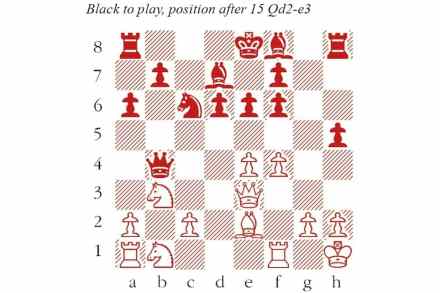
White to play. Giri-Praggnanandhaa, Chessable Masters 2022. A game from the preliminary stages. What did Giri play to induce resignation? Answers should be emailed to chess@spectator.co.uk by Monday 6 June. There is a prize of £20 for the first correct answer out of a hat. Please include a postal address and allow six weeks for prize delivery. Last week’s solution 1…Qe2! If 2 Rxe2 Rb1+ 3 Bf1 Rxf1 mate Last week’s winner Ashley Murphy-Elliott, Oakworth, W.

A rising star

Ding Liren took first place at last month’s Chessable Masters, the fourth event in the 2022 Meltwater Champions Tour. But it was his defeated opponent in the final, 16-year-old Rameshbabu Praggnanandhaa from India, who stole the show. The teenager’s reputation is already well established, and he made headlines in the (non-chess) media in February when he beat Magnus Carlsen in a rapid game at the Airthings Masters, the first event in the tour. Remarkably, at the Chessable Masters, he added a second victory over Carlsen, who blundered in an almost even position in their game from the preliminary stage. Even more impressive were the scalps he took in the knockout stages. In the quarter finals he scored a 2.5-1.

No. 704

Black to play. Bacrot-Anand, Bastia Rapid 2001. A spectacular blow from Anand prompted Bacrot to resign. What did he play? Answers should be emailed to chess@spectator.co.uk by Monday 30 May. There is a prize of £20 for the first correct answer out of a hat. Please include a postal address and allow six weeks for prize delivery. Last week’s solution 1 Be1! And White won in the end. Not 1 Bg3? Qh3+!! 2 Kxh3 Bf1# or 1 Bf2 Qh3+!!

Tiger bites man

Viswanathan Anand left the spectators in awe at the Superbet Rapid earlier this month. The ‘Tiger of Madras’, as he is sometimes known, was awarded a wildcard spot to the second leg of the Grand Chess Tour in Warsaw, which began just a couple of days after the first leg ended in Bucharest. At 52, the former world champion was the oldest player by some margin, and at least on paper could not be counted as one of the favourites. And yet Anand devoured the field in the rapid section, winning his first five games in a row, and secured clear first place with 7/9. It was a joy to watch. But only those with short memories will be truly surprised by his display of ageless ability.

No. 703

White to play. Vachier-Lagrave-Caruana, Bucharest 2022. The Bh4 can retreat to g3, f2 or e1. Which one is best, and why? Answers should be emailed to chess@spectator.co.uk by Monday 23 May. There is a prize of £20 for the first correct answer out of a hat. Please include a postal address and allow six weeks for prize delivery. Last week’s solution 1 h6+! Kxh6 2 Rxg6+ hxg6 3 Qh3+ followed by Qh4 or Qh8#. Not 1 Rxg6+ hxg6 2 h6+ Kh7!

Rock, paper, scissors

The Superbet Chess Classic in Bucharest concluded last weekend in a dramatic tiebreak between Wesley So, Maxime Vachier-Lagrave and Levon Aronian, who all took wildly different paths to finish the main event on 5.5/9. Wesley So was the tournament rock. He won two controlled games against Nepomniachtchi and Mamedyarov and otherwise never looked in danger. The other two certainly weren’t rocks, but they couldn’t decide whether to be paper or scissors. Vachier-Lagrave won two sharp battles, against Caruana and Firouzja. But when he met Aronian in round 6, it was Vachier-Lagrave who volunteered for a shredding. Maxime Vachier-Lagrave-Levon Aronian Superbet Chess Classic, Bucharest, May 2022 The previous move, 25 Kc3-d4, placed the king on the worst possible square.

No. 702

White to play. Averbakh-Zita, Szczawno-Zdroj 1950. Black has just interposed Rb6-g6, so White needs an accurate finish before e3-e2 mate arrives. What did Averbakh play next? Answers should be emailed to chess@spectator.co.uk by Monday 16 May. There is a prize of £20 for the first correct answer out of a hat. Please include a postal address and allow six weeks for prize delivery.

Remembering Averbakh

Yuri Averbakh had a wry explanation for why he was made chairman of the USSR Chess Federation in 1972. There was a feeling that Boris Spassky, the Soviet world champion, would lose his title to Bobby Fischer in Reykjavik that year. Nobody else wanted to deal with the fallout, so Averbakh got the job. Whatever the truth of that, Averbakh had been deputy chairman for ten years already, and throughout his life showed a tireless appetite for almost every role that chess has to offer. He left his mark on the game as a player, politician, writer, analyst, editor, researcher, historian and arbiter. Yuri Lvovich Averbakh died in Moscow on 7 May, just a few months after celebrating his 100th birthday. He was born in Kaluga, a small city 100 miles from Moscow.

No. 701

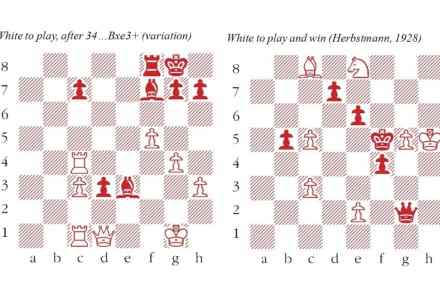
White to play. Reshevsky-Savon, Petropolis 1973. Reshevsky played the awful 1 Qxg6+, and resigned after 1…Bxg6. Many moves win, but which one forces mate in just three moves? Email answers to chess@spectator.co.uk by Monday 9 May. There is a prize of £20 for the first correct answer picked. Please include a postal address. Last week’s solution 1 Nf4+! Rxf4 2 h8=B and stalemate follows. Not 1 Ne7+ Bxe7 2 h8=B Bf6!

Gorilla tactics

There is a video in which a small group of students amble about passing a basketball back and forth. The instruction at the start is to count how many times the players pass the basketball. Then comes the punchline – did you see the gorilla? Halfway through, a figure in a gorilla suit walks through the middle of the scene, beats its chest and walks off. It was designed as a psychological experiment, with the startling outcome that about half the viewers missed the gorilla altogether. One explanation is obvious – they were focused on the basketball. But how can you miss a gorilla? Blunders at the chessboard can be just as perplexing. True, some are easily ascribed to nervousness or carelessness. Those are often the ones where you kick yourself right after making the move.

No. 700

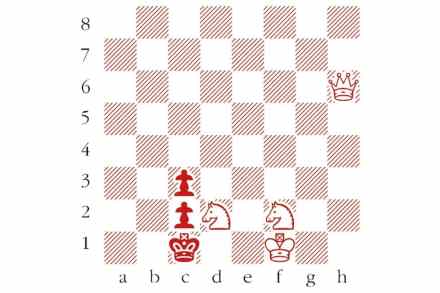
White to play and draw. Composed by Jan Timman, 2011. 1 h8=Q Rxd5 wins for Black, so how does White escape? Answers should be emailed to chess@spectator.co.uk by Tuesday 3 May. There is a prize of £20 for the first correct answer out of a hat. Please include a postal address and allow six weeks for prize delivery. Last week’s solution: 1...Qxe2+ 2 Kxe2 Bg4 is mate.

Ordination

In the dying seconds of an online blitz game, I promoted a pawn and instantly regretted it. There was nothing wrong with the move, but the extra second spent on choosing and clicking the queen was more than I could spare. A few flailing moves later, my time ran out. Of course, I had forgotten to switch on ‘Always Queen’, a handy setting offered by all decent chess websites. Some 99 per cent of the time, a queen is what you want. But just occasionally, a knight, rook or bishop is superior. A knight may land with check, where a queen does not. To see a rook or bishop trump a queen is rarer still, as neither piece has any obvious point in its favour. But it can happen in scenarios where a queen would stalemate the opponent, but a lesser piece would not.