Luke McShane

Luke McShane is chess columnist for The Spectator.

No. 733

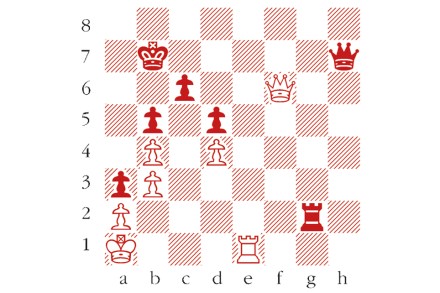
White to play. Tartakower–Winter, Hastings, 1935. White’s next move required careful calculation, but William Winter resigned once he had seen it. What did Tartakower play? Answers should be emailed to chess@spectator.co.uk by Monday 16 January. There is a prize of £20 for the first correct answer out of a hat. Please include a postal address and allow six weeks for prize delivery. Last week’s solution 1 Qh5!
Staying the course

After a pause during the pandemic, the Hastings Chess Congress returned for its 96th edition in the days after Christmas, with renewed support from software company Caplin. A newly published book, The Chess Battles of Hastings by Jürgen Brustkern and Norbert Wallet (New in Chess, 2022), offers an enjoyable chronicle of the event’s rich history. Among the vignettes of congress luminaries, one anecdote caught my eye. One year in the 1980s, heavy snowfall caused the heating in the playing hall to fail, to which most players responded with an early draw offer. But grandmaster Murray Chandler persevered for five hours, he and his opponent ‘like two Eskimos, in woollen hats and winter coats’, and became joint winner thanks to his victory.

No. 733

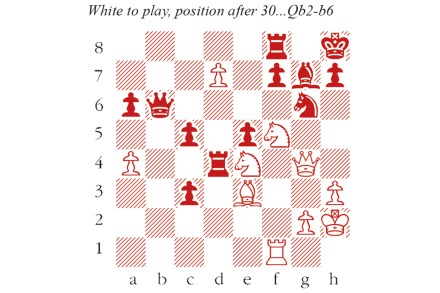
White to play. Dubov-Sarin, World Rapid Championship, 2022. Dubov’s next move turned the attack up to 11, inducing instant resignation. What did he play? Answers should be emailed to chess@spectator.co.uk by Monday 9 January. There is a prize of £20 for the first correct answer out of a hat. Please include a postal address and allow six weeks for prize delivery. Last week’s solution 1…Qc2+! 2 Kxc2 Bf5 mate, or 2 Ka1 Qxb2 mate.

Triple crown for Carlsen

Doing your job, and not a jot more – ‘quiet quitting’ – became one of the buzzphrases of 2022. In The Spectator, Stephen Daisley lauded this as the philosophy of the clear-eyed pragmatist, not the layabout, and wondered when more young employees would cotton on. Was Magnus Carlsen thinking along the same lines? For the time being, he remains the world champion in classical chess, and many believe that his job, his grand duty, is to defend the title at all costs. So there was much consternation when he announced in July his intention to abdicate, leaving the title to be contested between Ian Nepomniachtchi and Ding Liren later in 2023. It seems to me that Carlsen sees his job differently.

No. 732

Black to play. Babula-Kovacevic, Bundesliga 2022. Black faces a fierce attack, but an extraordinary move won him the game. What did he play? Answers should be emailed to chess@spectator.co.uk by Monday 2 January. There is a prize of £20 for the first correct answer out of a hat. Please include a postal address and allow six weeks for prize delivery. Last week’s solution 1 Qa2!, e.g.

Twelve questions for Christmas

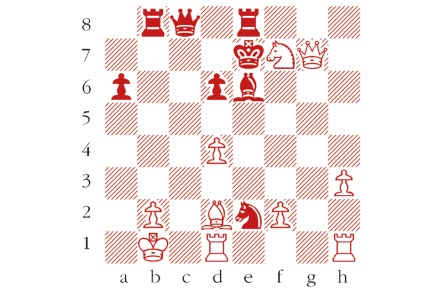
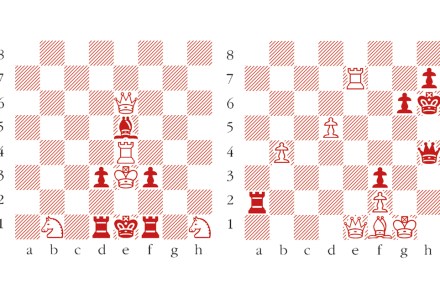
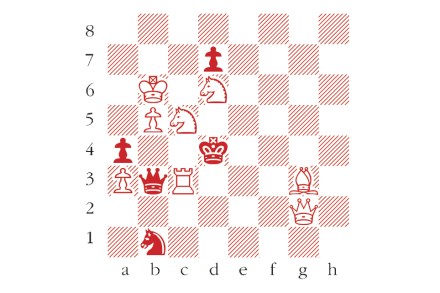
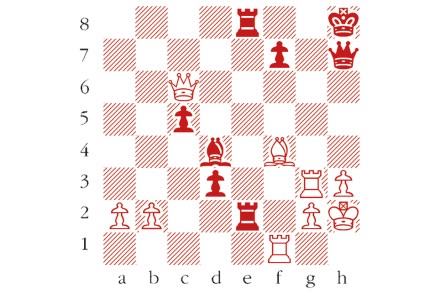
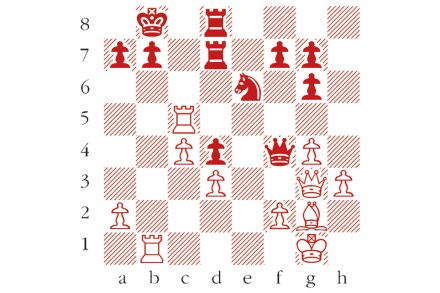
1. Who tweeted, in answer to the question ‘Do you still play chess?’: ‘I did as a child, but found it to be too simple to be useful in real life: a mere 8 by 8 grid, no fog of war, no technology tree, no random map or spawn position, only 2 players, both sides exact same pieces, etc. Polytopia addresses these limitations.’ 2. Who was handed a six-month ban by the Fide Ethics commission for his cheerleading of the invasion of Ukraine, ruling out his participation in this year’s Candidates tournament? 3. Who came second behind Ian Nepomniachtchi, and will challenge ‘Nepo’ for the world title in 2023, in light of Magnus Carlsen’s abdication? 4. White to play and mate in two moves (diagram above left).

Puzzle

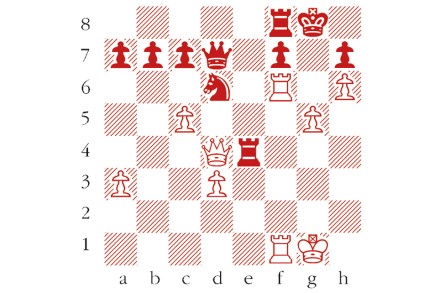
White to play and mate in two. Composed by van Beek & Wurzburg, 1909. This is one of the problems solved by Nunn at the 2019 World Solving Championship. Please note that because of the Christmas printing schedule this is not a prize puzzle. Last week’s solution 1 Qxd3 and Black resigned: Qxd3 2 Rf7+ Nxf7 3 Rxf7+ Rg7 4 Rxg7+ Kh8 5 Rd7+ wins the queen.

World Senior Championship

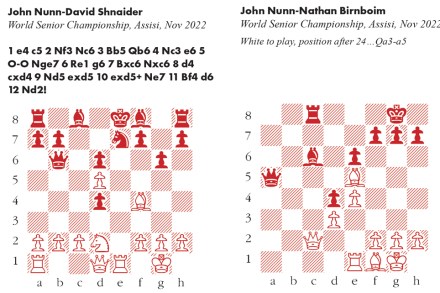
English grandmaster John Nunn was the top seed in the over-65 section at the World Senior Championship, held in Italy last month. A series of crisp attacking games put him in the lead with 6.5/7. But an uncharacteristic miscalculation in round eight saw him lose a miniature against Danish grandmaster Jens Kristiansen. Going into the 11th and final round, Nunn still trailed by half a point, so his fate was no longer in his hands. As the games unfolded, Kristiansen had the draw well within reach, but succumbed to a neat endgame zugzwang against Jose Luis Fernandez Garcia. Meanwhile, against Valentin Bogdanov, Nunn spun a slim advantage into gold with a leisurely king manoeuvre from the h-file to the b-file. Nunn took the title with 9/11, ahead of a quartet on 8.5/11.

No. 731

White to play. Sindarov-Sarin, World Team Championship, Jerusalem 2022. Sindarov has an extra pawn and a dominant position. Which move did he play to ensure a quick knockout? Answers should be emailed to chess@spectator.co.uk by Monday 5 December. There is a prize of £20 for the first correct answer out of a hat. Please include a postal address. Last week’s solution 1 Be5+! Bxe5 2 Qxe8+ or 1…Rxe5 2 Qf6+ and mate follows next move.

World Team Championship

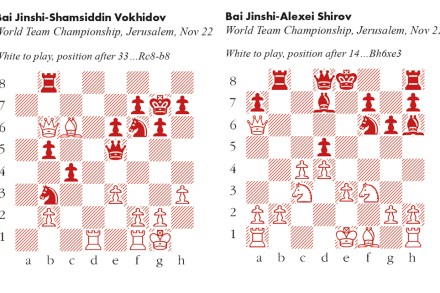
The young team from Uzbekistan, who took gold medals at the Olympiad in Chennai, came close to repeating that achievement at the World Team Championship in Jerusalem last month. They cruised through the group stage, quarters and semis, and met China in the final, who got there despite fielding none of their elite players, such as world No. 2 Ding Liren. The match promised to be close, and it was China who triumphed. Their star player was Jinshi Bai, who scored 8.5/11, including this crucial win from the final. Bai Jinshi-Shamsiddin Vokhidov World Team Championship, Jerusalem, Nov 22 In the diagram position, 34 Qa7 Rc8 is balanced, but Bai found a clever counterblow. 34 f4! The point is that 34…Rxb6 35 fxe5 Rxc6 36 exf6+ Kh6 37 Rd7 wins. But 35…Ng4!

No. 730

White to play. Erigaisi-Mamedyarov, MeltwaterChampions Finals 2022. Erigaisi’s next move wrapped up the game in style. What did he play? Answers should be emailed to chess@spectator.co.uk by Monday 28 November. There is a prize of £20 for the first correct answer out of a hat. Please include a postal address and allow six weeks for prize delivery. Last week’s solution 1…Qe1+! 2 Nxe1 Rxe1 3 Bf1 Bxc4 4 Qxc4 Nxc4 wins, e.g. 5 g3 Nd2!

Meltwater Champions Tour

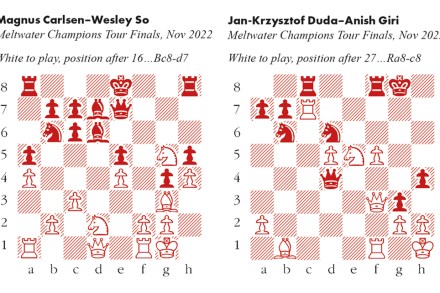
When Magnus Carlsen renounced his world championship title earlier this year, one of his stated goals was to focus on other events, without bearing the burden of preparation for a regular title match. The Meltwater Champions Tour is an important battleground for the Norwegian, and he showed devastating form at the Tour Finals in San Francisco earlier this month. Initiated by Carlsen during the pandemic, the elite series of rapid tournaments is mostly played online, although four out of eight players travelled to San Francisco for the finals. This was the only decisive game from Carlsen’s first-round mini-match against the runner-up.

No. 729

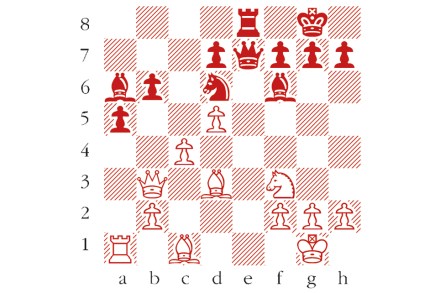
Black to play. Schwetlick-Lecroq, 32nd Correspondence World Championship. White’s last move, Qd1-b3, is a blunder that can’t have been endorsed by a computer. What did Black play to force resignation? Answers should be emailed to chess@spectator.co.uk by Monday 21 November. There is a prize of £20 for the first correct answer out of a hat. Please include a postal address. Last week’s solution 1…Qh2! wins. Carlsen’s 1…Qc2 (or 1…Qd3) allows 2 Re7+ Ka6 3 Ra7+ Kxa7 4 Qe7+ Ka6 5 Qa7+ Kxa7 stalemate.

Lengthy Correspondence

‘In fact it is now conceded by all experts that by proper play on both sides the legitimate issue of a game ought to be a draw…’ Those words were written by Wilhelm Steinitz, who became the first world champion after beating Johannes Zukertort in 1886. But their 20-game match saw 75 per cent decisive games, a quantity of bloodshed that would be unimaginable in the 21st century. By comparison, Magnus Carlsen has played five world championship matches, in which less than 25 per cent of the classical (slow) games were decisive. It is not a matter of style, but rather of skill – the fact is that modern players make far fewer mistakes.

No. 728

Black to play. Fedoseev-Carlsen, Fischer RandomWorld Championship, 2022. 1…Qd3, 1…Qc2 and1…Qh2 all create deadly threats, but only one ofthese wins. Carlsen chose wrongly. Which move should he have chosen? Answers should be emailed to chess@spectator.co.uk by Monday 14 November. There is a prize of £20 for the first correct answer out of a hat. Please include a postal address and allow six weeks for prize delivery. Last week’s solution 1 Rg6+! fxg6 2 Qh8+! Kxh8 3 Rxf8# Or 1…hxg6 2 Qg7# Last week’s winner G.

Syntactical error

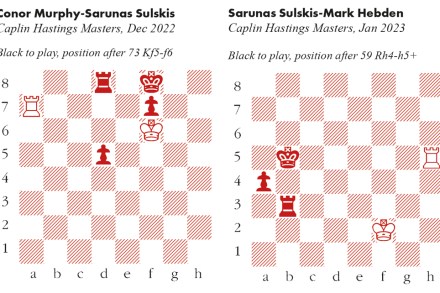
The chess lexicon has adopted a useful word from German, fingerfehler, fehler meaning mistake or error. Sometimes, the hand does not obey the brain. Imagine that you are busy contemplating A, followed by B and then C, and engrossed by the consequences of C. Meanwhile, the hand is eager to get involved, and picks up the piece to make move C. Standard competition rules are that once you’ve touched a piece, you must move it, so even if you catch yourself before executing the move, the damage from picking up a different piece may be terminal. Mercifully, I don’t recall ever doing this, but I’ve come close enough to know that the phenomenon is real.

Remembering Basman

Just a fortnight ago, I had the pleasure of introducing a friend to the ‘Immortal Waiting Game’, Michael Basman’s victory over the Swedish grandmaster Ulf Andersson, played at Hastings in 1975. Basman landed in a passive position out of the opening, and began to shuffle back and forth, so that at move 23 his pieces were in the identical state they had been in at move 11. It was a psychological masterstroke. Andersson, a distinctly patient player, girded himself to attack, only to waver and botch the execution so badly that Basman turned the tables and won the game. On 26 October, Basman died from cancer at the age of 76.

No. 727

White to play. Basman-Balshan, Israel 1980. How did Basman decide the game in his favour? Answers should be emailed to chess@spectator.co.uk by Monday 7 November. There is a prize of £20 for the first correct answer out of a hat. Please include a postal address and allow six weeks for prize delivery. Last week’s solution 1 Rg8! Rb1+ 2 Kh2 Rb2+ 3 Kh3 (White’s rook prevents g5-g4+) Rb1 4 b8=Q!

Losing their heads

Chess players tend to fidget while they think. They crack their knuckles, stir their coffee, and bounce their legs. I have watched Boris Gelfand and Daniil Dubov twiddling a captured pawn in their fingers, with notable dexterity, despite being deep in thought. It’s a common tic, so when Sam Sevian reached out to pick up a piece while contemplating the position shown in the first diagram, I presume the motion was entirely unconscious. But it was odd for several reasons. First, it wasn’t Sam’s move, and the unwritten etiquette is to refrain from fiddling while the opponent is thinking. Stranger still, his outstretched hand didn’t settle on a stray pawn.

No. 726

White to play. Salov-Horvath, Groningen 1983. In this treacherous rook and pawn endgame, White found the only winning move. What did he play? Answers should be emailed to chess@spectator.co.uk by Monday 31 October. There is a prize of £20 for the first correct answer out of a hat. Please include a postal address and allow six weeks for prize delivery. Last week’s solution 1 Nd5! Qxd2 2 Nc7#. But not 1 Nb5 Qb6!