Luke McShane

Luke McShane is chess columnist for The Spectator.

No. 831

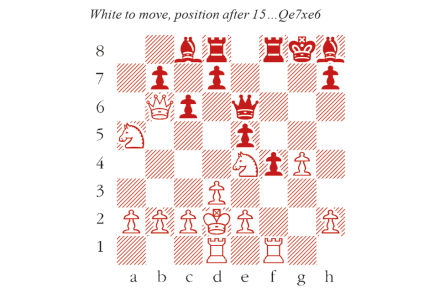
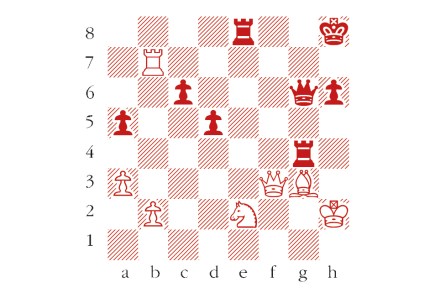
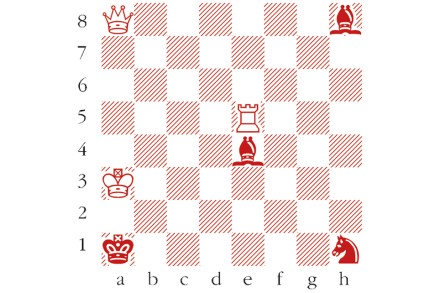
White to play. Composed by František Dedrle, Deutsches Wochenschach, 1921. Black plans to draw by eliminating the last pawn on b5. What is White’s only winning move? Email answers to chess@spectator.co.uk by Monday 6 January. There is a prize of a £20 John Lewis voucher for the first correct answer out of a hat. Please include a postal address. Last week’s solution 1 Kf4! cuts off the g6-f5 escape, threatening Re8-h8 and Rb8-g8 mate.

The new world champion

Cast your mind back to April 2023, when Ding Liren from China became the world champion, defeating Ian Nepomniachtchi in Astana. After 14 seesaw games, Ding triumphed in a rapid tiebreak, in which his move 46…Rg6! from the final game was a memorable piece of brinkmanship, living dangerously and pushing for the win. December 2024 saw the conclusion of Ding’s title defence in Singapore against his brilliant 18-year-old challenger Gukesh Dommaraju from India. Alas, the majestic courage which Ding showed in Astana has seemed to desert his game ever since, to the point where Gukesh was considered a heavy pre-match favourite. To the delight of this spectator, Ding brought character and resilience to his title defence, and the match remained tied after 13 games.

Gukesh’s championship win is a triumph for Indian chess

Eighteen-year old Gukesh Dommaraju, from India, has become the youngest ever world chess champion – after defeating defending champion, China's Ding Liren, in Singapore yesterday. There is an adorable clip online in which an 11-year old Gukesh, smiling shyly, states his ambition to become the youngest world champion. Bold as that goal was, at the age of 18 he has accomplished it with time to spare, since Garry Kasparov and Magnus Carlsen were both 22 years old when they won the title.  The fourteenth and final game of the match saw an extraordinary turn of events. Up until that point, the scores were tied, with two wins apiece and nine draws. After four hours of play, Gukesh held an advantage, but most commentators anticipated that Ding would hold the line and secure a draw.

Twelve questions for Christmas

1) Which former US women’s chess champion, who in 1961 became the first chess player to appear on the cover of Sports Illustrated, died earlier this year? 2) This year a boy from Argentina became the youngest ever to be awarded the International Master title, at the age of ten years and eight months. He even defeated Magnus Carlsen in an online bullet game. What is his name? 3) Noland Arbaugh, who was paralysed below the shoulders after a diving accident, demonstrated the outcome of his pioneering medical procedure by playing chess. How did he make the moves? 4) The grandmaster parent of a well-known chess streamer played a ‘Battle of Generations’ match against the world’s most popular YouTube chess personality. What were the players’ names?

No. 830

White to play. The conclusion of one of the rapid games from the ‘Battle of Generations’ match (See question 4 above). Which move did the grandmaster play to decide the game in her favour? Email answers to chess@spectator.co.uk by Friday 27 December. There is a prize of £20 for the first correct answer out of a hat. Please include a postal address and allow six weeks for prize delivery. Last week’s solution 1 Rf8! wins, e.g.

Ding’s early win

It may sound strange to say that Ding’s win in the first game of his world championship match came as a shock, but it did. His recent form had been shaky and his challenger Gukesh, heavily favoured by pundits, had the advantage of the white pieces. There was every reason to expect Ding to stick to classic match strategy which dictates a ‘safety first’ approach when playing black. Gukesh opened with 1 e4, whereupon Ding usually prefers 1…e5 and plays in a solid, classical style. Instead, his choice of 1…e6 (the French defence) was, I imagine, perceived by Gukesh as a small provocation. It is likely that Ding’s second, the imaginative Hungarian grandmaster Richard Rapport and a renowned expert on the French, influenced his decision.

Chess puzzle

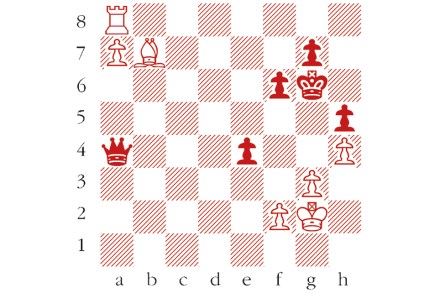
White to play. Adewumi-Shlyakhtenko, New York, November 2024. The dangerous passed pawn on a7 means that White is the side pressing for the win. Which move allowed 14-year-old Tani Adewumi to win the game? Please note that because of the Christmas printing schedule there is no prize for this puzzle. Last week’s solution 1…c3!

The World Championship

The World Championship match between Ding Liren and Dommaraju Gukesh is now underway in Singapore. The $2.5 million prize fund will be decided over 14 games of classical chess, and in the event of a 7-7 tie, there will be rapid tiebreaks on 13 December. Pre-match consensus had Ding, the reigning champion from China, as a heavy underdog, with only around a 20 per cent chance of victory. He has appeared afflicted by a psychological crisis since winning the title last year, and his recent form has been dismal. His challenger, 18-year-old Gukesh from India, has had a splendid run, climbing well above Ding in the world rankings.

No. 829

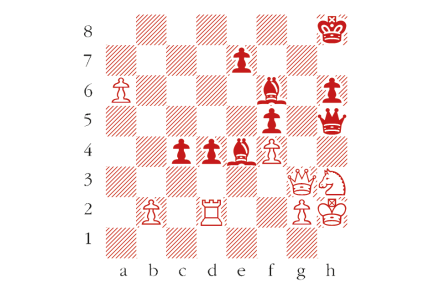
Black to play. Gretarsson-Fressinet, European Individual Championship, November 2024. In this position, both players overlooked a decisive tactical idea. Which move should Black play? Email answers to chess@spectator.co.uk by Monday 2 December. There is a prize of £20 for the first correct answer out of a hat. Please include a postal address and allow six weeks for prize delivery. Last week’s solution 1…Rxe2+! 2 Qxe2 Qh5+ 3 Kg2 Rxg3+ wins. But not 1…Qh5+ 2 Kg1 Rxe2 3 Qf8+!

Slow and steady

‘I kind of played old man’s chess in that game,’ said Magnus Carlsen, after winning a game against S.L. Narayanan, a top Indian grandmaster, at the Tata Steel Rapid in Kolkata last week. ‘No long variations, just positional chess.’ None of his moves would have come as a great surprise to his opponent, while Narayanan’s mistakes were inconspicuous. Yet Carlsen steadily assumed control of the game, consistently sensing the optimal places for his pieces. S.L. Narayanan-Magnus Carlsen Tata Steel Chess India Rapid, November 2024 1 e4 e5 2 Nf3 Nc6 3 Bb5 a6 4 Ba4 Nf6 5 O-O Be7 6 Qe2 6 Re1 is more common, and one standard continuation is 6…b5 7 Bb3 d6 8 c3 O-O 9 h3 Na5 10 Bc2 c5 11 d4.

No. 828

Black to play. Erigaisi-Dubov, Tata Steel India Blitz, November 2024. Dubov chose Rg4-e4, overlooking a tactical shot that would have won the game. What was the winning move? Email answers to chess@spectator.co.uk by Monday 25 November. There is a prize of £20 for the first correct answer out of a hat. Please include a postal address and allow six weeks for prize delivery. Last week’s solution 1 Be8! threatens 2 Qxb8#.

The Babson task

To an outsider, we chess players might seem a rather uniform breed. Studious and contemplative, we spend hours absorbed in a board game to no apparent end. It is the archetypal thinker’s hobby. But within the subculture, there are many, perhaps even a majority, who identify as pragmatists, not thinkers. Results are the driving motivation. At the board, they are drawn to ideas which are likely to wrong-foot the opponent, with no special regard for their objective merits. In their study, they disdain the more obscure, frivolous or unrealistic chess problems such as the one in the puzzle below. What, they ask, is the purpose of seeking a subtle mate in 2, when a simple move like 1 Qxb8+ wins easily? For some players, the game’s rewards are not intrinsic at all.

No. 827

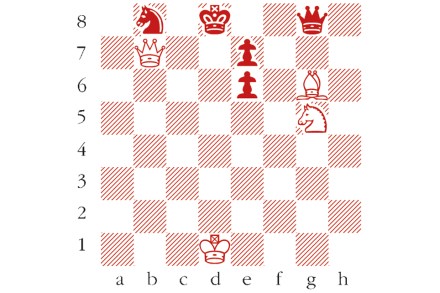
White to play and mate in 2. Composed by Sam Loyd, La Stratégie, 1867. Email answers to chess@spectator.co.uk by Monday 18 November. There is a prize of £20 for the first correct answer out of a hat. Please include a postal address and allow six weeks for prize delivery. Last week’s solution 1 Be8! threatens 2 Nf3#. If 1...g6+ 2 Nf7# or 1...

Meet me in St Louis

Garry Kasparov retired from competitive chess in 2005, but has proved that at the age of 61 he remains competitive at the highest level. That is an extraordinary achievement in an time when just five of the world’s top 100 active players are older than 50. The former world champion joined a powerful field in St Louis for nine rounds of ‘Chess 9LX’ played at a rapid time control. Chess 9LX, in which the pieces on the back rank are shuffled at the start of the game, is an ideal format for Kasparov, who can count on pure chess skill, without worrying about his outdated knowledge of opening theory.

No. 826

White to play and mate in 2. Composed by Otto Wurzburg, the Pittsburgh Gazette Times, 1917. Answers should be emailed to chess@spectator.co.uk by Monday 11 November. There is a prize of £20 for the first correct answer out of a hat. Please include a postal address and allow six weeks for prize delivery. Last week’s solution 1 Qd8+ Kh7 2 hxg3 Rh5+ 3 Qh4 and White won quickly.

End of The World

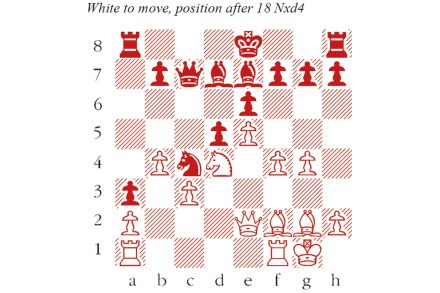
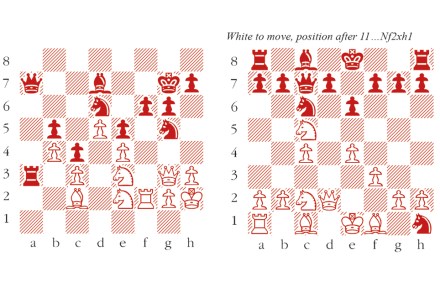
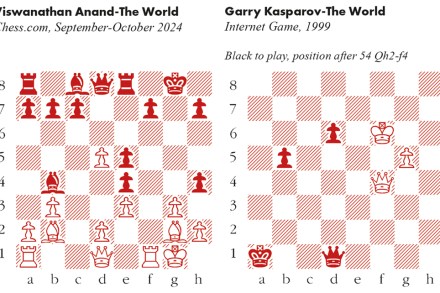
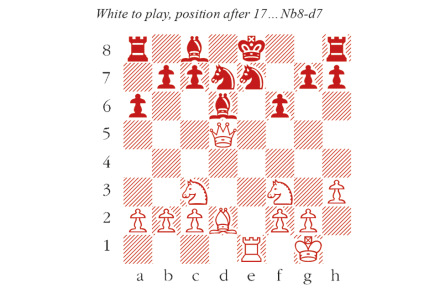
In 2016, the naming of a polar research ship was put to a public vote, and ‘Boaty McBoatface’ was the overwhelming winner. Should humanity’s fate ever be staked on a game of chess against alien invaders, I hope we don’t get a vote. If the internet has taught me anything, we would end up playing the Bongcloud Opening ‘for the lols’ and be vaporised. Even ignoring the saboteurs, the wisdom of crowds does not reliably select good chess moves. The recent game between former world champion Viswanathan Anand and ‘The World’ was a case in point.     In the first diagram above, you can see why the world voted for 14…Qd8xd5, which mops up a pawn, defends the pawn on e4, and attacks d2.

No. 825

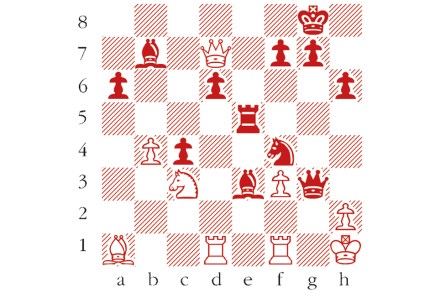
White to play. Abdusattorov-Maghoodloo, European Club Cup, October 2024. Black’s preceding move Qg6xg3 backfired spectacularly. Which move allowed White to turn the tables? Email answers to chess@spectator.co.uk by Monday 4 November. There is a prize of £20 for the first correct answer out of a hat. Please include a postal address and allow six weeks for prize delivery. Last week’s solution 1 Qd5! threatens Qa2#. If 1…Bxd5 2 Re1# or 1…Bb1 2 Qd4# or 1…Kd1 2 Qd1#.

WR Masters

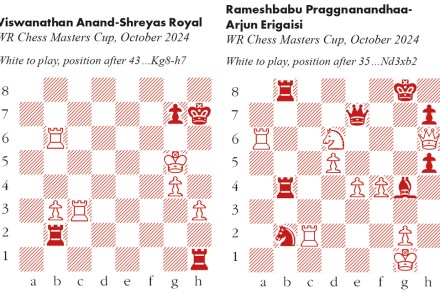
Two of England’s brightest prospects received a golden opportunity to play at the WR Chess Masters Cup, an elite knockout tournament held at the Langham Hotel in London last week. WR is Wadim Rosenstein, a keen chess player and CEO of the German WR logistics group, which last year partnered with Fide to organise the World Rapid and Blitz Team Championships in Düsseldorf.    Shreyas Royal recently broke the record to become the UK’s youngest grandmaster at the age of 15 years and seven months. In the first round of the knockout, he faced former world champion Viswanathan Anand. With two extra pawns in the diagram below, one would expect Anand to comfortably notch up the win.

No. 824

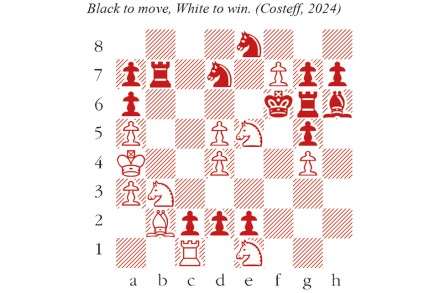
White to play and mate in two moves. Composed by Hermann Feodor Lehner, Deutsche Schachzeitung, 1873. Email answers to chess@spectator.co.uk by Monday 28 October. There is a prize of £20 for the first correct answer out of a hat. Please include a postal address and allow six weeks for prize delivery. Last week’s solution 1…f6! wins, e.g. 2 Rxf6+ Qxf6. Shankland chose 1…Kh7? missing 2 Qg8+!! Kxg8 3 d8=Q+ Kh7 4 Qh4 with perpetual. 1…Kh5 2 Rc5+ is no better.

Metacognition

Congratulations to Sir Demis Hassabis, who last week was awarded a Nobel prize for his work on AlphaFold, which uses artificial intelligence to predict the structure of proteins. Developed by DeepMind, AlphaFold belongs to the same family of work as AlphaZero, which revolutionised computer chess when it was released in 2017, and before that AlphaGo, which in 2015 was the first program to defeat a professional Go player. I had the honour of partnering with Hassabis for the Pro-Biz Cup at the London Chess Classic in 2021. Now CEO of Google Deepmind, at 13 he ranked second in his age group behind Judit Polgar. There is no doubt that his youthful fascination with strategy games sowed the seeds of his scientific achievement.