Lloyd Evans

Lloyd Evans

Lloyd Evans is The Spectator's sketch-writer and theatre critic

Slump fever

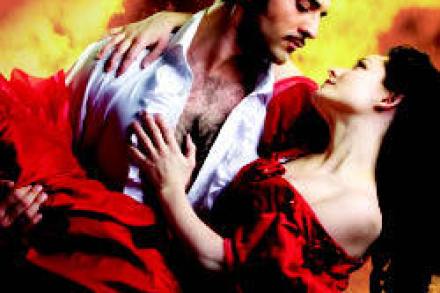
Gone With the Wind  New London Theatre How did they get it so wrong? Turning chicklit’s greatest story into a hit musical should have been a doddle. Just put the characters on stage and let the warm romantic breeze of the narrative carry you safely home. And that’s exactly what Trevor Nunn has done and yet the critics have misinterpreted Gone with the Wind and denounced it as a flop. I’m baffled. At last week’s Saturday matinée I joined a sell-out crowd and saw a handsome gutsy version of a completely captivating novel. Never mind the timeless magic of the storyline, look at the performances.

The big sleep

Small Change Donmar War and Peace, I and II Hampstead Oh my God. Did that really happen? I knew nothing about Peter Gill’s 1976 play, Small Change, before arriving at the Donmar to see this revival under the author’s own direction. It’s a love letter, an immensely detailed and spectacularly superficial account of the working-class experience as related by four dimwits living and whingeing in south Wales. It may be a script but it isn’t a drama. Screeds of Dylanesque poetic observation are interrupted by shouting matches. There’s no story, nothing at stake for the characters, no suspense at all, just a pair of brainless rowdies and their battleaxe mums splurging out wordy tosh about their hopes and feelings and their thwarted this, that and the other.

Foreign folly

Wedding Day at the Cro-Magnons Soho The Internationalist Gate The Black and White Ball King’s Head You can tell when a culture has lost its way because it starts handing out awards. There’s a small club of annual prizes that have some legitimacy. Oscar, Bafta, Booker, Olivier, Nobel — all provide worthwhile verdicts on the disciplines they attach themselves to. But adding to their number cheapens the entire enterprise. Like prophets and fire drills, the more awards there are the more they get ignored. Little surprise, then, that the Lebanese playwright Wajdi Mouawad has collected so many trophies that he has to scramble over heaped ramparts of silverware every time he leaves the house.

Best of British?

Mike Leigh. Ground-breaking maverick or pretentious miseryguts? To ask the man himself isn’t perhaps the best way to secure an impartial verdict, but the personality that emerges in this series of interviews (composed with superb fluency by Amy Raphael) is an articulate, engaging, generous, highly original and occasionally peppery creative spirit. No British film-maker since Hitchcock has had Leigh’s array of talent. He can act, write, design and direct and he could easily have become one of the industry’s most bankable players had he not doggedly pursued his peculiar working method. He doesn’t use a script. Each film is built up through months of painstaking research and improvisation which he likens to the creation of ‘cartoons in the Raphael sense’.

In Scarlett’s shoes

Lloyd Evans on the extraordinary story behind Trevor Nunn’s ‘Gone with the Wind’ The heart sinks, almost. The brow droops, a little. A yawn rises in the throat and dies away. Another musical has opened in the West End and, yes, it’s based on a blockbuster movie and, yes, that too was based on a million-selling novel. Those of us who want more new straight plays in the capital and who tire of these revivals-of-revivals are bound to feel a twinge of despair that a song-and-dance version of Gone with the Wind has opened at the New London theatre. Directed by Trevor Nunn too. What could be more tediously predictable?

Weightless babblefest

Bliss Royal Court Peter Pan, El Musical Garrick The Last Days of Judas Iscariot Almeida The Royal Court’s anointed one, Caryl Churchill, has translated a new play, Bliss, by the Canadian writer Olivier Choinière. Bliss goes like this. Four shelf-stackers dressed in supermarket fatigues stand in a communal lavatory. They narrate a long dreary tale about Céline Dion, her family and some journalists. After half an hour, there’s a new story. A pregnant woman, whose body lacks genital or cloacal apertures, is forced to give birth by firing the foetus through her sealed rectum while she explodes. At least I think that’s what it was about. When their tales end so does the play. Bliss! What an absurd weightless babblefest.

Family ructions

God of Carnage Gielgud Never So Good Lyttelton Into the Hoods Novello Nothing terribly original about Yasmina Reza’s new play, God of Carnage, which examines the idea that civilised behaviour is a decorative curtain that masks our true savagery. Two nice smug bourgeois couples, while attempting to patch up a row between their sons, descend into an inferno of violence and rage. But the show, not least on account of the script, is an absolute triumph. The back story is contrived with great artistry so that small plot details reappear with minor changes that give them massive new force. And Reza draws her characters very deftly and sympathetically. But her orchestration of relationships is, if I’m being fussy and I usually am, a bit limited.

Lost in translation | 29 March 2008

A Couple of Poor, Polish-Speaking Romanians Soho Theatre The Man Who Had All the Luck Donmar Warehouse Brave thrusts at the Soho. A wacky new play by Polish wunderkind Dorota Maslowska has been translated and directed by the theatre’s artistic supremo, Lisa Goldman. It opens with a pair of ugly drunken hitch-hikers speaking English in dense Slavic accents. They get a lift from a mild-mannered twit who speaks English in an English accent and after threatening him with murder they set off on a bizarre journey across Poland towards Warsaw. To be properly understood the play requires an exact knowledge of Eastern Europe’s recent history.

WEB EXCLUSIVE: Intelligence Squared debate report – “The West is provoking a new Cold War with Russia”

Motion: The West is provoking a new cold war with Russia Chair: Jonathan Freedland For the motion: Alexei Pushkov Anatole Kaletsky Professor Norman Stone Against the motion: Edward Lucas Dr Lilia Shevtsova Ronald D. Asmus Russia and the West came head-to-head at Intelligence Squared on Tuesday night. Chairman Jonathan Freedland hailed the aptness of the subject. ‘Just after a new Russian president has been democratically elected. Although some might feel,’ he added, ‘that two of those words aren’t entirely accurate.’ First into the bear-pit, a super-smooth Muscovite with silvery hair and piercing blue eyes. Alexei Pushkov is both a professor of international relations and the presenter of Russian TV’s most popular current affairs show.

Having the last laugh

Hard to define Lewis Hyde. Antiquarian, classicist, story-teller, mythographer, connoisseur, philologist, teacher and scholar, he is as multifarious as the trickster archetype which forms the subject of his new book. In Greece trickster appears as Hermes, and Hyde begins with the Homeric Hymn written around 420 BC which deals with Hermes’s birth and career. Zeus runs off with Maia and together they produce a cunning, wily boy, full of flattery and schemes. Hermes stumbles across a turtle and turns it into the first lyre. Longing for meat, he steals cattle from Apollo and evades discovery by driving them backwards across sandy ground so that their hoofprints point away from their destination. Rubbing sticks together, he makes a fire and burns a sacrificial offering.

Courting humour

Legal Fictions Savoy Baby Girl; The Miracle Cottesloe Edward Fox is having the time of his life. The creepy but compelling Jackal has evolved, late in his career, into a specialist light comedian. He’s seriously funny playing the lead roles in a double bill of John Mortimer plays, one from the 1980s, one from the 1950s, which have proved surprisingly resistant to the passage of time. The Dock Brief still functions beautifully even though its premise now requires explanation. Before legal aid was introduced, barristers were selected at random to represent defendants who lacked funds for lawyers. An alleged wife-murderer, Fowle, is ready to plead guilty but his fastidious last-minute advocate Morgenhall demands that for propriety’s sake he construct a false defence.

Coward’s way

The Vortex Apollo Plague Over England Finborough Major Barbara Olivier Like a footballer’s wife on a shopping binge at Harrods. That’s how Felicity Kendal lashes into the fabulous role of Florence Lancaster in The Vortex. Every fold, every tassle, every rippling golden pleat of this part is sifted and ransacked for its emotional possibilities. Florence is an unstable fading beauty whose young lovers collide jealously with her adoring son, Nicky. Noël Coward’s breakthrough play evokes the ache of despair beneath the hedonist glitz of the 1920s, and this near-flawless production, directed by Peter Hall, is marred only by its rather schematic sets.

Crossing continents | 12 March 2008

Perhaps it’s greed. Or is it greed laced with betrayal? Certainly it’s unseemly. As their careers draw to a close, British authors have developed a habit of stuffing their collected notebooks into a rucksack, hopping to America on Virgin and flogging their life’s jottings to the highest bidder. In 2006 Salman Rushdie accepted an undisclosed sum from Emory University in Atlanta for a collection of papers said to include two unpublished novels and the ‘Fatwa Diaries’ written during his decade on the run from Islamic executioners. The same university handed over $600,000 for a collection of Ted Hughes’s papers in 2003. The University of Texas has done deals with Arnold Wesker and Julian Barnes, the latter reportedly for $200,000.

Best forgotten

Amnesia? Forget about it. That’s my advice to dramatists considering handling this theme on stage because it always generates the same problem. Memory equals personality so a character without a memory isn’t a character. He’s some clothes. The central figure in The Living Unknown Soldier is a French major suffering from total memory loss after being wounded in the trenches. Early on, the script seems to recognise that its main character is a dud and focuses instead on the search for his family. Adverts are posted and hordes of bumbling French families turn up at the clinic all claiming Major Breakdown as their long-lost son.

IQ2 goes back to school

Lloyd Evans reports on the latest Spectator / Intelligence Squared debate Intelligence Squared squared up to intelligence last Tuesday. How do we get the best from our brightest youngsters while not chucking the dimwits on to the educational scrapheap? Chris Woodhead, former chief inspector of schools, proposed the motion, ‘All schools, state as well as private, should be allowed to select their own pupils.’ With his wry, memorable turn of phrase, he derided the idea that selection equals segregation. ‘It’s a myth that the sharp-elbowed middle classes colonise the best schools while the working classes lose out.’ Teachers, he said, were sick and tired of Whitehall diktats.

Coward tribute

Brief Encounter The Cinema Haymarket The Homecoming Almeida Under the Eagle White Bear Bit of a spoiled brat, the Cinema Haymarket. Can’t decide what it wants. Originally built as a theatre, it defected to the movies for many years but having tired of hosting popcorn blockbusters it’s now receiving plays again. Lovely auditorium, though. Wide comfy seats arranged with such a steep rake that you can see perfectly even if the chap in front of you is Lennox Lewis in a top hat. This new phase of its life begins with an update of Brief Encounter. Like the venue, the show isn’t certain quite what it wants to be. The classic storyline is supplemented with heaps of visual effects, snatches of music-hall pastiche and enough Noël Coward songs to qualify as a tribute show.

Sound effects | 20 February 2008

  Strange fish, Peter Handke. His 1992 play The Hour We Knew Nothing of Each Other is wordless and consists of semi-amusing visual skits. In James Macdonald’s production these mime acts are played out in an unnamed city that looks as if it’s been moulded from dough by a chimpanzee. It’s like an early rehearsal for a hit-and-miss silent comedy. Tons of mad ideas and a failure rate of 98 per cent. I found myself drifting pleasantly towards sleep and I became vaguely aware of people around me coughing. How would the actors respond? Spectators don’t cough because they’ve got a cough. They cough because they’re dissatisfied. It’s booing without the bad manners.

A morning cigar and a glass of wine with Sir John

At 84, John Mortimer is still thrilled by his latest theatrical success, appalled by the cult of ‘health and fitness’ and sorry that the Labour party he loved has vanished. At 84, John Mortimer is still thrilled by his latest theatrical success, appalled by the cult of ‘health and fitness’ and sorry that the Labour party he loved has vanished. By Lloyd Evans The pubs in Paddington open at 8 a.m. It was a glorious winter’s morning and though I was tempted I decided against a pick-me-up. I was on my way to interview John Mortimer, the socialist bon viveur who famously enjoys a glass of champagne at sunrise, and it seemed disrespectful to arrive with a sullied palate. Climbing soberly aboard the 8.30 for Henley, I sped towards Oxfordshire.

Bleak house

Uncle Vanya Rose Theatre, Kingston The Death of Margaret Thatcher Courtyard At last the Rose has burst into bloom in Kingston. Luckily I allowed myself twice the suggested 40 minutes to get there from Waterloo. It took me quarter of an hour to extract a ticket from the computerised machines, which have been brilliantly programmed to be thicker and slower than human beings. On reaching Kingston I got instantly lost in a jungle of contradictory signposts. Best advice, make for Kingston Bridge (visible from outside the station), turn upstream and walk for three minutes along the riverbank. And there you are. Peter Hall’s new theatre is a modernist redoubt arranged across three floors. The lobby and bar have been designed with no inventiveness or artistry.

Grief and groans

Purgatorio Arcola Happy Now? Cottesloe The Lover/The Collection Comedy Purgatorio. Hardly a seductive title and I confess it was curiosity rather than enthusiasm that dragged me to the Arcola in Hackney to see how Ariel Dorfman (best known for his 1992 play Death and the Maiden) had handled the Medea myth. His update transplants the characters to a therapy unit and the play opens with Medea under analysis describing in lacerating detail how she killed her children. Confusingly, her cell is furnished with a kitchen knife which she occasionally brandishes in the analyst’s face. More confusingly, he shrugs the threat aside as if she were waving a lollipop at him. Then the roles are reversed.