Lloyd Evans

Lloyd Evans

Lloyd Evans is The Spectator's sketch-writer and theatre critic

Our squandered national treasure

Torn with grief, Melvyn Bragg has produced a condolence book for the South Bank Show (born 1978, died of neglect, 2010). These 25 vignettes, based on the best of his interviews, are more than just the cosy clippety-cloppety sounds of an old cowboy trotting into the sunset. They offer intriguing comments on the film-making process and present valuable new insights into their subjects. Most have the shape and phrasing of short stories and his meetings with the gravest maestros read like mini-epics. We watch plucky little Melvyn as he approaches the armoured titan in his lair, tempts him forth and charms him into dropping his guard. He meets Francis Bacon at 9 am and finds six bottles of champagne waiting on the table, one open.

Rotten truth

The Empire Royal Court, until 1 May Polar Bears Donmar, until 22 May The Royal Court’s stuffy little upstairs theatre is hosting a new play about cultural imperialism. D.C. Moore sets his scene in Helmand where a young English corporal finds himself morally compromised by his desire to torture a Taleban prisoner. The twist is that the prisoner is a norf-Lunnin geezer, of Asian extraction, claiming to have been kidnapped by insurgents while ‘holidaying’ in Kandahar. This device neatly brings the war back home and turns the play into an examination of the competing religious factions in Britain. And though the script is never less than absorbing, and often very funny too, it takes a while to hit cruising speed and the plot lacks complexity.

Triumphant pursuit

London Assurance Olivier, in rep until 2 June Bedroom Farce Duke of York’s, booking to 10 July Trickster nature has been maliciously kind to Simon Russell Beale. It made him the leading actor of his generation and instilled in him a desire to perform Shakespeare’s awesome roll-call of warrior princes. It also built him like a chest of drawers. His physique has always hampered his Shakespearean outings, so it’s a great relief, and a pleasure, to see him on the stage of the National in a role that complements every last bauble in his dazzling thesaurus of effects. London Assurance, a slapstick comedy, was written in 1841 by a 20-year-old playwright, Dion Boucicault.

Last orders | 7 April 2010

The choppers, and the whoppers, were flying at Westminster today. David Cameron invited the prime minister to try a spot of accountability at PMQs. Would he admit that he scrimped on transport aircraft in Helmand? Brown, with breathtaking cheek and not a little rhetorical dexterity, flipped the question upside down. ‘I do not accept that our commanding officers gave the wrong advice,’ he said and insisted that he never sent underequipped troops into battle. He clarified this with a smokescreen. ‘I take full responsibilitiy but I also take the advice of our commanding officers.’ Here was the morality of the restaurant freeloader, accepting the food but passing the bill down the table. Cameron leapt on it. ‘That answer sums up this premiership.

Suicide note

The Gods Weep Hampstead, until 3 April Mrs Warren’s Profession Comedy, booking to 19 June Finding fault with Shakespeare is one of the RSC’s favourite activities. It’s now so fed up with King Lear that it has decided it needs to be scrapped and rewritten. A tall order? Not a bit of it. The company maintains a team of ‘embedded’ writers whose talents rival those of the bard, more or less, and Dennis Kelly has been given the tiresome but necessary job of correcting the faults of this famously ill-written drama. Kelly’s previous works — Debris, Orphans, Osama the Hero, and Our Teacher’s a Troll — give some hint of his artistic range. He likes controversy, violence and macabre humour.

Losing the plot

The Sanctuary Lamp Arcola, until 3 April Eigengrau Bush, until 10 April Furore fever still obsesses Irish playwrights. In Edwardian times there was nothing like a good old riot at the Abbey Theatre to get a new work established as a classic. Luvvie lore is replete with tales of mass walkouts and punch-ups at Dublin premières where the fisticuffs invariably end with the house being stormed by Sinn Fein while W.B. Yeats leaps on to the stage to appeal for calm and the Polish ambassador gets stabbed with a hat pin. Tom Murphy’s 1975 drama, The Sanctuary Lamp, seeks the rowdy affirmation of this tradition.

Not the main event

Cameron was scarcely trying at PMQs today. Show up, look a bit cross, slip in a joke or two, then sit down and wait for the Budget. That was his plan. When the PM offered his congratulations on BabyCam, the opposition leader quoted a text he’d received – ‘How do you find time for these things?’ Making this wisecrack seemed more important to him than attacking the PM. His tactics were odd, out of touch, retrospective. He asked about Brown’s attempts to conceal the evidence that, as chancellor, he flogged the nation’s gold too cheaply and blew vast sums in potential profits. Brown’s bungling over the bullion billions should be a promising issue.

Gothic caricatures

Love Never Dies Adelphi, booking to October The Fever Chart Trafalgar Studio 2, booking to 3 April Love Never Dies has been bugging Andrew Lloyd Webber since 1990. He felt that the Phantom of the Opera needed a sequel and he’s been working on it for roughly three times as long as it took Tolstoy to write War and Peace. The script assumes no knowledge of the earlier show. Christine, an unhappily married French diva, is offered a singing contract by a mysterious maestro who runs a theatre in Coney Island. She arrives with her husband and son and discovers that the maestro is none other than the obsessed Phantom himself. The ensuing love triangle is marred by the bizarre psychological distortions of the characters.

Miracle at SW1

He did it. We saw him. It actually happened.  History was made at PMQs today as Gordon Brown finally gave a direct answer to a direct question. Not only that, he admitted he'd been wrong about something. Tony Baldry (Con, Banbury) informed the PM that his assertion before the Chilcot Inquiry that defence spending has risen, in real terms, every year has been contradicted by figures released to the Commons library. Up got Brown, looking like a wounded old teddy-bear, and offered this epoch-making concession. 'I accept that in one or two years real terms spending did not rise.'   What a union of opposites. Brown and the truth. It was alarming, almost unnatural, to witness. Like Santa in a scuba suit or the Pope playing pinball.

Sister act | 13 March 2010

Private Lives Vaudeville, until 1 May Party Arts, until 13 March This isn’t right. This can’t be happening. She’s over 50. Quite a bit over. In fact, she’s 53 and she’s playing the 29-year-old heroine in one of the finest comedies in the repertoire. And she’s doing it in London. And she isn’t even English. What possessed Kim Cattrall to imagine she could play Amanda in Private Lives? The answer turns out to be, supreme self-possession. From her first entrance, her starry grace communicates itself to the entire auditorium. The age question resolves itself straight away. She appears half-naked in a bathrobe. Her soft bare arms are plump and tanned and show none of the sinewed graininess of the gym or the bench press.

Tornado in the chamber

It was like a volcano going off. At PMQs today Cameron was calmly dissecting the prime minister’s underfunding of the Afghan war when he quoted two former defence chiefs who’d called Brown ‘disingenuous’ and ‘a dissembler’. Then someone shouted, ‘they’re Tories!’ Cameron lost control. Instantly, completely. His temper just went. White in the face, he leaned his flexed torso across the dispatch box, hammering at it so hard that it nearly disintegrated. ‘Is that it?’ he yelled. ‘Is that what this tribalist and divisive government thinks of those who serve this country!?’ Rippling with anger he demanded that the PM dissociate himself from his backbenchers’ smears.

Great Scot — a triumph for Vettriano!

Every year the cream of Scotland comes to Boisdale of Belgravia to celebrate Scottish talent and to toast the winner of the Johnnie Walker Blue Label Great Scot award. Boisdale is quietly opulent. The mighty banqueting tables and blood-red walls decorated with country views suggest baronial splendour in a modern key. It’s Balmoral with central heating. Our host, Andrew Neil, began on a note of unapologetic patriotism. ‘Scotland invented the modern world,’ he said, and reeled off a list of his homeland’s greatest contributions to world culture. Tarmac, television and Tennent’s Super didn’t get a mention and instead he focused on ‘the decimal point, the cure for scurvy and the patron saint of Ireland, St Patrick.

Inner beauty

Ghosts Duchess, until 15 May Off the Endz Royal Court, until 13 March Ghosts is the most Ibsenite of all Ibsen’s plays. In a sub-Arctic backwater two pairs of lovers pursue doomed romances while outside it drizzles constantly. Oswald can’t marry his mother’s serving-girl because his brain is being attacked by syphilis. Meanwhile, Pastor Manders’s ardour for Mrs Alving is smothered by his inflexible Calvinistic ideals. And outside it’s still drizzling. The external plotting of this great emotional thriller is unusually clumsy. Early on we’re told, in very specific terms, that a brand-new orphanage (made entirely of wood and not covered by buildings insurance) is being overseen by a notoriously clumsy carpenter who drinks too much.

Hague gives Hattie a PMQs kicking

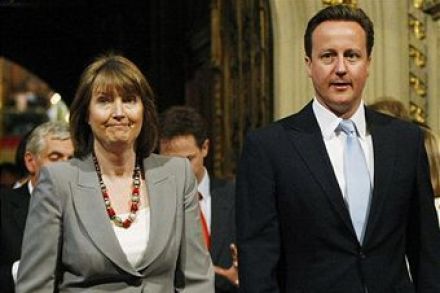
Brown bunked off PMQs today, claiming a prior luncheon engagement with President Zuma of South Africa. Downing Street blamed the Queen for double-booking the PM. Can that be true? The head of state deprives the Commons of its democratic right to shout ‘Answer the question’ at a block of granite. Perhaps she had their best interests at heart. Hattie Harman, replacing the PM, turned up in a pair of alarmingly shrill pink glasses. Opposite her, William Hague wore a sober suit of inky blue. He looked ominously business-like as he aimed his first shot at her. Why had Brown cut the helicopter budget while the country was fighting two wars? This sent Hattie scampering to her dressing-up box of muddled phrases.

Cheapening the currency

Here come the Oscars. Even people who rarely visit the cinema can’t resist the world’s greatest awards ceremony. The collision of extremities makes it compulsive viewing. It’s a sort of morality play where the seven deadly sins, and their contrary virtues, are paraded in dumbshow. Greed, hope, vanity, despair, jubilation, pride, joy, envy and a dozen other maxed-out sentiments are let loose. Moderation is banned. Temperance, decency and any restraining impulse must take the night off so that excess and all its spiritual allies can frolic and cavort. We know what will happen. The winners, clutching the pepper pot-sized statue, will sob their gratitude to the world and claim that the gilded midget means more to them than all the money they will ever earn.

Marital infidelity

Serenading Louie Donmar, until 27 March Measure for Measure Almeida, until 10 April Genius detectors, busy in America, want us to meet the playwright Lanford Wilson. He hasn’t made much impact here possibly because his talent is so vast it can’t be hauled across the Atlantic. His 1970s play Serenading Louie focuses on marital infidelity in the suburbs, and English audiences are entitled to make comparisons with our home-grown chroniclers of bourgeois disenchantment. Wilson doesn’t stand much chance, I’m afraid. His static, pain-strewn narrative has none of the fun or sparkle of English suburban drama. And where Tom Stoppard, Michael Frayn, Alan Ayckbourn and Mike Leigh could manage one good line every couple of minutes, Wilson manages one every hour.

True romance

‘Any closer and they’ll start kissing,’ said Cameron. The PM and his beloved chancellor were seated side by side at PMQs today, chatting showily throughout. Their rhubarb-rhubarb conversation was intended to quell the rumours of civil war in Downing Street. The ploy misfired. Two men conversing don’t both speak at each other simultaneously. But that scarcely mattered. The session was the rowdiest and least illuminating of the year so far. At times it was noisier than the Pamplona bull-run. Cameron began by trying to elicit answers about the appalling mortality rates at Staffordshire Hospital. Brown adopted his cenotaph grimace and reeled off a list of inquiries, investigations and disciplinary sanctions which parked the issue in neutral territory.

Pale imitation

11 and 12 Barbican, until 27 February A Life In Three Acts: Bette Bourne and Mark Ravenhill Soho, until 27 February Peter Brook, the world’s most maddening theatre director, returns to London with an adaptation of a novel set in the French colony of Mali in west Africa. Brook is never as bad as his critics hope nor as good as his fans dream. So he always disappoints somebody. 11 and 12 tells of a schism within an oppressed Muslim sect. Some worshippers recite 11 verses of a certain prayer, others 12. The tiff intensifies and the French authorities order a crackdown. This dispute neatly encapsulates the seismic pettiness of religious controversies but the bust-up isn’t pursued very far.

Spectator debate: ‘We must quit Afghanistan now’

Chair – Andrew Neil Proposing – Correlli Barnett, Simon Jenkins Opposing – Charles Guthrie, Andrew Roberts Farce very nearly visited the debate on Afghanistan on Tuesday. A parliamentary three-line whip prevented the MPs Liam Fox and Peter Kilfoyle from reaching the hall. So our ancient democracy threatened a debate on Afghanistan’s brand new one. The issue that kept them in parliament? Democratic reform. Correlli Barnett proposed the motion and lamented that America’s ‘panic and rage’ had precipitated the war after 9/11. Accepting the consequences of retreat would be bolder than propping up the ‘posturing clown’ Hamid Karzai. We should leave by September.

Losing the plot

Really Old, Like Forty-Five Cottesloe, in rep until 20 April Stage Fright Canal Café, until 20 February This is what the National is for. A little-known writer Tamsin Oglesby has been given a chance to shine on the Cottesloe stage. Her Alzheimer’s play sets out to give the age-old issue of old age a brisk shake-up. We’re in the near-future. A sinister new health trust, The Ark, has been set up to grapple with the problem of granny-management. Ruthless bureaucrats discuss hardline policies. Motorway-style lanes should be imposed on pavements to allow athletic pedestrians to speed past dawdling wrinklies. A new wonder-drug has been discovered whose hidden side effect is death. ‘Ten per cent of old people suffer from dementia,’ says the chief policy-maker.