Lloyd Evans

Lloyd Evans

Lloyd Evans is The Spectator's sketch-writer and theatre critic

PMQs sketch: Miliband begins to run out of arguments

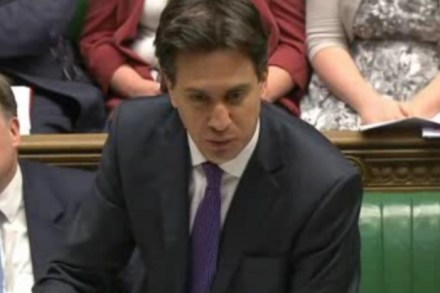
Syria overshadowed PMQs today. The chamber was quiet and sombre. And both leaders were clearly about to do their world-statesman bit. Ed Miliband rose to his feet with an air of ineffable goodness. He looked like St Peter on his way to donate the dead Judas’s sandals to a charity shop. He asked about Britain’s readiness to accept Syrian refugees in accordance with a UN directive. Britain, said Cameron, is already the second largest donor to Syria. And the crisis can’t be solved by few hundred refugee placements. Miliband used two more questions to press the case for ‘orphans who had lost both parents.’ Cameron said he was prepared to ‘listen to the arguments’. ‘I feel we are gradually inching forward on this issue,’ said Miliband.

The play to watch if your country is breaking up

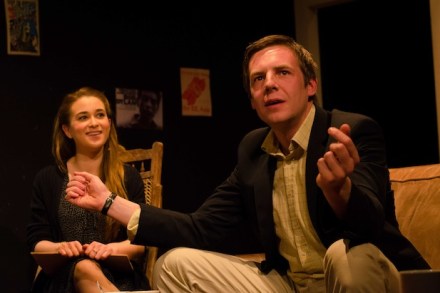
Of all the West End’s unloved venues the loveliest is the Arts Theatre. It specialises in creaky off-beat plays like Only Our Own by Ann Henning Jocelyn. We’re in Connemara, in the west of Ireland, in the early 1990s. A family of Anglo–Irish toffs are struggling to cope with their status as universal pariahs. Wherever they go they’re out of place. Catholic Ireland resents them. In England, their spiritual home, they feel like aliens. Titania, a narky teenager, is baffled by her parents’ religious prejudices and she merrily announces her involvement with a boozy local bumpkin. He’s Catholic, naturally. This prompts a bombshell of a speech from Titania’s grandmother, Lady Eliza, who witnessed a village insurrection in 1922 when she was just 11.

The ‘semi-detached’ member of Margaret Thatcher’s cabinet

John Biffen was mentally ill. This is the outstanding revelation of Semi-Detached, a memoir which has been assembled from his diaries and from the autobiographical writings which he completed before his death in 2007. During the mid-1960s he tried psychotherapy, which he described as ‘lugubrious’, ‘painful’ and ‘not a cure’. He got far better treatment from a Harley Street specialist, Peter Dally, who regulated his lithium doses with blood tests and improved his health to the point where he felt able to join the shadow cabinet in 1976. He served as Trade Secretary under Mrs Thatcher and later as Leader of the House. Biffen loved gossip.

The Duck House is the best show in the West End

It’s taken me a few months to catch up with the political farce The Duck House. Then again, it’s taken The Duck House a few years to catch up with the expenses scandal that it mocks. The story is set in the half-forgotten era of 2009. Robert Houston, a glib New Labour high-flier, is planning to defect to the Conservatives on the eve of the general election. His scheme, which is a little hard to decipher, is to stand for the Tories in his safe Labour seat and to persuade his Labour supporters to join him in a mass conversion to Conservatism. Having pulled off this piece of electoral magic, he expects to land a plum job in the cabinet as soon as Cameron is returned to power.

PMQs sketch: a subdued week, but the bear-pit will be back

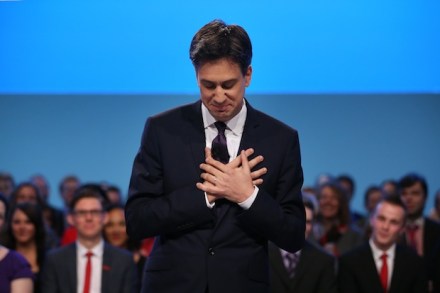
It’s a whole new kind of politics. The subdued atmosphere at PMQs had two possible causes. First, the tragic death of Paul Goggins had stunned the House into near silence. Ed Miliband seemed close to tears as he paid his tribute. ‘Labour has lost one of its own, and one of its best.’ Moving to more substantial issues, Miliband chose the neutral topics of monsoons and roulette machines. He saluted the work of the flood-wardens and the efforts of courageous citizens who had leapt to each others’ aid during the storms. Cameron replied by vowing that river defences would be reinforced with huge sandbags stuffed with cash. Then Miliband moved to fixed-odds betting machines.

Get tickets for Emil and the Detectives, and opera glasses — some of the child actors are tiny

It starts with a brilliant joke. We’re in the Weimar Republic in 1929. Little Emil Tischbein is listening to his mother and a moaning neighbour, Mrs Wirth, lamenting Germany’s loss of moral fibre. Mrs Wirth cites a recent gangster film whose depravity shocked her to the core. ‘We saw it three times,’ she adds.  Forewarned about thieves and hoodlums, Emil travels to Berlin carrying a precious cargo of 140 marks. A sinister stranger robs him on the train and he befriends a gang of Berlin school-kids who set off to retrieve his cash. Erich Kästner’s classic is directed with great style by Bijan Sheibani, who captures much of the book’s verve and atmosphere.

PMQs sketch: This being Yuletide there were some turkey ticklers

Christmas is excellent news for a Labour opposition. The season of goodwill throws rich and poor into sharp relief. Red-faced aldermen gather at loaded tables to gobble up roast goose and plum-duff. And afterwards they throw sixpences at starving chimney-sweeps who scrabble for crusts of bread in the snow. At least that’s how it should be. But Labour is in trouble this year. A dearth of bad news has gripped the country. There’s a chronic shortage of shortages. And the lack of a serious crisis is reaching crisis proportions. Ed Miliband is suffering. He looked positively nauseous as he stood up at PMQs and applauded the ‘welcome’ fall in joblessness. ‘More!’ shouted the Tories. Miliband’s lips curled queasily.

Jude Law’s Henry V is a buccaneer leading a stag-night raid across the continent — but he’d be a great Macbeth

Henry V is the final show in Michael Grandage’s first West End season. The theatre was full to bursting on press night. Jude Law, in the title role, had attracted a crowd of autograph hunters, who shivered outside the stage door. One was a tall, chubby young man in loose grey clothes wearing a bobble hat and a very kindly grin. His flies were undone. The play itself is a disjointed, rambling affair. Poorly shaped, and even a little artless, it’s crowded with fights, bloodshed and laddish humour. The scenes of brutality are offset by soaring passages of patriotic verse that have been quoted into overfamiliarity. There was much coughing and guttural distraction throughout the performance. Grandage aims for handsome, elegant informality and here he scores full marks.

Is this the real First Lady of ‘Borgen’?

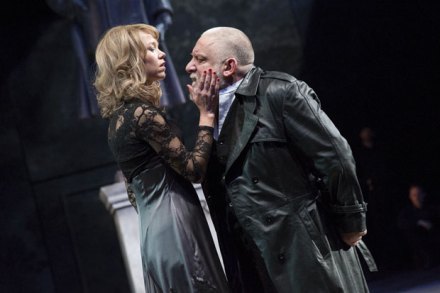
I meet Birgitte Hjort Sorensen in a plain office near the Donmar Warehouse in the West End. She’s warm, sharp and engaging, and her fast-flowing English is adorned with the odd Eurotrash platitude. Her American twang owes itself to the global language school of television. ‘I watched a lot of American and English TV growing up. We have it subtitled, not dubbed. Denmark is such a small country and nobody’s going to speak Danish outside of Denmark.We kind of have to learn.’ She’s about to appear as Virgilia in Coriolanus at the Donmar. How does she find playing the wife of a tyrannical anti-hero? ‘Interesting in that she doesn’t talk a lot compared to some of the other characters, who talk quite a lot.

PMQs sketch: The snarling between Cameron and Balls enters fresh territory

Christmas is here. And Ed Miliband’s script writers have already got their present. The sack. Really, he seems to have let them go. At PMQs he was reading out insults that pre-date Nicholas Parsons. Out of touch, complacent, the plaything of millionaires. Cameron can fight off such jibes his sleep. Tory backbenchers asked questions full of happy economic tidings. Conservative constituencies are alive with commercial euphoria. New investment, new apprentices, new customers. It’s all thanks to this wise and decisive government. Cameron duly lapped up the credit. Peter Lilley revealed his personal remedy for the proposed pay hike for MPs. ‘Re-table the Boundaries Commission report!’ he advised. In other words fewer MPs with higher salaries.

You can’t have Mojo and your money back

In 1992 Quentin Tarentino gave us Reservoir Dogs. At a stroke he reinvented the gangster genre and turned it into a comedy of manners with a deadly undertow. This new mutation looked as if it might be easy to copy. Many tried. Among them was Jez Butterworth, whose 1995 play Mojo takes Tarantino’s zany-macabre format and moves it to Soho in the 1950s. Butterworth also leans heavily on Pinter. The play opens in the back-office of a nightclub. Two pilled-up criminals are exchanging streams of lairy London chit-chat. Their boss, Ezra, has discovered a teenage heart-throb named Silver Johnny but rival gangsters are keen to muscle in and grab a piece of the star’s income. The details are hard to follow because the jabbering thugs leap so fast from one topic to the next.

PMQs sketch: Clegg has fun on the train set, but he’s killed chances of a Lib-Lab pact

Crash-bang-wallop. The chances of a Lib-Lab pact in 2015 have just gone hurtling through the floor. David Cameron is away in Beijing looking for Chinese venture capitalists who can turn Britain into the new Africa. Nick Clegg took his place at PMQs. He lost no time socking it to Labour. They were intellectually bankrupt, he said, and economically illiterate. Their energy policy was a con. And union stooges were swamping their membership lists. Harriet Harman hit back. ‘Leave it to us to worry about our party members,’ she said, ‘especially as so many of them used to be his.’ She dismissed Clegg’s favourite idea that he acts as a brake on Conservative policy. ‘He’s the accelerator,’ she gloated.

Sketch: Alan Rusbridger’s select committee interrogation

Guardian editor, Alan Rusbridger, was quizzed about the Snowden leaks in select committee today. The chair was amply filled by Keith Vaz who always comes across as well-fed, well-meaning and well-nigh useless. He began by thanking the Harry Potter clone for showing up at all. ‘I didn’t know it was optional,’ said Rusbridger frostily. Vaz wondered if the Guardian boss loved his country. Rusbridger affected surprise at the question and said he loved our principles of free speech and democracy. He was a patriot. Labour members toadied up to him and hailed his paper as a champion of liberty. But the Tories were ready to lock him in the slammer and grind the key into iron filings.

Ben Miller interview: ‘Everyone was doing alternative comedy. I thought I’d distinguish myself by just telling jokes’

Ben Miller is wolfing down a pizza. I meet the comedian in a Cambridge restaurant where he demolishes a Margherita shortly before racing off to appear on stage in The Duck House, a new farce about corrupt MPs. The show is set in 2009. Miller stars as a Labour backbencher who wants to jump ship and join the Conservatives. But first he has to convince a Tory bigwig that his expenses claims are entirely legitimate. He’s not helped by his dim-witted wife, his corrupt Russian cleaner, and his anarchist son, Seb, who has sublet the family flat in Kensington to a suicidal Goth. The writers Dan Patterson and Colin Swash wanted to stage the play just before the 2010 election. Miller believes this would have been premature.

Martin Shaw’s flaws make him perfect for Twelve Angry Men

Strange actor, Martin Shaw. He’s got all the right equipment for major stardom: a handsome and complicated face, a languid sexiness, a decent physique and a magnificent throbbing voice. He sounds like a lion feeling peckish in mid-afternoon. At top volume, his growl could dislodge chimney pots. And yet he’s just a steady-eddy TV performer who does the odd stint in the West End. Why isn’t he Patrick Stewart or Anthony Hopkins? Perhaps his rhythm is too slow. Certainly, he lacks pep or sparkle, or a sense of mystery. You know what he’s going to do next because he’s just done it. And even then it wasn’t much. Warmth, innocence and fun are outside his range but these defects make him a great choice to play the central role in Twelve Angry Men.

PMQs sketch: Hashtag ‘Green Crap’

Loan sharks got a biff on the nose at PMQs today. Cameron wants to cap the sum that each of us can borrow. Ed Miliband was puzzled. This is a U-turn, he said. When he proposed to cap energy bills Cameron called it ‘Marxism.’ Cameron shrugged this off. And he gloatingly invited Miliband to ‘congratulate us’ for pushing through an important reform. Tricky for Ed. When the government filches your idea, you can’t complain without seeming to oppose your own position. Miliband moved to the looming winter crisis which he seems to be looking forward to. Last year an additional 31,000 deaths were recorded. All the PM’s fault, apparently. ‘Any excess death is a tragedy,’ said Cameron, appearing to take responsibility for the wipe-out.

Finally — a play about insomnia that cures insomnia

Athol Fugard is regarded as a theatrical titan but I usually need a microscope to find any trace of greatness in his work. The Island is set in a South African prison camp in the 1960s. Two banged-up lags, John and Winston, are toiling in the noonday heat. The governor torments them with a Kafka-esque prank. They’re placed at opposite ends of a sandpit and given shovels and wheelbarrows. Each must amass a dune of gravel, which his colleague is forced to deplete. This backbreaking futility is supposed to grind their spirits into nothing. It fails. Released from punishment at sundown, they retreat to their cells where they express themselves with abandon. They amuse each other with frolicsome monologues. They swap reminiscences about good old chums from home.

Nightmare at PMQs!

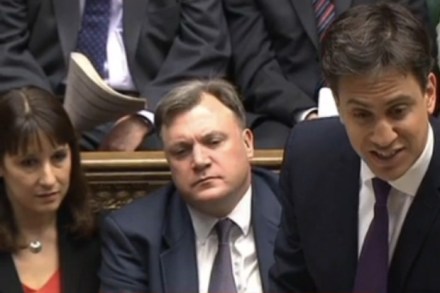
It started as soon as Ed Miliband stood up at PMQs today. ‘Nightmare!’ yelled the Tories. ‘Nightmare!’ They’d been fired up by the first question from Steve Brine, who craftily double-loaded his query. He referenced the Co-op bank and the ‘nightmare email’ in one sentence. Would the PM respond, he asked, ‘to grave concerns about the nightmare unfolding at the Co-operative?’ Cameron pretended to be all serious. He fretted about the regulatory controls and about safeguarding the bank without fleecing the tax-payer. ‘Nightmare!’ goaded the Tories. Ed Balls, seated beside Miliband, flushed puce. Not a natural Trappist, the shadow chancellor is clearly under orders to shut his gob during PMQs.

‘Keeler’ is not just about Tory bigwigs chasing nymphettes around the pool

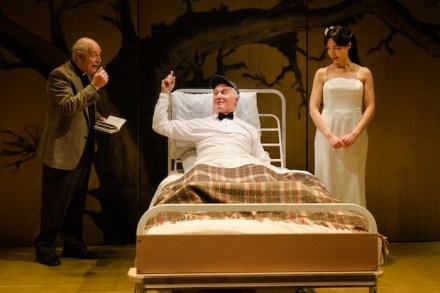
It’s an unlovely venue, for sure. Charing Cross Theatre, underneath the arches, likes to welcome vagrant plays that can’t find a home elsewhere. The dripping exterior, opposite a gay love-hub named Heaven, feels as if it’s paved with tears. The foyer is scented with mildewed chip fat and the ink-black auditorium looks like a closed-down fleapit from the 1950s. Perhaps this air of neglect explains why few of its productions win rave reviews. Keeler, starring Paul Nicholas, got an unfair monstering. The play is an absorbing docudrama, which explores the relationship between Stephen Ward and his protégée Christine Keeler. Their flatshare was a complex and unusual set-up. Ward was multitalented, socially ambitious, intelligent, charming and articulate.