Lloyd Evans

Lloyd Evans

Lloyd Evans is The Spectator's sketch-writer and theatre critic

Self Esteem is the star of this David Hare musical

Teeth ’ n’ Smiles is not quite a musical. David Hare’s 1975 play about rock’n’roll includes a handful of tunes performed by a group of failing musicians. It feels like several dramas rammed together. One strand concerns the aimless witter of instrumentalists who lounge around backstage discussing drugs and groupies. Another strand follows the lead singer, Maggie, and her destructive appetites for booze and casual sex. The third element concerns the band’s manager, Saraffian (Phil Daniels), who knows nothing about showbusiness and seems keen to advertise his ignorance to the world. Saraffian is a Dickensian figure who talks like Fagin and believes that pop stars should resemble school prefects.

Don’t miss it: Summerfolk, at the Olivier, reviewed

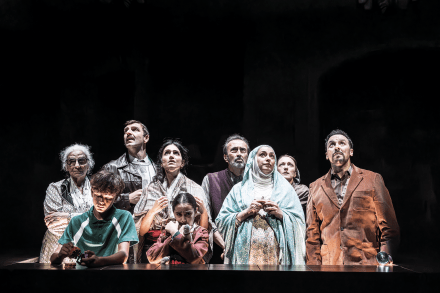
Dachniki meaning ‘dacha people’ is the Russian title of the National Theatre’s new production of Gorky’s sprawling 1905 drama. Nina and Moses Raine, who adapted the play, chose the flavourless title Summerfolk which doesn’t quite capture the play’s distinctive Russian atmosphere of ennui, intellectual rumination and despair. However, their perky, supple and idiomatic dialogue works very well. Gorky appears to have written the script as a feverish homage to Chekhov, who died in 1904, and he pinched numerous characters and plot twists from his mentor. The beautiful, vain and sexually inert Varvara is a copy of Yelena in Uncle Vanya. Kaleria, the nervous actress who performs amateur verse for her friends, is inspired by Nina in The Seagull.

Lazy: America is Beautiful, Chapter 1 reviewed

Neil LaBute is one of America’s most provocative and interesting playwrights. His best-known work, The Shape of Things, was made into a movie starring Rachel Weisz and Paul Rudd. America the Beautiful consists of nine plays in three chapters, the first two of which are being staged at King’s Head, the third at the Greenwich Theatre. This complex arrangement sends a signal that LaBute is a mercurial and elusive artist whose fans must chase across London to savour the full richness of his talent. The lesbian stares and leers aggressively while her victim cowers and bleats in protest The first show, Chapter 1, consists of three unconnected skits about sexual jealousy.

Damian Thompson, Francis Pike, Ysenda Maxtone-Graham & Lloyd Evans

25 min listen

On this week’s Spectator Out Loud: Damian Thompson says his addiction to the piano has only got worse with age; Francis Pike ponders if Kim Jong-Un is lining up a female successor; Ysenda Maxtone-Graham explains the art to left-wing boasting; and finally, Lloyd Evans contemplates becoming a magistrate. Produced and presented by Patrick Gibbons.

Damian Thompson, Francis Pike, Ysenda Maxtone-Graham & Lloyd Evans

My burning ambition for my old school

Every boy longs to see his school burn down and for me the dream came true twice. In February 1977, I was walking to Sunday Mass when I spotted a cluster of teachers at the school gates. The old Victorian hall had caught fire overnight and collapsed. I couldn’t believe it. This was my personal Towering Inferno and I’d missed the whole thing. In my mind’s eye I could see it all: the leaping flames, the burning joists, the black columns of ash rising over south London, and the thunderous roar as the roof crashed to the ground. Nothing was left but a few pathetic wisps of smoke rising from a pile of charred beams. The teachers were standing around looking shocked and miserable – as if mourning the death of a pet rabbit. Why so glum?

Do I have what it takes to be a magistrate?

I’m thinking of becoming a magistrate. Before applying, I was advised to attend a few sessions and find out how it all works. My first case was a bag theft from a London pub. The accused, an Algerian football ace, pleaded guilty through an interpreter. The court heard that his glittering football career had been cut short by ‘an accident’ and he was currently living in London ‘with the support of friends’. The magistrate, a kindly, soft-spoken redhead, fined him £60 and made a note of his ‘good character’. She reduced his fine by £20 as a reward for pleading guilty. The defendant lounged against the rail of the dock looking irritable and impatient as his sentence was pronounced. Outside the court, he spoke to his lawyer without a translator.

Cynthia Erivo’s Dracula is tiresome

Interest in Dracula seems to go on for ever. Kip Williams has chosen Cynthia Erivo to star in his new version of the yarn about a clique of blood-quaffers who bite their victims’ necks and lick the seepings. The show is staged as a read-through of Bram Stoker’s text supplemented by costumes, wigs and a few orchestral hits recorded on tape. Erivo plays all 23 roles and her performance is simultaneously filmed and broadcast to the audience on TV screens dotted around the theatre. This creates two problems. First, Erivo can’t see or interact with the crowd because she’s encircled by wardrobe assistants and cameramen who swarm around her like gnats. Secondly, the audience are expected to look at the screens and not at the stage. This is odd.

Fans of George Eliot are in for a shock: Bird Grove at Hampstead Theatre reviewed

Bird Grove by Alexi Kaye Campbell is a comedy of manners set in 1841. A portly suitor, Horace, arrives at a respectable house intending to propose to a rebellious and brilliant 22-year-old, Mary Ann. Horace’s father is dying and he must find a bride before nightfall or lose a substantial legacy. This ludicrous but very human situation starts the play. It’s instantly gripping. Mary Ann is in the drawing room being treated for headaches by a French mesmerist along with two wealthy radicals, Mr and Mrs Bray, who encourage her political activism. Her father, Robert, introduces his guests to each other and invites them to stay for tea. This fascinating glimpse of her early life shows George Eliot as a surly, arrogant, spoilt and heartless pest A hilariously awkward party ensues.

The blandness of Hugh Bonneville

Shadowlands, by William Nicholson, is a solid and unsurprising account of the brief marriage between C.S. Lewis (known as Clive), and the American poet Joy Davidman. Her cancer diagnosis overshadowed their romance but they snatched a few lustful holidays together before she expired in an NHS hospital in 1960. Hugh Bonneville, as Clive, delivers his standard three-note performance – bemused decency, bumbling hesitation, ironic charm – which tells us nothing about the author’s inner life. Bonneville has succeeded in building a huge presence in the movie industry from an almost complete dearth of actorly qualities. He’s not handsome, sexy, tough, athletic, amusing, mysterious, evil or even slightly unpleasant. He’s not brilliant or stupid. He’s not admirable or despicable.

James Heale, Lisa Haseldine, Simon Heffer & Lloyd Evans

25 min listen

On this week’s Spectator Out Loud: James Heale reflects on Nigel Farage's leadership team; Lisa Haseldine argues that Europe is in denial over its defence; Simon Heffer looks at the extraordinary rise – and tragic fall – of the first Labour Prime Minister, Ramsay MacDonald; and finally, Lloyd Evans reviews the plays I'm Sorry, Prime Minister and American Psycho. Produced and presented by Patrick Gibbons.

James Heale, Lisa Haseldine, Simon Heffer & Lloyd Evans

Should I be a Jew, Muslim or Hindu? 

Time is running out. We all have to meet our maker at some point, and although I’m fit as a fiddle I like to plan ahead. God has many brands and many names and I want to show up at the right shrine and to use the correct form of address. Technically, I don’t believe in a creator, because my rational mind accepts the agnostic theory. Existence is an attribute of entities that are bound by time and space. God is unbound by time and space, therefore existence is not among his attributes. QED. And yet something in me rejects this logic and yearns to believe – just in case. What if he really is up there? I should pick a team.

Dazzling: I’m Sorry, Prime Minister at the Apollo Theatre reviewed

Jim Hacker is back in the West End. I’m Sorry, Prime Minister, written by Jonathan Lynn (who co-wrote the original TV series), brings us the former PM in semi-retirement as the Master of Hacker College, Oxford. Jim, now Lord Hacker, is facing a revolt by the students and the senior fellows who claim to have been offended by his high-table banter. He was overheard making positive comments about the British Raj and suggesting that the word ‘negro’ should not be expurgated from the work of James Baldwin. Both opinions are blasphemous according to the killjoy theocrats who govern our political discourse. Jim is ordered to quit his post but he refuses and the college authorities offer him a chilling compromise.

No chemistry between the performers: Arcadia at the Old Vic reviewed

The Old Vic’s production of Arcadia by Tom Stoppard has a vital component missing. The house. Stoppard’s brilliant historical comedy is set in a country manor owned by the Coverly family and the script examines, among other things, the evolution of decorative taste during the 18th and 19th centuries. But no architecture is present on stage. The audience has to imagine what the show fails to supply because the Old Vic’s interior has been redesigned ‘in the round’ with a central playing area encircled by pews as seats. This leaves no room for a large-scale set. Arranging the venue like a boxing ring ensures that parts of the action are invisible to parts of the audience.

Marvellously conservative: Cable Street reviewed

Cable Street is a musical that premièred last year at the Southwark Playhouse and has now migrated to the Marylebone Theatre. Fans of beautiful staging will be instantly smitten by the amazing achievement of the designer, Yoav Segal. The script by Tim Gilvin and Adam Kanefsky tells the story of a violent stand-off in October 1936 between cockney activists and Oswald Mosley’s British Union of Fascists. The authors treat the East End during the depression as a panto or a moral fairy tale. It’s good vs evil. The socialists are hard-working, golden-hearted heroes who rise up against the wicked landlords and their cruel rent hikes. The fascists are angry, misshapen losers led by a waddling baldie in a stick-on moustache. The socioeconomic background is hard to decipher.

If this play is correct, the Foreign Office is a joke

Safe Haven is a history play by Chris Bowers who worked for the Foreign Office and later for the UN as a human-rights activist. The two careers seem to be interchangeable. His drama follows an idealistic and oversensitive Oxford graduate, Catherine, who joins the diplomatic service during the first Gulf War in 1991. Catherine believes that the Foreign Office exists to throw money at basket-case countries that lack the maturity to govern themselves. The entire department acts as a sort of puppy rescue service for dysfunctional nations overseas. All her colleagues accept the wisdom of this approach even though it has the same effect as casting diamonds into quicksand. Catherine responds to historic events like a homeowner assessing a new lamp for the guest bedroom.

Why is this low-grade Ayckbourn play in the West End?

Woman in Mind is a dyspeptic sitcom set in 1986 starring Sheridan Smith as Susan, a moaning Home Counties housewife who slips into a Yorkshire accent when she gets cross. Susan sunbathes in her leafy garden sipping coffee and carping about everyone close to her. She loathes her scowling sister-in-law, Muriel. She can’t bear her husband Gerald, a cerebral vicar, and she refuses to revive their moribund sex life. She constantly badmouths their grown-up son, Ricky, who lives with a community of mute hermits in Hemel Hempstead. How did this scout-hut show reach the West End? In Act One we learn that the rules of Ricky’s community forbid him from speaking to his parents. But in Act Two the story changes.

The rebellion will have a craft stall

A new party has entered UK politics. Take Back Power seeks to ‘tax the rich and fix Britain’ and they’re planning a revolution that will replace parliament with ‘a house of the people’. Once the regime has been overthrown, Take Back Power will divide the country’s wealth in favour of the poor. About 300 supporters showed up at their launch event last Saturday in a semi-derelict municipal building in Tower Hamlets. Their media game is pretty good. The hall was dominated by a big screen that beamed pithy slogans and memorable statistics to the crowd. ‘James Dyson hoovered up £13.3 billion.’‘John Ratcliffe is hoarding £17.04 billion.’ Their marketing team know that precise figures are more persuasive than rounded-up sums.

Oh, Mary!’s climax is an inspirational bit of comedy

High Noon, directed by Thea Sharrock, is a perfectly decent version of a trusty western which celebrates its 74th birthday this year. An elderly sheriff, Will Kane, marries a priggish beauty, Amy, on the day of his retirement but his marital plans are overturned by news that a dangerous convict, Frank Miller, has been released from jail and hopes to shoot Will dead. Amy is a devout Quaker and she grumbles bitterly as Will cancels their honeymoon and heads back to town to deal with the evil Frank. But Frank is not the brightest criminal in New Mexico. News of his plans have spread and everyone knows that he’ll show up at midday aboard the express train.

My advice to the next generation

Everyone went to the same school as someone famous. In my case it’s Spider-Man, Tom Holland, who joined my former school about 30 years after I left. Back in the mid-1970s, the most famous old boy was another superhero, Major Pat Reid, who’d been captured by the Germans during the war and briefly imprisoned in Colditz. His bestselling memoir popularised the notorious jail and led to a TV series, an Action Man model and various other spin-offs. He was known as the only man to have escaped from the Nazis and turned it into a board game. He showed up on sports day, in July 1975, to give us a pep talk and hand out prizes to the school’s top athletes. I wasn’t among them, of course. My great days as a sportsman lay ahead of me. They still do, in fact.

Why has the National got it in for Oirish peasants?

The Playboy of the Western World is like the state opening of parliament. Worth seeing once. Director Caitriona McLaughlin delivers a faithful production of John Millington Synge’s grand satire about dim-witted Oirish peasants and, perhaps unwisely, she spreads the show across the entire length of the vast Lyttelton stage. It looks as if it’s being performed on a railway platform. The drama consists of several broad, daring and improbable steps. A handsome farmer’s boy, Christy, rolls up in a sleepy village in Co. Mayo and claims to have murdered his father. The lustful local girls treat him as a hero rather than an outlaw and compete for his hand in marriage. When Christy wins a prestigious donkey race he sets the seal on his pluck and manliness. Then, disaster.