Lisa Haseldine

Lisa Haseldine

Lisa Haseldine is The Spectator's online commissioning editor - foreign affairs.

Can Putin successfully drag Belarus into war with Ukraine?

From our UK edition

Putin’s war in Ukraine is not going his way. As the screw tightens on him, what options does he have left up his sleeve? There remains, of course, the possibility that Putin could, at some point, choose to deploy nuclear weapons – he himself has threatened this enough times. But there is also Belarus. Controlled by Alexandr Lukashenko, currently in his sixth term as president thanks to an election in 2020 rigged in his favour with Putin's help, the country has sat on the fringes of the war since it began. On Monday, as Putin launched his latest attack on Ukraine, Belarus announced that, together with Russia, it was deploying a joint regional forces group to its borders in response to the ‘worsening situation’ in Ukraine.

Is it time to look again at nuclear power?

From our UK edition

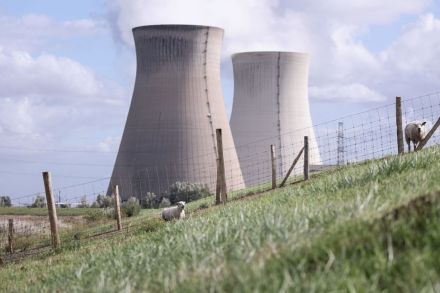
Putin’s invasion of Ukraine in February this year marked a watershed moment in the debate on energy security. How we heat our homes, power our businesses, and what needs to be done to protect those energy sources was thrust once again to the top of each European country’s agenda. The fallout from war in Ukraine has also led to a question being asked: is it time to look again at nuclear power? This was the topic of discussion at a Spectator panel at Tory conference. Robert Buckland, Secretary of State for Wales thought so: ‘We cannot afford to lose any time in investment in nuclear.’ This was proved most painfully when rocketing energy prices quickly began to expose how vulnerable Europe’s dependence on gas made it.

Putin fires a warning to the West

From our UK edition

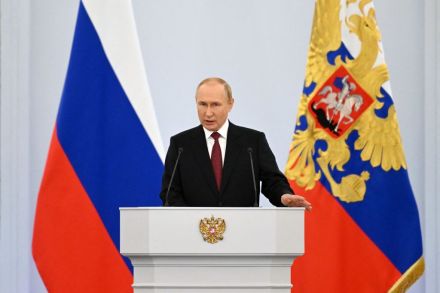
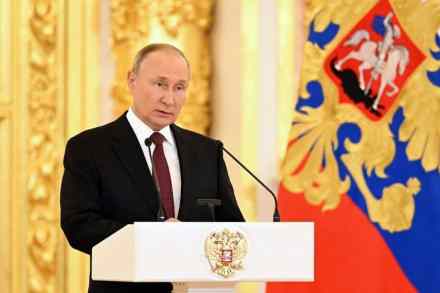
‘The West has let their mask slip and revealed their true nature!’ That was Vladimir Putin's message to a hall of vacant-looking officials at the Kremlin this afternoon. The Russian president gathered the great and the good of Russia to reveal the formal annexation of the Ukrainian regions of Donetsk, Luhansk, Zaphorizhzhia and Kherson. But Putin's audience in the hall would be forgiven for quickly losing sight of this. This was a speech aimed at Russia's enemies in the West. Putin justified the expansion of the Russian Federation by insisting that the four now-annexed Ukrainian territories had voted in favour of joining Russia: ‘This is the will of 20 million people’, he said.

Could Russia shut its borders?

From our UK edition

In Putin’s Russia, fortunes can change rapidly. A week on from the partial mobilisation of the army, Russians are gripped by the fear that the closure of the country’s borders is next. Those who are not willing to risk death in Ukraine are looking for a way out. In the six days since 21 September, when Putin announced his plan in a pre-recorded television address, protests have sprung up in at least 43 towns across the country; the human rights organisation OVD News has said that more than 2,300 people have been arrested for taking part. According to the official terms of the Kremlin’s partial mobilisation, those with military experience aged between 18 and 35 are being called up first (those holding higher military ranks can be summoned up to the age of 65).

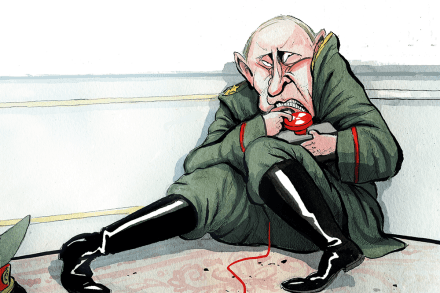
Cornered: what will Putin do now?

From our UK edition

41 min listen

In this week’s episode:For the cover of the magazine, Paul Wood asks whether Putin could actually push the nuclear button in order to save himself?He is joined by The Spectator’s assistant online editor Lisa Haseldine, to discuss (01:03).Also this week:Why is there violence on the streets of Leicester?Douglas Murray writes about this in his column this week and we speak to journalist Sunny Hundal and research analyst Dr Rakib Ehsan about what’s caused the disorder (13:44).And finally:Is three – or more – a crowd?Mary Wakefield discusses the poly-problems or polyamory in her column in The Spectator and is joined by comedian Elf Lyons, who has written about her experience of polyamory before (26:46).

‘Staying silent isn’t an option’: meet Putin’s new opposition

From our UK edition

Not every critic of Vladimir Putin ends up in jail. It still suits Russia’s President to present his country as a democracy. Elections are occasionally held against opponents whom Putin goes on to defeat, so enemies are often tolerated if they don’t pose a serious threat. Last week, 70 local councillors from across Russia used this remaining freedom to sign a petition calling for his resignation. Their protest started with a letter from councillors in St Petersburg which called for Putin to be indicted on charges of treason and removed from office. A petition followed. I spoke to a few of the signatories and found them surprisingly willing to discuss their reasoning with me. They don’t expect to overpower Putin and they know they risk being jailed.

Over 1,300 arrested as protests spring up across Russia

From our UK edition

Putin has met the latest stirrings of dissent against his regime with force. More than 1,300 Russians have been arrested this evening at protests against forced mobilisation. While it’s not known how many exactly have taken to the streets, protests on this scale have not been seen in the country since Putin invaded Ukraine seven months ago. Chanting ‘No to war’ and ‘Putin get in the trenches’, crowds including both men and women, young and old, have gathered in open defiance of the Kremlin’s intention to send a further 300,000 reservists into a warzone. According to OVD News – the Russian human rights organisation keeping tally of arrests – at the time of writing, protests are taking place in at least 38 cities.

How seriously should we take Putin’s nuclear threat?

From our UK edition

Vladimir Putin has announced the partial mobilisation of the Russian armed forces. In a pre-recorded address delayed from last night, the Russian president declared that all reservists would be called up for service in Ukraine. Nuclear war, he stressed, was not off the table.  In tones bordering on the hysterical, Putin declared that Nato leaders had been discussing the possibility and acceptability of using nuclear weapons against Russia:  ‘I want to remind those who allow themselves to make such statements about Russia, we too have various means of destruction at our disposal that are more varied and modern than those owned by Nato countries.

Luhansk and Donetsk to hold ‘referendums’ on joining Russia

From our UK edition

Authorities in the Russian-occupied Luhansk and Donetsk regions of Ukraine have announced that both would hold referendums on formally joining the Russian Federation this coming weekend. Although the breakaway states of the Luhansk and Donetsk People’s Republic (LPR and DPR respectively) have been controlled by Putin-loyal separatists, they have technically remained semi-autonomous. Similar announcements about a referendum have been made in the recently-invaded regions of Kherson and Zaporizhzhia. Russia, of course, has welcomed the decision – the Chairman of the State Duma Vycheslav Volodin declared its readiness to provide Luhansk and Donetsk with total support. Putin is due to give an address to the nation on the subject this evening.

Wagner Group exposed recruiting Russian prisoners for Ukraine

From our UK edition

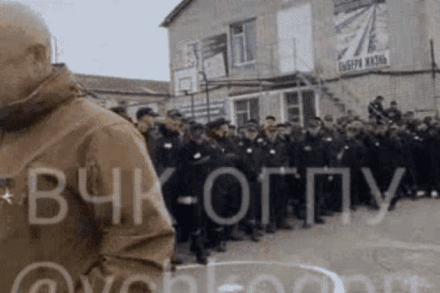
The Wagner Group thrives in the shadows, but now its founder has been caught on camera: recruiting prisoners from a Russian penal colony for the war in Ukraine. In the video, Yevgeniy Prigozhin paces about a large group of prisoners, giving them the hard sell on joining the Russian war effort. He offers them a deal: six months of service in return for a pardon for their crimes. But, should they arrive in Ukraine and refuse to fight, they will be considered deserters and shot. ‘The war is difficult,’ he says; the pro-Kremlin group has used ‘more than two and a half times’ the amount of ammunition used by Soviet forces during the battle of Stalingrad in the second world war. https://twitter.com/wartranslated/status/1570123353331011586?

Has Kadyrov turned on Putin?

From our UK edition

Just how much of a grip does Vladimir Putin have on the situation currently unfolding in Ukraine? Over the weekend, the Ukrainian Army made a series of rapid advances, reportedly regaining control of as much as 3,000 square kilometres of formerly Russian-controlled territory. According to one Ukrainian commander, the counter-offensive had Russian soldiers fleeing for the border ‘like Olympic sprinters’. In a sign of just how dire a situation the Russian war effort looks to be in, Chechen leader and Putin loyalist Ramzan Kadyrov took to social media to criticise the campaign. In a rambling voice note on the messaging app Telegram, Kadyrov slammed the Russian retreat from the towns of Izyum and Kupiansk.

How Russia reacted to the death of Mikhail Gorbachev

From our UK edition

‘Some will say he bought us freedom. Others that he took our country. Mikhail Gorbachev, one of the most controversial politicians in Russian history, has died.’ This is the verdict of the tabloid Komsomolskaya Pravda - a mixed review of a politician with a mixed record. And one reflected in a Russian press which today reads rather differently to the British. The broadsheet Izvestia’s long obituary had a pitiful verdict: ‘A communist who buried the idea of communism six feet under (most likely against his own wishes), and the leader of a great country who helplessly watched it collapse.

Without Gorbachev, would I exist?

From our UK edition

Mikhail Gorbachev’s legacy will forever centre around his successful, albeit far from painless, promise to open the USSR, and Russia, to the rest of the world. He brought about the end of the Cold War, allowing the West to breathe a collective sigh of relief. However, my debt to him is more personal. For without Gorbachev, I almost certainly would not exist. Gorbachev’s accession as eighth, and final, leader of the Soviet Union in 1985 marked a turning point in the country’s history. The politicians who chose him could hardly have predicted quite what his rule would entail.

Landlords are exploiting generation rent

From our UK edition

As interest rates hit nearly 2 per cent and inflation tops 9 per cent, many Brits are feeling the pinch. But once again it seems that generation rent is worst off. Last month, my landlord hiked my rent by £450, or nearly 30 per cent. I’m far from alone: rents across the UK have gone up by as much as 17 per cent. Renters in the UK have been overlooked since the cost of living crisis began to grip the country earlier this year. With inflation soaring and the cost of energy, water, food, petrol and other essentials also rocketing, life is suddenly, alarmingly, getting more expensive. The Bank of England’s decision to raise interest rates has got homeowners in a flap, with many understandably concerned about the impact this will have on their mortgage repayments.

Belarus’s opposition leader on her plan to take down Lukashenko

From our UK edition

On this day in 2020, Belarus held presidential elections. Standing against the dictatorial incumbent of 26 years Alexandr Lukashenko was Sviatlana Tsikhanouskaya. An unlikely candidate, English teacher Tsikhanouskaya decided to stand for election in place of her vlogger husband Siarhei, who was arrested and subsequently jailed for 18 years after the authorities refused to register his own candidacy for the contest. Dismissed as a threat by Lukashenka on account of being a ‘housewife’, Tsikhanouskaya was permitted to run. Hugely underestimated, her rallies attracted tens of thousands of supporters, making them the largest in Belarus’s post-Soviet history.

Russia’s RuTube is no match for YouTube

From our UK edition

As Russia has stepped up its military campaign in Ukraine, the crackdown at home has intensified. The Kremlin has suppressed news sources that didn’t align with its world view, squashing the country’s last remaining independent media. But even Vladimir Putin couldn’t quite plug all the gaps as the truth about the reality of his deadly campaign continued to trickle back to Russians at home. Frequently this was happening via social media. At the time of the invasion, an increasing number of Russians, nearly 40 per cent, according to the independent Russian polling organisation Levada Center, most often got their news this way.

Struggling Brits need help, not free theatre tickets

From our UK edition

Lurking in the background of the Tory leadership contest, the cost of living crisis rumbles on. With Autumn round the corner, fears over the sharp rise in the energy price cap have once again hit the headlines, inflation continues to soar and ever more people are wondering how they’re going to pay their bills. In recent days, to the sound of muted trumpets, the government launched its latest initiative to tackle the crisis: Help for Households. Billed as a partnership scheme with businesses such as supermarkets and entertainment venues, the scheme boasts a variety of deals over the summer period designed to help out struggling households.

‘Borexit’: How the foreign press covered Boris’s resignation

From our UK edition

Boris Johnson’s departure isn’t just front-page news in the UK. Germany’s press – which has never been much of a fan of Johnson since the days of Brexit – has taken a sombre, if derisive, tone towards his resignation. Today has seen the coining of a new term in the media, with popular tabloid Bild.de splashing the one-word headline ‘Borexit’ across the top of their homepage in a large green mockup of a fire exit sign. German broadsheet Der Tagesspiegel takes its readers through a chronology of the scandals that consumed Johnson’s time in office, eye-catchingly branding him a ‘scandal noodle’.

Chechen warlord Kadyrov mocks Zelensky in spoof video

From our UK edition

A strange video of Ukrainian President Volodymyr Zelensky is currently circulating online. In it, he sits at his presidential table, dressed in his trademark khaki t-shirt. Staring straight down the camera, he addresses the Ukrainian people: ‘Dear citizens!’ At first glance, it could really be one of Zelensky’s nightly addresses. Except, almost immediately, you notice the meaty disembodied hand gripping him by the left shoulder. With apparent distress, Zelensky continues, announcing the surrender of Ukraine on ‘land, sea and air’. The meaty arm shakes him to get him to spit the words out, committing Ukraine to ‘complete denazification’ within a month of signing.

Could Belarus join forces with Russia in Ukraine?

From our UK edition

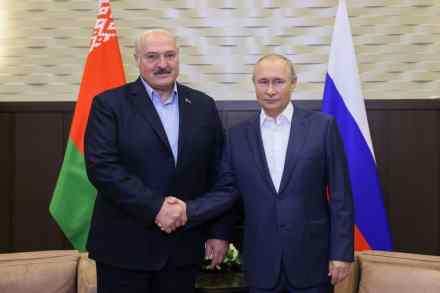
Next week Putin is due to meet Alyaksandr Lukashenka, self-proclaimed president of Belarus, for the sixth time since the invasion of Ukraine. This will also be the first time in three years that they have met in Belarus. Much hooha is usually made by the Russian and Belarusian press of their meetings. There is always a ‘happy families’-style photoshoot: Lukashenka towering over Putin, grasping his hand in his meaty fist, looking like Laurel and Hardy’s grotesque reincarnation. According to official readouts, their long meetings tend to cover a variety of mundane topics: agricultural output, the state of their economies, general commitments of mutual support.