Katy Balls

Katy Balls

Katy Balls is The Spectator’s former political editor.

Why ministers are reluctant to change face mask guidance

'Will the public be asked to wear face masks in public?' This is a topic of debate today for the government’s SAGE committee of scientific advisers. Although the government dismissed the idea early on in the coronavirus pandemic, many other countries have since changed their own advice in support of them (read Dr John Lee's analysis of the medical evidence here). Chief scientific adviser Patrick Vallance has recently suggested they could play a role in stemming infection: The evidence on masks is much more persuasive for masks stopping you giving it to somebody than it is for preventing you catching it. We have a review ongoing at the moment on the evidence around masks.
Will Boris disappoint the lockdown hawks in government?

15 min listen

Behind the scenes, the Cabinet is split on whether or not to lift the lockdown. The hawks such as Rishi Sunak, Liz Truss, and Alok Sharma, are concerned about the economic and human costs of a sustained lockdown; the doves, such as Matt Hancock, worry that lifting the lockdown too soon risks a second wave. Given Boris's liberal instincts, the hawks hope that he will come down on their side. But will the Prime Minister disappoint?

Why isn’t the UK testing at full capacity?

14 min listen

The government revealed today that its testing capacity is at 38,000 a day. So why, then, are less than 16,000 tests being taken each day so far? Cindy, James, and Katy also discuss the new vaccines task force, the extension of the furlough scheme, and what the latest numbers out of China mean.

When will the public accept an end to the lockdown?

In the weeks leading up to Boris Johnson announcing lockdown measures, ministers and aides wondered how in the world you could enforce a lockdown like the one seen in authoritarian China in a liberal democracy such as the UK. But following Dominic Raab confirmation on Thursday that there will be another three weeks of lockdown, public resistance is the least of ministers' concerns. The biggest surprise about the lockdown within government has been the level of public support for it. Polling has repeatedly shown that rather than fighting the social distancing measures, Britons are embracing them more obediently than anyone in might have dared imagine.

The five tests for easing the lockdown

15 min listen

As expected, Dominic Raab announced an extension to the lockdown today, with no clear end date set. But he did offer insight into the criteria that the government is using to judge when that time might come. Katy Balls writes about it here and she discusses them on the latest episode with James and Cindy. The difficulty comes from tests four and five - in particular, some in government tell James that the goal to carry out 100,000 tests per day may not be met until mid-May. In this episode, James also reveals that the government is considering changing its advice on masks.

Corona wars: will either Trump or Xi win?

44 min listen

Historian Niall Ferguson writes in this week's cover piece that, even before coronavirus, the Cold War between America and China was already getting underway. With the current pandemic, animosity between the two superpowers has only increased. So when it comes to the geopolitics of the 'corona wars', who will win? Niall tells Cindy on the podcast that it may not be either; that when it comes to pandemics, city-states actually do better than empires. That's the Taiwans, the South Koreas, and the Singapores. He's joined on the podcast by Gerard Baker, the editor at large of the Wall Street Journal.

Dominic Raab’s five tests for easing the lockdown

Dominic Raab has this evening confirmed that there will a lockdown extension of three weeks. The First Secretary of State said that while there had been encouraging signs that the rate of infection had significantly reduced, it was still too early to break away from any lockdown measures. He said the most dangerous thing for both public health and the economy would be a second wave of coronavirus infections. While the government line remains that ministers will not publicly discuss an exit strategy on the grounds that it distracts from the current social distancing measure, Raab went the furthest he has in addressing the issue.

Keir Starmer’s coronavirus gamble

13 min listen

Keir Starmer has written to the government to demand that they publish detailed criteria on what would be enough to lift this lockdown. It's his first offensive as the leader of the Opposition in the current crisis, but it's not a move that has been welcomed by all on the left. So how shrewd is his gamble?

Keir Starmer’s coronavirus gamble

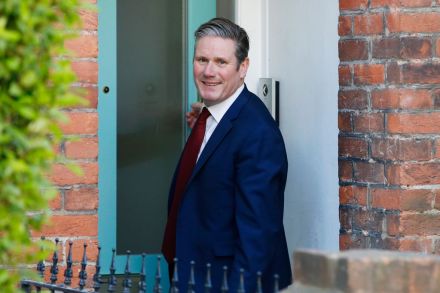
After promising to work constructively with the government to tackle coronavirus, Keir Starmer has this morning gone on the offensive. The Labour leader has written to the de facto deputy Dominic Raab calling on him to publish the outline of the government's exit strategy. Ministers have repeatedly refused to discuss any easing of the lockdown publicly on the grounds that it is counter-productive to do so until the death rate has begun to fall. Starmer disagrees – and says the public deserves to know the 'principles and approach' driving the work going on behind the scenes on the exit strategy while also citing the long term effect of school closures on inequality in the UK.  Starmer has so far succeeded in winning criticism from all sides for his intervention.

Rishi Sunak tries to calm coronavirus crunch fears

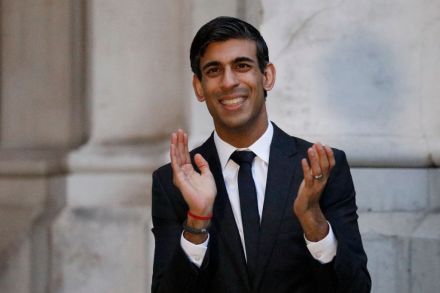
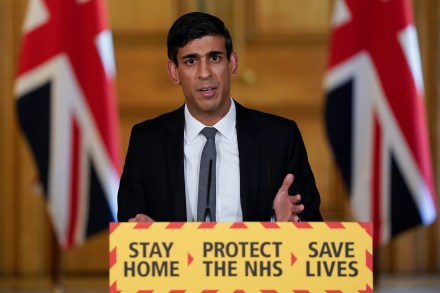
Following Tuesday's bleak headlines over the effect the coronavirus lockdown could have on the economy, the Chancellor attempted to strike an optimistic note in the daily government press conference. With the OBR projection suggesting three months of lockdown followed by a partial easing could lead to the UK economy shrinking by 35 per cent, Sunak said that while the prediction was worrying the figures were in some ways unsurprising as these are unprecedented times. However, the Chancellor stressed that it was simply 'a possible scenario' and it 'may not even be the most likely'.  Sunak said the important takeaway is that the economy would likely 'bounce back quickly' once measures are lifted.

Is the UK on track to be Europe’s worst hit country?

18 min listen

On the Andrew Marr Show today, Sir Jeremy Farrar, a senior scientific advisor on the government's scientific advisory group Sage, warned that the UK is on track to become one of the worst hit countries in Europe by coronavirus. So has the British government been too slow in its response?

Boris Johnson leaves hospital – and heads to Chequers to recover

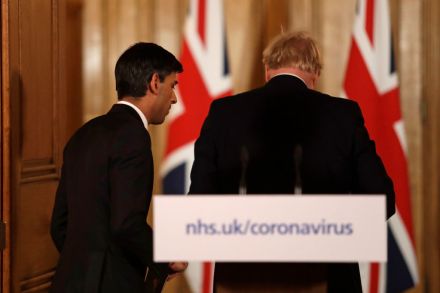
Boris Johnson has been discharged from hospital. After being moved out of intensive care on Thursday, the Prime Minister is now well enough to leave hospital to begin his recovery at Chequers. A No. 10 spokesman said: The PM has been discharged from hospital to continue his recovery, at Chequers. On the advice of his medical team, the PM will not be immediately returning to work. He wishes to thank everybody at St Thomas’ for the brilliant care he has received. All of his thoughts are with those affected by this illness. On the release of the news, Johnson's fiance Carrie Symonds took to social media to thank NHS staff. She said 'there were times last week that were very dark indeed'.

The human cost of the coronavirus lockdown

16 min listen

The government is trying to find out the human cost of the coronavirus lockdown, with one model seen by ministers estimating 150,000 'avoidable deaths'. So could the cure to the pandemic be worse than the disease itself?

Controlling lives, controlling money: how to tackle financial abuse

34 min listen

Domestic abuse services are braced for an avalanche of new cases as a result of social distancing. Of these cases, not all have or will be physically violent - instead, Women's Aid reports a significant proportion of cases in which access to money was used as a form of control. In the government's Domestic Abuse Bill, economic abuse will be for the first time recognised as a form of coercive control. So how can it be identified, and how can the women and men who are its victims be helped? Katy Balls speaks to Jess Phillips, Labour MP and domestic abuse campaigner; Olivia Robey, a safeguarding and vulnerability advisor and former SpAd at the Home Office; and Fiona Cannon OBE, Responsible Business, Sustainability and Inclusion Director at Lloyds Banking Group.

The unknown factor that will help decide when the lockdown ends

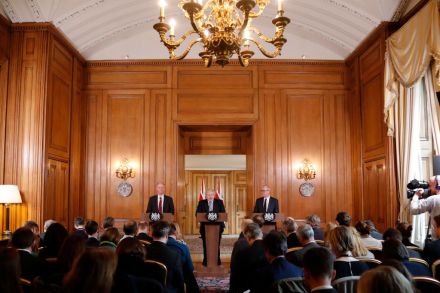
Dominic Raab used the daily coronavirus press conference to confirm that the nationwide lockdown is unlikely to be lifted anytime soon. The First Secretary of State said that 'the measures will have to stay in place until we clearly have the evidence that we have moved beyond the peak'.  As for when we should start to see the number of fatalities fall, the chief scientific officer Patrick Vallance said that this could be around two weeks after the peak of Intensive Care Unit admissions. Given that no one thinks we have yet reached that point, there is some way to go. As for what happens after, the most sobering point of the conference came from Vallance when he was asked about the overall rate of infection.

Boris Johnson moved out of intensive care

The Prime Minister was moved out of intensive care on Thursday evening but remains in hospital. After being moved on Monday night to an ICU where he received oxygen treatment, Boris Johnson's health has slowly improved in recent days. Now, in the clearest sign he is on the road to recovery, Johnson no longer requires a bed in intensive care. A No. 10 spokesman said: The Prime Minister has been moved this evening from intensive care back to the ward, where he will receive close monitoring during the early phase of his recovery. He is in extremely good spirits. This is not to say that Johnson should be expected to return to work imminently.