Judith Flanders

The master and the loyal retainer

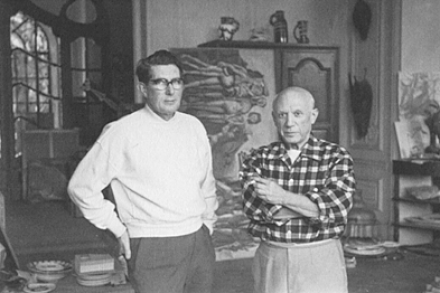
Listing page content here It was not easy to be an attendant at the court of King Pablo, for Picasso, ‘with his fringe of white hair round the back of his head, his never tiring black eyes, his red shirt, is always the centre of everyone’s thoughts, especially as everyone else’s movements depend on his and no one, not even he, knows what it will be’. It was no easier to be King Pablo: P. wanting everyone to enjoy themselves started making masks with the tablecloths and most of the guests put them on, but some began to smuggle them under the table as valuable souvenirs. P., seeing this, looked around with an angry face and, collecting all the masks, crumpled them up and threw them into the sea.
The Goddams and the snail-eaters

A French journalist writing in 1999 was succinct: ‘The English hate the French. Who reciprocate … A purée of prejudice on a bed of inherited loathing. The French consider the English to be arrogant islanders, eating boiled lamb with mint, and not knowing how to be seductive. The English consider us talkative, arrogant, dirty, smelling of sweat and garlic, flighty, cheating and corrupt.’ ‘Inherited’ may be the most telling word in that outburst, and it is Robert and Isabelle Tombs’ keynote in this magisterial study of the on-going love-hate relationship between the British and the French over three centuries.

Lust for life

I must declare an interest. At my solitary meeting with Maggi Hambling, she suddenly barked, ‘Would you like to see my hysterectomy scar?’ (She was dissuaded by the rather nervous men present.) I had been ‘Maggi-ed’: hit with a piece of confrontational behaviour, simply to see what the response would be. Andrew Lambirth had a similar introduction: he first saw her as, fishnet stockings waving in the air, she performed at a cabaret for a friend’s birthday; she then announced he must be gay because the friend who introduced them was. Despite the terrible drawback of being hetero, he was permitted to stick with her, recording conversations over the next two decades, which now make up the text of the book that summarises her career to date.

Dogged does it

William Boyd has written a dozen novels and short stories in the past quarter-century. That makes him a fairly prolific author. Factor in a dozen screenplays realised (and another couple of dozen that were never made, for the usual inscrutable film-world reasons), and he seems properly Stakhanovite. But take a deep breath, because Boyd estimates that in his moments of leisure he has also written three-quarters of a million words or so of journalism. Given this, it is rather startling to find, in the first 20 pages of this selection of essays and reviews, three references to his ‘laziness’ at school. Less surprising is to find that what it is he admires, as an adult, is doggedness (a favourite term), determination.

New technology, component costs and product placement

The fashion for novelty is scarcely, well, novel. In the 18th century Dr Johnson warned that the frenzy for the new had reached such a pitch that men would even look to ‘be hanged in a new way’. New fashions, new fabrics, new furniture, new decorations and ornaments, all cascaded out of workshops and factories. Adam Smith, in The Wealth of Nations, his 1776 summation of the new theory of supply and demand, talked about the ‘universal opulence which extends itself to the lowest ranks of the people’. And leading the way in supplying the voraciously consuming masses for the previous two decades was Josiah Wedgwood, ‘Potter to Her Majesty’ as he proudly styled himself.

The play’s the thing | 21 August 2004

‘His name is protean. He begets doubles at every corner … On the wet morning of 27 November 1582, he is Shaxpere and [his prospective wife] is a Wately of Temple Grafton. A couple of days later he is Shagsper and she is a Hathaway of Stratford-on-Avon. Who is he? William X, cunningly composed of two left arms and a mask. Who else? The person who said (not for the first time) that the glory of God is to hide a thing, and the glory of man is to find it.’ Thus Nabokov on the mystery of Shakespeare. The mystery is not that we don’t know much about the man from Stratford, although the facts are barely enough to fill two or three typed pages. The mystery is that, from mediaeval times onwards, there is not any other author about whom such doubts of attribution cling.

Dark deeds on the District Line

In 1863, the London underworld was revolutionised — not the crime statistics, but the literal underworld, when the first underground railway opened, with trains running, unimaginably, beneath the surface of the earth. This was, as the Times had pointed out when plans were first mooted, as silly as thinking of machines that could fly through the air, or of battles that could be fought in the sky, or trains running in tunnels under the Channel.

An innocent at large in dystopia

Turgenev wrote, ‘Whatever a man prays for, he prays for a miracle. Every prayer reduces itself to this: “Great God, grant that twice two be not four.”’ Pete Dexter starts from the other end. His characters know that, whatever they pray for, twice two will always be four — and it will always be held against them, and they will have to pay for it. It is 1953. Train is a black teenager who caddies at a white golf club, an inspired innocent who carries grass seed back to the ghetto to grow a lawn, who feeds a literally lame duck he names Marliss. Miller Packard is a police sergeant who discovers in Train the most naturally gifted golfer he has ever seen.

Beta plus and beta minus

Say ‘Rossetti’ to most people, and you will get back ‘Dante Gabriel’, or ‘Christina’, or perhaps a description of paintings of exotically beflowered, heavy-jawed women. It is impossible to imagine that anyone will respond with, ‘Of course, William Michael’, much less ‘Lucy Madox’. Angela Thirlwell, in her passionately argued double biography, wants to bring Dante Gabriel’s little brother and his wife out of the wings and into the spotlight. William Michael Rossetti’s main claim to fame was as aid and support to both his feckless, ultimately chloral-sodden brother and his retiring, home-loving sister.

I was a camera

Julia Margaret Cameron is hip. This would not have astonished her - she had every confidence in her vision as a photographer - but for many decades she has been regarded merely as the female face of the male act, someone who created pretty-pretty photographs of allegorical or religious scenes, with the odd Great Man thrown in as a make-weight. This may be changing. A Cameron exhibition opens at the National Portrait Gallery this week which will give an opportunity to reassess the work; with From Life Victoria Olsen gives a look at the life. The life was, in many ways, separate from the art. Cameron worked on photography intensively from 1864 to 1875. She lived, however, from 1815 to 1879, and From Life does not scant on the other 54 years.