Jonathan Jones

Papandreou to go, but uncertainty remains

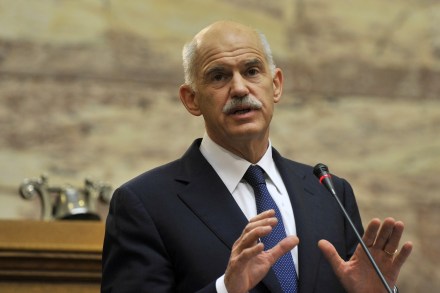
The eyes of Europe, which have been focused on Greece all week, will see a slightly brighter picture today – albeit one still engulfed in heavy fog. The good news: a new coalition government will be formed – the government of "national unity" that EU leaders wanted – to approve the bailout package ahead of new elections. Prime Minister George Papandreou will step down, following his aborted call for a referendum on the bailout terms last week. His future had been a major part of the uncertainty surrounding Greece: reports of his resigntion on both Thursday and Friday turned out to be premature, if only by a matter of days.

From the archives: A nuclear Iran

This week there were rumblings that war with Iran may be closer than most people thought. In a piece for the Spectator in 2004, Andrew Gilligan argued that even with a nuclear bomb, Iran would not be a threat to us: The case for not attacking Iran, Andrew Gilligan, 27 November 2004 Do the last few days remind you of anything, by any chance? Presidential heavy breathing about a ‘rogue’ Middle Eastern state; a supporting chorus of exiles with dramatic new claims; and a senior member of the US government bearing intelligence which turns out to be more spin than spine-chilling. Less than a month after the presidential election, the Bush White House has begun its campaign against Iran.

Were the police hacking phones too?

"As an American who spent many years in this underground industry, I can tell you that the British phone hacking scandal has exposed only a tiny part of a vast criminal network." So Frank Ahearn wrote in The Spectator a few weeks ago: he spent his life as a "skip-tracer" (as they're called in America), dealing in the black market for information. There are many clients, he says, and journalists are just one part of it. The people he worked for included husbands investigating wives, insurance companies trying to expose dodgy claims and – yes – even the police, using "skip-tracers" to solve cases. Finally, this aspect of the British hacking industry is beginning to be made public.

Papandreou stays… for now

Confusion has reigned today in Athens, clouding the first day of the G20 summit in Cannes. Reports at midday that the Greek Prime Minister was to resign turned out to be false. Papandreou's staying put, for now at least. Instead, it seems there will be no referendum on Greece's bailout package. In a sharp reversal, Papandreou reportedly told his Cabinet: "The referendum was never an end in itself. We had a dilemma – either true assent or a referendum. I said yesterday, if the assent were there, we would not need a referendum." It seems he may have gained that assent, in that the opposition New Democracy party will support the deal. But they are still calling for Papandreou's resignation and for elections to be held in six weeks' time.

A collision course with Iran?

Are we on the verge of war with Iran? The Guardian's frontpage today suggests we might well be. Here's a taster of the article: "Britain's armed forces are stepping up their contingency planning for potential military action against Iran amid mounting concern about Tehran's nuclear enrichment programme, the Guardian has learned. The Ministry of Defence believes the US may decide to fast-forward plans for targeted missile strikes at some key Iranian facilities. British officials say that if Washington presses ahead it will seek, and receive, UK military help for any mission, despite some deep reservations within the coalition government.

BREAKING: Greek PM Papandreou offers his resignation

The BBC reports that Papandreou will resign today and ask the Greek president to approve a new coalition government, with former ECB vice president Lucas Papademos likely to take over as Prime Minister. Opposition leader Antonis Samaras has said: "I'm asking for the formation of a temporary, transitional government with an exclusive mandate to immediately hold elections. And the ratification of the bailout deal from the current parliament." This is now the main question: will Papandreou's replacement approve the bailout before new elections are held? UPDATE: It now seems Papandreou might not be resigning after all.

The Gingrich revival

Just a few months ago, Newt Gingrich's presidential campaign looked like it was in its death throes. His poll ratings were in free fall after his criticism of fellow Republican Paul Ryan's plan to reform Medicare as "right-wing social engineering", and his top staff had quit en masse. But somehow, Gingrich has managed to gradually rebuild his campaign and rehabilitate himself in the eyes of Republican voters. The chart below shows how Republican's views of Gingrich have changed over the course of the campaign. You can clearly see his ratings sliding in May-June, but then recovering slowly since July.

Cain accused

We've been following Herman Cain since the start of the Republican nomination race, and seen him rise to prominence in the process. But now there's an extra obstacle between him and a shot at the presidency — and it could be a biggie. Politico reports that at least two women accused Cain of sexual harassment when he was CEO of the National Restaurant Association in the 90s: "The women complained of sexually suggestive behavior by Cain that made them angry and uncomfortable, the sources said, and they signed agreements with the restaurant group that gave them financial payouts to leave the association. The agreements also included language that bars the women from talking about their departures.

All aboard the Herman Cain train

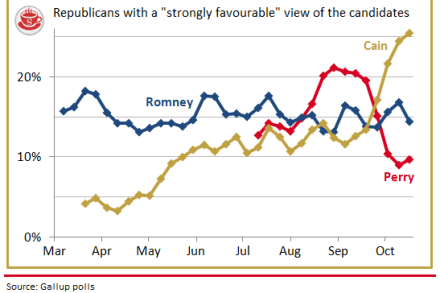
https://www.youtube.com/watch?v=MOFB-2yJzCY Herman Cain – the former CEO of Godfather's pizza – has gone from virtual unknown to frontrunner in a matter of months. In both of the national polls realeased this week, he leads Mitt Romney by four points. Gallup's favourability ratings are a good way of tracking the popularity of the candidates. The chart below provides a pretty good illustration of the race so far. It shows Perry's quick rise when he entered the race in August, and his even quicker fall following his first debates in September. You can also see Cain's gradual rise after that strong debate performance in May, and his much steeper rise in the past month.

The American Milibands

If you thought the Labour leadership election last year was tough on the Milbands' mother, spare a thought for the Krumnow family of Elmore, Ohio. Brothers Lowell and James are engaged in what could be an even bigger electoral contest. They're fighting not over the leadership of the Labour party, but instead to be mayor of a 1,500-strong town. And, as with the David-Ed battle, this campaign hasn't taken a particularly fraternal course. 54-year-old Lowell — the incumbent mayor — has taken a swipe at his older brother's record on the council: "He has probably missed more meetings in the two years he's been a councilmember than I have missed in 20 years.

Labour aren’t capitalising on the government’s woes

Ipsos MORI's latest monthly political monitor is just out, and it doesn't bring much good news for either the government or the opposition. 63 per cent of respondents are dissatisfied with the government and 54 dissatisfied with David Cameron — both the highest proportions since the election. On the public's number one issue — the economy — just 36 per cent say the government's done a good job. And even wose, a whopping 77 per cent say they've done a bad job of keeping unemployment down — hardly surprising considering unemployment has risen by 100,000 since the election. But while all this presents a great opportunity for Labour, other numbers show how bad a job they're doing at taking advantage of it.

Has the EU debacle hurt Cameron?

Leaving aside Cameron's relationship with his own backbenchers for now, how has yesterday's vote affected the public's view of him? The first proper hint comes from today's YouGov poll (conducted on Sunday and yesterday), which asks respondents to rate the qualities of each of the party leaders. Among the public as a whole, there is no significant change in views of the Prime Minister since last month. But there is a change in what Conservatives think of him, and not in the direction Cameron would like. Now just 40 per cent of Tory voters think Cameron is honest, down from 53 per cent last a month ago. And a mere 19 per cent say he's "in touch with the concerns of ordinary people," down from 31 per cent.

Gaddafi’s death boosts support for Libya intervention

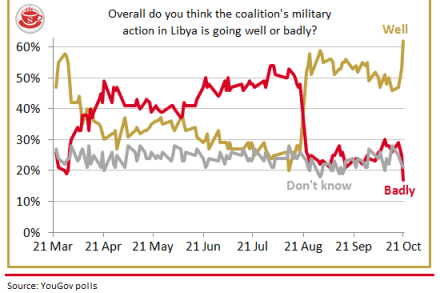
In August, I showed that the rebels' success in toppling Gaddafi's regime had boosted British support for the intervention in Libya – and David Cameron's handling of it. Unsurprisingly, this week's news appears to have done the same. Even though Gaddafi's death was not an explicit goal of the intervention, it seems to have been many people's definition of success. 62 per cent now say the military action is "going well", up sharply from 46 per cent last week: As a result, 45 per cent now support the decision to take military action, while only 31 per cent think it was wrong – the lowest opposition since the start of the conflict. And there can no be no doubt that Libya is seen as a personal success for David Cameron.

Cameron’s strategy is better than it looks

The number of Tory MPs set to defy the government in the vote on an EU referndum tomorrow now stands at around 90, and numerous backbenchers – including John Redwood and David Davis – have called on the Prime Minister to drop the three-line whip. Even though he is certain to win the vote, many are already accusing Cameron of "blundering" and mismanaging this affair. But others are now suggesting that Cameron is in fact displaying a great deal of political nous by taking on the hardline Eurosceptics in his party.

The Spending Review, one year on

It's been a year since the Coalition's Comprehensive Spending Review, but the public is in no mood to celebrate its anniversary. As the economy has failed to recover – GDP was no higher in June this year than at the time of the Review – sentiment has turned against the government. The latest YouGov polling shows that just one-in-three think the government is handling the economy well, against 58 per cent who say "badly". At the time of the Spending Review, the public was split evenly on this question. Similarly, just 33 per cent think the government's spending cuts are good for the economy, while half say they're bad. But people do think the cuts are necessary – by a two-to-one margin.

Republicans go all in in Vegas

Up till now the debates between the Republican presidential candidates have not thrown up much excitement. That changed last night as the main contenders stopped playing nice and started going after each other. The most notable exchange came when Rick Perry accused Mitt Romney of hiring illegal immigrants. This caused Romney to lose his usual above-it-all cool: This exchange will not have done Romney any favours, but he compensated with other strong moments and so retains the "favourite" label. What has changed, though, is the tone of the primaries: it's going to be a more aggressive campaign as we close in on the first primaries.

Labour failing to regain economic credibility

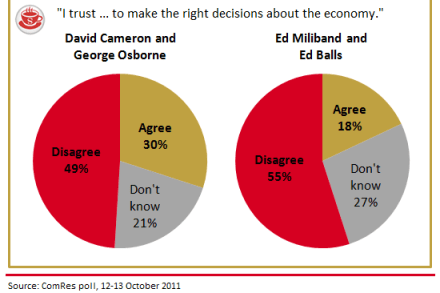
Labour may have a narrow leads in the polls, but they continue to lag behind the Tories on the public's number one issue: the economy. Today's ComRes poll finds that just 18 per cent trust Eds Miliband and Balls "to make the right decisions about the economy", compared to 30 per cent for Cameron and Osborne. Worse, the two Eds don't even have the confidence of the majority of Labour voters: only 48 per cent trust them on the economy. YouGov also find Labour behind when it comes to the economy. 30 per cent think the Conservatives would handle it best, while just 26 per cent think Labour would. And that's despite the fact that 58 per cent of the public think the Coalition is managing the economy badly.

Fox resigns, Cameron responds

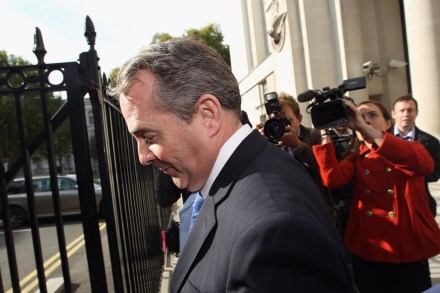
Liam Fox has just resigned as Defence Secretary. Here is his resignation letter to the Prime Minister in full: Dear David, As you know, I have always placed a great deal of importance on accountability and responsibility. As I said in the House of Commons on Monday, I mistakenly allowed the distinction between my personal interest and my Government activities to become blurred. The consequences of this have become clearer in recent days. I am very sorry for this. I have also repeatedly said that the national interest must always come before personal interest. I now have to hold myself to my own standard.

The centre ground’s there for the taking

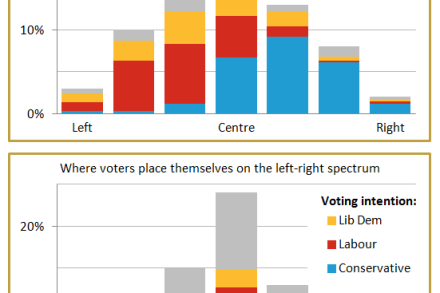
YouGov recently repeated its occassional exercise of asking people where they'd place themselves, the parties and the leaders on the left-right spectrum. Anthony Wells reported some of the findings on Saturday: Cameron is seen as slightly less right-wing than his party, while both the Tories and Labour appear to have moved away from the centre-ground since the election. One thing these YouGov numbers allow us to do is see where on the spectrum the parties get their support from. First, how people voted in 2010 and then how they say they'd vote now: This looks broadly as you'd expect, with Labour dominating among left-wing voters and the Tories doing likewise on the right.