James Forsyth

James Forsyth

James Forsyth is former political editor of The Spectator.

A Mail order Budget

I suspect that the government will be quite pleased if this Budget is nothing more than a one day story. There was no headline-or-vote-grabbing initiative in it. Instead Darling chose to raise taxes on the safest of targets, drinkers. Darling must be hoping, though, that by hopping on the Mail’s ban the bag bandwagon, he has guaranteed himself favourable coverage in at least one paper.
Treasury Purple

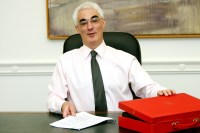
Seeing Darling wearing a purple tie and Yvette Cooper a purple suit, one wonders whether some spin doctor has decided that purple best represents stability in a time of global uncertainty. The Prime Minister, however, is sporting a red tie.

The word of the day: stability

We’re only a few minutes in and Darling has already said stability at least three times. The phrase of the day is ‘global uncertainty’—which Darling and Brown think is their get out of jail free card.

What’s the right response to boredom?

The spin ahead of the Budget is that it is going to be really quite dull, a chance for Darling to remind us of his ability to bore us all into submission. The Treasury keeps stressing that there are no rabbits to be pulled out of hats. Either this is an elaborate double-bluff or we are all going to need to heavily caffeinate ourselves to get through the speech, my money—the £1.79 for a coffee at Pret to be precise—is on the latter. If Darling plays it Boycott straight, it poses a challenge for David Cameron. Most of his backbenchers, and his grassroots, will be looking for a morale boosting, knockabout speech. But if he delivers that, there’s a danger that it allows Darling to contrast his grown-up, sober approach with the flippancy of the Tories.

The Clinton Obama fight turns ugly

Over on Americano, a look back at a particularly vicious set of back and forths between the Clinton and Obama camps and a look forward to tonight’s primary returns in Mississippi. Update: As expected, Obama has won the Mississippi primary.

US CentCom Commander resigns

Admiral William Fallon has resigned as CentCom commander over a magazine profile--that he cooperated with--that pitted him against the White House’s hawkish Iran rhetoric. In a statement, Fallon said: "Recent press reports suggesting a disconnect between my views and the president's policy objectives have become a distraction at a critical time and hamper efforts in the Centcom region. And although I don't believe there have ever been any differences about the objectives of our policy in the Central Command area of responsibility, the simple perception that there is makes it difficult for me to effectively serve America's interests there".

Spitzer’s done

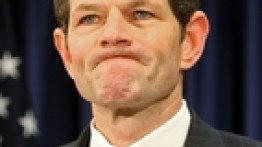
Eliot Spitzer’s political career is over. The New York Governor might not have resigned yet but it is impossible to see how he can recover from the revelation that he was a client of an expensive prostitution service. The problem for Spitzer is not just that he has been caught in a sex scandal but that he has based his political career on his own integrity; without it, he is nothing. Just to compound the problem, what alerted law enforcement to Spitzer’s activities was a series of suspicious financial transactions making it impossible to depict this as a purely private, sexual matter. Spitzer’s fall has been as dramatic as his rise.

A gulf in opinion

A profile of Admiral William Fallon, the head of US Central Command, in Esquire is bound to make waves as it claims that, “well-placed observers now say that it will come as no surprise if Fallon is relieved of his command before his time is up next spring, maybe as early as this summer, in favor of a commander the White House considers to be more pliable. If that were to happen, it may well mean that the president and vice-president intend to take military action against Iran before the end of this year and don't want a commander standing in their way.” The whole piece is slightly breathless and has Fallon as the one good man standing between the neo-cons and their crazy plans.

You’d be mad to miss it

If you haven’t seen Mad Men—the drama set in a Madison Avenue advertising agency in 1960—already, I’d thoroughly recommend watching it. (You can catch up on the first episode here.) It is the best drama that there has been on TV in quite a while.  As James Delingpole says in the magazine this week, it is "utterly brilliant." It does, though, beg the question of why all the best TV these days seems to be American—quite a turn around from a few years back, when British shows were the best thing on American TV and the worst things on our screens had been shipped in from across the pond. Now, we export pappy, reality TV formats and import high-quality American drama. I wonder what accounts for this shift?

Darling wins one

Over at Boulton and Co, Jonathan Levy reports that Alistair Darling has successfully faced down Gordon Brown over who should lead an inquiry into the economic effects of climate change. Darling wanted Adair Turner but Brown is still unhappy with Turner over his pension reform report which was too free thinking for Brown's tastes. However, the puppet Chancellor has stood his ground and Turner will reportedly be announced as the head of this review later today. All this acts as further proof of Iain Martin’s thesis that after his nightmare start and the briefing against him, Darling is now determined to fight his corner.

And the lion shall lie down with the lamb

The most surprising piece of news in the papers this morning is that Gordon Brown is sounding Peter Mandelson out about whether he would like to serve a second term as Britain’s European Commissioner. It is, as The Times notes, a rather drastic turn around since last March when Mandelson rather tartly declared: “I don’t know whether this is going to come as a disappointment to him, but he can’t actually fire me. So like it or not, I’m afraid he will have to accept me as commissioner until November 2009. But I will not be seeking a nomination for a further term.” It appears that the great Mandelson Brown feud is coming to an end. A Brussels source tells The Guardian, "There has been a fairly major shift in how these people interact. It is much warmer.

Political progress in Iraq

The latest State of Iraq update from the Brookings Institution in The New York Times confirms the security success of the surge—there have been fewer civilian deaths in Iraq this past February than in any since the war started. Now, the argument moves to whether Iraqi politicians are capable of taking advantage of the space created by the surge. It is clear that national reconciliation in Iraq remains a considerable way off. But it would be wrong to dismiss the definite signs of progress we have seen on this front recently. As the report notes, “The most intriguing area of late is the sphere of politics.

Talking the talk while walking the walk

David Cameron’s piece in The Sunday Telegraph this morning is a neat example of how he tries to position himself politically. On the one hand, the article is about what could be considered a classically right-wing cause: getting those on incapacity benefit who, physically, can work off the welfare roll and into paying employment. But rather than concentrating on the tough side of this message—for instance, the Tory’s plans for independent medical check for all incapacity benefit claimants—Cameron focuses on the children, worrying about the “half a million children who are dependent on their parents' incapacity benefit.

Can Cable turn the Lib Dems into The British Bull Moose Party?

Vince Cable’s speech to the Lib Dem spring conference today showed how fortunate it was for the two main parties that he did not become leader either in 2006 or after Ming Campbell’s departure. He is able to deliver cutting criticism of the two main parties while staking out political positions that appeal to both Labour and Tory voters. The address was littered with Cable’s usual telling jokes. His one on Northern Rock definitely hit home: “During the Northern Rock crisis the boat was drifting listlessly. Captain Brown was hiding in his cabin. And Midshipman Osborne was jumping excitedly in and out of a lifeboat.

God and Blair at Yale

Yale has just announced that Tony Blair will be the Howland distinguished fellow there next academic year: “Mr. Blair will lead a seminar at Yale and participate in a number of events around the campus. The course in which he will participate with Yale faculty will examine issues of faith and globalization. His efforts at Yale relate to the work of the Tony Blair Faith Foundation that he will be launching later this year.” Now that he is out of office, Blair clearly does do God.

Publish and be done

Venetia Thompson’s account of what it was like to be a posh bird in on the trading floor revealed just how old-fashioned this part of the City still is with people turning up to work still drunk, some very un-pc language being thrown around and a woman standing out like a sore thumb. The article made quite a splash and Venentia’s City days have now come to a close.  Which leaves us wondering, what other industries Coffee Housers think might be in need of having a little light shined upon them? Let us know in the comments.

Did Clegg pick the least worst option?

Nick Robinson has a good post up at the BBC explaining why Nick Clegg got himself into such a mess on the Lisbon Treaty. The whole thing is well worth reading but here’s the most important section: “So why did he order his MPs to sit on their hands, to vote neither yes nor no in this week’s referendum vote in the Commons? That is the question being asked not least by those heading today to the Lib Dem spring conference in Liverpool. The answer is that he feared something much worse. Given a free vote, a vast majority of his MPs – some suggest as many as 50 - would have voted with the Tories to try and force a referendum on the Lisbon Treaty and to defeat the government. The problem is that a number of key figures would have refused to join them.

 Calamity Clegg

Matthew Norman has a very funny column in The Independent today on the damage that Nick Clegg has done to himself and the Liberal Democrats with his appalling handling of the Lisbon treaty vote. As Norman asks, “What must Lib Dem MPs be making of the contrast between his punchy, basso profundo leadership style and the pubescent squealings of Mr Clegg? Much as we all enjoy wacky bids for inclusion in the Guinness World Records book, they can hardly ditch yet another leader before he has even completed that mythical first 100 days. Even so, you needn't hijack that new machine which reads human thoughts from brain patterns to see what is on their minds.” The latest Mori Political Monitor shows that the Lib Dems are still becalmed at 16 percent in the polls.