James Forsyth

James Forsyth

James Forsyth is former political editor of The Spectator.

Official: Iran told HMG it was killing British troops in Iraq

Tucked away in today’s papers is a very important story, a statement on the record by Sir John Sawers, formerly political director at the Foreign Office now Britain’s ambassador to the UN, about a deal the Iranians offered: "The Iranians wanted to be able to strike a deal whereby they stopped killing our forces in Iraq in return for them being allowed to carry on with their nuclear programme: 'We stop killing you in Iraq, stop undermining the political process there, you allow us to carry on with our nuclear programme without let or hindrance'." It has long been known that the Iranians are responsible for the deaths of British forces in Iraq.
British politicians must start talking about Iran

The news that Iran now has enough enriched uranium for a nuclear bomb is a reminder that at some point soon—maybe even before the next election—the moment of decision on Iran will be reached. But listening to the British public debate you’d be blissfully unaware of this. When was the last time you heard Brown, Cameron, Miliband or Hague give a speech on Iran which went beyond the usual platitudes? It’s obvious why our politicians are so reluctant to talk about Iran: there are no votes in it and, realistically, no good options. But Iran going nuclear would be a transformative event.

Brown still believes

Peter Oborne’s column this morning contains this telling anecdote: “Amidst all this shambles, it is only the Prime Minister who keeps faith in his policies. I am told that, at a recent Cabinet meeting, he earnestly told his senior colleagues that it was still possible to win the election, and the main problem was that the Government found it hard to get its message across. As the Prime Minister spoke, Cabinet ministers rolled their eyes and cast despairing glances at each other.” One of the key dynamics in British politics right now is that Brown thinks he can still win the next election even if many of the Cabinet do not.

Politics | 21 February 2009

James Forsyth reviews the week in politics The worst thing about this week for Gordon Brown is that no one has bothered to dub it his worst week ever. Normally, a few days which saw a Prime Minister receive the succession of blows that Brown has suffered since Saturday would lead to forests being chopped down and extra barrels of newsprint being ordered in.

Get ready for the return of shadow cabinet elections

One of the fun things about Labour’s return to opposition will be the return of shadow cabinet elections. Tony Blair never managed to change the fact that the Parliamentary Labour Party elects the shadow cabinet. This is going to cause some mighty ruckuses and put some rather odd people in Labour’s top team. Just imagine if David Cameron’s choice of shadow cabinet members was dictated by the Parliamentary Party. The rules are that Labour MPs get to vote for 19 members of the shadow cabinet, at least four of their votes have to be for female candidates. The results are then published with the candidates ranked in order of popularity, something that always creates a good story — Gordon Brown came a lowly 13th in the last set in 1996.

The British Foreign Secretary gets stood up

Jason Cowley’s profile of David Miliband in the New Statesman is an engaging read. But one line in it stood out to me: “we waited for a group of Indian politicians to arrive for dinner (in fact, only two of the expected nine turned up)” How did it come to this, a British Foreign Secretary, and we are after all a permanent member of the UN Security Council and the fifth largest economy in the world, is not considered worth turning up to dinner with? This is more worrying than anything else that I’ve heard about Miliband’s (disastrous) India trip. It suggests a decline into irrelevance. PS I’ve put in a call to the Foreign Office to see if they can shed any light on why so many guests didn’t show, I’ll update when I hear back.

Is the Yvette Cooper for leader rumour really a kick at Balls?

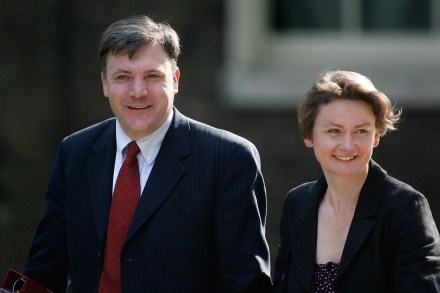
The Evening Standard’s scoop that Yvette Cooper is being urged to stand as a ‘stop Harman’ candidate has sent the Westminster bush telegraph into overdrive. The speed with which the Cooper story is spreading is proof that we have now entered the stage of Labour party’s decline where no rumour is too far-fetched to be dismissed. Although, it is only fair to point out that the makeover and media training Cooper has had have worked; she has gone from being one of the worst frontline Labour performers to one of the best. Her intellect—if not her judgement—should also not be in doubt. Treasury civil servants say she has a far better grasp of the economy and the current situation than the Chancellor. But I suspect that there might be foul play at work here.

Scrapaccino

Peter Mandelson’s outburst about the chairman of Starbucks is set to go down in political folklore as the bookend to the mushy peas guacamole tale. (Before I’m corrected, I know it wasn’t actually Mandelson who said it, but that is the legend and, as they say, print the legend). The spiritual leader of New Labour attacking the head of the company that brought lattes and cappuccinos to middle Britain feels like the end of an era. But to be serious, it is interesting that Mandelson got so riled by what the foam man said. I suspect that Jane Merrick is right in her analysis: “the strength of his words in the outburst - he is not exactly renowned for using the f-word - could be because Schultz's remarks are on the money. Consumer confidence is collapsing.

The Obama administration must pursue a unified Iran policy 

The greatest foreign policy challenge the Obama administration faces is Iran. The problem posed by Iran is compounded by the sheer number of ways in which Iran is a problem for the US. First and foremost, there is Iran’s nuclear programme. But then there is also Iran’s support for Shiite extremists in Iraq, its role as the major backer of the rejectionists of Hamas and Hezbollah and its desire to make life even more difficult for the US in Afghanistan. This makes policy coordination essential, it is no use the US pursuing one policy in one area only to undercut it elsewhere.

America rules the skies

Mark Bowden’s piece in The Atlantic on American air superiority and the danger of it waning is well worth reading. It is quite remarkable that no American solider has been killed by an enemy air attack since 1953. But the statistic that really grabbed my attention was this one: “The F‑15, the backbone of America’s air power for more than a quarter century, may just be the most successful weapon in history. It is certainly the most successful fighter jet. In combat, its kill ratio over more than 30 years is 107 to zero. Zero. In three decades of flying, no F‑15 has ever been shot down by an enemy plane—and that includes F‑15s flown by air forces other than America’s.

Watford can’t live up to these expectations

One of the key parts of political spin is expectations’ management. But Labour seems to have completely forgotten this when it comes to the G20 summit. The way Labour is talking it up, it if it doesn’t end with Obama chairing Gordon Brown on his shoulders through the streets London while proclaiming that Brown has saved the world it will be a bit of an anti-climax. In reality, the summit probably will give Brown a bit of a boost. It will allow him to play the statesman on the world stage and associating with Obama can’t hurt. (Although the idea of a joint Brown-Obama Wembley rally, which reportedly made it to the memo stage, is an idea that is as crass as it is desperate.

Brown misses out on first Oval Office visit

Hillary Clinton, on her tour of Asia, has announced that the Japanese PM will be the first foreign leader to be received by President Obama at the White House. Prime Minister Aso will visit Washington next week. This still leaves the race to be the first European leader to visit Obama open. But Gordon is not favoured to win that one either. PS Prime Minister Aso is, in some ways, in an even worse state than Gordon Brown. His approval rating is below 10 percent and his finance minister has had to resign after appearing tired and emotional at the G7 Finance Ministers in Rome.

If Obama can’t get Republican votes in Congress, he’ll be forced further left than he wants to–or should–go

Barack Obama likes to portray himself as a post-partisan politician, someone who reaches beyond party. So, it was a blow to him to have to pass the stimulus without a single Republican vote in the House and only three Republican votes in the Senate. His cabinet doesn’t look particularly bi-partisan either. Robert Gates is a hold-over from the Bush administration but he is not even a registered Republican meaning that the only Republican in the Cabinet is the Transportation Secretary Ray La Hood: Bush also chose transportation for the one member of the other party in his Cabinet, Norm Mineta.

You couldn’t make it up: Blair wins a million bucks while Brown struggles desperately on

The contrasting fortunes of Blair and Brown over the last few years are like something out of a childhood morality tale. Impatient Gordon hurries Tony out of office before he wanted to go. The result: Blair escapes the blame for the financial crisis, leaves office with impressive approval ratings and secures a string of impressive international jobs. Also, by getting out before the crunch hits, Blair makes a small fortune on the international speaking circuit and raises enough money to get several charities growing. Meanwhile, Gordon inherits the crown at pretty much the worst possible time and now finds the Labour party almost certain to go down to a massive defeat and those close to him apparently looking for a face-saving exit for him.

Will the downturn break the eurozone?

There has been some speculation that the financial crisis will force Britain to join the euro. But I think it is far more likely that the crisis will break the eurozone. Consider this from the FT’s Wolfgang Münchau, who could hardly be called a euro-sceptic: “The right course would be to solve the underlying problem – to shift at least some of the stimulus spending to EU or eurozone level and, ideally, drop those toxic national schemes altogether and to adopt a joint strategy for the financial sector, at least for the 45 cross-border European banks. But this is not going to happen. It did not happen in October, and it is not going to happen now.

Blair policy-chiefs talking to the Tories

Westminster loves defections; they are tangible sign of the direction in which the wind is blowing. So, David Freud’s decision to move out of Labour’s orbit and to the Conservatives is being treated as big news in the village. Tory Kremlinologists should note that it was George Osborne who reeled him in. This is a sign of both Osborne’s continuing importance to the Cameron project and the fact that Freud will be reporting into the leadership not Theresa May. Paul Waugh blogs that the Tories should now be reaching out to two former heads of Blair’s No 10 policy unit, Geoff Mulgan who is now running the Young Foundation and Matthew Taylor who is at the RSA. But here, the Tories are ahead of the game.

A face-saving exit for Brown?

Few commentators are as well plugged into the Brown circle as Jackie Ashley which makes her column this morning absorbing reading. Ashley floats the idea that Brown might quit after the G20 summit in April to become head of a new international financial regulatory body. Ashley admits that the story sounds implausible but she says that “it comes from quite close to the inner core.” Leaving aside the fact that putting Brown in charge of this body would be rather like putting the head of the West Indies Cricket Board in charge of all pitch preparation for international cricket, it seems highly implausible that Brown, who has waited so long for the chance to be PM, would leave voluntarily. But Ashley writes that the argument goes like this, “he isn't stupid.

The next American geography

Richard Florida’s Atlantic cover-story on how the current recession will re-shape America is a thought-provoking read. He argues that the coming economy requires a different kind of geography: “the economy is different now. It no longer revolves around simply making and moving things. Instead, it depends on generating and transporting ideas. The places that thrive today are those with the highest velocity of ideas, the highest density of talented and creative people, the highest rate of metabolism. Velocity and density are not words that many people use when describing the suburbs. The economy is driven by key urban areas; a different geography is required ...

Moore pain for Brown

There are few things the press likes more than a whistleblower, they make for great copy. So, Gordon Brown will be alarmed to see Paul Moore, the HBOS whistleblower, appearing in The Independent on Sunday. ‘Paul Moore, the former head of risk at HBOS, told the IoS that he has more than 30 potentially incendiary documents which he will send to MPs on the Treasury Select Committee. He says they disprove Mr Brown's claim about the reasons for HBOS's catastrophic losses – now estimated to be nearly £11bn – and show that it was the reckless lending culture, easy credit and failed regulation of the Brown years that led directly to the implosion of British banks.