James Forsyth

James Forsyth

James Forsyth is former political editor of The Spectator.

The police no longer have the public’s confidence

The British Crime Survey shows that most people do not have confidence in the ability of the police and their local council to tackle crime and anti-social behaviour. Only 46 percent of people in England and Wales do, according to the survey. In a way this is not surprising, you see the police on the street less than you used to and the police do not seem concerned with many of the crimes that worry the public most. Jacqui Smith, The Daily Mail reports, is now going to scrap all other targets and instead require all police forces to reach a 60 percent level of confidence by 2012. But if public confidence is what the police are to be measured on, why not go the whole hog and make police chiefs accountable to the public at the ballot box?
Clegg can bank on this policy going down well

Nick Clegg returns to the political fray today with an interview with The Times. What’s making news from it is this proposal: On the eve of the Liberal Democrats’ conference in Harrogate, Mr Clegg told The Times that these directors had shown that they were not fit to oversee companies.” This strikes me as very clever politics. There is a phenomenal amount of anger, much of it justified, at the fallen masters of the universe who seem to have paid no price for their actions. Politicians of all parties have been trying to tap into this but few of their ideas have cut through. Clegg’s proposal is eye-catching enough to do so. It is also that rare combination, just and populist.

Blair did God a lot more and a lot earlier than the press realised

Stan Greenberg, who polled for both Bill Clinton and Tony Blair, spoke at the RSA earlier this week. In his talk, he revealed that during the 1997 campaign Blair had a separate team of faith advisors whose role it was to check that his politics were in line with his religious beliefs:  Here is what Greenberg said, it is 39 minutes in if you want to listen to it for yourself: 'He had a separate religious group that met weekly during the campaign, the’97 campaign, which he met with weekly. He said that he would talk to them and make sure, kinda check he wasn’t going too far in his politics from his religious faith. But none of those people were introduced into the campaign. But that was a separate domain.

There is one group of people who will miss this government

Has there ever been a better Cabinet for headline-writers than the current one? As Prime Minister there is Brown with all the obvious gags. Then, as Chancellor we have A Darling—those headlines pretty much write themselves. The Schools Secretary, who has a tendency to verbiage, is called Balls. The most Machievllian member of the Cabinet who is named Straw and the deputy leader and PC enforcer is a woman called Harman.  It is hard to see how you can't get much better than this from a headline writers' perspective. PS This post is a good excuse to pass on a story from Fraser that is too good to check. Apparently, there was a man who thought he was blind. Then, his long-term girlfriend left him. He cried so much, that somehow, his sight was restored.

What do you make of this Darling?

Ed Balls, who is—remember—Secretary of State for Children, Schools and Families—has just given an interview to Sky News (video after the jump) solely on the economy. (The invaluable Politics Home has quotes from it, here). Obviously, Balls knows a lot about the subject. But it seems odd that it is him who is put up to respond to the shadow Chancellor’s remarks on quantitative easing, when he is now not in an economic brief. Surely, it should have been the Chancellor himself or the Chief Secretary to the Treasury? This kind of thing is just going to fuel the rumours that Darling is being cut out of the loop by Downing Street and that a troika of Balls, Mandelson and Brown is now running economic policy with help from Shriti Vadera.

Would you take this bet?

Paul Krugman, the Nobel prize winning economist, and Greg Mankiw, chair of the Council of Economic Advisors under George W. Bush, are probably the most influential public intellectual economists in America from the left and the right respectively. The two take different-sides on the question of how effective the Obama stimulus will be and Mankiw is now challenging Krugman to put his money where his mouth is: "Team Obama says that real GDP in 2013 will be 15.6 percent above real GDP in 2008. (That number comes from compounding their predicted growth rates for these five years.) So, Paul, are you willing to wager that the economy will meet or exceed this benchmark?

No game-changer

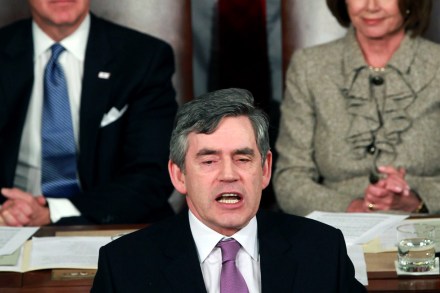
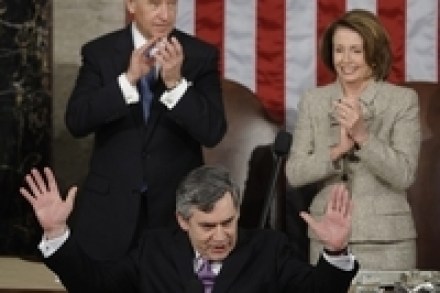
As Gordon Brown heads back to London he can content himself with the fact that his Washington trip has not turned into the disaster is threatened to during the whole not a ‘press conference but a pool-spray’ moment. His speech wasn’t up there with Blair’s 2003 effort, but his knowledge of American politics enabled him to hit most of the right notes and, at the risk of being guilty of the soft bigotry of low expectations, Brown’s delivery was better than usual. Brown must, though, know that the trip has not changed the course of British politics which, from his perspective, it needed to. To use an American sporting metaphor, Brown needed to him a home run with this visit but only succeeded in getting on base.

Brown’s speech to Congress: Live blog

Gordon Brown is about to deliver his speech to a Joint Session of Congress. When Blair addressed one in 2003, he received 19 standing ovations. Brown by having the Queen offer the ailing Teddy Kennedy an honorary knighthood has sweetened the mood and guaranteed him a few standing ovations.  One problem for Brown is that it is harder to hit the rhetorical high notes in a speech that focuses mainly on the economy than in one on foreign policy. Whatever you think of the content, Blair's speech in 2003 was a rhetorical tour de force. In that respect, the bar is set almost impossibly high for Brown. He's also far less of a draw in the US. As one US journalist friend of mine said to me last night, 'Brown's a good second or third story' while Blair was a lead. 4.

Progressive ends, different means

Jenni Russell’s piece in The Guardian today about how the left should support the “progressive wing” of the Tory party has set tongues wagging. Tim Montgomerie has some interesting thoughts on it and attempts to identify “the important ten” who one Tory told Russell form the “progressive wing” of the party. Personally, I must admit to finding that these arguments over the naming of things generate more heat than light. In his Demos speech, David Cameron laid out four things that progressive Conservatism stood for: moving people permanently out of poverty, a society with equality of opportunity, a greener, sustainable planet and a safer society. These goals, though, can be achieved in very different ways; that is where the rubber hits the road.

Hard cases make bad law

The row over Fred Goodwin’s pension reminds me of the debate over the alleged killers of Stephen Lawrence and whether the law of double-jeopardy should be altered to allow them to be prosecuted again for his murder. It is clearly morally wrong that Goodwin should be receiving such massive rewards for failure, a £693,000 annual pension for ruining two great banks. But there’s also little doubt that, thanks to the government not checking the fine print before they signed off on him retiring early, that he is legally entitled to it. It is tempting to rewrite, or bend, the law to redress this wrong as it is (far more intensely because of the gravity of offence) to waive double-jeopardy so that the alleged killers can be prosecuted.

Base politics

Lexington, The Economist’s US political correspondent whose new blog is well wroth checking out, flags up an interesting post from New Majority, the site that is leading efforts to modernise the Republican party: “26% of the electorate is white evangelicals, and 74% of them voted for McCain.  McCain pulled slightly less than 46% of the vote, so about four-in-ten of McCain’s voters were white evangelicals. To put it in perspective, white evangelicals are nearly twice as important to Republicans as African-Americans are for Democrats.  Despite the surge in African-American turnout and the record high percentage Obama received from those voters, blacks comprised only 23% of the winning coalition.

Downing Street grateful for its “useful idiots”

Harriet Harman’s comment on Sunday that Fred Goodwin’s pension arrangements are “not enforceable in the court of public opinion” did suggest, as Alex argues, a belief in the rule of the mob not the rule of law. (It also raised the question of why on earth the government had effectively signed off on them when it bailed out RBS). But I suspect that Downing Street is not that enraged about the remarks even if it won’t support them. As Francis Elliott writes, “From Number 10’s perspective the controversy over Sir Fred Goodwin serves a useful purpose in conducting public anger over the recession away from the Government.

Trouble looming on the Home Affairs front for the Tories

One of the features of the Tory party now is that there is no defining split. But there are plenty of areas of difference. One, as Baeghot notes in his write-up of yesterday’s Convention on Modern Liberty, is on where the balance on civil liberties should be struck. Bagehot reports that: “Mr Grieve was obliged to admit that he wasn’t absolutely sure what "fewer rights, more wrong", a new slogan from Chris Grayling, the latest shadow home secretary, had meant.” Grieve must surely have realised that he was going to be asked about this new line from Grayling given the subject of the conference, so it is surprising that he did not have an answer ready. It is, perhaps, an indicator of future rows to come.

How long will this go on?

The New York Times op-ed page features a string of short articles by various economic and financial figures on when the recession will end. The consensus view is that the American economy will come out of recession late this year. But Roubini and Niall Ferguson offer far more bearish takes. Roubini warns that “We now face a 1 in 3 chance that, if appropriate policies are not put in place, this ugly U-shaped recession may turn into a more virulent L-shaped near-depression or stag-deflation (a deadly combination of economic stagnation and price deflation) like the one Japan experienced in the 1990s after its real estate and equity bubbles burst.” While Ferguson writes “I find it quite easy to imagine two consecutive years of contraction.

Fighting words from Mandelson but is there a strategy behind them?

The Mandelson interview in today's Observer is full of barbs at his internal opponents. Consider this exchange about the leaking of Cabinet discussions about the future of the Post Office: ‘"Unlike some of my colleagues, I don't comment to the press on the internal discussions and workings of the cabinet and its committees." So it was true. And then he was on the phone to Gordon Brown to have Harman put back in her box and everyone dragged into line? "I'm not commenting either way," he twinkles. So that's true as well.’ Mandelson appears absolutely determined not to back down regardless of how much of a split the proposals are causing in the Labour Party.

Britain at its best

Matt in his Sunday Telegraph column sums up perfectly why it was right that PMQs was suspended following Ivan Cameron’s death:  “This was our unwritten constitution at its very best, as the Commons responded with nimble common sense to a practical dilemma presented by a private tragedy. It would have been grotesque to proceed with Prime Minister's Questions only a few hours after the death of young son of the Leader of the Opposition. The properly British solution was not to pore over Erskine May or to fret about setting a precedent, or sliding down a slippery slope. Does anyone seriously believe these extraordinary circumstances are likely to recur? As so often in our institutional history, the right answer was to extemporise judiciously.

Three very different Prime Ministers

Simon Hoggart’s column in The Guardian today has this great little anecdote: “The other day I heard a story about Sir Robin Butler, the cabinet secretary to three prime ministers. At a dinner he was asked their reaction when he said something they disagreed with. Thatcher, he said, simply blew up. John Major would not say anything, but would look hurt. And Tony Blair would - pause for effect - say: "Um, yes, I agree with you.