James Forsyth

James Forsyth

James Forsyth is former political editor of The Spectator.

118 rebels

Today was a day with two significant developments. First, the publication of the detailed coalition agreement. Second, the fact that 118 Conservative MPs have rebelled against David Cameron before his first Queen's speech. The coalition agreement is a document that, I suspect, most Conservatives can get behind. It is not perfect but then no coalition agreement was ever going to be. All of which makes me feel that the 118 is the more significant development of the day. When you consider how many members of the parliamentary party are either on the government payroll or newbies you realise how substantial, in terms of numbers, this rebellion was. The leadership can't dismiss 118 MPs as a swivel-eyed fringe. There is a serious job to be done to rebuild trust.
Cameron’s move is tactically smart but strategically foolish

David Cameron’s move to neuter the 1922 has been pulled off with great tactical skill. He sprung the move on the party and then called an instant ballot, denying any rebellion time to gather strength. But however tactically smart this move might have been I can’t shake the feeling that it is strategically foolish. Tory backbenchers are talking about their leader in a way they never have before. As one senior MP told me, ‘resentment has turned to hate.’ Even those backing the measure expect a quarter of the parliamentary party to vote against it. Once these MPs have rebelled once, even in a secret ballot, they will find it easier to do it again.

The 1922-2010 Committee

In a move of breath-taking audacity, David Cameron has just announced that there will be a ballot of the parliamentary party to establish whether or not members of the government payroll vote will be able to be full voting members of the 1922 Committee. This may seem like a small technical change but it is of massive importance: it would hugely limit the power of Conservative backbenchers to hold the government to account. When the Conservative party has been in government, the 1922 Committee has been the voice of the backbenchers. It is how they have held Conservative ministers and prime ministers to account. Cameron’s move, if successful, would effectively remove that power from them.

Mind the culture gap

Danny Finkelstein’s column this morning is one of the most important things to have been written since the coalition was formed. Danny makes the point that the coalition has no ideas infrastructure in place. There’s nowhere for it to go to get new ideas. Think tanks will rush to fill this void. But as Danny notes, there will also have to be a cultural comfort with the other side. That there isn’t at the moment is demonstrated by the look on Tory MPs’ faces when you debate whether Nick Clegg should be invited to address Tory conference. One of the clever things that the coalition agreement has done is to make the main tax cut of this government a Lib Dem one. It is a reminder to the Tory party that the Lib Dems believe in freedom too.

The coalition should Budget in Labour’s long leadership contest

Labour’s decision to opt for a long leadership contest means that the new leader of the opposition will not be in place when George Osborne presents his emergency Budget on the 22nd of June. This presents the coalition with a significant political opportunity. Harriet Harman is a consistently underrated Commons performer, she came off far better than most people expected she would in her clashes with Hague at PMQs when Brown was absent. But one subject she was not comfortable on was economics.

Jon Cruddas won’t run for Labour leader

The Guardian has just broken the news that Jon Cruddas won’t run for Labour leader. This is a pity. Cruddas is one of the most honest and engaging politicians you could ever hope to find. He was prepared to speak up about immigration and its effects on the working class when most Labour politicians just wanted to ignore the issue. There are also few people in public life keener to debate and explore ideas than Cruddas. In an article in The Guardian, Cruddas says—with characteristic frankness—that he’s not running because being a major party leader requires ‘certain qualities I do not possess’. He does not, however, rule out taking on a senior job.

The gathering storm over the 55 percent plan

There is a massive difference between rebellious talk and actual rebellion. But some of the language surrounding the 55 percent rule has been striking. When I told one senior MP that David Cameron had said on Sunday that he would whip this vote, the MP shot back defiantly, ‘you whip if you want to.’ David Davis’s intervention on the issue on the World at One was particularly significant. Having called the 55 percent rule ‘just a terrible formula for government’ it is hard to see how he can support the measure. It is also hard to imagine that a man who picks his fights so carefully would have marched so far up the hill if he was not confident that he had a critical number of foot soldiers behind him.

Working side by side

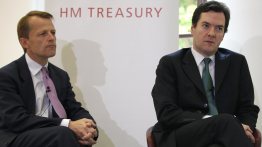
George Osborne and David Laws’ press conference this morning gave some hints about the chances of the coalition making it. The Treasury is where, I suspect, this coalition will succeed or fail. If the two parties can keep it together on how to reduce the deficit and how fast to do it, then I expect that they’ll be able to deal with the other issues that are thrown at them. Encouragingly from this perspective, Osborne and Laws seemed comfortable sharing a platform; there were no attempts to score points off each other. It appeared to be a harmonious double-act. But Osborne didn’t refer as many questions to Laws as he did to Phillip Hammond, his trusted and super-able deputy in opposition, back in the day.

David Miliband sets out the fraternal dividing lines

David Miliband is one of those politicians who speeches improve when you read them on paper, his delivery still distracts more than it adds. If the Labour party is going to pick the Miliband who is the more natural platform speaker then David hasn’t got much of a chance. But if they want the Miliband who is more prepared to think about why Labour really lost then David might well be their man. On Saturday, Ed Miliband talked about how Iraq, a ‘casualness’ about civil liberties and a failure to regulate the banks properly had cost Labour the election. This might be Ed Miliband’s genuine analysis but it is also what Labour members want to hear: Labour lost because it wasn’t Labour enough.

Prime Minister Cameron’s first TV interview

David Cameron’s first broadcast interview from Downing Street contained two significant pieces of news. First, George Osborne will commission an independent audit of the public finances and state spending on Monday. I suspect that this audit will reveal that things are even worse than the official figures suggest. The political purpose of this audit will be to provide cover for the necessary cuts, to show that they are necessary because of Labour’s economic mismanagement. I also expect that the new Office of Budgetary Responsibility will provide a new, more cautious set of economic forecasts. The other piece of news was Cameron confirming that the vote on the 55 percent clause will be whipped.

Labour leadership candidates move towards the Cruddas position on immigration

One striking feature of the Labour leadership contest so far is how a new more honest line on immigration is emerging. At the Fabian Society conference this morning, Ed Miliband declared that ‘immigration is a class issue’. Pointing out that, “If you want to employ a builder it’s good to have people you can take on at lower cost, but if you are a builder it feels like a threat to your livelihood. And we never had an answer for the people who were worried about it." In the Guardian, Ed Balls sounds a similar note. He tells Patrick Wintour and Nick Watt that Labour did not, in the eyes of voters, do enough on immigration.

A contest that sets brother against brother

Ed Miliband was on impressive form at the Fabian Society conference this morning. Early on, he defused the tension over the fact that he was running against his brother with a well-delivered joke about how, given her politics, he his mother would be voting for Jon Cruddas. Throughout he showed a real lightness of touch when addressing the brother against brother question. After today, there can be little doubt that Ed Miliband is running as the candidate of the soft left of the Labour party. He claimed that ‘the state can do extraordinary things’, said that New Labour’s’ ‘combination of free markets plus redistribution’ had reached the end of the road, and argued that the Labour party needs to talk about class more.

Can this marriage of convenience work?

‘It is not the prize. It is a means to the prize.’ This is how one long-time political ally of David Cameron described the Tory leader’s entrance into Downing Street at the head of a coalition government. The deal with the Liberal Democrats which has put Cameron in Downing Street is, as this Cameron ally admits, ‘an arranged marriage not a love match’. In the run-up, the bride’s family was trying to negotiate a better dowry from an alternative suitor, and many in the groom’s family were praying that he would be jilted at the altar. Guests on both sides of the church could be heard whispering that the marriage would never last.

Cameron’s surprise honeymoon 

Before the election, the received wisdom was that the new government would not have much of a honeymoon. The thinking went that the anti-politics mood was so strong and the cuts required so deep, that there’d be no May ’97 style moment. But the coalition has changed all that. One poll shows a 60 percent approval rating for it. The coalition is also getting a positive response from the international commentariat. Most of today’s New York Times op-ed page is given over to praising it. David Brooks says that the coalition might become a ‘model for all the other countries in the same desperate straits.’ Praise in the foreign press might not make much impact on the British electorate, but it will help Cameron’s standing on the world stage.

Two areas where the coalition will be radical

Two junior ministerial appointments today suggest areas where the coalition government intends to be radical. First, Nick Herbert has been made minister for police reform. In opposition, Herbert was key to the elected police commissioners agenda and this appointment suggests that the coalition will follow through on this idea in government. The police establishment will attempt to stop elected police commissioners from happening. It’s crucial that Cameron doesn’t blink when they do. Elected police commissioners will ensure that the police concentrate on the crimes that really worry the public. They will do a huge amount tom reduce fear of crime. The other significant appointment is Greg Clark as minister for decentralisation.

The Tories who missed out on the Cabinet

Downing Street has just blasted out the full list of Cabinet ministers and those ministers entitled to attend Cabinet. The biggest casualty from the old shadow Cabinet is Chris Grayling who goes from being shadow Home Secretary to a minister of state at DWP. Grayling’s demotion has been much predicted in recent weeks. Tellingly, Grayling was the only shadow Cabinet member to argue against offering the Lib Dems a referendum on AV at the shadow Cabinet meeting on Monday. However, I expect he’ll make a good fist of the welfare brief—it is territory he knows well having shadowed DWP in opposition. The next most noticeable Tory absentees are Greg Clark, Nick Herbert and Theresa Villiers.

The coalition passes the easy bit with flying colours

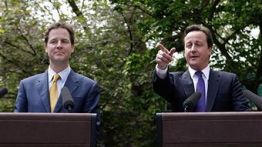
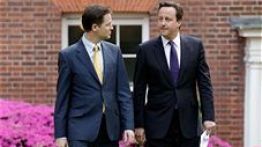
The first press conference of this new era was a definite success. The body language between Cameron and Clegg was good. When Clegg called Cameron ‘Dave’ it sounded very natural. Cameron’s argument was that the two parties could have come to a confidence and supply agreement but that would have been ‘uninspiring’ and could have broken down at any time. What the Prime Minister didn’t mention is that the coalition agreement ties the Lib Dems into cuts as well as providing stable government. Clegg was excellent, as in the debates he is helped by being a little bit taller than Cameron. He defused any tension when Andy Bell reminded Cameron that he had dismissed him as his favourite joke with a bit of humour.

The coalition agreement at a glance

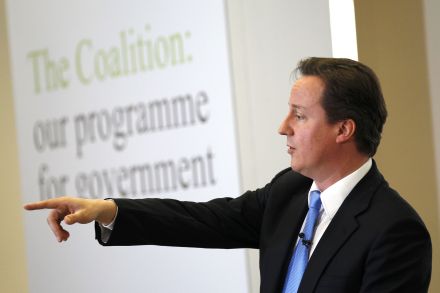
I have just had a quick read through the coalition agreement and a few things jumped out at me. First, this new government will not abolish Lord Mandelson. The agreement states that while the parties are committed to a wholly or mainly elected Lords ‘likely there will be a grandfathering system for current Peers’.   The Tory manifesto commits a Conservative government to introducing ‘new rules so that legislation referring specifically to England, or to England and Wales, cannot be enacted without the consent of MPs representing constituencies of those countries.’ The coalition agreement has watered this commitment down significantly. The new government will merely ‘establish a commission to consider the ‘West Lothian question’.

Danny Alexander takes on a tough job

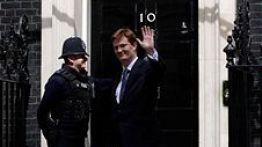
Danny Alexander is a brave man to take on the job of Scottish Secretary in this government. I did a slot on Radio Scotland last night and Labour and the SNP were tearing into the Lib Dems for going into coalition with the Tories, accusing them of selling out the 85 percent of Scots who had voted against the Tories. As a unionist, I found the whole conversation extremely disturbing. Even on the Labour side, there seemed to be no recognition that this was a UK election and what mattered was the UK distribution of seats. When you combine this with the fact that Tory MPs are acutely conscious that they have a majority in England and Wales then there is a real threat to the union.