James Forsyth

James Forsyth

James Forsyth is former political editor of The Spectator.

EXCLUSIVE: Warsi did not clear speech with No. 10 <br />

From our UK edition

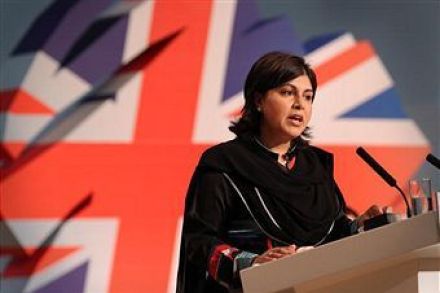
Sources inside Number 10 tell me that while there was a ‘general awareness’ that Baroness Warsi was to give a speech on faith, they did not know the specifics of what she was going to say. They say that no text was cleared by Downing Street. They claim that the first they knew of the controversial lines in the speech was when they were informed that Warsi’s team had briefed them out to the Telegraph.
A bad morning for the government<br />

From our UK edition

This morning has not been a good one for the government. There’s been an embarrassing admission that 28 days detention will simply lapse on Monday, the Conservative party chairman is delivering a speech that the vast majority of Conservatives think is muddle-headed at best, and the Prime Minister finds himself in a public debate with the mother of a quadriplegic child. 2011 was always going to be a hard year for the government but what should worry Downing Street is that two of these problems are self-inflicted. The whole counter-terrorism review should have been finished before 28 day detention expired. The fact that it has not been makes the government look like it can’t work to a deadline and is drifiting in a crucial area of policy.

Using a politician’s spouse to attack him is below the belt, Andy Burnham should apologise

From our UK edition

Andy Burnham crossed a line today in using Sarah Vine, Michael Gove’s wife, to take a pop at the Education Secretary. Burnham, mockingly citing a recent Vine column, argued that the fact that the Goves have a cleaner ‘raises further questions about whether he is living in the same world as the rest of us.’ Now, by this logic I suspect that the majority of his shadow Cabinet colleagues are not living in what Burnham thinks of as 'the same world as the rest of us'. This ungallant attack seems particularly unpleasant when you consider that Sarah Vine came to Frankie Burnham’s defence when she was attacked for the outfit she wore to an unveiling of a statue of the Queen Mother.

Gove raises the spectre of an electoral pact

From our UK edition

Michael Gove has reignited talk of a Tory Lib Dem pact by urging people in Hull to vote Lib Dem to keep Labour out at the local elections. Gove’s intervention was not planned but it does reveal how he thinks. Gove’s department is the most coalitionised. Not only is there a Lib Dem minister there in Sarah Teather, tellingly the only Lib Dem minister not to moan to the Telegraph’s undercover reporters about her colleagues. But there is also David Laws, who is acting as an unofficial adviser to Gove. Anthony Wells’ thorough analysis of an electoral pact suggests that it could do well in the seats where it matters.  Obviously, all this discussion of pacts could be overtaken by events if AV passes.

Laws: the 50 percent rate should be abolished asap

From our UK edition

David Laws has penned a robust defence of the coalition’s economic policies for The Guardian. He points out that the big dividing lines in politics are on the economy and then goes onto say: 'Ed Miliband is betting that economic recovery will be derailed, and while trying to reconcile many divergent views in his party, he has generally taken the position that cuts should be delayed and that high tax rates (including the 50% tax rate) should be retained. Ed is getting all the big economic decisions wrong, and leading his party into an economic policy cul-de-sac.

To combat binge drinking among the young, make it easier for people to drink under-age in pubs

From our UK edition

Mary Ann Sieghart has a great piece in the Independent today about how, inadvertently, we have designed a system that almost encourages young people to drink irresponsibly. As she argues, a lot of problems have come, oddly, from making it harder for people to drink under age in pubs.  As Sieghart puts it, ‘And because we were under 18, we knew we had to remain inconspicuous. The landlord would tolerate our presence as long as we didn't embarrass ourselves or him. We didn't dare get smashed or he wouldn't allow us back. And because we tended to meet the same group of friends in the same pub, being banned was not a good move.’ There are, by contrast, no such constraints when under 18s buy drink--or get someone to buy them drink--from an off license.

Cameron’s rough ride on Today

From our UK edition

David Cameron’s interview on the Today Programme this morning was another reminder of what a hard year it is going to be for the government. The bulk of it was devoted to Cameron doing his best to defend and explain the government’s planned reforms to the NHS. Cameron, normally so assured in these interviews, seemed frustrated as John Humphrys kept pushing him on why he was doing it having condemned NHS reorganisations in the past.   Then, the interview moved on to bankers’ bonuses. As he did on Andrew Marr earlier in the month, Cameron implied that action was coming. But there were no specifics set out, and if action is coming it will contradict with the signals that the Treasury was sending out last week.

How Iran’s nuclear programme was delayed

From our UK edition

Iran’s nuclear programme is the most likely source of a major global conflict. So it is highly significant that the outgoing head of Mossad recently told the Israeli parliament that technical problems meant that Iran might not be able to make a bomb until 2015. These technical problems have, as a riveting piece in the New York Times explains, being caused by a computer virus. The stuxnet (correction) virus is in wide global circulation but it only kicks in when it spots the pattern that is used for centrifuges making highly-enriched uranium. When it does, it makes the centrifuges spin so fast that they destroy themselves. This virus appears to be a joint production of the Israeli, American and British secret services.

Miliband’s compliment to Thatcher

From our UK edition

Ed Miliband’s speech today contained an interesting compliment to Margaret Thatcher. He said that the challenge for Labour now was to ‘change the common sense of the age’ as the Tories had done in the 1970s. Miliband’s argument is that Labour need to articulate an entirely new political economy. As he put it,’ we can’t build economic efficiency or social justice simply in the way we have tried before.’ What I find interesting about Miliband is that he trying to move the centre ground from opposition, something than no one has done successfully since Thatcher. Both Blair and Cameron moved towards it in opposition and only tried to shift it in government.

Politics: Westminster just isn’t built for coalitions

From our UK edition

The Liberal Democrats’ current problems can be traced back to 28 October 1943. The Liberal Democrats’ current problems can be traced back to 28 October 1943. On that day, the House of Commons decided that the bombed Commons chamber should be rebuilt and its oblong structure preserved. This ensured that the British tradition of confrontational politics — and with it the pull towards a two-party system — would continue into the post-war era. Winston Churchill understood what was at stake in the debate. He knew that ‘we shape our buildings, and our buildings shape us’. As he told the House, the chamber’s shape ‘is a very potent factor in our political life’.

Warsi’s ‘nasty party’ moment

From our UK edition

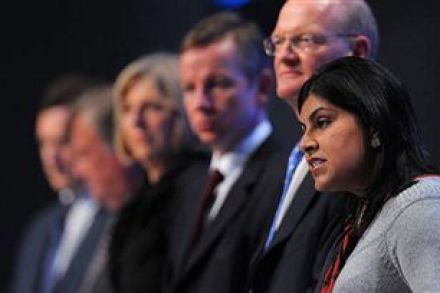
Sayeeda Warsi’s attack on the ‘right wing’ of the Conservative party has had a predictable impact. There is fury that the party chairman is attacking a section of the party, it is something that a considerable number of Tories will never forgive her for. It is also being pointed out that there were a lot of Tory MPs campaigning in Oldham on Saturday and they came disproportionately from the right of the party.  What to do about Warsi is quite a problem for the Tory high command. She does visibly show how the party has changed but she’s also not very competent. Cameron has already split her role, giving Cameron’s university friend Andrew Feldman a whole bunch of the financial and administrative responsibilities.

Lib Dems concede defeat in Oldham East and Saddleworth

From our UK edition

Andy Sparrow is reporting on his live blog that the Lib Dems have conceded defeat in Oldham East and Saddleworth. We won’t have a full result for a couple of hours yet. But all the signs are that Labour’s majority will be substantial, well over the 1,000 mark that Lib Dems were talking about earlier in the week.

We await their lordships

From our UK edition

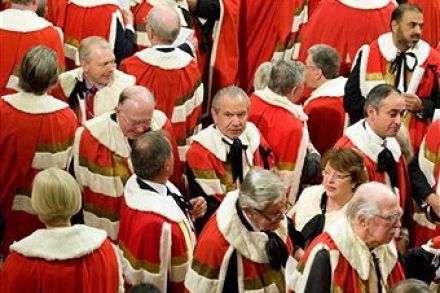
The May 5th date for the AV referendum is under threat because the bill paving the way for it might not get through the House of Lords in time. The problem is that the referendum bill is linked to the plan to equalise constituency sizes which Labour is steadfastly opposed to. So Labour lords are blocking its progress. One Lib Dem lord complains that the problem is ‘all these Scottish ex-Labour MPs who are behaving like they are still in the Commons.’ Labour is stressing that it would happily allow the bill to be split in two and then vote through the May 5th date.

An important test for the Lib Dems

From our UK edition

Tomorrow’s vote in Oldham East and Saddleworth is the first big event of the political year. It is a marginal seat that Labour just held at the last election, beating the Liberal Democrats by a touch over a hundred votes. But the by-election has been caused by the Lib Dem candidate taking the Labour MP to an election court over false statements which has placed particular pressure on the Liberal Democrats to perform well. The polls at the weekend had Labour romping home. But the Liberal Democrats are confident that they will run Labour close, talking about a margin of a thousand or less. If the Lib Dems come a strong second, the result will be pretty much be a wash politically.

An ill-tempered exchange

From our UK edition

The first PMQs of the year was a bad tempered affair. The Prime Minister had clearly decided that attack was the best form of defence, hurling insult after insult across the despatch box. He accused Ed Miliband of being a ‘nothing man’, told him that his Shadow Chancellor can’t count and that he doesn’t count and mockingly brought up Miliband’s brother. But Cameron didn’t do anything to politically detoxify the bonus issue, which is going to carry on haunting this government, note that Lloyds — partly state owned — is going to award its boss a £2million pound bonus.

Party management issues

From our UK edition

The trouble over the European Referendum Bill rather sums up the current state of the relationship between the Conservative party leadership and its more truculent backbenchers. The Bill was meant to be something to cheer up the troops. But it has ended up going down so badly that the whips have been left tearing their hair out and wishing that the government had never introduced it. Some of the policy differences between the leadership and the backbenches will never be resolved, particularly in coalition. But, as so often, a lot of the difficulties with this bill have been caused by poor communication and an inability to take proper soundings. The more one talks to Tory MPs, the more one is struck by how they feel that there is no proper feedback mechanism.

An arena where words are dangerous

From our UK edition

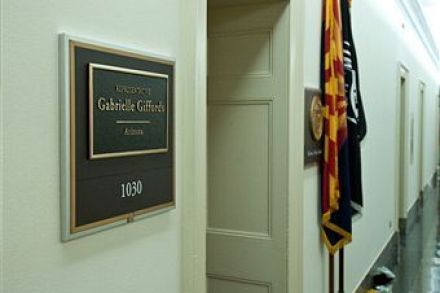
‘it was a deranged individual living in a time and place where anger and vitriol had reached such a fever pitch that we had dehumanized those in public life’ The words of Andrei Cherny on the shooting of Gabrielle Giffords are worth reflecting on. Political discourse has a tendency to hyperbole. But sometimes people need to think through the logic of their rage. For example, all those people who carried round signs saying ‘Bush=Hitler’ should have considered the implications of what they were saying—who of us would not have thought it right to assassinate Hitler if possible? Equally, those who talk about people being traitors should remember what the traditional punishment for treason is and whether treason is what they are really alleging.

Johnson running out of his nine lives

From our UK edition

Ed Miliband's press conference today was a classic example of clever opposition politics. He and Alan Johnson said that Labour would continue the bonus tax on the banks for one more year. This policy has the twin advantage of maximising the coalition's discomfort over the whole issue of bankers' bonuses and expiring well before the next election. The rest of Miliband's press conference was devoted to an attempt to defend the record of the previous Labour government. Miliband kept making the valid point that in the years before the crash Cameron and Osborne weren't saying that Labour was spending too much but were instead committed to matching Labour's spending plans.

Why the Cameroons think the Lib Dem poll rating matters

From our UK edition

Matt d’Ancona’s piece in The Sunday Telegraph arguing that the coalition should stick to its long term strategy and ignore the slings and arrows of the daily news cycle makes an important point. The Blair governments would, undoubtedly, have achieved more if they had done this. But the circumstances for the coalition are different in one crucial regard: it could fall far more easily. What keeps keep Tory Cabinet ministers up at night is the fear that the Lib Dems could dump Nick Clegg and that a new leader would then pull the party out of a coalition. At the moment, this seems like an unlikely prospect—not least because it would almost certainly lead to a general election. But it does only require the support of 75 Lib Dem local parties to call a leadership vote.

Society can’t function without some degree of trust

From our UK edition

One of the most worrying developments of recent years has been a belief that any adult who wants to teach or help children should be suspected of immoral tendencies. This has led to a belief that even the most innocent of actions should be seen as perverted until proved otherwise. It is harder to find a purer expression of this viewpoint than the videos produced by the musicians’ union called ‘Keeping children safe in music’ and backed by the NSPCC. These videos urge music teachers never to touch children while teaching them. When you consider the process of teaching someone how to play the violin or the piano, you realise just how absurd this instruction is.