Isabel Hardman

Isabel Hardman

Isabel Hardman is assistant editor of The Spectator and author of Why We Get the Wrong Politicians. She also presents Radio 4’s Week in Westminster.

Peers get ready to kill the boundaries bill

Peers will vote shortly on an amendment to the Electoral Registration and Administration Bill which could kill the boundary changes. Coffee House understands that there is no government whip on the issue, and the Lib Dems are being told to support the amendment from Labour's Lord Hart which will delay the changes until 2018. A senior party source says: 'They will be expected to vote for the amendment in line with the public position set out by Nick Clegg.' The amendment will then move back to the Commons. The government's attempts, reported over the weekend, to push the reforms through using minority parties have run aground after both the DUP and SNP said they would vote against the changes. There are also at least two Conservative MPs who will vote against: Glyn Davies and Philip Davies.

Ministers hope pension reforms will calm concerns about stay-at-home mothers

Today's pensions announcement contains an attempt by strategists to reassure those who worry that the government is abandoning the family. One of the gripes from the Tory backbenches about the mid-term review was that it provided precious little confidence that the tax break for married couples that they hope for will be forthcoming, with simply a promise that the Lib Dems could abstain in a vote on the matter. It was all very well announcing new childcare measures, MPs such as Tim Loughton complained, but what about those women who wanted to stay at home with their children? But the briefings ahead of today's announcement have carefully sought to underline that stay-at-home mothers will be among those who will benefit.

Home Office won’t produce estimate of number of Romanian and Bulgarian migrants

Eric Pickles says he's waiting for figures on how many Romanians and Bulgarians are expected to come to the UK when transitional controls on their freedom of movement expire on 31 December 2013. The problem is that the Home Office isn't producing those figures, arguing that such an estimate would be impossible. I've spoken to a Home Office source, who told me: 'There are no Home Office figures in terms of a projection of the numbers because there's not really very much point in guess work about this because it really is just guess work. Instead, our view is that we should be focusing on the factors that are bringing Europeans here to Britain and cutting out abuses of freedom of movement such as sham marriages, and looking at access to benefits and public services.

David Cameron continues with his ‘tantric’ European strategy

David Cameron told journalists before Christmas that he had a 'tantric' approach to his European policy speech: that it would be all the better when it eventually came. So today he decided to continue tantalising his party and the media by popping up on the Today programme a whole week before he's due to give the speech, and refusing to give details of what that speech will contain. It's an interesting strategy, as speaking so far before the speech won't help the Conservative party remain calm. The next week was always going to be a little frenzied in the run-up to the speech. But here's what we did learn from the Today interview: 1. The Prime Minister is in favour of Britain in Europe. He argued that 'Britain does have a European future', but that this future involves reform.

Ed Miliband’s economic lacuna

Refusing to publish your 2015 manifesto at the start of 2013 is, obviously, a sensible one. However uncomfortable Labour frontbenchers have felt over the past two and a half years about not being able to respond to the jeers of 'well, what would you do then?' from ministers at departmental questions, writing another one of the longest suicide notes in history would have left them in still greater discomfort at the polls. But how do voters know whether to trust you or not when they've only recently booted you out of government? Ed Miliband was trying to explain this tension to James Landale on Marr this morning. Miliband: But, James, I've tried to explain to you why it isn't reasonable for an opposition at this stage of a parliament to set out precisely what will be in the manifesto.

Leveson Royal Charter plan remains uncharted territory

Strong words in the Lords today about the media and the government's stance on Leveson, but what are the discussions like between the three parties behind the scenes? Though they started off with some similarly stern words, the cross-party talks on the response to the Leveson report have, all sides agree, been progressing well. Far from the communication breakdown that some envisaged, there has been a relatively pleasant atmosphere. The Lib Dems and Labour, though they disagree with the Conservative line, are both keen to praise Oliver Letwin in particular for the way he is conducting the discussions, and for going away and working on the details discussed in each session.

Lessons from the Lords on Leveson

Peers are spending today debating the Leveson report. They've been at it for an hour and a half, and will continue debating until 5pm, but the first few speeches have yielded some interesting points to chew on. Labour's Baroness Jones of Whitchurch devoted a great deal of her speech to the damage that the 'dark arts' of the media had done both to private individuals and to celebrities. She described the distress of the victims going through the inquiry, and contrasted it with the response of the government in rejecting calls for statutory underpinning. The terrible treatment of those experiencing terrible bereavement was the reason the Inquiry was set up, and those in favour of statute now say the victims have been betrayed.

How the mid-term review didn’t quite hit the spot

Bearing in mind that the mid-term review was originally conceived as means of boosting Coalition morale after the collapse of Lords reform, it hasn't done enormously well. With two more very awkward stories stemming from the review hitting the papers today, the exercise has left Downing Street in reactive mode, rather than functioning as the proactive promoter of proalition politics. These are the main problems with the review: 1. In trying to manage headlines about the review, Downing Street inadvertently created a slew of negative coverage by withholding the 'audit' of coalition achievements. The audit turned out to be a very boring and badly applied gloss (Ronseal quality control would have rejected it).

MPs: We’re underpaid and worried about Christmas

Are MPs paid too little? Quite a few of them seem to think so. Parliamentary expenses watchdog IPSA released the results of a survey today which found 69 per cent of MPs think they are underpaid. If that wasn't quite enough to light the touchpaper, Tory MP Andrew Bridgen very bravely appeared on PM this evening to make the following rather provocative comments: 'We work in the constituencies and we work in Westminster. In the city of Westminster average salaries are well over £100,000. We work in both those spheres. Now I know MPs who will say in private that every year they are getting poorer.

Merkel ally’s referendum warning underlines Cameron’s precarious position

The major gamble that David Cameron is taking with his strategy on Europe is, as James explains in this week's magazine, that he's relying on signals from Angela Merkel that she is keen to help him with a renegotiation. She has certainly given a few of those in recent months. But today one of her colleagues in the Christian Democrat party undermined some of the confidence that has been building about Merkel's position. Gunther Krichbaum is the chair of the Bundestag's European Affairs Committee, and is leading a two-day cross-party delegation to Britain. He believes a renegotiation would open a 'Pandora's Box', and that Britain should tread carefully: 'There is certainly a risk that [a referendum] could paralyse efforts for a better Europe and deeper integration.

Three problems with Sir Jeremy Heywood’s ‘plebgate’ evidence

Sir Jeremy Heywood's evidence to MPs on the Andrew Mitchell row didn't go down very well at all this morning. Though a powerful man, the Cabinet Secretary is not well-liked by MPs, and before he appeared some had already named him as a central figure in the fiasco that led to the chief whip resigning. The Public Administration Select Committee hearing did little to improve this perception. Here are the main problems with his evidence: 1. Heywood's investigation was limited. The Cabinet Secretary said he was asked to conduct a 'very specific review' of emails about Mitchell's behaviour from a man claiming to be a constituent of the deputy chief whip to see whether they should change the Prime Minister's view of whether Mitchell should remain in position.

Nick Clegg survives LBC grilling intact

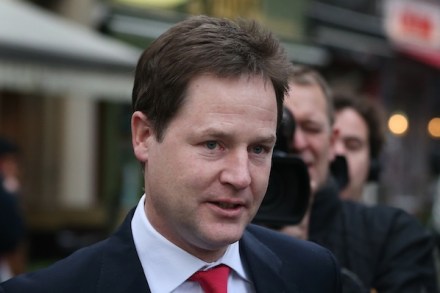
At 9 o'clock this morning, journalists all over the country were fiddling with their radios excitedly. Nick Clegg was about to start his first LBC phone-in, and they were gleefully waiting for the Deputy Prime Minister to huff and puff his way through half an hour of enraged callers. There was even a live high-definition feed from the studio, so everyone could watch Clegg looking sad. Disappointingly for those lying in wait next to their radios, Clegg actually performed rather well. Sure, those on the phone weren't calling just to say they loved him, but the Deputy Prime Minister wasn't huffing and puffing when he answered their questions about tuition fees, benefit cuts and all the other awkward things the Lib Dems have had to swallow since entering government.

Michael Gove’s plans for profit-making schools

Coffee House readers won't be surprised by the Independent's report that Michael Gove has been telling friends he has no objections to profit-making schools: he explained his position on the matter at length to Fraser in December. Then, the Education Secretary said he was keen for the one profit-seeking school in this country, IES in Suffolk, to make the case to the public for more profit-seeking schools: 'What I said to them [IES] is the same argument that Andrew Adonis has made: we’ve created the opportunity for you to demonstrate what you can do and win the argument in the public square. You have an organisation that has been criticised, in some cases demonised, now running a state school.

PMQs blows underline importance of Tory NHS rehabilitation mission

While Ed Miliband wasn't exactly Mr Pugnacious today at PMQs, one of his better blows was when he read out the promise in the Coalition Agreement to 'stop the top-down reorganisations of the NHS' and asked whether that would be on a list of broken promises in the audit of government achievements. Labour always sees the NHS as an easy way to score points now that the government's hard-won credibility has been scuppered by the Health and Social Care Act, and naturally Miliband roused some cheers from his MPs. James argued back in December that it is now impossible to have a mature conversation about the NHS. Indeed, the Tories are now to the health service what Tesco is to nice-looking coffee shops: a combination that arouses suspicion, whether or not it is warranted.

Secret audit of Coalition pledges offers few clues on progress

Finally, the copper-bottomed, unvarnished Programme for Government Update, aka the Secret Audit, has landed. You can read the full document here, but in summary, it's not immediately very helpful. It is laid out as a point-by-point 'analysis' of how the government is meeting its pledges in the Coalition Agreement, but the wording is such that you can't actually tell whether there are any areas on which it has failed. Reading this document, you'd think everything was pretty hunky-dory with the government as there is no assessment of whether each pledge is completed, underway, or forgotten. This is the assessment of the House of Lords reform pledge: We published a draft Bill and White Paper on House of Lords reform in May 2011.

Copper-bottoming the Coalition

Number 10 officials have been working on the mid-term review since the autumn, with what the Prime Minister's spokesman described today as a 'long-term intention' to publish the awkward annex. But even though the review itself was delayed from the real mid-term point of the Coalition to this Monday, it doesn't seem to have given those working on it sufficient time to get the annex ready for publication at the same time. The PM's spokesman said: 'It has been a long standing intention to publish the annex. What we needed to do was to copper-bottom it.' The implication was that there was a great deal of copper to put on the bottom of this point-by-point analysis of the government's progress against the pledges in the Coalition agreement.

Unpublished Mid-Term Review annex acknowledges Coalition failures

The Coalition's decision to publish a Mid-Term review reminded some of Tony Blair's ill-fated annual reports, which strangely stopped appearing after 2000. Blair's last report embarrassed him because it contained mistakes: the danger of this document was that while lauding the government's progress to date, it might also have to accept a number of failures. That wasn't the case on Monday: in fact, the report itself was largely a paraphrase of every government policy announced so far, which was quite Blairite in itself as it sought to dress up old announcements as new plans. There was no admission of failures, or at least not until David Cameron's adviser Patrick Rock was snapped carrying a memo warning that the annex assessing those targets could lead to 'unfavourable copy'.

David Miliband is out of exile: but what happens next?

Reports of his return to frontline politics certainly seem to have woken up David Miliband. He has given a very energetic speech in the Commons this afternoon in the Welfare Uprating Bill: so energetic, in fact, that he managed to steal poor Sarah Teather's rebellious thunder, speaking directly after the former Lib Dem minister. Shortly afterwards, he was spotted at the top of the Portcullis House escalators shaking the hand of admiring Labour MPs who passed by. As Dan Hodges points out on his blog, the Blairite MP was perfectly happy to attack the Welfare Uprating Bill from the Left, calling it 'rancid', and arguing that it undermined the Tories' confidence in their welfare reforms so far.