Isabel Hardman

Isabel Hardman

Isabel Hardman is assistant editor of The Spectator and author of Why We Get the Wrong Politicians. She also presents Radio 4’s Week in Westminster.

Nurses cannot dismiss calls for reform out of hand

It's not unusual for a trade union representing its members to resist change, and today the Royal College of Nursing is sticking well and truly to form. Not only has Peter Carter, its chief executive, called the government's plan to put nurses through a year of work as healthcare assistants 'stupid', he has also penned an op-ed for the Guardian in which he appears resistant to the suggestion that the profession needs to consider wholesale reform following the Francis Report. Carter writes: 'For the million or so people working in the NHS, a number of things come with the job: a boom-and-bust budget, growing demand and a high level of public expectation.

How can the Tories work with trade unions?

In the latest instalment of WWTD? Boris Johnson has called for 'Thatcherite zeal' from the government in standing up to militant trade unions. According to the Sun on Sunday, the Mayor of London wants a turnout threshold of 50 per cent before a strike is legitimate. A group of Tory MPs - including those quoted in today's story - have been pushing for trade union reform for some time. Their argument is that a movement founded to push the rights of the low-paid to the top of the agenda is now more interested in flattering the vanity of its high-paid leaders by pulling unnecessary strikes on low turnouts.

Fitch downgrades UK credit rating

Fitch's announcement that it is downgrading the UK's credit rating to AA+ isn't as politically explosive as the downgrade from Moody's in February, as it was inevitable that once one major ratings agency dropped the AAA, the others would follow like dominoes. The bigger story will be when all agencies have dropped the rating. Fitch said this afternoon that the reason for the downgrade was that 'the fiscal space to absorb further adverse economic and financial shocks is no longer consistent with a 'AAA' rating'. The agency forecasts that general government gross debt will peak at 101 per cent of GDP in 2015/16, having previously warned that failure to turn this around and place debt on a downward trajectory towards 90 per cent of GDP would trigger a downgrade.

The school day and the ‘global race’

Should Michael Gove lengthen the school day? The question itself is wrong, of course, as what he wants to do is give schools the opportunity to change hours as they wish, rather than telling them what do to. This isn't a case of 'here is your freedom, and this is how you must use it', but a change in the contract so that schools can do what they want. Currently, the contract for teachers in maintained schools states that they should work no more than 195 days or 1265 hours a year. The Education department has asked the independent School Teachers' Review Body to look again at this contract so that schools are not forced to keep 195 days as a maximum.

Tories keen to exploit Labour’s Southern Discomfort in local elections

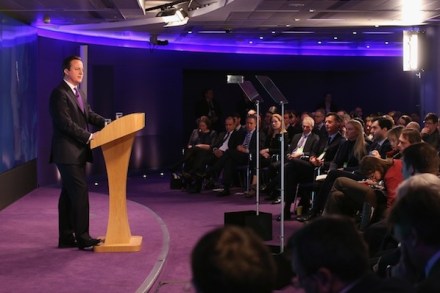
David Cameron's local election kick-off speech today notably contained no reference to UKIP, but 12 mentions of Labour. The Conservative leader and his colleagues concerned with campaigns are on a damage-limitation exercise about the party's chances in the local elections, and as well as taking the attack to Labour on the policy front - arguing that the Tories have freed councils from Labour's restrictions, kept council tax down and reduced local government waste - a plank of their strategy involves attacking Labour's prowess in southern council seats. The key phrase which you can expect to hear whenever there is evidence that the Labour campaign is faltering in the south is 'Labour's Southern Discomfort'.

Govt keeps Snooping Bill campaigners in the dark

It's not looking good for the Snooping Bill. The legislation is currently being re-written after serious concerns were raised with the first draft, but I've got hold of a letter from privacy campaigners which accuses the government of failing to hold the public consultation that was one of the conditions laid down in the damning report that killed off the first draft. The letter, from Big Brother Watch, Liberty, Open Rights Group and Privacy International, expresses fears that meetings between the organisations and Home Office ministers could be used as evidence that ministers have been consulting on the new legislation.

A ‘lurch to the left’ or a wise appointment?

One interesting decision that Ed Miliband made this week was to appoint Karen Buck as his PPS, following the long-planned departure of John Denham. Tory MPs have told me they were very quickly given 'lines to take' on how this represented a big 'lurch to the left' on the Labour leader's part. CCHQ is right that Karen Buck is on the left of her party: as a shadow welfare minister she pushed for the party to oppose the £26,000 benefit cap when Liam Byrne's official line was to leave it be (one he later reversed). But the line to take conveniently forgets that one of the principal purposes of a PPS is to act as a conduit between a leader or minister and the opposite side of the party. So a minister on the right of their party should in theory appoint a PPS on the left.

Ed Miliband shouldn’t dismiss husky-hugging out of hand

Today's Ipsos MORI finding that voters can't see Ed Miliband as Prime Minister underlines how much hard work the Labour leader really has to do. The poll for the Evening Standard found 66 per cent of those asked didn't believe he was ready to rule the country, against 24 per cent who did. He is also polling behind his party, with 58 per cent disagreeing that Labour is ready to form the next government against 29 per cent who do. As the general election draws closer, voters will find their minds focus more on this question of whether they can imagine the party governing rather than simply on Labour as what Tony Blair described as a 'repository for people's anger'. And as they do that, they'll want to know what it is that Labour stands for rather than simply what it is that Labour opposes.

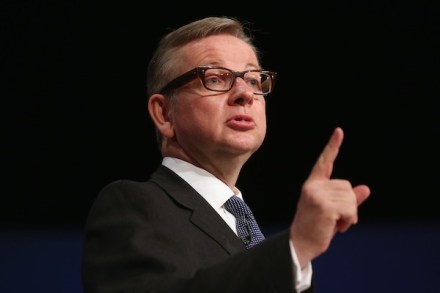
Michael Gove: Unions need to do a better job

Cometh the Gove, cometh the angry trade union representative. It was inevitable that the Education Secretary would have at least one exchange with someone from one of the two largest teaching unions when he took questions from the floor at today's Spectator education conference. Gove spoke powerfully without notes on his vision for education, and then in conversation with Andrew Neil, attacked those he believed had low expectations for certain pupils. He said: 'There are wonderful people in teaching and I want to empower them. This is, I think, a tremendous opportunity for teachers. But there are some in the teaching profession, I'm afraid, who won't take yes for an answer. They say we'd like more freedom - and we'd give them more freedom with academies and free schools.

The date George Osborne’s vultures are circling over

It was only last week that a Tory MP was warning Coffee House of the dangerous impact that high levels of public debt can have on growth. Today that theory is fighting for its life, with the authors of the Harvard paper that developed it in the first place in the firing line for an error in a spreadsheet. If you haven't been following the Reinhart and Rogoff row, here's a quick catch-up: a paper from two professors and a doctoral student at the University of Massachusetts published this week argues that Carman Reinhart and Kenneth Rogoff of Harvard were wrong to reach the conclusion they did about a 90% debt to GDP ratio seriously affecting the growth of a country's economy.

Lion-hearted crowds cheer the Iron Lady

When I arrived at St Paul's at 6 o'clock this morning, a line of people, around 40-strong, had already set up camp with union flags (and one Canadian flag, too) opposite the church courtyard. The police officer drawing to the end of his night shift told me they had been there all night. Later, as the hearse left the Palace of Westminster, the pavements opposite were packed. Yes, there were some people who turned their backs, and others who held placards decrying Thatcher's legacy. This video from the Guardian shows some of them chanting 'waste of money!' as the procession approached. As Thatcher's friend Conor Burns has been repeatedly saying for the past week and a half, the late Prime Minister would have seen that as a tribute in kind as well.

David Cameron: We’re all Thatcherites now

David Cameron is giving a reading at Margaret Thatcher's funeral later today, but this morning he gave his eulogy on the Today programme. He made the quite striking observation that 'we're all Thatcherites now'. In one sense this is quite an obvious comment: as countless commentators have observed over the past week and a half, Margaret Thatcher didn't just change the way the Conservative party viewed economics and the state, she also changed the way Labour sold itself as a party. Cameron said: 'I think in a way we're all Thatcherites now because - I mean - I think one of the things about her legacy is some of those big arguments that she had had, you know, everyone now accepts.

Was today’s conservatory revolt really necessary?

Eric Pickles did manage to avert a defeat in the Commons on plans to let homeowners build extensions and conservatories without planning permission, but it's worth asking how on earth the government managed to get in the position where its backbench was so worked up on a policy like this in the first place? The amendment, tabled by Lord True and approved by peers - would have allowed councils to opt out of the new freedoms.

Michael Gove the evil overlord strikes again

Michael Gove is at it again. Today he's taken it upon himself to 'heap further misery' onto teachers with 'reckless' plans that would damage children's education. At least, that's what the NASUWT teaching union would have you believe. The Education Secretary has in fact published advice for schools on performance-related pay, which they can use from September of this year. It means that coasting teachers won't get automatic pay rises based solely on length of service, and that good teachers who put extra effort in will get pay rises. So the unions appear to be outraged not on behalf of their entire membership, but on behalf of those teachers who aren't going to get pay rises: in other words, they're annoyed that the game is up for poor performers.

Maria Miller and Oliver Letwin’s perfect press regulation

There was a curious meeting of the Culture, Media and Sport Select Committee this morning. The MPs took evidence from Oliver Letwin and Maria Miller, and then from Harriet Harman, on press regulation. An evidence session with Oliver Letwin is curious enough anyway, as the Minister for Government Policy does tend to speak as though he's reading from a will, complete with codicils. But what was really rum was that everyone in the room seemed to be talking about quite different systems of press regulation. Miller and Letwin were eerily cheery, repeatedly telling committee chair John Whittingdale that they were 'the optimist in this case', and that their plans were not statutory regulation. Miller even objected to the idea that the industry might not be keen.

Planning ‘love-in’ fails to rouse good feelings

So it doesn't look as though last night's 'love-in' that I reported went particularly well. Cheryl Gillan described planning minister Nick Boles last night as 'completely unmoveable'. Meanwhile, Zac Goldsmith, leader of the rebels on the extensions row in the Commons, was on the Today programme this morning calling it an 'odd policy' and 'very bad, clumsy politics'. He argued that there were other ways of using construction to promote growth: 'There are alternatives: we could relax the planning system without undermining democracy, without going against everything we said in opposition about localism, protecting back gardens and so on. We could easily have a sort of default green light for developments that aren't opposed by neighbours.

MPs invited to planning ‘love-in’

Parliament's only just back from Easter recess and already there's a threat of rebellion in the Commons. The Growth and Infrastructure Bill returns to the Commons tomorrow afternoon for 'ping-pong', and a number of MPs are agitated about an amendment that passed as a result of a rebellion in the Upper Chamber. In March, the Lords passed an amendment from Tory peer Lord True which would allow councils to opt out of a policy giving homeowners the right to extend their homes without planning permission. The government is naturally seeking to overturn that amendment, but Tory MPs aren't convinced.

Tax transparency: Cameron says relax

When dolphins hunt fish, they gang up on them as a school, chasing them into the shallows. So it happens at the daily lobby briefing: when a morsel of a story appears and someone lets down their guard, the whole pack of journalists jumps in. Today the Prime Minister's official spokesman was chased into the shallows on the plan, which appears rather dead in the water, to publish ministers' tax affairs. The plan had been for the most senior members of the Cabinet to do this, and David Cameron, George Osborne, Nick Clegg and Vince Cable had agreed on it last spring. But nothing has happened.

A tale of two benefit cuts

The first four pilots of the government's £26,000 benefit cap for workless families launches today. While there's a bit of debate today about the rights and wrongs of this particular benefit cut, it's worth comparing it with another policy that has grabbed many more headlines. The benefit cap is, as James reported recently, one of the most popular policies pollsters have ever encountered. It was launched as a flagship policy by the Chancellor at the 2010 Conservative autumn conference, with a snappy name. Most backbench Tory MPs report that the only thing that annoys their constituents about the cap is that it's still too high: Chris Skidmore told me in the autumn that he wished it could be dropped to £15,000.

The Blairites bite back | 14 April 2013

Ed Miliband may have politely told Tony Blair what to do with his advice about the direction of the Labour party, but the former Labour Prime Minister's allies aren't quite so keen to let his New Statesman piece disappear into the party recycling bin just yet. On today's political programmes, they popped up to drive home their belief that Blair should jolly well be listened to, not ignored. Tessa Jowell was so keen to make this point on Murnaghan that she managed to turn the discussion on Margaret Thatcher around to how much Blair had to offer politics twice.