Isabel Hardman

Isabel Hardman

Isabel Hardman is assistant editor of The Spectator and author of Why We Get the Wrong Politicians. She also presents Radio 4’s Week in Westminster.

Cameron keeps his friends close, but now he’s drawing his MPs closer

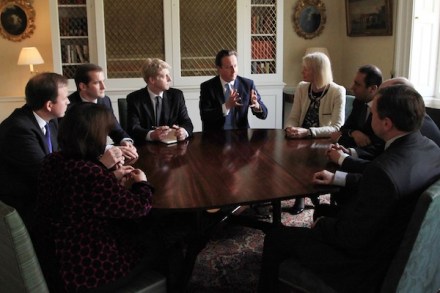
David Cameron and the Tory party appear to be emerging from a period of marriage counselling that has gone particularly well. The leader is making more of an effort with his backbenchers generally (James examines this in his column tomorrow), and tomorrow's papers bring yet more news of reconciliation. The Prime Minister is beefing up his political policy operation by appointing a panel of bright and impressive MPs to help him, and promoting Jo Johnson to be his head of policy and a Cabinet Office minister. Those MPs aren't just impressive, though: some of them, including Jesse Norman and George Eustice, are also rebels. This is a big gesture to say that the troubles of the past year and a bit should go behind the party now as it gets in shape for 2015.

How far will the government go to deport Abu Qatada?

This morning, after the Sun and the Mail reported that ministers might go as far as to leave the European Convention on Human Rights in order to get their way, the Prime Minister's official spokesman refused to rule out such a move. He said: 'The government will explore every option in seeking to deport this dangerous individual and that's what we are going to keep doing. 'The Prime Minister met with the Home Secretary, the Justice Secretary and the Attorney General yesterday to discuss the case. I'm not going to get into specifics as to what the Government is considering, as I say, we are going to explore every option.

Theresa May tries to calm Snooping Bill nerves

It seems the Home Office is growing a little bit nervous about its flagship Communications Data Bill. I understand that Home Secretary Theresa May took time out of an Abu-Qatada-packed day yesterday to ring internet service providers to try to give reassurances about the legislation. As I explained yesterday, there's a growing sense in Westminster that this Bill won't survive. Many backbench Tory MPs tell me of a rumour sweeping their party that it is already dead. Other sources involved in the negotiations suggest that there's a possibility that the Home Office might jettison the more controversial parts of the legislation in order to get the darned thing through.

Ministers mull dramatic measures to succeed in Qatada battle

When Theresa May makes her statement on Abu Qatada to MPs today, she will be expected to give further details on plans reportedly mooted by the Prime Minister to temporarily withdraw Britain from the European Convention on Human Rights. This is a high-risk strategy for two reasons. The first is that by so clearly involving himself in the process, the Prime Minister risks being damaged by the fallout from another failed attempt to get Qatada out. The second is that a temporary withdrawal from the Convention, even to remove a hate preacher than all agree should have left this country long ago, will send Cameron's Liberal Democrat coalition partners into orbit. The PM held a meeting with May, Justice Secretary Chris Grayling and the Attorney General Dominic Grieve yesterday.

How the Snooping Bill could end up dead in the water – sooner or later

When Cabinet met this morning, ministers didn't discuss the Communications Data Bill, which the government hopes to get into the forthcoming Queen's Speech. But there is a growing sense in Westminster that it won't make it out of the Commons alive - if it even manages to make it into the Commons. Here are three different scenarios for what could happen to this controversial piece of legislation: 1. The Bill fails to make it into the Queen's Speech. Discussions about the legislative programme for the next parliamentary year are taking place at the moment.

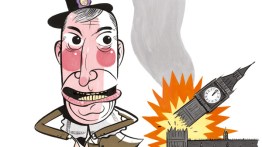
No-one does anti-politics stand-up like Nigel Farage. But what about that tax policy?

Nigel Farage joined lobby journalists in Parliament for lunch today. Like many of his hustings, it was a box office event, and indeed like many of those campaign trail appearances, he made plenty of the same jokes that those who follow him about have heard many times before such as the one about being married to a foreigner, and about the problem with the Westminster bubble: 'They look the same, they sound the same, God! They're dull! I mean, they are not much fun to be with.' Farage, of course, is fun to be with.

PM and Osborne prefer their ‘own words’ to describe miserable economy

George Osborne might have used Justin Welby's comments on the problems with the banks this morning as a sign that he has at least one ally out there, but this afternoon, the Prime Minister's official spokesman distanced the government from the Archbishop's use of the word 'depression' to characterise this country's current economic circumstances. He said: 'The Prime Minister agrees with the point the Chancellor of the Exchequer was making when he was asked that question this morning. What the Chancellor said was that he agreed with the Archbishop's analysis that we have a slow and difficult recovery because of the problems in the banking system and those are the problems that need addressing.

George Osborne stays in attack mode

George Osborne is well-known as the 'submarine Chancellor'. But recently he's been out and about a little bit more than we're used to. He went on the attack this month on welfare, and today he made a rare appearance on Radio 4, and then gave a speech on Scotland and the pound. Ahead of today's borrowing figures - which show he's just about squeaked home on his claim that the deficit is coming down every year of this Parliament - he told John Humphrys that the economy was recovering, and discounted the views of the IMF's chief economist Olivier Blanchard, saying: 'That is one voice, one person. The chief economist has a well-known set of views on this, which he has expressed in various forms over several years.

The question Labour won’t even consider on the NHS

Labour's new independent commission on health and social care aims to draw up plans on bringing together health services and social care so that the NHS can be financially sustainable. Launching the plans today, Ed Miliband said that 'we must make every pound we spend go further at a time when our NHS faces the risk of being overwhelmed by a crisis in funding because of care needs by the end of this decade'. But there is one big question that Sir John Oldham, who will chair the year-long review, won't be asking about the long-term financial viability of the health service. It's a question that some Labourites are well-attuned to, and that the chair of NHS England (formerly the NHS Commissioning Board) Malcolm Grant raised earlier this month.

MPs to push government on plans for new migrants

MPs will debate the government's preparations for more Bulgarian and Romanian migrants in Westminster Hall today, as another survey suggests that there's no need to get unduly worried about the lifting of transitional controls. Ministers have in recent weeks managed to calm Tory backbenchers down by making announcements regarding restricted access to benefits and housing, but there's still sufficient appetite for this afternoon's debate, led by Mark Pritchard, and a session of the Home Affairs Select Committee tomorrow with the Bulgarian and Romanian Ambassadors and Immigration Minister Mark Harper. Pritchard tells me: 'EU migration and non-EU immigration is of real concern to many communities throughout Britain given the record numbers who entered Britain between 1997-2005.

Number 10 defends Sir Jeremy Heywood’s freelancing

What is Sir Jeremy Heywood up to? Last week he jointly wrote an article praising Margaret Thatcher which led to a Labour MP accusing him of having 'prostituted his high office'. This week he's revealed to be discussing the behind-the-scenes wranglings in the Cabinet on economic policy. The Times' Sam Coates reports this morning that the Cabinet Secretary revealed to a private meeting of bankers that there were four different positions on growth in the Cabinet.

Nurses cannot dismiss calls for reform out of hand

It's not unusual for a trade union representing its members to resist change, and today the Royal College of Nursing is sticking well and truly to form. Not only has Peter Carter, its chief executive, called the government's plan to put nurses through a year of work as healthcare assistants 'stupid', he has also penned an op-ed for the Guardian in which he appears resistant to the suggestion that the profession needs to consider wholesale reform following the Francis Report. Carter writes: 'For the million or so people working in the NHS, a number of things come with the job: a boom-and-bust budget, growing demand and a high level of public expectation.

How can the Tories work with trade unions?

In the latest instalment of WWTD? Boris Johnson has called for 'Thatcherite zeal' from the government in standing up to militant trade unions. According to the Sun on Sunday, the Mayor of London wants a turnout threshold of 50 per cent before a strike is legitimate. A group of Tory MPs - including those quoted in today's story - have been pushing for trade union reform for some time. Their argument is that a movement founded to push the rights of the low-paid to the top of the agenda is now more interested in flattering the vanity of its high-paid leaders by pulling unnecessary strikes on low turnouts.

Fitch downgrades UK credit rating

Fitch's announcement that it is downgrading the UK's credit rating to AA+ isn't as politically explosive as the downgrade from Moody's in February, as it was inevitable that once one major ratings agency dropped the AAA, the others would follow like dominoes. The bigger story will be when all agencies have dropped the rating. Fitch said this afternoon that the reason for the downgrade was that 'the fiscal space to absorb further adverse economic and financial shocks is no longer consistent with a 'AAA' rating'. The agency forecasts that general government gross debt will peak at 101 per cent of GDP in 2015/16, having previously warned that failure to turn this around and place debt on a downward trajectory towards 90 per cent of GDP would trigger a downgrade.

The school day and the ‘global race’

Should Michael Gove lengthen the school day? The question itself is wrong, of course, as what he wants to do is give schools the opportunity to change hours as they wish, rather than telling them what do to. This isn't a case of 'here is your freedom, and this is how you must use it', but a change in the contract so that schools can do what they want. Currently, the contract for teachers in maintained schools states that they should work no more than 195 days or 1265 hours a year. The Education department has asked the independent School Teachers' Review Body to look again at this contract so that schools are not forced to keep 195 days as a maximum.

Tories keen to exploit Labour’s Southern Discomfort in local elections

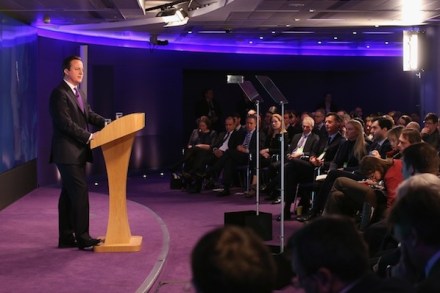
David Cameron's local election kick-off speech today notably contained no reference to UKIP, but 12 mentions of Labour. The Conservative leader and his colleagues concerned with campaigns are on a damage-limitation exercise about the party's chances in the local elections, and as well as taking the attack to Labour on the policy front - arguing that the Tories have freed councils from Labour's restrictions, kept council tax down and reduced local government waste - a plank of their strategy involves attacking Labour's prowess in southern council seats. The key phrase which you can expect to hear whenever there is evidence that the Labour campaign is faltering in the south is 'Labour's Southern Discomfort'.

Govt keeps Snooping Bill campaigners in the dark

It's not looking good for the Snooping Bill. The legislation is currently being re-written after serious concerns were raised with the first draft, but I've got hold of a letter from privacy campaigners which accuses the government of failing to hold the public consultation that was one of the conditions laid down in the damning report that killed off the first draft. The letter, from Big Brother Watch, Liberty, Open Rights Group and Privacy International, expresses fears that meetings between the organisations and Home Office ministers could be used as evidence that ministers have been consulting on the new legislation.