Isabel Hardman

Isabel Hardman

Isabel Hardman is assistant editor of The Spectator and author of Why We Get the Wrong Politicians. She also presents Radio 4’s Week in Westminster.

How can the Church keep earning its right to intervene in politics?

Given the political parties are already well underway with their General Election campaigns, the Church of England couldn’t have waited much later to dispense its advice on how to campaign and what to campaign about. In this week’s Spectator, the Archbishop of York gets on with handing out some of that advice, telling me that politicians are behaving like men arguing at a urinal over who is ‘the biggest of the men’ and explaining why he’s edited what appears to be a pretty lefty collection of essays called On Rock or Sand? Firm Foundations for Britain’s Future. You can read the full interview here.

Archbishop John Sentamu on why politicians are like men arguing at a urinal

‘I shoot further than you, I am the biggest of the men!’ says John Sentamu, Archbishop of York. He is talking about the way politicians conduct themselves in the immigration debate. ‘We have got to be more grown up about it and not be like people who are screaming at each other across banks of a river,’ he says. ‘They mustn’t do what some people call male diplomacy which is always around the urinal… that kind of argument, it doesn’t work!’ Sentamu prefers a still small voice of calm from politicians, even if his own voice is booming and indomitable. His is never more than a few words away from a chuckle or a joke. This week sees the publication of a collection of essays called On Rock or Sand?

The Tories are likely to ‘weaponise’ in the lead up to the election

David Cameron did, as James says, manage to avoid debating the rather more electorally damaging issue of the A&E crisis at Prime Minister’s Questions today because Ed Miliband chose to talk about the TV debates instead. But he still had a good opportunity to raise the Labour leader’s refusal to confirm or deny that he had said he wanted to ‘weaponise’ the NHS as an issue. When Labour’s Toby Perkins asked him whether he was ashamed of what happens when the Tories run the NHS, Cameron replied: ‘Now he quite rightly says it’s very important that we conduct this debate in a very good and civilised way. Now at the weekend, the leader of the Opposition was asked seven times whether he had used the phrase that he wanted to weaponise the NHS.

Labour’s energy price trap for the Tories

This afternoon Labour has its debate on forcing energy companies to pass on lower oil prices to their customers. The potency of the political attack has been blunted rather by the party’s admission that its energy price freeze is in fact a cap, rather than an endless promise that no matter how fabulously low prices already are, Labour will freeze them. But the Opposition Day debate is designed to suggest that the Tories don’t care about people’s energy bills.

Sign up to TV debates or we’ll go ahead without you, leaders warn Cameron

Labour, the Lib Dems and Ukip are having quite a bit of fun with their identical letters from their respective leaders demanding that David Cameron take part in the TV debates - or risk having something done to him that is even worse than a noun being turned into a verb (the latest threat is that he will be ‘empty-podiumed’, which sounds considerably more unpleasant than being ‘empty-chaired’ and possibly as bad as someone ‘weaponising’ something).

Did Richard Curtis script today’s showdown between Osborne and Balls?

Even though they ended up walking through the lobbies together (though not hand in hand, skipping, sadly), Ed Balls and George Osborne still managed to have the sort of Commons showdown that would fit right in to the script of Bridget Jones. On and on their furious fighting went, over whether the long-term economic plan was working, over whether Labour had a long-term economic plan, over whether Britain would get its AAA credit rating back, over whether Balls would borrow more and whether Osborne was cutting the deficit slower than he’d intended. On and on and on. Both looked as though they were enjoying tearing chunks out of one another before agreeing with each other on paper.

Tories split between rival parties

David Cameron is holding another one of his parliamentary party meetings this evening to discuss party strategy and rally the troops. Normally these things are quite well-attended, save a few conscientious objectors who think these events are an attempt by Downing Street to undermine the 1922 Committee. But today’s one might look a little quieter, or at least see some MPs slipping out early. The reason is that David Davis is holding one of his very good parties in the ‘naughty corner’ of Portcullis House tonight.

Has anyone seen Nigel Farage?

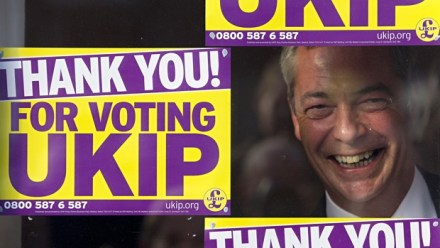
‘Ukip seems to have imploded,’ one ‘mainstream’ politician remarked to me yesterday. ‘We haven’t heard anything from them.’ True, Ukip have been rather quiet since Christmas, but anyone in the Tories or Labour who is dancing around imagining that they’re set fair for an election without Nigel Farage has got rather carried away. The truth is that Farage’s party has decided to stay a little quiet for a few weeks, at least while the main parties slug it out over who would really cut the deficit and who really cares about the NHS. Sources tell me that they think the effect of all these launches, counter-launches, dossiers and dossiers debunking dossiers is to make the electorate even more fed up with mainstream politicians.

What will the Lib Dem ‘red line’ on a ‘Snooper’s Charter’ mean for a future coalition?

One of the obsessions that will only get worse over the next few months - along with checking every poll that comes out every day to see whether you’re six points up, four points behind, or level-pegging - is what ‘red lines’ the parties will set out for their Coalition negotiations. David Cameron has made his EU referendum one, and it turns out that this isn’t as much of a problem for the Lib Dems as all their huffing and puffing on the subject would have you believe. Nick Clegg has been setting more red lines because he is the leader of the party that wants to talk about coalitions, as opposed to the two main parties that would still like to talk about majority governments, however implausible that may now seem.

Tories drop weak policy areas for ‘six election priorities’ launch

Why have the Conservatives left out immigration and the NHS - two of the three issues that voters consistently cite as the most important in forming their decision about who to back in the General Election - out of their list of six priorities? Among the deficit, jobs, taxes, education, housing and retirement there is no room for the health service, immigration or Europe: which also tend to be the things David Cameron and Ed Miliband fight most vehemently over at Prime Minister’s Questions. Labour is very pleased about this, and is pretending to be very cross that the Prime Minister is ignoring the NHS.

Charlie Hebdo’s journalists were murdered for doing. Now people are being attacked simply for being

After Wednesday’s attack on Charlie Hebdo, an argument doing the rounds was that it would have been better not to publish cartoons that were deliberately provocative when the magazines had already suffered violent attacks. Why should the journalists put themselves and others, including Muslim policeman Ahmed Merabet, at risk of death? Now two people are dead in a kosher grocers in eastern Paris, perhaps those who thought that it unwise to publish aggressive cartoons can have a think again. Five or six people are believed to be being held hostage in the shop. The shop sells kosher food. Jews buy kosher food. The attackers appear to be killing people not for what they have been doing, but for who they are. Killed for being Jews.

Circle’s exit from Hinchingbrooke is a serious blow to competition in the NHS

This morning’s announcement by Circle that it will be leaving the contract to run Hinchingbrooke Hospital makes it even more difficult politically for anyone who believes in greater competition in the NHS to make their case. Opponents of private sector involvement in healthcare provision will say - with good reason - that this shows you cannot trust anyone other than the public sector to stick with a hospital in the tough times. Proponents will point out that ultimately providers leaving is better than entrenched failure. But in a way Circle needed to perform in a way that was atypical of the market: I had to succeed and it had to sty the course of its contract. That it hasn’t puts back the case for markets in the health sector by a very long way.

David Cameron will refuse to take part in the TV debates if the Greens are not included

Unsurprisingly, David Cameron has this afternoon said he won’t take part in the TV election debates if the Greens are no included in one of the line-ups. Currently the proposal is for Cameron vs Miliband, then Cameron vs Miliband vs Clegg, then Cameron vs Miliband vs Clegg vs Farage. The Greens have been excluded, as have the SNP and Plaid Cymru. This is the exchange between the Prime Minister and ITN’s Tom Bradby: Me; 'Time is running out; are you saying you are not going to go in as it stands unless at least the Greens are in?' Him; 'Correct.' — tom bradby (@tombradby) January 8, 2015 Why is Cameron so anxious about the Greens all of a sudden?

Refusing the Greens ‘major party’ status is bad for voters (but good for the Greens)

Who benefits from Ofcom’s daft draft ruling that the Greens not be listed as a ‘major party’ for the General Election? Well, though the Greens are cross and have warned about the ‘damage it risks doing to British democracy’, they must know that this will help cement their credentials as an anti-establishment party. Nothing quite like a ruling shutting you out from having the same number of party political broadcasts as the major parties to make your supporters feel as though the Establishment is out to get you. And that sort of feeling is good for attracting supporters. It certainly worked after the broadcasters decided they would exclude the Greens from the television debates: the party’s membership shot up.

Labour seeks urgent question on A&E crisis

Andy Burnham has put in a request for an urgent question on the A&E crisis, I have learned. The question, which the Speaker has yet to decide whether or not to grant, is as follows: URGENT QUESTION Rt Hon Andy Burnham MP To ask the Secretary of State for Health if he will make a statement on the major incidents that have been declared at a number of hospitals and on A&E performance in England. This might seem rather unsurprising at first glance, and it would be on any other day of the week. Today Ed Miliband will face David Cameron at PMQs and as I blogged earlier, it would be extremely odd if he didn’t use his questions to the Prime Minister to ask about the NHS.

How will Ed Miliband use the A&E crisis at PMQs?

Towards the end of 2014, David Cameron was finding PMQs ‘boring’. He knew that it was turning into a session where each week both he and Ed Miliband basically said the same thing over and over again, usually with a long string of statistics that the other couldn’t quibble while in the Chamber. He would talk about the importance of a strong economy, while Miliband would talk about the NHS. And then everyone would filter back out of the Chamber having learned nothing. Well, today the Prime Minister will probably find PMQs takes the same ‘boring’ format, but if Miliband crafts something less stunningly dull than a string of statistics (which both men are guilty of) then he could make the exchanges really quite difficult for the Prime Minister.

Labour only hurts itself by whinging in public

Ed Miliband’s office has complained that no-one told them about Angela Merkel’s visit to London, which takes place tomorrow. They are apparently very irritated about no-one telling them, even though the Foreign Office isn’t required to flag up visits like this anyway. But worse than that, they were given warning: in the newspapers. Here are the first few paragraphs of a story published by the Times on 27 December, entitled ‘Merkel puts culture and G7 on agenda for visit’: ‘Angela Merkel will make Britain her first overseas visit of the year in a sign of the importance that she attaches to her relationship with David Cameron.

Has Ukip given up persuading one would-be Tory defector?

Has one Ukip defection become less likely? Before Christmas, top Tories were falling over themselves to tell Basildon and Billericay MP John Baron how much they valued him and how seriously they were taking his demands for proper compensation for nuclear test veterans. Baron was very high on the list of MPs likely to defect to Ukip, and did little to assuage the fears of his colleagues by saying things like ‘never say never’ when asked if he might leave the Tories. But this week Ukip selected a candidate in his constituency, which suggests that the party has given up on the Tory MP moving over to join the People’s Army.

Is the NHS ‘crisis’ too complex for politicians to solve?

Is the NHS in crisis, or isn’t it? Jeremy Hunt doesn’t want to use the word, telling the Today programme that ‘there’s a huge amount of pressure’, while Norman Lamb argued that ‘I wouldn’t describe it as a crisis’ but ‘I readily acknowledge that the system is under intense pressure’. Few politicians want to describe something they’re notionally responsible for as ‘in crisis’ (though Lamb isn’t afraid to use pretty strong language about some areas of his portfolio, including mental health). But whatever word they use, ministers know that things aren’t hunky dory in accident and emergency departments at the moment - and this hasn’t been a cold winter.