Isabel Hardman

Isabel Hardman

Isabel Hardman is assistant editor of The Spectator and author of Why We Get the Wrong Politicians. She also presents Radio 4’s Week in Westminster.

Nicola Sturgeon sets out roadmap to a second referendum

Most politicians are having a miserable election, but not so Nicola Sturgeon. Her party is terrifying Labour in Scotland, she has put in very strong performances in the TV debates, and whoever is in government in Westminster from May will face trouble from Sturgeon. The forecasters now put the SNP on course to win between 40 and 50 of Scotland's 59 seats; Scotland is on the cusp of the sharpest change of political direction in her democratic history. But in order to sustain that momentum to polling day, Sturgeon needs to reassure nervous former 'no' voters who are considering voting SNP in order to exert the sort of left-wing pressure on Labour that Sturgeon promises.

Iain Duncan Smith is right about zero hours contracts – he’s just far too late

Into each day, outrage must fall. Today Iain Duncan Smith has performed the service of upsetting everyone by telling Sky News that zero-hours contracts should be rebranded ‘flexible-hours contracts’. The Work and Pensions Secretary said: ‘I think, with respect, the media and others have got this completely wrong, the flexible-hours contracts I’m talking about which are named ‘zero-hours contracts’, they are taking by people who want that flexibility. The reality is what we’ve had from Labour is a series of scare stories about these.

How Ukip plans to boost its national campaign

What will Ukip do with the £1.3 million donated by Express chief Richard Desmond? The party cannot plough the money directly into its fight in South Thanet because strict spending limits apply on fights in seats during the short campaign. But it can spend it in other ways to promote the party, and of course to promote Nigel Farage. The plan, sources tell me, is to buy more billboard posters and other national advertising slots, as well as being up Ukip’s social media presence. The Tories have been spending hundreds of thousands of pounds each month on this, so Ukip will never match them - but the party benefits not from money online but a strong grassroots presence of supporters who spread Ukip’s message.

The Tories have fallen for their own spin on Miliband

Believing your own hype is a dangerous thing in politics (and elsewhere). So is falling for your own spin. Spin is a message you craft that bears a tenuous link to the truth but is the line you want others to believe. You say it because something else is true, but it doesn’t suit you. You hope that the people you’re directing your spin at pick up at least some of its thrust and start seeing things the way you want them to be seen. If the Tories fail to make it back into government after this general election, one of the things they will have to come to terms with is that they fell for their own spin about Ed Miliband, without realising that the public might not. The Labour leader is not so desperately awful that he cannot string a sentence together.

The Ukip pledge that other parties may well adopt

One of the Ukip manifesto pledges that's making certain types a bit grumpy today is a pledge to abolish the Department for Energy and Climate Change. Unite has said that this ‘beyond barmy and would create chaos’. Unite is a union and is naturally keen to support the jobs of those who work for DECC and in industries covered by the department. But this particular Ukip policy might be one that a party of government ends up adopting. Nigel Farage’s party’s manifesto said today that DECC should be abolished because its ‘essential powers and functions can be merged into other departments’.

The Tories may have a strong message but do they have any momentum yet?

The Tories have another election broadcast out tonight that builds on the message of their manifesto: that they are for hardworking blue-collar people and that if you want sunshine, vote Tory. To that end, every outside shot in the film is bathed in sunlight, and everyone is in a pretty good mood: laughing as they work, smiling fondly at a newborn baby, grinning as they climb up the stairs (a child). Most of the attacks on Labour are framed as positives: that the Tories are freeing people from ‘mountains of debt’ and that businesses ‘aren’t held back’.

Lib Dems launch their manifesto with fairy lights and funky music

The Lib Dems are launching their manifesto this morning. In keeping with their whole slightly bizarre national campaign, which has seen Nick Clegg touring the country apparently completing a Bucket List of fun things he'd like to do before a bruising election result, the launch appears more like a birthday party than stage-managed political event. There are multi-coloured disco lights, fairy lights and funky music. Nick Clegg will speak shortly, and will warn that the Lib Dems are the only sensible alternative to the 'coalition of grievance' offered by other minor parties. As with his appearance in the TV debate, the Lib Dem leader wants to pitch his party as the stabilising choice in a chaotic era of minor parties and major parties that are, he claims, swinging off to left or right.

Are the Conservatives being honest about their new minimum wage policy?

The Conservatives have sent out a campaign email from David Cameron this evening promoting their key manifesto pledges. You'd expect that: now's the time to galvanise activists' support. But there is one line in there that jars: 'Everyone earning the Minimum Wage lifted out of income tax altogether.' This isn't true. Cameron was quite careful in his speech today to say that the Tories will make sure 'no-one on the Minimum Wage who works 30 hours a week pays any income tax on their wages'. If you're working 40 hours a week on minimum wage pay, you will continue to pay income tax. So when the email says ‘no one’, it only means those who work part-time on the minimum wage (which the government defines as 30 or fewer hours per week).

The Tories launch a smart, upbeat manifesto

David Cameron has just presented a smart Conservative manifesto with a solid speech. He didn't quite have as much fire in his belly as Ed Miliband did yesterday, but what he did have was a clear sense of purpose, articulated well within the speech and the document. The document opens by telling any voters who might be reading that the Tories have 'a plan for every stage of your life'. This might sound a tad menacing, but it is also an attempt to show purpose and present the Tories as a party interested in all voters at every stage of their lives.

Is Labour really wise to take on the Tories on the economy?

Ed Miliband gave a good, forceful, well-received speech at Labour’s manifesto launch this morning. It couldn’t have been anything else, given how close we are to polling day. There were some very well-delivered moments, particularly when it came to zero hours contracts and non-doms. The peroration was particularly energetic, with the Labour leader saying: ‘Over the last four and a half years, I have been tested. It is right that I have been. Tested for the privilege of leading this country. I am ready. Ready to put an end to the tired old idea that as long as we look after the rich and powerful we will all be OK. Ready to put into practice the truth that it is only when working people succeed, that Britain succeeds.

Labour tries to confound expectations with tough-sounding manifesto front page

Labour’s manifesto launch today sees the party seeking to confound expectations. Even though the party would prefer to fight a comfortable election campaign on the NHS, the fact remains that no party has won when behind in the polls on both the ratings of its leader and on the economy. And so the first page of the party’s manifesto, which was released last night, says this: ‘Our manifesto begins with the Budget Responsibility Lock we offer the British people. It is the basis for all our plans in this manifesto because it is by securing our national finances that we are able to secure the family finances of the working people of Britain.’ That last in particular sounds like the kind of thing the Tories have been saying for a little while.

Tories on £8bn NHS commitment: Trust in me

Towards the end of last week, the Tories were looking a bit miserable. Their slow response to Labour’s non-coms announcement, coupled with a ‘dead cat’ response from Michael Fallon which made the party look rattled and unpleasant had left the Conservative campaign looking unusually disorganised and slow-witted. But ministers have tried to pick things up, and some of their announcements in particular have left Labour in a similar mess. The story that David Cameron’s party will meet the £8bn demand for health funding from NHS England chief executive Simon Stevens has left Labour hopping around looking a bit cross and awkward.

Just to confuse matters, the Tories have launched two very incongruous policies

With every policy launch during an election campaign, it is worth asking why a party has chosen that policy and why it is launching it on that particular day. This is generally because answering those questions helps you work out what message a party is trying to send and whether they are on the defensive or offensive. But today it is worth asking this question simply because it would be nice to get an answer: why have the Tories launched two completely unconnected policies which don’t sound very Toryish on the same day? One of these policies is the freezing of rail fares, which begs the question, why did the Tories expend so much energy criticising Ed Miliband’s energy price freeze?

Tony Blair rallies the troops at Labour HQ

Tony Blair gave a speech at Labour HQ this afternoon, I understand, which rather puts paid to the claim that he was doing the very minimum required of the former Prime Minister to help his party. I hear from those present that it was a very upbeat address, in which Blair told Labourites he was optimistic about the party's chances in this election. He also reflected on his speech on Tuesday in which he warned of the dangers of a European referendum and described his party's outlook as a progressive internationalist one.

Is the Tory Trident row an example of a ‘dead cat’ strategy?

Are the Tories throwing dead cats into the election debate? This question only makes sense if you recall Boris Johnson's 2013 description of a strategy deployed by an 'Australian friend' of his: 'To understand what has happened in Europe in the last week, we must borrow from the rich and fruity vocabulary of Australian political analysis. Let us suppose you are losing an argument. The facts are overwhelmingly against you, and the more people focus on the reality the worse it is for you and your case. Your best bet in these circumstances is to perform a manoeuvre that a great campaigner describes as “throwing a dead cat on the table, mate”.

There’s no need for the Tories to descend into the gutter

You might be forgiven for expecting that a Defence Secretary giving a speech on defence during an election campaign would involve an announcement about his party’s defence policy. And Michael Fallon did ‘announce’ something today, which is that the Tories would commit to four nuclear submarines, updated missiles and warheads in a renewal of the Trident continuous at-sea nuclear deterrent. This was an announcement in the sense that the Defence Secretary said it in a speech with a party-branded board behind him, but it wasn’t a surprise.

Why is Nigel Farage in Grimsby instead of battling for South Thanet?

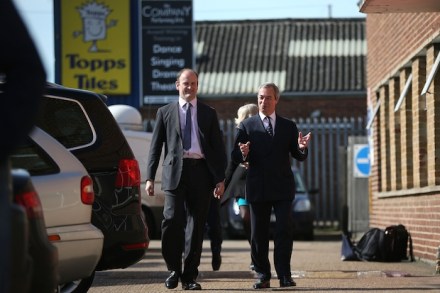
Nigel Farage is in Great Grimsby today, campaigning with Ukip candidate Victoria Ayling. The last Ashcroft poll focusing on Great Grimsby put Ukip behind Labour by one point, and that was in December 2014. Farage started his day at the docks before visiting a local fish market, to highlight the problems that the European Union's fisheries policies have caused in towns like Grimsby. But one of the questions is whether Farage can afford to be spending time away from South Thanet when his chances there are on a knife edge. Ukip has one safe seat, and that's Douglas Carswell's. Farage has to win his seat and the polls suggest he has a tremendous fight in order to do so.

Ed Miliband pledges to abolish non-dom tax status

Ed Miliband will tomorrow pledge to abolish the non-domicile rule which allows very wealthy people to avoid paying tax on much of their income. The Labour leader will say: 'There are people who live here in Britain like you and me, work here in Britain like you and me, are permanently settled here in Britain, like you and me, but aren’t required to pay taxes like you and me because they take advantage of what has become an increasingly arcane 200-year-old loophole. There are now 116,000 non-doms, costing hundreds of millions of pounds to our country, it can no longer be justified, and it makes Britain an offshore tax haven for a few.' The party isn't sure how much it would raise from this change, but that's not the point in any case.

The Tory ‘rally’ that wasn’t: these photos reveal how modern campaigning works

David Cameron took the stage at an election rally in Wadebridge, Cornwall this evening. He was surrounded by supporters waving placards. From the pictures, it seems there was a real sense of excitement about the Conservative party. But here are a couple of photos taken from a perspective that's a bit, er, different. The PM is currently holding a rally in Cornwall, in what appears to be a massive cow shed pic.twitter.com/eJh6RrnsQ6 — Niall Paterson (@skynewsniall) April 7, 2015 To give you a better idea of the size of this barn, and the size of the rally, the event is entirely behind this bus pic.twitter.