Isabel Hardman

Isabel Hardman

Isabel Hardman is assistant editor of The Spectator and author of Why We Get the Wrong Politicians. She also presents Radio 4’s Week in Westminster.

Nicola Sturgeon taunts ‘divided’ Labour party

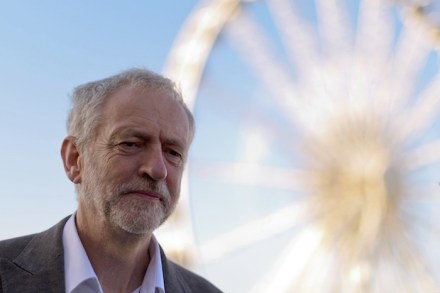
Remember those Tory posters that put a tiny Ed Miliband in Alex Salmond’s coat pocket? Well, it’s only five months since the general election, but Nicola Sturgeon doesn’t seem all that keen to put Jeremy Corbyn in her handbag. She seemed to suggest that she had given up on being able to work with the new Labour leader, saying: ‘You know, there is much that I hoped the SNP and Jeremy Corbyn could work together on. But over these last few weeks, it has become glaringly obvious that he is unable to unite his party on any of the big issues of our day.
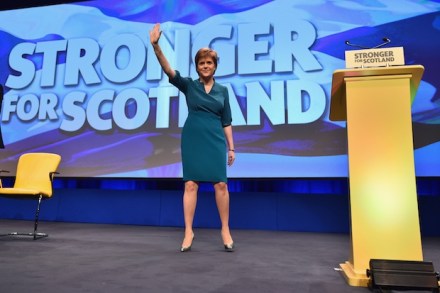
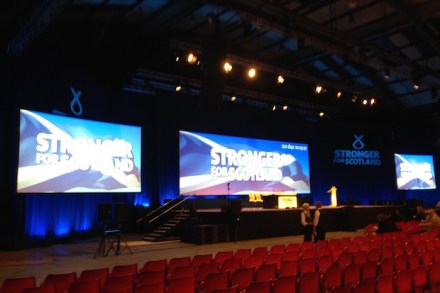
Nicola Sturgeon: SNP needs to talk about governing

SNP members are gathering for the first day of their party’s autumn conference in Aberdeen. The party is keen to trumpet quite how much has changed in a year, and it’s not just proud of its 56 MPs. Last night it released ‘figures showing the scale of its growth since the referendum’. These include the conference hall having four times as many seats as it did last year (from 1,200 to 4,765), the exhibition space is three times the size, there are three times as many fringe meetings and a media centre six times the size ‘to accommodate over 500 members of the media’. (The press room is a rather outdoorsy tent, incidentally). But the party has changed so much since its last conference.

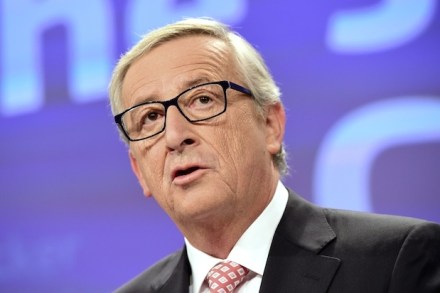
Jean-Claude Juncker accused of saying that the UK doesn’t need the EU

The 'Out' campaign in the EU referendum has seized on comments made by Jean-Claude Juncker where he appears to say that Britain doesn't need the European Union. He 'appears' to say it in the sense that the key word is rather muffled - and his team are insisting he said Britain does need the EU. You can listen to his comments in the European Parliament below, and it’s worth listening as it’s not clear whether he said ‘personally I don’t think that Britain needs the European Union’ or ‘personally I do think that Britain needs the European Union’. https://soundcloud.com/spectator1828/jean-claude-juncker-says-that-britain-does-not-need-the-eu His aides are insisting that he meant that Britain does need the EU.

Labour MPs prepare to rebel for first time against Corbyn: but it won’t change anything

John McDonnell has tried to explain why he U-turned on the fiscal charter this afternoon, saying that he has only ‘changed my mind on the parliamentary tactics’, not the principles of the matter. He told Sky News: ‘I have changed my mind, but I haven’t changed my mind on the principles of what the charter is standing for which is we need to tackle the deficit and we will tackle the deficit. Labour will tackle the deficit – we are not deficit deniers, I haven’t changed my mind on that. ‘But I have changed my mind on the parliamentary tactics.

Gove wins battle over Saudi prisons contract

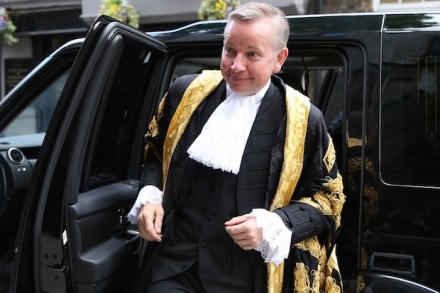
The government is pulling out of the £5.9 million deal to run a prison in Saudi Arabia, Number 10 has announced, after a row between two Cabinet ministers surfaced in the press. Downing Street also said that David Cameron was writing to the Saudi authorities to raise the ‘extremely concerning’ case of Karl Andree, a British pensioner sentenced to 350 lashes after being caught with homemade alcohol. But the Prime Minister’s official spokeswoman said that the Andree case wasn’t linked to the decision on the prison deal, and wouldn’t answer questions on when the decision was made.

Labour U-turn on fiscal charter to ‘underline our position as an anti-austerity party’

John McDonnell has just made his first U-turn as Shadow Chancellor, announcing that Labour will vote against the fiscal charter on Wednesday - having previously told the Guardian that it would support it. Labour’s support for the charter was previously to show that it wants ‘to balance the books, we do want to live within our means and we will tackle the deficit’, but in a letter today to MPs, McDonnell says: ‘I believe that we need to underline our position as an anti-austerity party by voting against the charter on Wednesday.’ Labour will publish its own statement on budget responsibility before the debate. The new politics does look rather like the old politics right now, with straight talking still apparently including rapid changes of heart.

What the Vote Leave campaign needs to do next

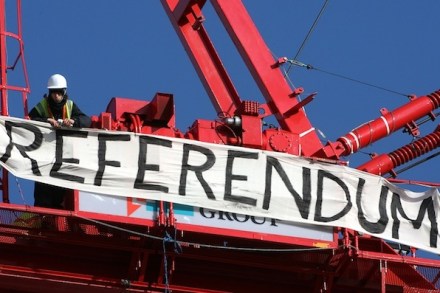
The cross-party ‘Vote Leave’ campaign launches today, with an impressive list of backers from politics and business. It is run by Matthew Elliot and Dominic Cummings, and has MPs from across the spectrum supporting it. This is what it needs to do next: 1. Get the official designation from the Electoral Commission. Vote Leave is the favourite to get the Commission’s funding, free mailing and campaign broadcasts. It is trying to underline that it is the better of the two campaigns - the other being Arron Banks’ Leave EU campaign - by showing off how many people from across the political spectrum it represents. 2. Work out what to do with Nigel Farage. Farage is one of the key figures who managed to make this referendum happen.

Labour justifies Corbyn’s Privy Council ‘snub’

Jeremy Corbyn is not attending today’s Privy Council meeting, which is being written up as a ‘snub’ in some quarters and dismissed as totally unimportant in others. The Labour leader’s spokesperson has issued this statement: ‘Although Jeremy was unavailable for today’s meeting, he has confirmed he will be joining the Privy Council. ‘As the Prime Minister and others did, it is far from unusual to miss the first meeting due to other commitments.’ Corbyn’s non-attendance is neither a snub nor totally unimportant. His spokesperson does make a good point that David Cameron didn’t cancel all other engagements in order to attend his Privy Council meeting and the Labour leader does intend to go.

What could the Conservative party offer a working class teenager from Moss Side?

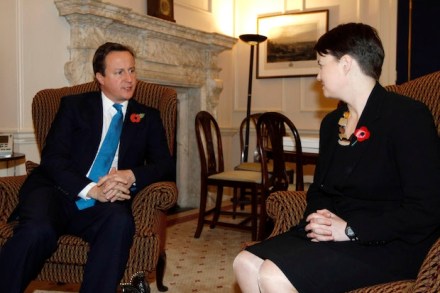
David Cameron had the best warm-up act possible today for his speech: before he was speaking, Scottish Tory leader Ruth Davidson had her turn. It’s a bit odd to describe someone who has been Scottish Tory leader since 2011 as a ‘rising star’, but the truth is that Davidson’s profile has been rising over the past year, and not just because of the Scottish referendum. Her speech was a pretty good demonstration of why this MSP should get an even higher profile in the Tory party across the UK: passionate, insightful, clear and human. Seb explains her key message, which was that the Tories cannot be ‘seen as decent technocrats’, here.

Who really won in the battle over right to buy?

David Cameron’s key policy theme in his conference speech was housing, and it included the announcement that the government is accepting housing associations’ offer of a voluntary extension of the right-to-buy to their tenants that allows them to avoid legislation. The Prime Minister said: ‘And in our manifesto, we announced a breakthrough policy: extending the Right to Buy to housing association tenants. Some people said this would be impossible. Housing associations would never stand for it. The legislation would never pass. ‘Let me tell you something. Greg Clark, our brilliant Communities Secretary, has secured a deal with housing associations to give their tenants the Right to Buy their home.

Tories could delay telling tax credit claimants how much money they’ll lose from cuts

The Tory revolt on tax credits looks likely to dominate this autumn. Many Tories across the party now regard this as conforming to a similar pattern as the 10p tax row under Gordon Brown, and few expect the cuts, which lower the threshold for withdrawing tax credits from £6,420 to £3,850 and speed up the rate of withdrawal as pay rises, to come to fruition in their current form. There are three camps of Conservatives on tax credits. There’s the large group who think the cuts seriously undermine their claim to be the party of working people and are wrong because they take £1,300 off those on low incomes, and will be altered soon enough.

David Cameron’s conference speech shows the essay crisis Prime Minister has finally planned ahead

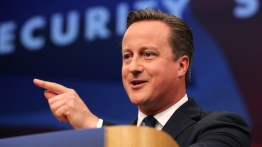
Clearly, the best thing a Prime Minister can do is announce that he doesn’t want to be Prime Minister for much longer. David Cameron has just delivered the clearest, most passionate and most authentic speech of his premiership to the Tory party conference, and all of it was founded on him not standing again as party leader in 2020. Early on, he said: ‘We’re only halfway through. For me, that has a very literal meaning. I can say something today that perhaps no Prime Minister has ever really been able to say before. I’m starting the second half of my time in this job. As you know, I am not going to fight another election as your leader. So I don’t have the luxury of unlimited time. Let me tell you: I am in just as much of a hurry as five years ago.

David Cameron makes home ownership the focus of his ‘turnaround decade’ conference speech

David Cameron’s conference speech today will include plans to increase home ownership, which has become a personal mission of both the Prime Minister and the Chancellor. The Tories convinced that people are more likely to vote for them if they are homeowners, and are well aware of polling that shows most people want to own their home in this country. So David Cameron will overhaul planning rules that his advisers believe slow down development - the section 106 requirements that mean developers must include affordable homes for rent in their plans - so that more homes that people can afford to buy are built. This reform will see the Tories trying to rebrand ‘affordable housing’.

Tory MPs grumpy about ‘arm candy’ photo rota

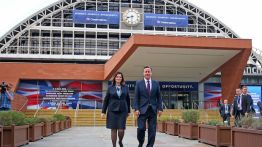
One of the fun jobs that new Tory MPs have to perform at conference is joining the special rota to follow David Cameron around. This isn’t a new rota, but it seems to have especially annoyed a number of the rather impressive 2015 intake, particularly some of the female MPs who think they are being used as arm candy. The rota involves walking with the Prime Minister between buildings so that when he is photographed, he has an entourage of supportive MPs with him, and so that they get their chance to have a picture of them walking with the PM in the national media. The photo above, of new Eastbourne MP Caroline Ansell, is one such example.

Boris Johnson’s bid to get back in the leadership contest

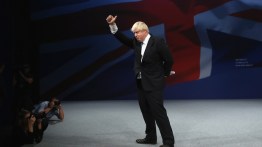
The Tory conference this year is so stage-managed that not only did the party manage the no mean feat of sending out a check-against-delivery text of Boris Johnson’s speech before he stood up, but the Mayor then stuck to that text almost entirely. That text contained new jokes, rather than recycled ones, and was the better for it. He made quite clear that he wasn’t giving up on the leadership contest, and that a difficult first term doesn’t mean he’s not a serious option to lead the party in the future. The reason Boris managed to show he was a serious option to lead the Conservative party was that he used those new jokes to show the appeal of Conservatism and the folly of the Left.

Theresa May has ‘quite a lot of explaining to do’ on immigration before the leadership contest

Theresa May will today claim that high levels of immigration make it ‘impossible to build a cohesive society’. The Home Secretary will tell the Tory conference that it’s not just about building more schools and homes to deal with immigration, but about driving those numbers down too: ‘Now I know there are some people who say, yes there are costs of immigration, but the answer is to manage the consequences, not reduce the numbers. But not all of the consequences can be managed, and doing so for many of them comes at a high price. ‘We need to build 210,000 new homes every year to deal with rising demand. We need to find 900,000 new school places by 2024. And there are thousands of people who have been forced out of the labour market, still unable to find a job.

George Osborne’s local devolution revolution

George Osborne is the man of the moment, the future Tory leadership contender who is riding high right now. So it was rather clever that instead of offering a showy speech to the Tory conference, the Chancellor announced a rather technical but big reform as his speech ‘rabbit’. His refrain throughout the address to conference was that ‘we are the builders’, and to underline that, he announced his National Infrastructure Commission which was trailed overnight. But he also announced reform to local government funding. This will see the abolition of the local government grant (it will be phased out), and in return councils will be able to keep all the rates they collect, with local authorities getting 100 per cent of their rates by 2020.

Low key atmosphere in Tory conference hall for low key leadership contest

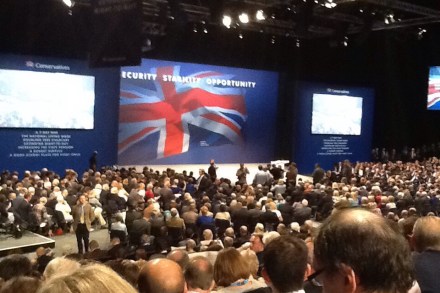
The cavernous hall housing the Tory conference speeches is not particularly conducive to a good atmosphere. All of the speakers so far this morning, including rising star Sajid Javid, haven't raised the roof, and the applause and standing ovations have felt rather polite and perfunctory, rather than excited and inspired. This might also be because a large number of delegates have spent a rather long time stuck in the rain waiting for someone to scan their bags in the security tent. Or it could be because none of the ministers speaking wants to appear too exciting, as too exciting means you are a threat to George Osborne, which tends to leave you in a messy place as a minister.

Major coup for Osborne as Lord Adonis resigns Labour whip to chair infrastructure commission

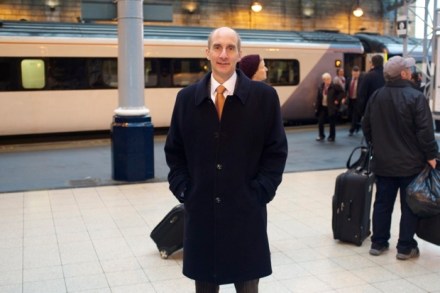
A key theme of this Tory conference will be the party running its tanks all over Labour’s lawn while the party indulges in splendid in-fighting. And George Osborne’s speech tomorrow will contain another big tank rumbling over another part of the party’s lawn. He has persuaded Lord Adonis to resign the party whip in order to become a cross bench peer and chair an independent National Infrastructure Commission. Adonis has issued this statement: ‘Without big improvements to its transport and energy systems, Britain will grind to a halt. I am pleased to accept the Chancellor’s invitation to establish the National Infrastructure Commission as an independent body able to advise Government and Parliament on priorities.