Gus Carter

Gus Carter

Gus Carter is the deputy editor of The Spectator’s US edition.

The Greggs delusion

Everything about Greggs is fake. You can smell it as you walk down any British high street. There’s an astringency, a hint that what lingers in those ovens is more than butter, flour, eggs and salt – that their food has been adulterated with something unnatural. What you’re smelling is an approximation of pastry, an attempt by the Greggs customer development unit to ‘curate an authentic baked goods experience’.  Of course, we all secretly know the food is fake. The texture of the baguettes suggest that they’ve been salvaged from a 1970s deep freezer found buried beneath a Midlands business park. And the fillings. All that slimy pink ham. The medical cross-sections of boiled egg.

The joy of colleague-cancelling headphones 

I’m writing this with headphones in, sitting at my desk on Old Queen Street. Please don’t tell Debrett’s. Apparently listening to headphones in the office is a huge faux pas, akin to cutting camembert with a fish knife. The company’s etiquette adviser, Liz Wyse, told the Times: ‘If you work in an open-plan office where there is frequent conversation and interchange of ideas between colleagues, do not wear AirPods or headphones.’  The worst thing that happens when zoned out on David Bowie is that a colleague has to wave near your eye line We will, she assures us, be ‘much more valuable staff members’ if we instead choose to ‘tune into conversations’ and ‘stay alert’. Beep boop. Jeeves3000 has spoken.

The joy of cheese rolling

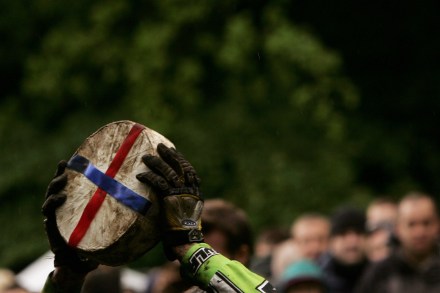
It’s unnerving being surrounded by a crowd in the woods. You can hear people but only glimpse their limbs or faces through the leaves. It triggers something primordial, similar to the feeling of being watched. Ideally, someone with a big strimmer would have given Cooper’s Hill a good going over before the cheese rolling. But cheese rollers don’t concern themselves with ideals.  My friends were shocked by the brutal pitch of the hill. Could someone really hurl themselves down that? On the last Monday of May, and for reasons lost to time, a wheel of Double Gloucester is thrown down the hill and a group of runners throw themselves after it. The first to reach the bottom gets the cheese.

Niru Ratnam, Gus Carter and Graeme Thomson

20 min listen

This week: Niru Ratnam argues that teachers are putting principles before children (00:59), Gus Carter discusses the curious business of fertility (08:14), and Graeme Thomson reviews Beyonce at Murrayfield Stadium (14:24).  Produced and presented by Oscar Edmondson.

Ukraine’s next move

39 min listen

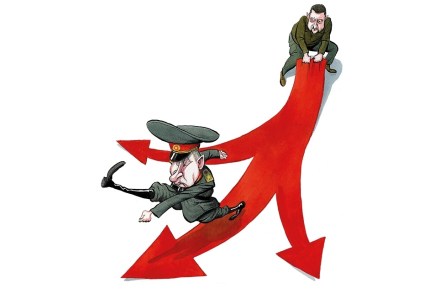
This week: In his cover piece, journalist Mark Galeotti asks whether Putin can be outsmarted by Zelensky’s counter-offensive. He is joined by The Spectator’s own Svitlana Morenets to discuss Ukraine's next move. (01:08) Also this week:  Journalist David Goodhart writes a moving tribute to his friend Jeremy Clarke, The Spectator’s much-missed Low Life columnist who sadly passed away earlier this week. David is joined by Cass Pennant and Freddy Gray, The Spectator’s deputy editor, to remember the life and writing of Jeremy Clarke. (12:52)  And finally: The Spectator’s deputy features editor Gus Carter writes this week about the curious business of fertility.

The curious business of fertility

I’ve always wanted children. Friends sometimes tease me about my broodiness, apparently uncommon among single 29-year-old men. But unless I’ve accidentally knocked someone up in the past few months, I’m going to be an older parent than mine were by the time they had me. I suppose that’s normal. The average age at which couples start a family has risen consistently since the mid-1970s. I’m told not to worry: look at Mick Jagger, whose youngest child was born when he was 73. Men don’t suffer from the same biological restraints as women. One acquaintance insists rather admirably that she’s going to have children by 25, regardless of the consequences. She also insisted on smelling me to test my pheromones and, therefore, our compatibility.

Britain is stuck in a fertility trap

Pope Francis wants you to have sex. Or at least he wants Italians to have more sex. The country, he says, is facing a ‘Titanic struggle’ against demographic doom. Last year, the population dropped by 179,000 people – and Italy is projected to lose another five million by 2050.  What’s happening in Italy is, to a greater or lesser extent, being repeated across the western world. In the UK in 2020, there were four workers per retiree. By 2041, the ONS projects there will be just three. We’re getting older, there are fewer of us and, all other things being equal, we’ll poorer for it. Either we tax the declining population more to maintain the same level of welfare or we will have to cut back on things like care and pensions.

Why I’ve fallen out of love with my Brompton

In the darkest depths of lockdown, trapped in a subterranean flat in South London, I struck upon an idea: I would buy a bike. I’d had one at university and remembered enjoying the meditative effects of gliding through parks and down streets. It would mean something to do other than fighting over who got to work at the kitchen table or staring mutely at our little telly.  I met the seller in a multi-storey car park in Woolwich. He popped his trunk, revealing a jumble of metal tubing and cables about the size of a suitcase: a foldable Brompton bicycle. As he lugged it onto the concrete floor, Taut explained that he loved the bike but had just bought a super-lightweight, modified Brompton. It was time to part ways.

James Heale, Mary Wakefield and Gus Carter

15 min listen

This week: James Heale says the gloves are off as Labour campaigning takes a bitter turn (00:54), Mary Wakefield worries that she’s raising a snowflake (17:47), and Gus Carter tells us about the colourful history of the green man (31:34).  Produced and presented by Oscar Edmondson.

The colourful history of the green man

All hail our pagan King! The time has come to lay down your crosses and take up the bough of oak. Britain is to return to the old ways – at least if you are to believe the conspiracy theorists, who were distressed to see, on the bottom of the coronation invitation sent out last week, the face of a green man staring back at them. His eyes are bright, his mouth exudes fronds of ivy – the green man calls to us. Depending on your particular view of the world, his inclusion is either an affront to Christian decency or a jolly salute to our monarch’s peculiarities. The green man is a playfully sinister envoy of the otherworldly. His face, either made entirely of leaves or a fleshy human screaming forth foliage, is carved into hundreds of parish churches.

Crash test: the new era of economic uncertainty

40 min listen

On the podcast: The Spectator's economics editor Kate Andrews looks back on a week of economic turbulence and asks whether we should be worried, for her cover piece in the magazine. She is joined by the economist – and former 'Trussketeer' – Julian Jessop, to discuss whether we are entering a new era of economic uncertainty (01:06). Also this week: In the magazine, The Spectator’s deputy features editor Gus Carter says that the culture of toxic masculinity has gone too far, and that young men are being marginalised in schools and online as they are repeatedly told that they are a danger to women. He is joined by the Times columnist Hugo Rifkind, to explore how today's sexual politics is impacting young men (13:21).

Sexual politics is damaging young men

Masculinity has been in crisis for as long as anyone can remember. The usual explanation is that post-industrial society doesn’t much care for brawn. We’re all office dwellers now, mutely churning out spreadsheets for other spreadsheet producers. The theory makes sense as far as it goes. But something else has changed much more recently: a rejection of the very concept of masculinity. The polling company YouGov found that just 8 per cent of people have positive views of white men in their twenties, by far the lowest of any ethnicity or age group. Males are routinely presented as inherently dangerous, aggressive and animalistic, incapable of controlling their own instincts. You can see it on public transport, where government adverts announce that staring is sexual harassment.

The madness of the lockdown trials

I think we can now admit that Covid sent us all a little loopy. Matt Hancock certainly seems it, handing over more than 100,000 highly sensitive texts to a hostile journalist. Today’s revelations show Hancock telling colleagues ‘we are going to have to get heavy with the police’. While everyone gets excited about the lockdown files, there are still plenty of lockdown trials going before the courts. Which, even if a gratuitous breach, seems a little pointless now. Rules are being enforced that are no longer in place. Rules that, the Daily Telegraph reports, weren’t based purely on ‘the science’.

Matthew Parris, Lionel Shriver and Gus Carter

24 min listen

On this week’s episode, Matthew Parris wonders what ‘winning’ in Ukraine really means (00:52), Lionel Shriver says she’s fighting her own war against words (08:43), and Gus Carter wonders whether it’s a good idea to reintroduce Bison into Britain (18:28).

Rolling in it: the return of Tory sleaze

43 min listen

Katy Balls, The Spectator’s political editor, writes about the return of Tory sleaze. She’s joined by Jill Rutter, a senior fellow at the Institute for Government, to discuss the problems piling up for Rishi Sunak and the Tories. (00:50) Also this week, security expert Mark Galeotti writes about why Europe has been reluctant to give Ukraine tanks. Journalist Owen Matthews and Ben Hodges, former commanding general of the United States Army (Europe), join the podcast. (18:44) And finally, Gus Carter, The Spectator’s deputy features editor, writes in this week’s magazine about bison being reintroduced into the UK. He joins the podcast with the environmentalist Stanley Johnson. (33:40) Hosted by William Moore. Produced by Oscar Edmondson.

Does Britain need bison?

The Blean is just north of Canterbury. It’s ancient woodland – mentioned by a couple of Chaucer’s pilgrims – now managed by a conglomerate of well-meaning wildlife trusts and charities. Drive through a small industrial estate and past a garage and you’ll reach the visitors’ centre. Beyond that is bison country. Four wild European bison now roam the 50 hectares of woodland and scrub, merrily smashing through young birch trees and tearing up the earth. They have been introduced as part of a rewilding project. The latest, the first male of the herd, was brought over from Germany two days before Christmas. Rewilding is controversial and easily mocked.

The paradox of Alan Watts

There’s an advert for cruise holidays on television at the moment. It’s all dolphins and dining halls and laughing women flashing their teeth. Above the tinkly swelling music is a familiar voice. It's the kind of clear English accent that might remind you of a compelling history teacher or vicar. ‘I wonder, I wonder, what you would do if you had the power to dream any dream you wanted to dream,’ he says. ‘You would, I suppose, start out by fulfilling all your wishes, love affairs, banquets, wonderful journeys. And after you’d done that for some time, you’d forget that you were dreaming.’  The voice belongs to Alan Watts. He’s a strange choice for a cruise advertisement.

Are you man enough to eat raw offal?

From our US edition

The dominant wolf gets the liver, at least according to the podcaster Joe Rogan. In one episode, a bodybuilder called “CarnivoreMD” (real name Paul Saladino) tells him: “If you eat liver, you get to be an alpha male... or alpha female.” Offal has taken a markedly macho turn in recent years. No longer consigned to memories of the postwar school cafeteria, organs have become the preferred food of a certain type of gym bro. The word “offal” implies wastage — from the Middle Dutch for offcuts — but it can also be a delicacy. Foie gras is only the most obvious example. For the most part, though, the West has become squeamish about what was once called “variety meat.” But a new wave of offal-lovers is reviving an interest in organs.

offal

Kemi Badenoch: ‘I’m Brexit fatigued’

Liz Truss wants growth at 2.5 per cent. That figure will allow the UK to pay off the huge cost of her energy subsidy – predicted at around £40 billion – while also putting the public finances on a more sustainable footing. The problem is that growth is elusive. Between the financial crash and the Covid lockdowns, the UK’s average growth rate was just 1.3 per cent.  One of the few sure-fire ways to grow the economy is trade. New markets give companies the chance to grow their sales purely by matching up new consumers with goods that they want. The power to do this, to set our own trade arrangements in a way that aligned with British interests, became a central argument in the Brexit debate.

Jenny McCartney, Dan Hitchens and Gus Carter

24 min listen

This week on Spectator Out Loud, Jenny McCartney argues that tomorrow belongs to Sinn Fein in Northern Ireland. What could this mean for reunification (00:55)? Then, Dan Hitchens asks why Oxford killed a much loved catholic college (11:44) before Gus Carter reads his notes on the tabletop game Warhammer (20:12).Produced and presented by Oscar Edmondson.