Gavin Mortimer

Gavin Mortimer

Gavin Mortimer is a British author who lives in Burgundy after many years in Paris. He writes about French politics, terrorism and sport.

Where did it all go so wrong for Emmanuel Macron? 

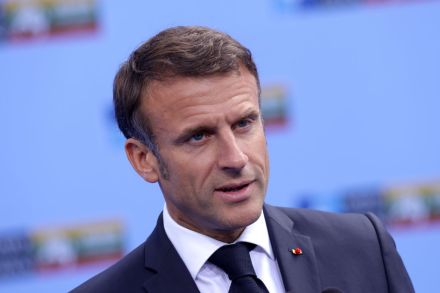
It is Bastille day in France but few people are in the mood for festivities. The riots of a fortnight ago have left physical and psychological scars that won’t heal anytime soon.    It is Emmanuel Macron’s seventh Bastille day as president, and his special guest this year is Narendra Modi, Prime Minister of India, chosen to mark the 25th anniversary of the strategic partnership agreed by the two countries.    France is more divided, more angry and above all more frightened than it has been in decades The day’s celebrations will end in the traditional way, with a grand display of fireworks, although the cynic might wonder if the French haven’t had enough of those in recent weeks.

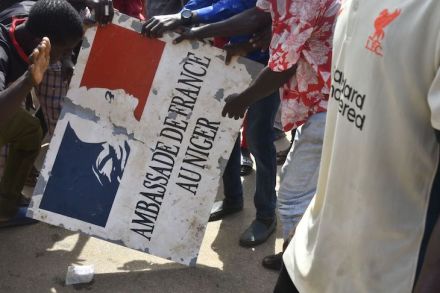
What was Algeria’s role in the French riots? 

In March 2012 a French Algerian called Mohammed Merah murdered three soldiers and shot dead three Jewish children and a rabbi in southern France; three years later two French Algerian brothers murdered the staff of Charlie Hebdo and later in the year men of Algerian heritage were among the terror cell that slaughtered 130 people in Paris. The two teenage killers of the elderly Normandy priest in July 2016 could also trace their lineage to that region of North Africa, and it is an Algerian woman awaiting trial who is accused of the horrific rape and murder of 12-year-old Lola last October in Paris.  These crimes elicited scant comment from Algeria.

Who really helped end the French riots?

It wasn’t president Macron who brought six days of rioting in France to an end, nor the brave bands of mothers who called for calm in some of the inner-city estates. It wasn’t even the presence of 45,000 police and gendarmes on the streets that persuaded the rioters, arsonists, vandals and looters to stand down. Instead, it seems that it was the drug gangs who decided enough is enough. Having so many boys in blue patrolling the streets was bad for business and so gang leaders exerted their influence and ordered the young hoodlums back to their bedrooms.  That, at least, was the news broken to Macron at the start of this week when he dropped by a police station in the 17th arrondissement of Paris.

France’s riots have left the country more divided than ever

There is a myth of France, specifically of its banlieues, that has been frequently repeated in recent days. Descriptions of ‘marginalised suburbs’, ‘ghetto-like suburban estates’ and of ethnic minorities ‘shunted away into suburban housing projects…out of sight and out of mind’ have emerged in the international media. It’s even been suggested in one British publication that rising food prices were to blame for the riots.  Nanterre, where 17-year-old Nahel was shot dead by a policeman eight days ago, has some tough estates but it not a ghetto abandoned by the French state. The housing estate where Nahel lived was built in the late 1970s and at the time was considered ‘an emblematic project of democratic urban planning’.

France’s riots are fuelling division over Europe’s migrant crisis

The riots that have ravaged France in recent days have given Eric Zemmour a second wind. The leader of the right wing Reconquest party has been on the airwaves and in the newspapers, saying, with a touch of schadenfreude, ‘I told you so’.  In a television interview on Saturday evening, Zemmour explained that the reason he entered politics in late 2021 was because of what he described as the Republic’s twenty-year policy of ‘crazy mass immigration’. It was the issue on which he campaigned during last year’s presidential and parliamentary elections. Unlike Marine Le Pen and her National Rally party, Zemmour barely mentioned the cost of living crisis; immigration and Islam were his main agenda.

France wants Macron to send in the army

Nearly three quarters of French people think it’s time for President Macron to send in the army to restore order to the towns and cities that have been sacked in recent days. According to a poll published yesterday, 70 per cent of people said they wanted the military to be deployed to areas that have been looted, vandalised and firebombed since police shot dead a 17-year-old in western Paris on Tuesday morning. The teenager, Nahel, was laid to rest on Saturday afternoon but it remains to be seen whether the furious reaction to his death – for which a policeman has been charged with voluntary manslaughter – will abate in the coming days.

Is it safe for France to host the Rugby World Cup?

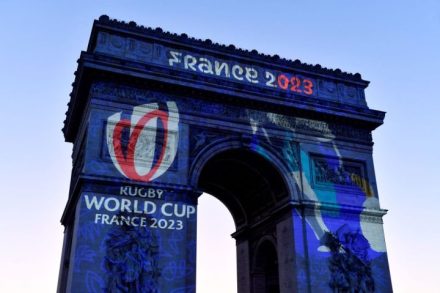
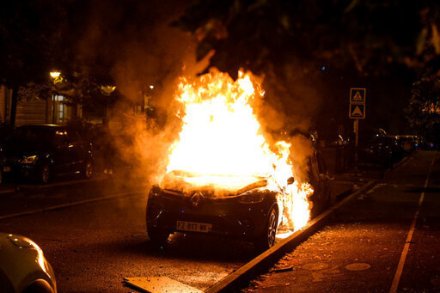
The Rugby World Cup kicks off in just under ten weeks with hosts France playing New Zealand in the Stade de France. The national stadium sits squarely in Seine-Saint-Denis, a district which yesterday was smouldering after a night of anarchy. Shops were looted, cars torched and a bus station destroyed in an orgy of violence that was replicated across the republic.   President Macron cut short a trip to Brussels for a crisis meeting with ministers and security chiefs in Paris on Friday morning, and he reportedly said there will be ‘no taboos’ in doing what is necessary to restore law and order. Further details will be forthcoming but there is no indication at this stage that a state of emergency will be declared, as many on the right have demanded.

France is in danger of descending into anarchy

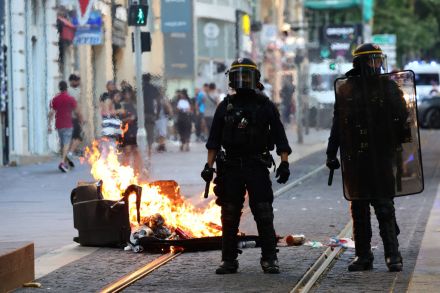
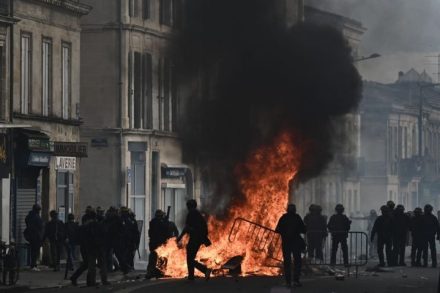
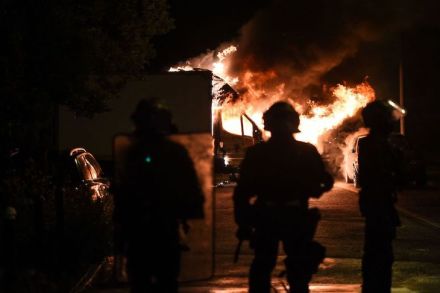
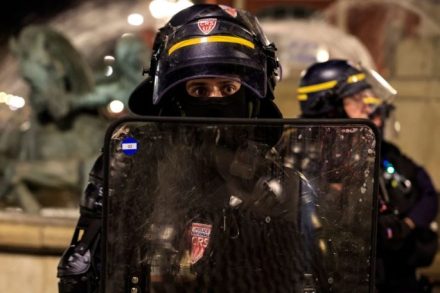
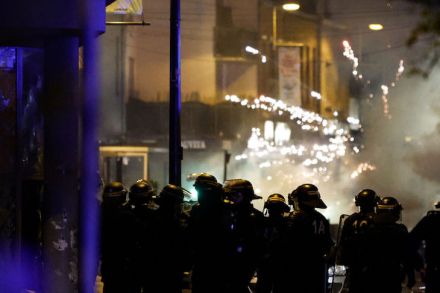
France endured its worst night of rioting yet on Thursday as violence continued across the country. For the third consecutive evening, youths went on the rampage in most major cities, despite the presence of 40,000 police. Shops were looted, town halls attacked, police stations firebombed and vehicles were hijacked in extraordinary scenes of urban warfare. The police fought running battles with mobs and made 421 arrests, over half of which were in the capital. The epicentre of the anarchy was in Nanterre, in the west of the city, where on Tuesday morning 17-year-old Nahel was shot dead by police as he sped away from a traffic stop.  The officer who fired the fatal shot has been charged with voluntary manslaughter and remanded in custody.

France is a country in chaos

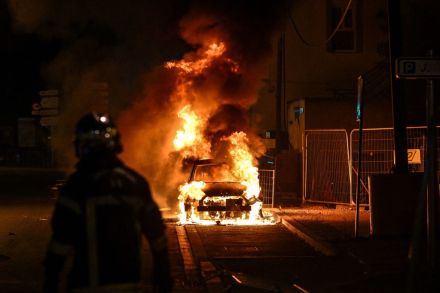
Emmanuel Macron is facing arguably the gravest crisis of his presidency after another night of rioting across France. Much of the trouble was in the Paris region, particularly Nanterre, to the west of capital, where on Tuesday police shot dead a 17-year-old after he sped away from a vehicle checkpoint.   On a night of extreme violence, police cars were torched, police stations mortared, shops pillaged, trams destroyed and an attempt was made to storm a prison at Fresnes. Dozens of rioters were arrested in Paris, but there was also disorder across France, from Lille in the north to Lyon in the east to Toulouse in the south.

France erupts in violence after police shoot dead a teenager 

Much of Paris was a battleground on Tuesday evening as scores of youths rioted following the fatal shooting of a teenager by police. The 17-year-old, Naël (some reports spell his name as Nahel), was stopped by police at approximately 8.30 on Tuesday morning because of his erratic driving. According to reports, Naël had previous convictions for failing to stop at a checkpoint and driving without a licence. As two officers questioned the teenager through the window, the vehicle sped off and shots were fired. One hit Naël in the chest and he died at the scene.

Europe is shifting rapidly to the right

‘The left is sweeping to power across Europe,’ suggested the headline in the Independent in September 2021. The newspaper called on the analysis of Denis MacShane, the former Labour MP, to explains to its readers why this was so. MacShane posited that the election of Joe Biden as US president had reinvigorated the left-wing electorate while the population at large were voting for parties who were dealing with climate change most vigorously.   Eighteen months later and red has become an endangered colour in European politics. The latest blow to the left was in Sunday’s Greek general election; not only was the centre-right Prime Minister Kyriakos Mitsotakis re-elected with over 40 per cent of the vote, but the newly-formed Spartans took 12 seats in parliament.

France shouldn’t lecture anyone

Numerous heads of state from the third world are in Paris for a summit hosted by President Macron. The aim of the conference – or the Summit for a New Global Financing Pact to give it its full lofty name – is to ‘address the needs of developing countries in the fight against poverty.’ Is France, or indeed the rest of the West, in a position to dish out advice to developing nations?   The days of Europe being able to lecture developing countries about efficiency, integrity and prosperity are long gone. It was bleakly ironic that on the eve of the summit Paris was rocked by a huge gas explosion that blew apart a building in the fifth arrondissement, injuring dozens of residents. It’s the second such incident in recent years.

Is Macron having a Meloni makeover?

Emmanuel Macron never does anything by chance, so why did he allow himself to be filmed downing a beer in one on Saturday night? The clip, which has gone viral, has angered puritanical progressives. Green MP Sandrine Rousseau has branded Macron’s behaviour ‘toxic masculinity’.  The president of the French Republic slaked his thirst just before midnight in the dressing room of the Toulouse rugby team in the Stade de France. Toulouse had beaten La Rochelle to win the French rugby championship, an event at which Macron had been introduced to the players before kick-off. He ducked out of a similar invitation in April at the final of the French football cup, worried that the heckling would shake the stadium’s rafters.

Is Isis preparing to exploit Europe’s open borders?

There is a growing sense of unease in France that a new wave of Islamist terrorism will soon break over Europe. In February, Adel Bakawan, a Franco-Iranian specialist in Islamic extremism, said that the Islamic State is regrouping and is planning a mass casualty attack in ‘Berlin, London or Paris’. This week Thibault de Montbrial, president of the Centre for Reflection on Homeland Security, spoke in similar terms during a radio interview.   While Isis, or the Islamic State, no longer has a caliphate as it did between 2014 and 2019, it still has many fanatical followers scattered in Iraq, Syria and Afghanistan.

Berlusconi was the first leader to glimpse the looming migrant crisis

Silvio Berlusconi should be remembered for more than just his passion for football and sex. He was the first European leader this century to identity illegal immigration as an existential threat to the stability and cohesion of the continent.   Ironically, the former Italian prime minister’s infamous ‘Bunga-Bunga’ parties reportedly owed their name to a joke once told to Berlusconi by Colonel Muammar Gaddafi, a man who was also acutely aware of Europe’s vulnerability.  The two leaders were close, a friendship that became politically important when Berlusconi was re-elected PM in April 2008. A significant factor in his victory was illegal immigration from Africa, which had been steadily rising since the start of the century.

The betrayal of Annecy

The Green mayor of Annecy, François Astorg, declared a fortnight ago that his town in the south-east of France was ‘a land of resistance against fascism, a land of solidarity, a refugee town for those fleeing war, misery and the unhappiness in the world’.   On Thursday, Astorg, expressed his ‘immense sadness’ and his ‘anger’ hours after a Syrian refugee ran amok in a park in Annecy, stabbing six people including four toddlers. ‘It’s the first time this has happened in Annecy,’ declared Astorg. ‘It’s unacceptable’.   The mayor has said that there will be a rally to bring the town together; the cynic is entitled to ask 'what is the point?

France comes under attack again

What kind of man walks into a park on a summer’s day and randomly stabs and slashes at toddlers? That is the question France is asking itself today after the latest in a long line of bloody atrocities. The scene of this morning’s attack was in Annecy in south-eastern France, a popular holiday resort. An eye-witness said that a man 'started shouting and went straight to the pushchairs and stabbed the children repeatedly.' At least three children were stabbed, along with a young woman believed to be a mother. The numbers of victims would have been higher had the police not arrived in just four minutes. As they entered the park, recalled another witness, the assailant 'ran straight up to an old man who was with his wife and stabbed him'.

The European left’s fascism fantasy

France, Sweden, Italy, Finland and now Spain. The demise of the left in western Europe continues apace and yet their only solution is to seethe about fascists in a make believe world of their own.   Nine months after Giorgia Meloni was elected Prime Minister – remember the hysterical warnings about her being Mussolini in heels – the only horror the Italian left has experienced is electoral wipeout. At last weekend’s local elections, Meloni’s conservative Brothers of Italy party romped to victory in many towns that were once staunchly Socialist. As a jubilant Meloni crowed: ‘Strongholds [of the left] no longer exist.

France’s failure to tackle migration is a warning to the Tories

Perhaps the most illuminating comment made by Nigel Farage during his discussion with Fraser Nelson on Spectator TV earlier this month was when he reflected on the Brexit campaign. 'I remember being told, by [Daniel] Hannan and Boris Johnson, "no, no, don’t discuss immigration in the referendum",' reminisced the former leader of UKIP. '"We’ll lose the referendum. Some of our very posh friends don’t like this sort of thing".'  It's not just posh Tories who blanch at the mention of the ‘I’ word; so do posh socialists, which explains why immigration is now out of control in the UK. The vast majority of MPs, if not all strictly ‘posh’, certainly hail from the middle-class graduate class.

French sport has been plunged into crisis

The head of the French Olympic Committee has resigned just over a year out from the Games’ opening in Paris. Brigitte Henriques announced her decision at the Games’ committee's general assembly, the result according to the French media of ‘a year-and-a-half of internal squabbling.’ There was much fanfare when Henriques was nominated to the role in June 2021, winning 58 per cent of the vote to triumph over her nearest rival, the former Judo Olympic champion Thierry Rey. The then 50-year-old Henriques was lauded as the first female president of the French Olympic committee, the culmination of a career that had included a stint as the vice-president of the French Football Federation. ‘I want to dedicate this victory to all women, particularly my daughters,’ she said.