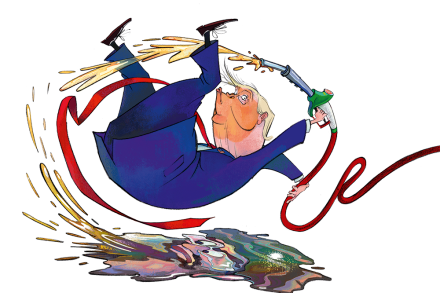
How real is the ‘Trumplash’?
Freddy Gray is in DC and is joined by Dan McCarthy from the Heritage Foundation to discuss why the Iran war is unpopular in America; the significance of China ahead of Trump's visit; plus NATO, Europe & 'Trumplash'.
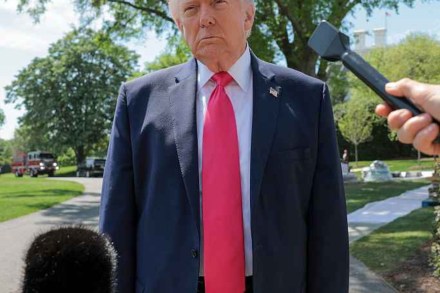

Freddy Gray is in DC and is joined by Dan McCarthy from the Heritage Foundation to discuss why the Iran war is unpopular in America; the significance of China ahead of Trump's visit; plus NATO, Europe & 'Trumplash'.
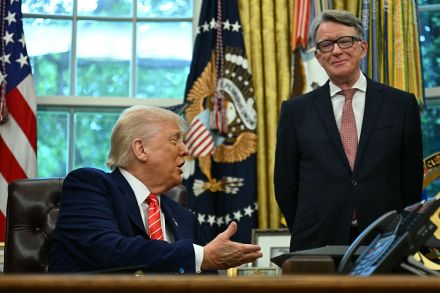
As public messages of support go, it scored pretty low on the conviction-o-meter. ‘Prime Minister Keir Starmer of the United Kingdom acknowledged that he “exercised wrong judgement” when he chose his Ambassador to Washington,’ said President Donald Trump on Truth Social last night. ‘I agree, he was a really bad pick. Plenty of time to recover, however! President DJT.’ Uh oh. None of the trademark capitalisation, which suggests Donald’s heart isn’t really in it. Some aide must have just spoken to him about Keir Starmer’s Peter Mandelson crisis, or perhaps a news story came to his attention.
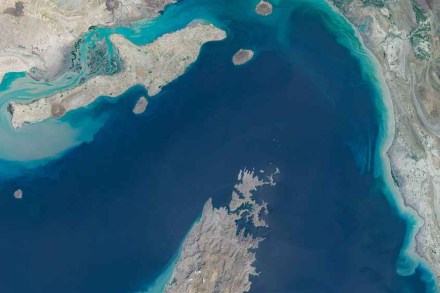
A ceasefire between Israel and Lebanon has just come into effect. Iran’s Foreign Minister says 'in line with the ceasefire in Lebanon, the passage for all commercial vessels through Strait of Hormuz is declared completely open for the remaining period of ceasefire'. Freddy Gray is joined by Spectator contributor Charlie Gammell, an expert on Iran, to discuss the negotiations and why they originally broke down plus what a post-conflict Iran could look like.
From our US edition
In America, important men don’t seem to suffer too much over their links to the late Jeffrey Epstein.Bill Clinton, Bill Gates, Donald Trump, Howard Lutnick and Paolo Zampolli, among others, might regret their past friendships with the world’s most famous sex criminal. Certainly, they resent having to face pesky questions about it.But the story just rumbles on, darkly, a source of endless intrigue and gossip and conspiracy theories – sustained as it is by the occasional publicity jolt, such as last week when First Lady Melania Trump, apparently without the knowledge of her husband, decided to give a big public statement denying that she, er, something something Jeffrey Epstein.
25 min listen
Donald Trump’s latest clash with the Pope has stunned even the more hardened of America-watchers. According to the President of the United States Chicago-born Pope Leo XIV, the spiritual leader of 1.3 billion people, is 'WEAK on crime and terrible on foreign policy.' He also claimed that, 'If I wasn’t in the White House, Leo wouldn’t be in the Vatican.' Is the war in Iran the only reason the Pope and the President have clashed? And what does it tell us about religious relations in the US today? In a special podcast collaboration, the host of Holy Smoke Damian Thompson and the host of Americano Freddy Gray discuss the dispute. Produced by Patrick Gibbons and Natasha Feroze.
50 min listen
The Pope is 'WEAK on crime and terrible on foreign policy' – this was the verdict of the President of the United States this week, as he appeared to deepen his row with the leader of the Catholic Church. In the magazine this week, Damian Thompson reports on why the President appears to have engaged in his own Holy War with the leader of 1.3 billion Catholics around the world. For this week's Edition, host William Moore is joined by deputy editor Freddy Gray, commissioning editor Lara Brown – and the former Archbishop of Canterbury, Rowan Williams. Baron Williams, now retired from the Lords, fears there is something 'demonic' in the political culture of the United States right now, as people appear to twist Christian teaching to justify their own causes.
Donald Trump’s latest clash with the Catholic Church stunned even the most hardened veterans of culture-war X. According to the President of the United States, the Chicago-born Pope Leo XIV, the conspicuously holy spiritual leader of 1.3 billion people, is “WEAK on crime and terrible on foreign policy.” He also claimed, “If I wasn’t in the White House, Leo wouldn’t be in the Vatican.” Spectator associate editor Damian Thompson joins Freddy Gray to discuss the dispute.
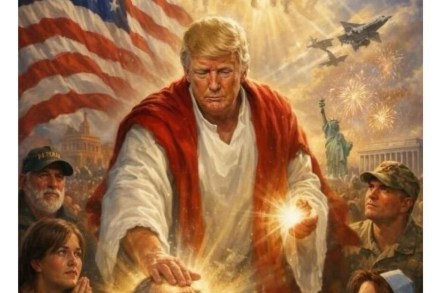
Freddy Gray speaks to Shadi Hamid, author of the book The Case for American Power, which explores – and puts forward – the case for American power in spite of Donald Trump.
From our US edition
A useful rule, when trying to understand current affairs, is AAL: Acronyms Always Lie.A case in point would be the acronym of the year so far: TACO (Trump Always Chickens Out). It means that Donald Trump is always bluffing and, when push finally comes to shove, he folds.TACO has caught on since Liberation Day and the onset of Trump 2.0’s tariff agenda, and is now deployed again and again to describe the President’s latest ceasefire with Iran. Over free trade, Greenland, and the Middle East, he’s shown himself to be a playground bully who loves to intimidate adversaries only to cave whenever the going gets tough.
30 min listen
Freddy Gray is joined by Jacob Heilbrunn, Americano regular and editor of the National Interest. They discuss the Strait of Hormuz, rising energy prices and whether the US can extricate itself from a conflict it may not be able to win – and whether we're watching the end of Trumpism.

From our US edition
Will America’s ground invasion of Iran begin in the early hours of tomorrow? Everybody knows, by now, that Trump likes to initiate action late on Fridays, after the markets close. And late last night, the so-called Pentagon Pizza Watch channel – which monitors late-night food orders from the Pentagon for evidence that something big is afoot – reported a surge of activity, leading to all sorts of prediction-market bets that a new military operation would start this weekend. Of course, with so much money to be made on war gambling – there’s now a Polymarket "situation room" bar in Washington, DC – the odds of someone trying to dupe the markets are short.
33 min listen
Steven Crowder, host of Louder with Crowder, joins Freddy Gray to discuss the warring factions in the podcast world, worsened since Charlie Kirk's assassination; the global leftwing alliance promoting communism in Cuba, whether Trump was wrong to attack Iran & why Mark Carney kowtowed to China.
From our US edition
On Friday night, Donald Trump announced that America was “very close to meeting our objectives as we consider winding down our great military efforts in the Middle East.” He even pinned the announcement to the top of his Truth Social account to make sure everyone realized he meant it. That did little to settle the markets over the weekend, however, so this morning he took to Truth Social again to go further in ALL CAPS: The lingering fear is that the truth may be more TCCO (Trump Can’t Chicken Out) I AM PLEASED TO REPORT THAT THE UNITED STATES OF AMERICA, AND THE COUNTRY OF IRAN, HAVE HAD, OVER THE LAST TWO DAYS, VERY GOOD AND PRODUCTIVE CONVERSATIONS REGARDING A COMPLETE AND TOTAL RESOLUTION OF OUR HOSTILITIES IN THE MIDDLE EAST.
From our US edition
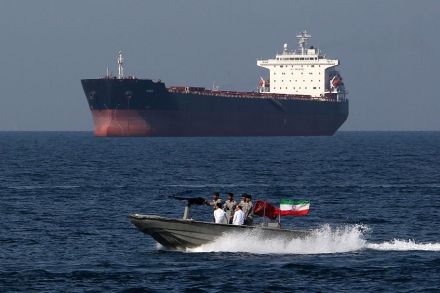
"Whoever rules the waves rules the world" – Alfred Thayer Mahan. Would Donald Trump have attacked Iran on February 28 if the Supreme Court had not ruled against his tariffs on February 20? The two issues may seem unrelated. Yet, as a fascinating piece by Captain John Konrad has pointed out, a closer inspection of Trump’s international agenda reveals his administration’s intense focus on trade, energy and maritime control – and that might help explain the otherwise inexplicable folly of the situation in the Strait of Hormuz. Trump is determined to bring about an American Golden Age. That involves controlling gas and oil, aggressively reducing China’s expanding control of shipping lanes, and establishing US dominance over key maritime chokepoints.
31 min listen
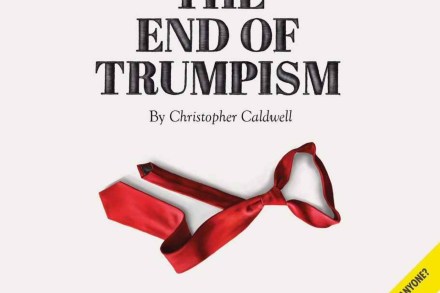
The attack on Iran is so wildly inconsistent with the wishes of his own base that it is likely to mark the end of Trumpism as a project. Freddy Gray is joined by Spectator columnist Christopher Caldwell to discuss Trumpism, JD Vance vs Marco Rubio, what's left of the Republican party after Trump, and the competing ambitions of Israel and Iran.
22 min listen
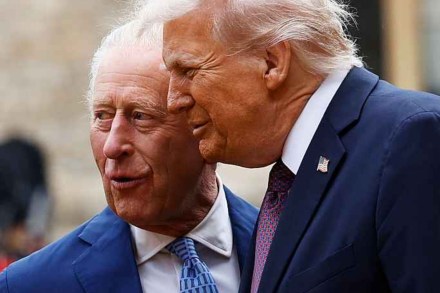
King Charles is due to travel to the US on a state visit to see President Donald Trump. Given the turbulence between Starmer and Trump over the war in Iran, some politicians such as Ed Davey have suggested the King should not go. Freddy Gray speaks to royal author and Daily Mail journalist Robert Hardman about the history of controversial state visits, why Donald Trump loves the royal family, and how King Charles navigates his royal duties and subtle influence over leaders.
30 min listen
Freddy Gray speaks to James D. Boys, author of the new book US grand strategy and the madman theory. He is also a senior research fellow at UCL. They discuss the origins of the madman theory – which applies insights from psychology to understand how your enemies think. James covers it from from Nixon to Trump and its intellectual home in Boston. They also explore how the madman theory is being applied in the Middle East conflict and how regularly the theory can be misapplied.
30 min listen
Freddy Gray speaks to Roger Kimball, editor of the New Criterion and Spectator writer about Trump’s SAVE act - a bill to tackle voter integrity soon to be voted on in the Senate.
Remember Signalgate? It was quite the story, and worth revisiting now in light of Operation Epic Fury, the ongoing crisis in the Strait of Hormuz and its dire implications for the global economy. In March last year, Donald Trump’s then National Security Advisor, Mike Waltz, somehow added Jeffrey Goldberg, the editor-in-chief of the Atlantic, to a Signal messaging group for senior government officials to discuss top secret military action against the Houthis in Yemen. The group included the Vice President J.D. Vance, Secretary of State Marco Rubio, Defense Secretary Pete Hegseth, Director of National Intelligence Tulsi Gabbard, White House Chief of Staff Susie Wiles and deputy chief of staff Stephen Miller, among others.
‘Donald Trump is a complicated person with simple ideas,’ said Kellyanne Conway, the former White House senior counsellor. ‘Way too many politicians are the exact opposite.’ It’s a good way of understanding the 45th and 47th US President and his extraordinary success. His turbulent personality causes mayhem, yet his political aims have remained constant, straightforward and popular. Decades ago, as a New York tycoon with a keen eye on international affairs, he identified three priorities for America: tackle the nation’s trade imbalances, force Nato allies to spend more on defence, and destroy terrorists. When it comes to realising those simple ideas, however, his more complex attributes emerge.