Fraser Nelson

Fraser Nelson

Fraser Nelson is a Times columnist and a former editor of The Spectator.

The Brown bust: tax

British households are far less able to deal with the credit crunch because taxes have risen by the equivalent of £6,520 per household compared to 1996/97 levels. This ratcheting up of the tax burden has been a steady feature of the Brown years but it is being felt with particular force now. During the boom years, homeowners felt richer as their house price rose at the fastest rate in the OCED and borrowed massively. So now, when the debt tap is choking, millions of households are right up against it because of this higher tax take. A tax cut is, of course, how to help people facing soaring food and fuel bills. But Brown has spent the money, and the bank bailouts mean even further tax rises.

Brown’s new plan to bring down the debt

I am hearing that Brown is to make up his own debt measurement, after losing a battle to have Northern Rock struck from the official national debt. It will be used in the pre budget report, exclude Northern Rock, and would show the figure Harman gave in PMQs today, national debt falling from 43 percent to 37 percent. It sounds implausible; it is one thing to fiddle your own golden rule, another to produce a fake national debt series so you can get around an ONS ruling. So I am treating this rumour with suspicion. I mean, he couldn't. Could he?

The Brown bust: Unemployment

How bad can unemployment get during the Brown Bust? Predictions of two or three million unemployed miss an important point. The concept of the “dole” has changed: unlike in the 1980s it has become a way of life, as well as a safety net. There were 5.2 million on out-of-work benefits last February of which just 806,000 were claiming unemployed benefit. The number of out-of-work, working-age people sustained by the workforce could break six million next year. The progress on tackling what Beveridge memorably called the “giant evil” of idleness was woeful – mainly because 81 percent of the new jobs were either created or taked by immigrants. They may go home, but the British jobless will still be with us.

The illustrated guide to the Brown bust

The Brown Bust: house prices This is the first in a short series on the illustrated Brown Bust, we’ll show you graphs looking at the various aspects of the bursting of the Brown Bubble. After failing to control monetary policy – giving the Bank of England an inflation-only remit – the out-of-control money supply led (as it always does) to an asset bubble which has now burst. This graph shows how spectacularly. In little over a year, UK houses have fallen by 14 per cent - more than they did in six years under the Tories. Both lines are rebased to 100, with 100 being the peak of the market and months along the bottom.

PMQs live blog

Harman v. Hague with Fraser Nelson from noon: 12:00 I’m still cross with William Hague for pitching up at that Lake Como villa at the Barclays Wealth shindig that was in the papers before he left. Utter idiocy. Sure, he arrived on its last day to accompany his wife who works there. But his political instincts should have told him to stay a million miles away, when the event got in the tabloids as a fat cat extravaganza. So his stand-up comedy at PMQs had best be good today. 12:05 Hague back again on Chapter 11, this time with FSB backing “would save thousands of jobs from going under”. “Nor should he write our economy off” – Harman has obviously been briefed this line by No10 as a catch-all when Tories attack.

It is grim out there in the real economy

As Gordon Brown says, Britain is indeed “leading the world” – but into recession, a property market collapse and soaring unemployment. This—not the stock market indices which mesmerise a bewildered House of Commons—is what matters. Take today’s inflation data – it shows a 30 percent rise in electricity prices, 40 percent for fuel prices and 50 percent for gas prices. And that’s before the winter sets in and everyone puts their central heating on. Food inflation is 13 percent and within that meat is up 20 percent. Globalisation continues to push down the costs of imports in relative terms, so overall CPI inflation is 5 percent.

He’s just making it up now

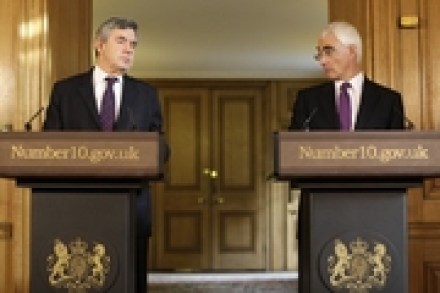
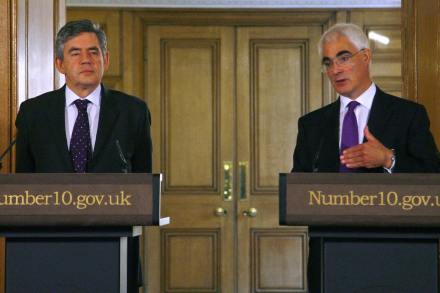
Another breathtaking Brownie at the Prime Minister’s press conference today: “I have to say we face this situation with relatively low national debt because of the steps we have taken since 1997, where we wiped off perhaps more than around £100 billion of debt by reducing the proportion of debt in our national income.” Huh? The ONS is unequivocal: net debt was £351bn in May 1997 and £632bn in August – or £545bn if you exclude Northern Rock. So where is his “wiping out” of £100 billion? Normally with a Brownie you can see how he cooked up the fake figure. But this time, it really does look like he just made it up. Consider this for a moment.

Does the credit crunch weaken the case for Scottish independence?

So what would have happened to the Royal Bank of Scotland and HBOS had Scotland been independent? The Scotsman quotes an anonymous Edinburgh banker saying “HBOS would have gone bust and RBS would have followed five days later. The Scottish state simply wouldn't have enough money to rescue two banks of that size as Iceland has done. As it would have been a Scottish problem rather than a British one – they'd both have gone to the wall.” In The Times, Jenny Hjul seductively argues that Iceland’s bankruptcy and Ireland’s woes expose the dangers of the small country model. Salmond even mentioned Iceland as a lodestar. He floated £100m – yes, million - as a HBOS bailout package, bless.

What to expect from the Euro-zone meeting

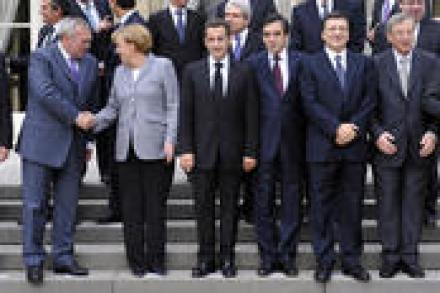
The Euro summit is underway now, and I’ve spoken to a few of my better-informed contacts about it. Here are some thoughts:-   1)      The bailout model they’re meant to agree to in Paris does, indeed, seem to be that of Sweden ‘92. It’s being called that in France and Germany, but you can bet Brown will be calling it the British/Brown Model – he’s on a relentless mission to make political capital out of this. 2)      It is worth someone (like Cameron) pointing out that the UK is probably in the worst position of the EU countries. Not only were our banks the most over-extended but our household debt is the highest any G7 country has already seen.

Is Brown’s plan to rescue the world’s financial system really his?

Not content with saving us poor souls in Britain, our Dear Leader now wants to save the world – and says so in tomorrow’s Times. He is demanding that other dithering countries copy his bold plan. It’s become the major theme of Saving Private Gordon – that the rest of the world will be inspired by the Dear Leader and show their love for him by adopting a similar bank recapitalisation scheme. Brown has mentioned the international element of this so often that I have started to smell a large, whiskered rat and I’d like to run a theory past CoffeeHousers. Gerard Baker tells us that the G7 had been talking about a co-ordinated response to the financial crisis.

Questions, questions, questions

Ben Brogan in today’s Daily Mail goes on precisely the right theme: translating these squillions into the real money - £16,000 per punter. The “that’s our money” anger picked up in the vox-pops around the country from members of the public has no echo in Parliament. This worries me – there’s something like £400 billion at stake here, and more scrutiny is required. It’s times like this I wish we had an American system, with a directly-elected prime minister, appointed Cabinet and separate legislature with its own mandate. America had plenty voices speaking up for its deeply suspicious taxpayers. In Britain, we don’t. I’m not saying I’m against the bailout.

A Swedish-inspired plan

Sweden really does rule. What Mervyn King and Gordon Brown have agreed today is, essentially, the Swedish 1992 bank bailout plan, (NYT write-up here). It was authored by the same conservative government which introduced the voucher school model that the Tories are proposing to replicate. While the UK bailout is comparable to the Paulson plan in the US (adjusting for the size of the respective economies) in terms of scale, it is a far better plan. And this is where Gordon Brown does deserve some credit. Instead of buying toxic waste, as Paulson proposes, the UK taxpayer is injecting capital and taking preference shares. This means that if the economy turns around, the UK shareholder will be first in line for the dividends.

Interest rates set to keep falling

Had six central banks not agreed to cut interest rates by the same amount today –50bp – I suspect the Bank of England would have gone lower. We’re at 4.5% now but we’re probably on a downward track to 3.5% or even 3.25%. Great news if you’re on a variable mortgage anchored to the base rate, but we’ll see how the interbank rate reacts. There is still much we have to learn, including how this £50bn bank bailout will be financed. Darling’s Mais lecture is tonight (delayed from last night) where he’s likely to tell us about a new set of rules for the age of debt which will dominate the next government.

PMQs report: Brown gets away with it

It’s unfair to say Brown “won” PMQs because Cameron decided not to play. There was a distinct air of national crisis to PMQs which, of course, helps Gordon Brown. Few amongst us would be so bold as to think the taxpayer will see this £50 billion again, but David Cameron was not going to point this out. His problem through all of this is an inability to say what he’d do differently. The rating of leaders rises during wartime, fear heightens collectivist instincts so this all benefits Brown. His mission is to talk up this idea of an economic war – but at the moment he doesn’t need much help. Funny that the US Congress was in revolt over the Paulson bailout plan - taxpayers’ money bailing out bankers etc -  but hardly a peep from our lot.

Amid the financial turmoil, Peter versus George is the key battle

The Taverna Agni is one of the more expensive restaurants in Corfu, but one would scarcely expect Peter Mandelson and George Osborne to slum it. As is normal for members of London’s political elite, they found themselves in the same exotic location one August weekend. So they went to chew the kleftiko together and laugh about Gordon Brown. We know that Mr Mandelson ‘dripped pure poison’ about the Prime Minister because the fact was leaked to the press within hours — but no one ran the story. Who, after all, cared about a long-retired spin-doctor named Peter? Scroll forward six weeks and that conversation is front-page news.

An L-shaped downturn?

Much of the talk about bank bailouts blithely presupposes there will be good times just around the corner – and the state will sell the dodgy assets at a profit to the taxpayer as happened in New Zealand, Hong Kong etc. It’s the “buy on the dips” mentality – the idea that what goes down must go up and the only question is whether we’re in a U-shaped downturn or a V-shaped downturn. Yet there is a third, horrible possibility: an L-shaped downturn. This prospect should be taken seriously, and here’s why. Despite all the media references to Britain being “on the brink” of recession, we probably entered one in July. The wait for official statistics means we won't find out until next year.

By moving Adonis from his job at education, Brown has ensured the death of Blair’s best policy idea 

I've just done the Westminster Hour with John Rentoul of the Independent on Sunday and we agreed afterwards that there is one question we could not have answered. Why on earth did Andrew Adonis accept his new job in the Department of Transport? The City Academies programme was his life. Anyone who knows him knew he went at it with monastic vocation. Every day was a battle against the system. Loosening the fist of government from schools was a task that beat Thatcher and Blair. For all Adonis efforts he about 85 City Academies up, against his target of 400. Given that there are 3,500 state schools, it shows what a slow, wearisome and uphill battle he was fighting.

Will the Mandelson gamble pay off for Brown?

One of the few history lessons I remember from primary school was how in medieval Scotland, condemned men could choose their executioner. I remember looking around and wondering which of my classmates would best finish me off quickly and painlessly. In my News of the World column today, I argue that Gordon Brown has revived this tradition by appointing Peter Mandelson. No more can you say the Labour rebellion is a shiver, looking for a spine to run down and no more will the likes of me moan about a spineless Cabinet. The Prince is back.   As Matt argues in the Sunday Telegraph today, this could all go badly wrong but the Tories should not discount the possibility of it going badly right. I agree, but my money is on it going badly wrong - and for the following reasons.   1.