Fraser Nelson

Fraser Nelson

Fraser Nelson is a Times columnist and a former editor of The Spectator.

Fuel for the rich or food for the poor?

Is biofuel a cause worth dying for? Or, more specifically, is the West so sold on the idea that we’re willing to let the poor starve as we fill our cars with the grain it would take to feed a man for nine months? This FAO report from the United Nations counts the damage: 75 million more in undernourished this year as a result of higher crop prices. And, as we now know, from a leaked World Bank report, biofuel production is responsible for three quarters of these price increases.   The UN is in a tricky situation here, as it also organises the IPCC – a collection of the world’s environment departments.

A Quick apology – but is it enough?

Every Christmas time, a turkey emerges to be hunted in the festive news vacuum. From Tim Yeo to Charlie Whelan, many have found themselves with the misfortune to have done something wrong when nothing else is happening - so will be pilloried from here to Hogmanay. This season it's Bob Quick who is being stuffed, and rightly so. David Davis and David Cameron are both basting him, prior to the festive roasting. He's issued an "unreserved apology"  - but, as he'll know, it goes far beyond that.  It's a bit rich to complain about the politicisation of the police service and then describe then entire Conservative party as "corrupt". Quick's problem is that this cannot be dismissed as a slip of the tongue.

Brown to wait until 2010?

The ghost of Christmas Future has arrived at Kirkcaldy - and persuaded Gordon Brown not to hold an election next year. So says Ben Brogan, and it rings true. I've previously set out the case for a January election, and Trevor Kavanagh that for a February one.  But the PM hasn't taken our advice, and tomorrow he'll rule out a winter election.  His loss.  Every week he waits, his fingerprints will be ever more visible in the economic mess and the Tory majority will be bigger. Ben says that Brown's unofficially ruling out April, May and June too.

Politics | 20 December 2008

Judging the Threadneedle/Spectator Parliamentarian of the Year awards is far from an onerous task. There are two splendid lunches, plenty of wine, first-rate gossip and more than a little argument. The deliberations are secret, but I can perhaps share with you an unexpected debate that took place when we were deciding who to name as Politician of the Year. Boris Johnson emerged a clear and deserving winner. But en route, as we pondered our options, another candidate, nominated for serious consideration, was Gordon Brown. There were a few objections around the table, to put it mildly, mainly along the lines that Mr Brown is a deplorable villain. It is safe to say that the PM would have struggled to command a consensus on the panel. Yet the case for him was irritatingly strong.

Brown should mind his taxes

The Prime Minister's routine half-truths, exaggerations and Brownies may have bored the British public into submission, but every now and again we get foreign governments or organisations setting him straight. After the Germans (and everyone else - list here) now it's the turn of Abdalla Salem El-Badri, head of Opec, to gently point out that British petrol prices were so high because 72 per cent of the pump price is tax. The "highest in Europe", el-Badri said. He wasn't undiplomatic enough to accuse the Prime Minister of deliberately misleading the British public, but he did say this: "I think Mr Brown is very confused. If he is looking out for the interests of his people he should look at the taxes. I advise that he should really look at these high taxes..." Petrol is now 89.

No triangle to ping

It's twelve months of Nick Clegg's Liberal Democrat leadership today and he celebrates by giving an interview to The Independent, saying he wants to be taken seriously. "It would help if he didn't claim to have slept with up to 30 women," said Nick Ferrari on LBC this morning. Andrew Pierce then came on and pointed out that this was unfair: we don't know if they were all women. And this is the tragedy for Cleggover: this is all people care about. Last week in PMQs he said that a single mother with two children had come to see him in his constituency, and the House roared with laughter - the joke being that might well have been the father. (It shows what guilty minds these MPs have). Alas poor Clegg: what's up?

On the Westminster grapevine…

'Tis the season for Christmas receptions at Westminster, where the hacks like myself compare notes with people who know a lot more about life than we do. There's a distinct lack of bubbly this year - funny how ministers take special care over that, while the government overspend is (literally) enough to fill every bath in England with Moet - but the chat's been first class, especially at the Centre for Policy Studies bash last night. I thought I’d share some of it with CoffeeHousers. Much of the below may be obvious to y’all, but I found it interesting and thought-provoking. Here are my top ten points from the right-leaning people I cornered: 1) EXPORTS Utter rot being talked about the economy now.

Picking the wrong fight

David Cameron plans to lead Labour rebels into inserting an amendment into the government’s welfare reform plans, basically removing all threat of sanction from lone mothers of children of pre-school age. This, I think, is the upshot of his press conference today. “The state prodding, pushing, cajoling mothers of children so young is simply wrong,” he said. “We need to help families, and that especially is true for single parents. It won’t do any good for our economy, or our society.” He said he suspected James Purnell was engaged in “some macho positioning exercise” which he said was “pretty sick”. CoffeeHousers will be unsurprised to hear that I disagree with Cameron on this.

What would you cut, Mr Cameron?

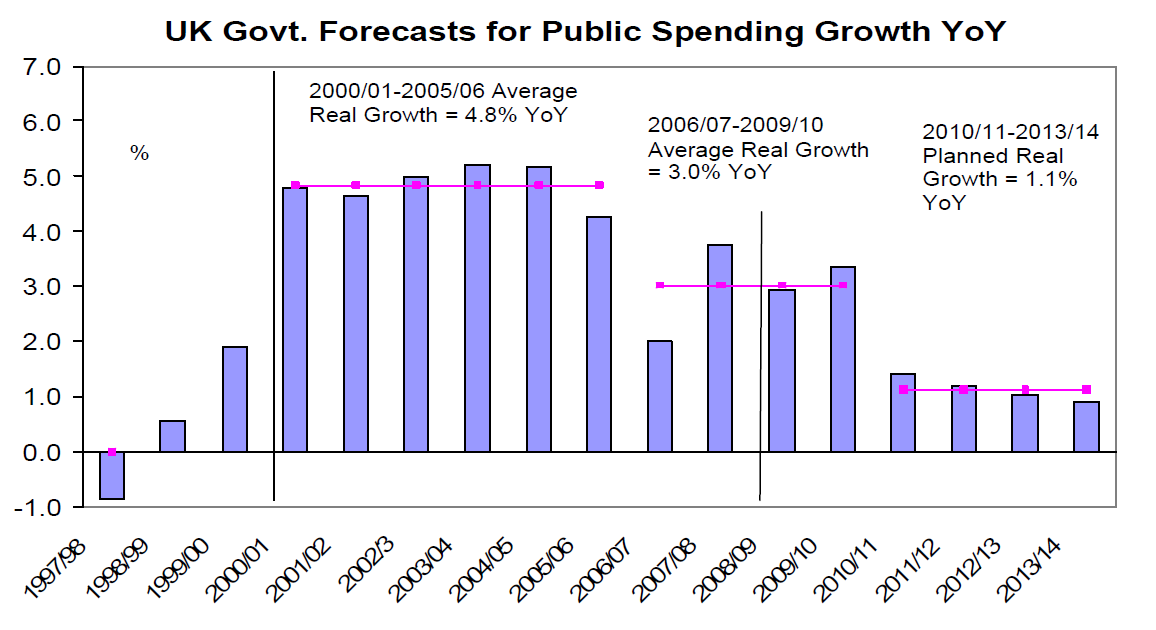
Much as I applaud David Cameron’s warnings about debt, and his bravery for doing so at a time when the borrowed penny hasn’t quite dropped over Westminster, would he actually do anything about it? I asked him at his press conference this morning. My point: that from April 2010 Gordon Brown intends to increase state spending at an average of 1.1 per cent (see graph, below). Cameron has ruled out real-term cuts, so would therefore have a range is between 0 per cent and 1.1 per cent – ie, between nothing and almost nothing. So where’s this great difference on the economy between the two parties? I have, of course, fallen into Brown’s trap here.

Far from alone

Gordon Brown is actually uniting the world, so far as his approach to the downturn is concerned, but not in the way he’d like us to think. From Tokyo to Toronto, finance ministers are saying that countries with a budget problem (like Britain) shouldn’t seek to borrow their way out of this. Slowly, a consensus is forming. Extra borrowing is fine for well-run countries that managed to pay off debt and run a budget surplus in good times. But countries like Britain – that blew her budget even in a debt-fuelled boom – will destroy their credibility (and currency) if they try to borrow even more now. It’s not just schadenfreude that makes the Germans so angry. They are making an important economic point: debt matters.

The damage done in the name of compassion

Does Britain need more volunteers? David Blunkett thinks so, and has just told BBC Westminster Hour that a "civil corps" is the answer to deep poverty. Here are his words (transcribed by the indispensable Politics Home). The lower classes, he says, "see volunteering as the preserve of the middle classes. To reach them, you have to have a dialogue, be able to talk with them, where they’re at and what they’d like to do.  It’s egging them on to feel that they could do something and might just give them hope.  What’s certain is that we need to give people hope." He bemoans "young people's behaviour" which he considers "in all sorts of ways completely dysfunctional.

An election with the X Factor

So much for supposed British electoral apathy: the final of the X Factor just attracted 8m votes - that stands pretty good comparison to the last election where Labour received 9.6m votes and the Tories 8.8m (and most under 35s didn't vote). Moreover most of tonight's electorate will have paid to vote - and gladly because, unlike the last election, the X Factor final made you feel proud to be British. It felt like a cross between the Last Night of the Proms and Mamma Mia: a real feelgood production that did tug the patriotic heartstrings of sentimental old fools like myself. The show isn't about the music, just as Strictly isn't about dancing. It's about characters, their background and the dreams they represent.

Squeezing the poor until the pips squeak

When Gordon Brown urges the bank to "pass on" the interest rate cut, why doesn't he lead by example with his very own state-owned mortgage company, Northern Rock? Because NR is up to no good - and the Financial Services Authority has given us a rare glimpse into exactly what its game is. It released a banking report (here, note 9.47) which confirmed that NR's loyalty is to the state: that is to say, it must "focus on repaying its government loan". Deplorably, it is doing this by deliberately overcharging those too poor to get a better deal. Here's now it works. Many millions (including myself) took up NR's low fixed-term rates.

The true extent of Britain’s debt

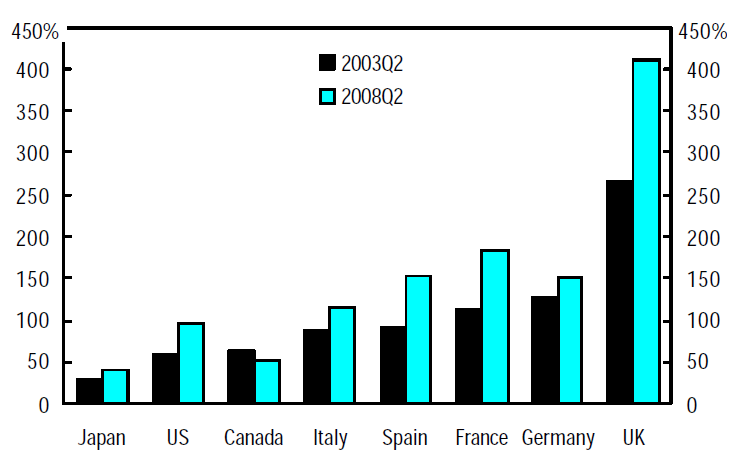
How much is Britain’s true national debt? Gordon Brown says 37% of GDP, the ONS says 43% of GDP – but this is just government debt. The reason Britain is in so much trouble is that our corporate and household debts are huge. It is the combination that makes us such a credit liability – but no one has ever put together a combination. Until now. Michael Saunders from CitiGroup has calculated ‘external debt’ – ie, what Britain owes the rest of the world. It is not 40% but 400% of GDP, the highest in the G7 by some margin. The next down, France, is 176%. America, flagellating itself for blowing such a debt bubble, is just 100%. Japan is about half America. The below graph shows ‘external debt’ – both in mid-2008, and five years ago.

A good place for Cameron to start

I’ve just come back from the Policy Exchange party, which had an austerity feel to it: smaller guest list, no bubbly. And David Cameron gave a good, but rather low-key speech where he said he was pleased that his speech at LSE today went past with no tomatoes being thrown. LSE has a left-wing reputation, Cameron said, so he was pleasantly surprised to see queues around the block. The LSE does have a reputation as a hotbed of leftism. But it is also the spiritual home of fiscal conservatism.  It was here that Frederick von Hayek came in the 1929 invited by Lionel Robbins.

Does Sure Start perform?

Is Sure Start really the success story that Rachel Sylvester suggests it is? I asked my colleague at the Centre for Policy Studies (CPS), Jill Kirby - perhaps the leading expert on family issues - for her take. She reviewed Sure Start in her CPS report Nationalisation of Childhood. That was two years ago, and the evidence was that for children of the most vulnerable (ie, jobless and lone parents) it was, amazingly, doing more harm than good. For the others, the benefits were negligible. Since then, Professor Edward Melhuish's National Evaulation of Sure Start has said that it is “plausible if by no means certain” that this problem on deprived children has been overcome.

Three hours’ worth of hot air

That three-hour debate on Damian Green really was a waste of time. A poll of MPs shows 30 want Michael Martin to go, but how many say that to in the chamber? Nada. We have some honesty from  Douglas Carswell and Bob Marshall-Andrews and that's about it. Some rebellion. All they were left with was innuendo. Dennis MacShane saying that sergeants don't fall on their swords, officers do. Wink, wink. And that was about as tough as it got. So this pointless committee of grandees will go off, boycotted by the Tories and the LibDems, to report after Green has been cleared. And report on what? We know pretty much what happened.

Tackling the giant evil of idleness

This year has seen a gruesome series of stories bearing out the Broken Society narrative, starting with teenagers shooting each other and ending with Karen Matthews abducting her own daughter in search of a McCann-style reward. Look at most of these stories, including Baby P, and there is a common theme: they take place in welfare ghettoes, those oases of deprivation in every British city. While we should condemn the evil, we should also condemn something the system that incubates the evil. There was a reason that Beveridge called idleness a “giant evil”. As I say in my News of the World column today when you pay people to do nothing you mess with human nature.

CCHQ gets crunched

When news of the Tory budget cut was broken by Conservative Home it was spun as a prudent cost-cutting. Yet there is (as ever, with CCHQ) plenty of comic chaos behind the scenes. The basic problem was overspending in the boom years. Last year the cash was flowing in from bankers who could easily spare £50,000 and would pay even more to touch the hem of David Cameron. Things were going so well that, according to one version I’ve heard, David Cameron personally added £2 million to the budget, saying the party had to spend to get more cash. Other sources say it wasn’t Cameron, the machine just grew fat on its own. But either way, one thing’s sure: they should have put more money away for a rainy day; fixed the roof when the sun was shining.

Politics | 6 December 2008

Knowledge that a secret exists is half of the secret, and Westminster loves nothing more than guessing what a secret might be. When The Spectator’s website revealed at 6 p.m. last Thursday that a major Conservative story was about to unfold, there was a flurry of frenzied speculation. One Cabinet member even called 10 Downing Street for clues. No one knew. Several theories were flying (George Osborne resigning, Samantha Cameron pregnant) yet none was as bizarre as the truth: a shadow cabinet member had just been arrested by anti-terror police in a leak inquiry. Once, such a development would have sent Conservative central office into spasm. This time, Damian Green’s arrest was played to perfection. When the news broke at 9 p.m.