Fraser Nelson

Fraser Nelson

Fraser Nelson is a Times columnist and a former editor of The Spectator.

If Cameron wants a second term, he needs to level with the public now

Might David Cameron be a one-term wonder? The pendulum of British politics does tend to move slowly and as little as 18 months ago the Tories could expect two terms at least. But the economic stars are aligning in a way that will make sensible Conservatives shudder. Cuts – real ones, not the type Gordon Brown accuses the Tories of – are looking inevitable. Those Dublin protests could be coming here next. Brown may borrow just enough to avoid making cuts, leaving Cameron to burst the public spending bubble. I outline this scenario in my News of the World column today. I’m not saying it’s likely, just that it should be taken seriously. Here are a few factors to consider.   1)   China may save Brown from the IMF.

The Abu Qatada case shows up the lunacy of the ECHR

It is, of course, lunacy to have £2,500 of taxpayers' money sent to Abu Qatada as per the instructions of the European Court of Human Rights. But what would a Conservative government do about this? It is crucial to remember that David Cameron's proposed Bill of Rights would itself enact the ECHR and, therefore, not be much use. As it stands, it's more of a media decoy - and this need not be so. The UK remains a sovereign country - all it would take is an act of Parliament declaring that the Bill of Rights would outrank any other jurisdiction and that we have our own laws. Not that we disagree with the aims of the ECHR, it's just that its application to English law is causing too many problems and leading to a sense of injustice.

The Spectator Inquiry–Part Two

We’ve had a great response to our call for help in The Spectator’s wiki-inquiry into the causes of the recession. Our hope is to draw on the collective wisdom of our readers – and we’ve received plenty of it already. So here is the second draft of our inquiry. Please bend it, shape it, any way you want it. Suggestions very much still welcome – on what we can add and, just as importantly, remove: we don’t want to overcomplicate this. If you made a suggestion earlier that is not incorporated and you think it should have been, please leave a comment saying so. If you want a question inserted in the remit, please phrase it as a question.

A first anniversary that shouldn’t be celebrated

It's the anniversary of the Northern Rock nationalisation today, and I've just done a discussion on Simon Mayo's R5 programme arguing why the occasion is not to be celebrated. Rosie Winterton, the pensions minister, was saying nationalisation was a great success. Her argument is worth recording here because it gives a clue why Labour's poll rating may sink sink further. Look at the pensioners, Winterton said; nationalisation of NR rescued them from losing all their savings. Did it really? Wasn't the the savings guarantee offered on 9 Oct 07 (which stopped the run on the bank)? Nationalisation - or, as it was called then, "temporary public ownership" - came in fully on 18 Feb 08, as most people listening would know.

The hole in our public finances

There is a problem hanging over British politics so big and ugly that no party wants to acknowledge it, far less discuss it: how far do we cut state spending?  Cameron's plan to outspend what he'll inherit from Brown is no longer viable. Since those decisions were taken, the UK tax base has collapsed. We can't go on forever bumming money off the Arabs and Chinese. There is a large, rusty bullet which a Conservative government will have to bite. That's why ConservativeHome's fulsome analysis today is such an important contribution to the debate. It talks about £100bn of cuts, and this is by no means a fantastical scenario.

The banks’ reverse takeover of Britain

As we wait for the next nationalisation - probably Lloyds Banking Group - a horrible thought occurs. Something has gone badly wrong. It is as if there has been a silent coup d'état - instead of the taxpayers owning the banks, the banks now seem to own the taxpayers. They have been given access to the present and future earnings of the British public, which will plug their mind-blowing losses. In my News of the World column today, I look at how Britain became a bankocracy - the government being so dependent on banking profits that it had a clear incentive not to ask too many questions about how this money was being generated. This isn't venal, I don't think it was some mafia-style racket. The money was there, the government just took it.

Freud defects to the Tories

The first serious Tory defection will be detailed in tomorrow's News of the World. David Freud, the architect of the Purnell welfare refrom that we've been admiring in Coffee House, is to become a Conservative peer and shadow welfare reform minister. So someone with genuine expertise will be in the DWP driving through a desperately-needed agenda. This is a real coup not just for David Cameron but George Osborne whom, I understand, has been working on Freud for months. Freud is a banker by training, but don't let that put you off him. He was hired by Tony Blair to think the unthinkable on welfare reform - and his suggestions (here) were genuinely radical. The sort that Blair now wishes he'd done in 1997. But this was 2007 and Gordon Brown was having none of it, so Freud was cut adrift.

Extended web version: ‘We need to be ready for two years of recession’

Opposite Alan Johnson’s desk is a plaque from the Chinese health ministry — a gift that must, at times, seem like a taunt. The Health Secretary controls 1.3 million staff, more than anyone bar the commander of the Red Army. His £120 billion budget is greater than any government department in Beijing. The Chinese economy and the NHS were both subjected to limited market-based reform — yet there the similarities end. Deng Xiaoping succeeded. Tony Blair was ousted. And now Mr Johnson stands in charge of the largest bureaucracy on the planet. We have heard strikingly little about health since he took over, which he regards as a success.

Politics | 14 February 2009

It cannot be much fun to interrogate men who are already broken, but the Treasury select committee had assembled on Monday for a show trial rather than a genuine cross-examination of witnesses. Sir Fred Goodwin, former head of RBS offered a ‘profound and unqualified apology for all the distress that has been caused’. And how well it would have suited the MPs around that table if this had been an admission of guilt not just for the banking crisis, but the wholesale collapse of the global economy. Such an act of ‘closure’ — if anyone had been convinced by it — would shield many of our politicians from the humiliation they deserve. For a bubble to exist, the entire political and financial establishment must climb inside it. When the bubble bursts, as J.K.

The Spectator Inquiry continues apace

Most of the stuff we do at Coffee House is for a laugh – but our wiki-investigation into the recession is deadly serious. We urgently need to find out what went wrong, and the thinking of the Westminster village consensus won’t do. We need you, your insights, your suggestions, your criticisms. If you have friends with expertise – in academia, the hedge fund industry, the quiet souls who weren’t promoted because they didn’t buy into the myth - urge them to leave their thoughts on how our investigation should proceed.  We provide the platform, you provide the energy and direction. So far it’s been great: over 40 responses to our scoping inquiry. I’ll do a revised ‘terms of reference’ later, and ask for your thoughts again.

Brown sits before the committee

There was a kind of grand jury feel to Gordon Brown’s appearance before the select committee chairs today. “I’m not sure I can make my hearing as exciting as the one you’ve had in the last two days,” he said. “Get started,” said John McFall.  Brown has a great genius in neutralising hostile questions by dragging it down into minutiae – a trick that Blair, the incurable thespian, could never quite master. I won’t blog the points that ran into the sand. Here’s my summary of Brown’s appearance, and my take on it: 1. Printing money. Brown said that the BoE has a “statutory duty” to keep inflation up if it falls below the 2% target. “Our target is not zero inflation”.

The Spectator Inquiry into the causes of the recession

We need your help. The Spectator is to launch an inquiry into the causes of the 2008 recession, and it is to be a wiki-inquiry: one that will be directed by you, report regularly back to you, and be moulded by your collective wisdom. It will live or die by your input. Finding out just why the economy went pop is perhaps the most important question in British politics right now: our understanding of the past will shape the future. Blaming the bankers, while a great national sport, could be a national calamity in the long run.

The unemployment ahead

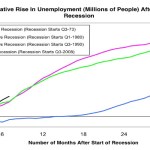
How high will unemployment get? In his interview with me in today's Spectator (an extended, web version here) Alan Johnson says - towards the end - that we'd best prepare for two years of downturn. He was being optimistic. During the last three recessions (mid-70s, early 80s, early 90s) it took three years for the unemployment to peak - and there is every chance that it will keep rising in Britain until 2011. The below graph, from Citi, certainly chimes with the Balls analysis of this being the worst recession for a century. It looks like we'll get ILO unemployment from today's 1.9m to about 3.4m - which will make about  6.5m on benefits in total. Imagine the bill this will present to Cameron: between a fifth and a quarter of the entire British workforce on the dole.

Brown’s job vacancies are dwindling

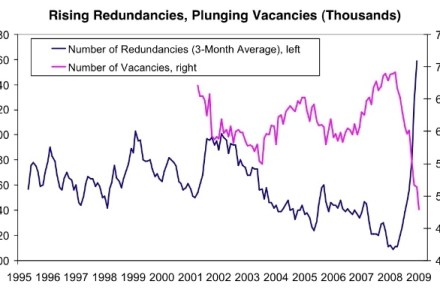
In PMQs today Gordon Brown said there are 500,000 vacancies in the economy - a revision from his recent 600,000 claim. But this morning's unemployment data show that even this is out of date. The number of vacancies is collapsing way below the half-million mark - so these British jobs are becoming even more scarce. The trajectory of unemployment so far the sharpest since the war. Monthly data for the Great Depression just doesn't exist, so Balls may be right after all.

Cameron gets all the best dividing lines in PMQs

It’s hang-a-banker season, so David Cameron had an open goal: Sir James Crosby, the former HBOS chief who allegedly sacked a whistle-blower, and who has today resigned his role at the FSA. The Labour whips planted a question with Khalid Mahmood about Crosby, as if to shoot the Tory fox. “They can even plant questions at short notice,” started Cameron, witheringly. Brown kicked it into the long grass, saying an investigation into banking “rejulation” as he pronounced it – after last week’s “rec-depression” there is something of the George W about Brown.

Sorry all round

Every Wednesday, a new and rather sadistic ritual takes place at Prime Minister's Question Time. David Cameron will ask Gordon Brown to admit he got something - anything - wrong and the Prime Minister will refuse. Mr Cameron is lowering the bar each time: last week, Brown was asked to confirm if there was a bust. It's as if he's programmed not to. Yet Martin Bright, our new spy, has news over on his blog: that No.10 has asked for DVDs of Barack Obama's apology and that Brown may be preparing his own one. There is more than just the public humiliation aspect here. I argued in my News of the World column last weekend that it shows us something about a politician: that he can recognise a mistake and change track. In these fast-changing times, the ability to correct errors is vital.

‘We need to be ready for two years of recession’

Opposite Alan Johnson’s desk is a plaque from the Chinese health ministry — a gift that must, at times, seem like a taunt. The Health Secretary controls 1.3 million staff, more than anyone bar the commander of the Red Army. His £120 billion budget is greater than any government department in Beijing. The Chinese economy and the NHS were both subjected to limited market-based reform — yet there the similarities end. Deng Xiaoping succeeded. Tony Blair was ousted. And now Mr Johnson stands in charge of the largest bureaucracy on the planet. We have heard strikingly little about health since he took over, which he regards as a success.

The talent drain

Good piece by Piers Morgan in today's Daily Mail about the British talent doing well in America. He quotes an American film director saying our actors are more likely to be formally trained - and then, to America, for the big bucks. From The Wire (McNulty's from Yorkshire) to Gossip Girl (Chuck Bass is from Hertfordshire), some the best known 'American' actors over there are Brits putting on an accent - it's something of a phenomenon. But it's not restricted just to acting. One of the most under-reported stories is the silent exodus of skilled Brits to countries with better state schools and safer streets. As I blogged a while back, Britain has repelled more of its high-skilled workers than any other G7 economy: or the Brits deemed to have high skills, 15% live overseas.

Martin Bright joins Spectator.co.uk

We have a new signing to reveal today: my old counterpart at the New Statesman, Martin Bright. We have long admired his writing here at Coffee House, and we're delighted that The Bright Stuff will be joining Melanie Phillips, Clive Davis and Alex Massie under the heterodox, multicoloured Spectator e-umbrella. It's not just the sharpness of his analysis and strength of his contacts that makes Martin a must-read. From a left wing perspective, he has investigated what he calls "Whitehall's love affair with radical Islam" as well as pretty much hounding Ken Livingstone out of office. So is he finally coming over to our side then? If only. He remains very much of the left, especially on issues like tax and the future of capitalism, which are now coming to the centre of the political debate.