Fraser Nelson

Fraser Nelson

Fraser Nelson is a Times columnist and a former editor of The Spectator.

Lord Lawson responds to the Spectator Inquiry

Lord Lawson has answered your questions on the recession – and then some. He warns that David Cameron will "have to do what we did initially, both cut back on spending in particular but also raise taxes". He also explains how his Board of Banking Supervision – which Brown abolished in 1997 – would have done a far better job than the FSA in seeing the crash coming. And proposes that investment banks should be lightly regulated, but that banks should be more heavily regulated. A return, in other words, to the Glass Steagall Act. Head over to The Spectator Inquiry wiki-page to read more.

Responding to the New Statesman

All of us in 22 Old Queen Street are admiring the New Statesman this week, guest edited by Alastair Campbell. He’s evidently put a hell of a lot of work into it and ransacked his contacts book: diary by Sarah Brown, interview with Alex Ferguson (Pete, a dedicated Man Utd fan, says it’s one of the best he’s read), Danny Finkelstein on the theory of the left waking up to the net (except they’re not, but it’s a good read) and Anthony Charles Lynton Blair on his new friend, God. While the Spectator is evidently on the other side of the fence to The New Statesman we’re not really rivals, insofar as very few people stand at WH Smith and go “eeny meeny” between the two of us.

Introducing the Spectator Inquiry wiki-site

Is there such a thing as the collective wisdom of Coffee House? By the end of The Spectator Inquiry into the recession, we'll find out. It's now live and with its own wiki site - http://spectatorinquiry.pbwiki.com. We're very much playing this by ear, so I'd be grateful if a few CoffeeHousers could head over there, have a fiddle about with it and let us know if it works. Within the next few days we will have the transcripts from interview with William White and Nigel Lawson. Meanwhile have a look, have a tinker, play with it, add pages, get writing, get stuck in...

The unemployment pain is only just beginning

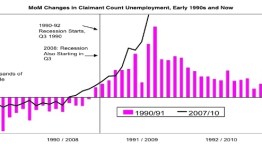
This is not even the end of the beginning. Unemployment is rising at the fastest rate since monthly records began, but it will keep rising for two more years. Every month we’ll get this. Every month, Cameron will say “your ‘help’ isn’t working,” and every month he’ll be right. I have two graphs below that make this point. The first compares the monthly rise of this recession to that of Major’s recession. And, below that, the trajectory of this recession versus the previous three.  Have a look at the bottom scale: that's 36 as in 36 months. Three years of rising unemployment. So it will last right up to the next election and will turn around perhaps in year two of a Cameron government. And that's if he's lucky.

Phoney footage

After PMQs, the burning question around Westminster is this: did Cameron overstep the mark when he shouted at Brown, "What a phoney"? Good point well made, I thought, but to other kinder souls it may come across as a bit harsh. Alan Johnson talks about Cameron coming across like Harry Flashman at times. That's because they look at Cameron and think "public school bully". The "phoney" moment comes 2:22 into the footage above - so what do CoffeeHousers think?

Cameron pummels Brown in PMQs

My, but David Cameron was good today. Assertive, contemptuous, energetic and all over Gordon Brown. Today's unemployment rise is the highest since records began (in 1972) so he had plenty of ammo. His point was strong and simple: nothing Brown has done is working. Unemployment is getting worse, all the time. Did this not show how stupid it was for Brown to claim Britain was best-placed to weather the recession? I'll say this for Brown: he is nothing is not audacious. Britain's unemployment is better, he said, than France, German, Japan and this country called the "European Union" (whose figures are dominated by France and Germany). He should have added: "But give me time" - seeing as UK unemployment is rising faster than any developed country apart from Iceland.

Cameron’s secret meeting: live blog

As I type, David Cameron is in the Boothroyd Room, in Portcullis House, addressing Tory MPs who are anxious to hear if his Big Sorry on Friday amounts to a change in direction. True in the Cameroon spirit of open information, I'm being sent some dispatches in real time. Whether it's interpretation or verbatim quotes isn't clear: I'll just pass it on to you raw.  The party, Cameron is saying, must reassure the public that they value public services.  Internal polling (which is the basis for the presentation - basically about party aims in 2009) has shown recently that the Tories are still vulnerable to being seen as anti-NHS. So care must be taken to combat this.

Cameron’s five reasons to vote Tory

So the winning question to David Cameron was Rhoda Klapp's "Give me five good reasons to vote tory". It chimes with our winning 2009 resolution for Cameron: "To resolve to produce 5 core reasons to vote Conservative which every British voter is familiar with by the next election". And his answer? 1) Get rid of an exhausted Labour government 2) Tories would give people more power over their lives, and devolve power to people and local authorities 3) Move away from an economy built on debt to one built on saving 4) Mend the broken society, with radical welfare reform 5) Radical school reform, too. My take... 1) Amen: an exhausted and (under Brown) downright dangerous government. 2) Admirable aim, but Cameron needs firmer, harder examples of this (other than school reform).

It won’t be enough to just say “sorry”

So just how sorry is David Cameron? On Friday he put his hands up to being part of a “cosy consensus” on tax and spending. So I had expected his press conference today to declare he’d torn up his plans to outspend what he inherits from Labour. All bets are off, I expected him to say, it's time for clean slate, and the Tories can make no promises on spending until they see the government books - i.e. real spending cuts aren't ruled out. But nope - his original position still stands: that the only question in his mind is the rate of increase in spending. But it will increase. And so, ergo, will debt.

Any questions for Cameron?

So what would you ask David Cameron after his apology on Friday? It's his press conference at 12.15pm today and I'm going along. If any CoffeeHousers have thoughts on a good question, let's have them...

Alistair Darling, the taxpayers’ unlikely hero

Might Alistair Darling prove to be a hero of the Labour endgame? When he was first appointed, I argued that he'd be a puppet - "no more a Chancellor than Captain Scarlet was an actor". I have since heard plenty of stories to the contrary: that he is doing a pretty good job saving taxpayers from the baser intentions of Brown, Balls, Cooper etc. He has been busy chasing Shriti Vadera away from his territory - she's prowling the City, claiming to speak with Brown's authority. He is pushing for transparency and honesty in the government, insisting that his Pre-Budget Report went to 2013/14 so he could show how he would get the deficit back to zero (Brown wanted to drop the tax-raising bad years). His Budget, for example, was the first since 1996 not to have some hidden trick.

Politics | 14 March 2009

The right to keep one’s political affiliation secret is in many eyes a sacred feature of British life. There are households where married couples don’t tell each other how they vote. Those who grew up during the Cold War era remember the years when, in some countries, party membership was a grim prerequisite of a halfway decent life. So it is still a matter of pride that, in Britain, one is never required to discuss one’s political beliefs. Unless, that is, you want to do a certain type of business with the state-controlled Royal Bank of Scotland. Geoff Robbins, a Cheshire-based computer consultant, recently approached RBS to ask for a credit-card processing facility for his business.

Cameron’s apology isolates No.10

So Cameron said come out and said sorry. Again. The first stage of his S-Word was that apology on the Andrew Marr Show which was interrupted when the signal from North Kensington collapsed. Today he said.... “Of course I’m sorry that we have got some things wrong, we were right to call time on government debt but should we have said more about banking debt and corporate debt, yes, we should have done.  Actually saying sorry is the easy bit, the difficult bit is for politicians to look back and say right where did I go wrong; it’s that, that needs to take place in order to build this trust with the public so we can get this economy out of recession and into recovery.” So why the mea culpa?

A mistake that must not be repeated

As I suspected, opinion amongst CoffeeHousers is divided as to whether RBS asking potential clients for their political affiliation is a big deal. A good chunk of you think this is a scandal. Others don’t. Where, they ask, is the story – it was a simple cock-up. RBS misread EU regulations about extending credit to Politically Exposed Persons (ie, overseas ministers who may be ‘vulnerable to corruption’) and ended up asked British clients if they belonged to political parties. RBS have apologised and didn’t mean any harm. And aren’t I being a bit paranoid linking this to the fact that RBS is state controlled – and trying to build this up into a Big Brother story when it clearly is a few call centre drones asking the wrong question?

RBS’s definition of a ‘politically exposed person’

Are you a "politically exposed person"? This is what RBS wants to know about its prospective clients, this is the question that led me (when posing as a potential client) to be asked if I was a member of a political party. And when a state-controlled bank like RBS asks people if they are "politically exposed" - a phrase with more than a hint of menace - it is no surprise that it sends shivers down so many spines. What on earth could they mean? What were they trying to get at? I put some questions about this to RBS earlier today. Here are their replies, and my comments.

Why are our state-owned banks asking customers about their politicial affiliations?

Some tip-offs are so awful that you almost hope they are untrue. When I was told by Geoff Robbins, a computer consultant, that he had been asked about his political connections before opening an account with the state-controlled Royal Bank of Scotland it sounded fantastical. Having the state owning the UK banking system is bad enough, but asking about party membership before you open an account? Not in Britain, I thought. And indeed, the RBS press office denied it outright. "We would not ask that question, nor dream of doing so," said an RBS spokeswoman. So had Robbins concocted his story? I doubted it. So I called RBS Streamline myself and pretend to set up an account for credit card processing facility.

How Brown plans to borrow more money than the market would ever let him

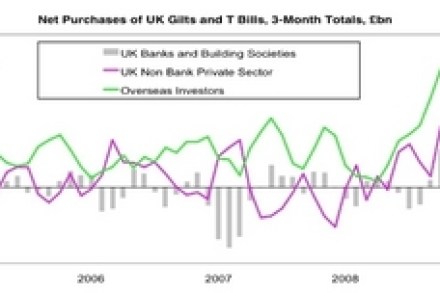
In PMQs today, Gordon Brown described the era of nationalised banks as a “wholly new world”. How right he is. The collision between the worlds of politics and banking has created much potential for mischief and I look at some of it in my political column for tomorrow’s magazine including what for me is the single most chilling development since the nationalisations started – but I’ll save that for when the magazine comes out tomorrow. For now, I’d like to share with you another suspicious aspect. For a while in Coffee House we’ve been saying that the markets wouldn’t let Brown borrow more: what if the Arabs and Chinese tire of buying all the debt? This presumed Brown’s hands would be tied by the market.

Don’t hold your breath for a manufacturing-based recovery

Hmmm. So much for manufacturing-based recovery that is supposed to come as a result of the crash of sterling. Manufacturing output was off 2.9% in January, the eleventh consecutive drop. The fact that we’re a lot cheaper to Americans and Europeans doesn’t seem to help much – partly because any sane foreign client will demand price reductions, mindful of the currency drop. Result: a precipitous fall in the ONS Manufacturing Index of Production (below):      And in case you were wondering then yes, it’s the worst of any post-war recession as the below graph from Citi shows. A Major-style bust? If only.

Let’s see more of Patrick Mercer

So what is to become of Patrick Mercer? On the Today programme this morning he was introduced as someone who "has served nine tours in Northern Ireland" - i.e. that rare thing: a politician who knows what he's talking about. As opposed to Shaun Woodward, whose sole credentials are being a Tory turncoat and being plonked in the Cabinet at a time when Brown was recruiting goats. As a solider, Mercer survived two IRA assassination attempts; he reeks of authority on the subject. This morning the Tory demonstrably outclassed the minister. It was one of those "ready for government" moments, which the Tories need more of. But Mercer, alas, is not expected to join the government. His political career path is something of a tragedy.

The language of terror

Terrorism is a propaganda war where words matter as well as bullets, and those who murdered the British soldiers at Massereene Barracks could not complain at the much of the coverage today. The BBC news, and much of the other news, announced simply that the Real IRA had carried out the attacks. Someone who does not follow the Northern Ireland peace process carefully could well take this statement at face value, and assume the IRA is back. And this is exactly what the terrorists want to convey. An integral part of the "Real IRA's" mission is to make out as if they are the genuine IRA and that the McGuinness/Adams movement is no more.  They wish to recreate the Troubles, have the army rescale its presence, and have everyone act as if it's the 1980s over again.