Fraser Nelson

Fraser Nelson

Fraser Nelson is a Times columnist and a former editor of The Spectator.

A tale of two Gordons: why Gekko is right and Brown is wrong

The Eighties mantra ‘greed is good’ may be unfashionable, says Fraser Nelson, but it is still true. We have forgotten that wealth generates revenue, while high taxes crush prosperity and pauperise nations. Will the Conservatives have the guts to declare this economic truth? Before Gordon Brown was writing books about political courage, the subject that fascinated him most was greed. He detected plenty of it when the Thatcher revolution was in full bloom. In 1987 he wrote a polemical book entitled Where There’s Greed, denouncing both the Conservatives and the ‘sinister insights of Adam Smith’.

Video nasty

A Labour-supporting friend of mine, who should know about these things, emails with a serious question: "Do you think that GB having to withdraw the YouTube doctrine on expenses is the biggest humiliation in Downing Street communications since the Women's Institute? I can't think of an equal." Well, I can. The botched election and the Damian McBride affair, to name but two - but that bizarre YouTube dance, admittedly, is a close third. As my friend continues, "I used to think the Brownites were all tactics and no strategy but that's unfair. They are **** at tactics too. Amateurs. The budget is the worst I have seen since Howe in 1980." Seriously, much damage has been done by that YouTube dance he performed.

Brown plays politics over troop numbers

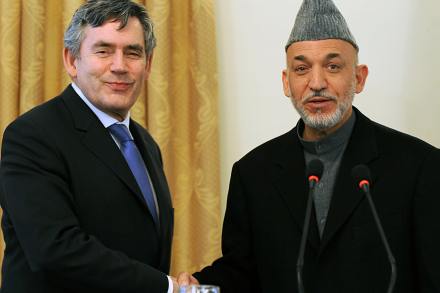
So Gordon Brown is in Afghanistan, pledging that Britain will provide 700 more  troops “to allow us to do more during the election period. We are confident that we are shouldering our share of the burden”. I hear that he made this commitment for a pre-election troop surge at the G20 summit to suck up to Obama - but that he hadn't squared this with the military, who had a frantic few days trying to work out how how on earth they would find the men. Ditto his notorious claim, made during the 2007 Tory conference, that 1,000 troops would be home by Christmas. The MoD had no idea what he was talking about, so they called No.10, who didn't know anything either. It was a piece of pre-election posturing, using soldiers as pawns in his battle against the Tories.

Cameron needs to up his game

Cameron is set to deliver a fiery speech to the Tory spring conference, but events are moving fast and he's struggling to keep up. For a start, last week's Budget implied 2.3 percent spending cuts for the three years covered by next year's spending review. Cameron was still talking about spending "growth" in his Cardiff speech last month, and Darling buried this idea before he did. There is a strong case for the government to spend less of other people's money, not just "restraint" in the increases. But I suspect we won't hear it today. Instead, the case we are hearing from the Tories often lacks coherence.  ConservativeHome tells us that Andrew Lansley is talking about protecting his NHS budget. As health is the no.

Politics | 25 April 2009

All Labour budgets are essentially works of deception, and Alistair Darling’s speech on Wednesday was no exception. Once again, the Chancellor deployed the normal, tiresome formula: pyrotechnics intended to distract voters from an ugly truth lurking in the small print. Except this time, the distractions were obvious fakes. No one seriously believes the British economy will be helped by a bribe for buying an imported car. And the truth was the ugliest Britain has been told in its peacetime history: that the nation’s finances are in freefall. By the time you have finished reading this sentence, the national debt will have increased by some £14,000 — rising by £175 billion this year and £173 billion next.

Printer rage

You have heard about Brown hurling staplers and mobiles in a rage before. But laser printers? A new one to me. Bloomberg, hardly a salacious source, says this in a story it has just released: "The prime minister, 58, has hurled pens and even a stapler at aides, according to one; he says he once saw the leader of Britain’s 61 million people shove a laser printer off a desk in a rage. Another aide was warned to watch out for “flying Nokias” when he joined Brown’s team. One staffer says a colleague developed a technique called a “news sandwich” -- first telling the prime minister about a recent piece of good coverage before delivering bad news, and then moving quickly to tell him about something good coming soon.

Brown’s deformed Laffer Curve and other stories

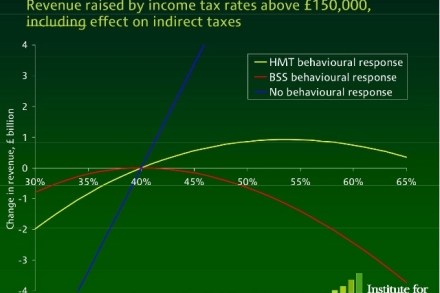
The IFS post-Budget briefing was laden with other fascinating points.  It seemed like half of London was packed into the theatre they hired for the venue, but for those of you who weren't there here are four other observations: 1. The 50p tax will not raise £2.4bn and may lose money. Crucially, when Darling estimated he’d squeeze £2.4bn from his 50p tax he didn’t factor in the fairly obvious point that the super-rich won’t be spending money that is being taken from them. So “the lower indirect tax revenues could eat up most of the £2.4bn” says Stuart Adam - he reckons about £1.5bn and questions the £2.4bn figure.

Significant cuts are hidden away in the Budget

Spending cuts are with us. Yes the truth always is dragged, shame-faced, out of a Labour budget the day after it’s delivered – and this time there was a real corker lurking in the statistical annex. Public spending is finally being cut, and significantly - by around £20 billion a year. Alistair Darling spoke with forked tounge when he said he’d “protect frontline public services while keeping current spending growth in real terms at an average of 0.7 per cent a year.”  This fooled Fleet Street, fooled the Tories, fooled me. But it didn’t fool Gemma Tetlow, a research economist at the IFS whose briefing I’ve just come back from. Here is the scam she unearthed. The slowdown in spending growth from 1.1% to 0.

The top ten Brownies of Budget 2009

This was a Budget of tricks, of bogus assumptions and of huge traps for the Conservatives. As Lord Lamont says, it was historic in its admission of failure. I do tire of the Treasury’s approach: every Budget we get pie-in-the-sky forecasts, which are torn up later. But the effect of these fake forecasts is to advance (or, in this case, protect) state spending. For all the mentions of 2014/15 this is a Budget designed to last no more than a year.  Here are my top ten Brownies. 1. The “trampoline recovery” theory is a fiction.  To reassure the debt markets (on whom the UK government is now utterly dependent) HMT has concocted the theory of what Cameron brilliantly and instantly called the “trampoline” recovery. Darling says 3.

What the Treasury told lobby journalists

Earlier, I referred to a Treasury briefing for journalists. This is an event which takes place straight after the Budget for lobby journalists. As it is on the record, we at Coffee House figured we'd release a transcript. It's an historic Budget, this is your money they're talking about and the the Treasury's thinking is crucial. This is from a senior Treasury civil servant, taking questions from about four dozen lobby journalists after he had gone through the main points of the Budget: There is no change in the projection of public spending growth from next year onwards? No, there is, there is.  He announced in his speech that it would now be running at 0.7% As opposed to? It was previously 1.1% What is the Chancellor doing about the unemployment forecast?

The growth lie

The first Big Lie in this Budget - and, frankly, I'd be surprised to find a bigger one - is that the UK economy will enter a sustained three-year economic sprint of 3.5% A YEAR from 2011. David Cameron instantly and brilliantly ridiculed this as the theory of the "trampoline recovery". We journalists just had an on-the-record briefing with the Treasury where this was questioned. The Treasury official claimed that no one is really forecasting beyond two years, so there's nothing to compare it against. Untrue. Five-year-forecasts are produced by, erm, HM Treasury (last one released here in February), and on page 23 we find the following: So where on earth does the Treasury get its claim of a sustained three-year 3.5% recovery from? The public finances are based on a projection of 3.

The pre-Budget bombshells

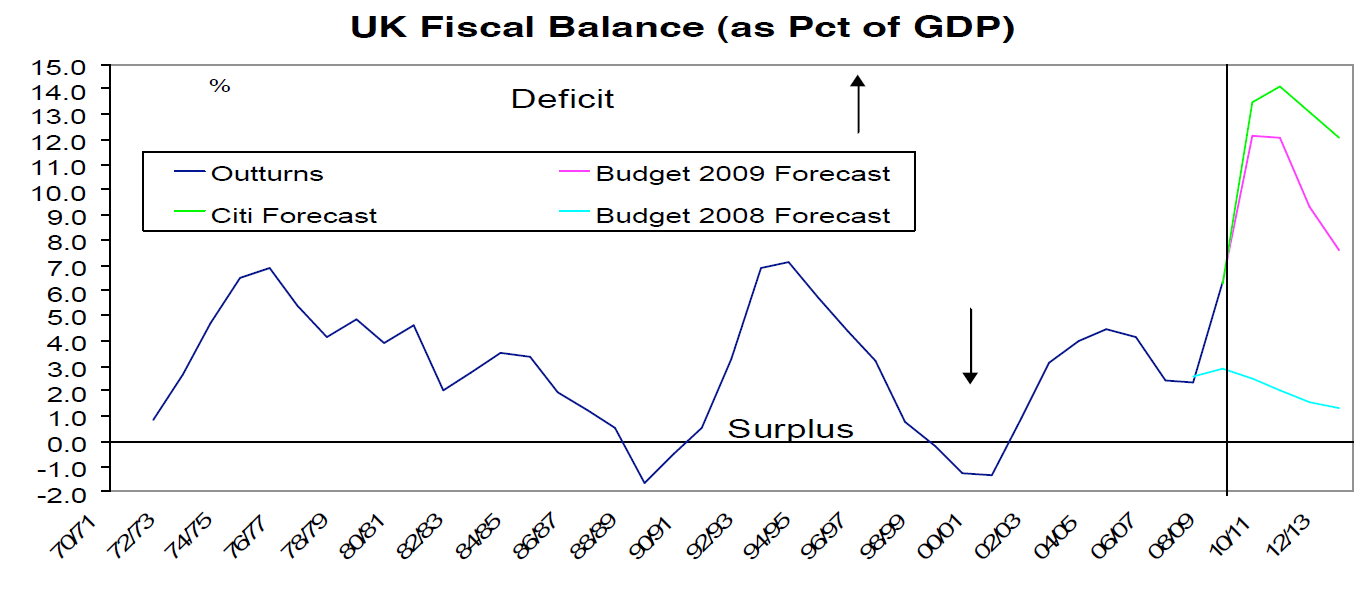
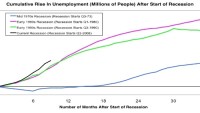
Two bombshells have landed pre-Budget. One: tax receipts are falling even faster than we thought (central government revenues down 12% in March, a record drop) and the 2008-09 deficit to £90bn, double the £43bn Darling forecast in his last Budget. Black hole, anyone? Next: claimant unemployment is now 1.46m. Last October, in his PBR, Darling forecast 1.41m unemployed by the end of the year. It hit 1.46m by March - the highest in 12 years. So how much worse can it become?  The below graph, from Citi, is worth a thousand words. This isn't even the end of the beginning.

Balls in trouble

Life is about to get worse for Ed Balls. Remember Ken Boston, the sacked head of the QCA exams quango who was sacked over the SATS exams fiasco? Well he is now released from the purdah of his contract, and we have been waiting for a while to hear his side of the story – namely that Balls and his deputy, Jim Knight misled both Parliament and the Sutherland Inquiry. He has written a letter laying out the porkie pies he claims that Balls and Knight served up, and I gather the BBC will run the story tomorrow. For example, he claims – staggeringly – that Knight concocted meetings that he was supposed to have attended. And Balls told Parliament that he, the loyal minister, had asked the QCA for assurances that the SATS exams were on track.

The IMF’s damning verdict

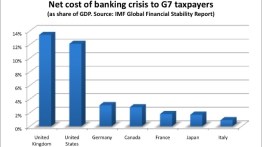
Forget the Budget. The IMF's Global Financial Stability Report has just produced the figures Gordon Brown didn't want you to read: the cost to the UK taxpayer of the banking crisis. The Treasury's approach is to airbrush banks out of the picture, and kid us on that we'll get the money back eventually. The IMF gives it to us straight. It estimates (p44, pdf) that when this is over British taxpayers will have the largest bill in the G7. The bank crisis will cost the UK some 13.7% of GDP - which works out as about £190bn (see graph below). The figure for the US is 12.1% and Canada just 2.8%. Again: this isn't a paper loss. This isn't made-up money.

It is inflation, not deflation, that we need to worry about

America has deflation: Britain doesn't. Really. Not at all. In fact, rude as it may be to point it out, prices are soaring here. Britain has the highest inflation in any European country. Sure, the RPI index is in negative territory - as you'd expect given the collapse in interest rates. But the average British shopper is still being fleeced at the tills, and the consumer price index (CPI) was 2.9 percent in March - something like the third worst reading (above the MPC target of 2.0 percent) since the Bank of England's so-called independence. It was only a couple of months ago that the Bank was forecasting 2.69 percent inflation for Q1 2009. It has turned out to be 3.0 percent. Inflation is overshooting expectations.

Smile, smile, smile

Finally, Gordon Brown has at last done something to cheer us up - and released what is perhaps the funniest video ever to come out of No10 (watch it after the jump). Now that his dirty tricks unit has been exposed, he's trying to come across all friendly and cuddly - and has given a video annoucement of his crackdown on Tory second jobs, disguised as a tightening of MPs expenses. He stops short of breakdancing, but only just. He's addressing a horribly serious issue: the near-fraudulent abuse of expenses by MPs. But he shuffles, waves his hands and beams as if he's playing Santa at a kiddies party. Occasionally, he lapses into his dour old self. Then, it's as if someone is holding up a card saying 'SMILE' or 'MOVE YOUR BODY'. Anyway, video below.

Economic inactivity and the recession

Perhaps the two most dangerous words for any Labour politician to say right now are "green shoots". Spend long enough in the economic desert and you can hallucinate, and many of the blips right now - an upturn in some property prices, a slight recovery in sterling - could be taken by anxious politicians as proof that the worst is over. But amidst these are genuine good signs. The banking system finally seems to have been stabilised (at cost, yet uncalculated, to the public purse). The fall of the pound has helped stem the fall in exports: Britain has fared better than may other European countries (the joys of a floating currency). And at a briefing with James Purnell today, I was told about another glimmer of hope: that unemployment is not yet feeding into a rise in economic inactivity.

Byrne backs Balls

My, how Balls is rattled. He has made Liam Byrne throw his body in front of the bullets with a statement declaring that he co-chairs those Wednesday afternoon attack meetings. Not that he'd regard them as such. Here are his words, with my thoughts: LB: “The Sunday Times' write-up of the weekly meetings I co-chair with Ed is not only inaccurate, it’s nonsensical and pretty offensive." FN: The many other details the No.10 whistleblower provided are accurate, we presume. And seeing as the nature of these meetings are so contested by No.10, what about releasing a list of attendees and isues discussed to lay the matter at rest?

Balls contra The Truth

Is the trail leading to Ed Balls? It seems that it was more than James and myself who found his "Damian who?" interview on Radio Four outrageously implausible. It was enough to have someone inside No10 tell all to Isabel Oakshott from the Sunday Times. It was Balls, he says, who recruited McBride from the backwater of the customs and VAT division.  And Balls who started using McBride as a personal spin doctor. I say in my News of the World column that Balls would use the Thatcher Room in No10 to chair those political meetings on Wednesday afternoon, which McBride would often attend. The more Balls fakes ignorance of the dirty tricks strategy, the more people inside Labour and No10 will be inclined to tell it how he was the dirty tricks Godfather.