Fraser Nelson

Fraser Nelson

Fraser Nelson is a Times columnist and a former editor of The Spectator.

Brown saves the worst till last

We have just witnessed Gordon Brown’s last and most audacious confidence trick. “Gordon Brown to resign” says the television newsflash: but the story was the very opposite. Gordon Brown is staying on, saying – pretty much – that it will take an SAS operation to get him out of No.10 before the autumn. He declared a "constitutional duty" to stay until a new administration is formed "with majority support in the House of Commons". Untrue. You just need a majority to pass laws. One can govern with a parliamentary minority (see Alex Salmond in Edinburgh, and Harold Wilson in 1974). Cameron won the right to govern, when he last week secured a greater share of the vote than Blair in 2005 and two million more votes than Brown.

Who’s using whom?

Another day of live political theatre, staged live at College Green. Given that Cameron last night negotiated a confidence-and-supply deal - ie, enough to keep him in a minority government like Alex Salmond has in Scotland - why is he negotiating further? What's more to discuss? This is what we find out today. David Steel told Radio Four this morning that Nick Clegg had told him, before the election, that he would put a time cap on any Con-Lib Pact - ie, a shelf life of one or two years. This suggests that the Lib Dems would not fall for the obvious Tory ruse: the offer of a referendum on PR due in 2012, but with the sneaky expectation of a new election in May 2011 at the latest. But Cameron has much more to offer - and things that suit him rather well.

A rolling Westminster drama

Another extraordinary day in Westminster. A deal looks likely to be agreed by Clegg and Cameron tomorrow morning, put to backbench MPs in the afternoon and then Brown will advise the Queen to send for Cameron on Tuesday. (Brown may choke on those words, but if he says 'send for Ed Balls' I don't think she will fall for it.) This evening at 6pm, the handful of Tories MPs who are in London met Cameron at the Commons to discuss the coalition talks. Rumours still fly but as I understand it a deal has been reached where the LibDems will vote for Tory cuts - thereby fulfilling Vince Cable's pledge to be the guarantor of stability. "But they will want Cabinet seats," I am told by a LibDem source. "Why be tainted with cuts with nothing in return?

My understanding is that Cameron will not sacrifice schools reform

During coalition talks, wild rumours can fly - and some of them can be true. That's why Michael Gove would have stopped many a Tory heart this morning by telling Andrew Marr that he was by no means wedded to a Cabinet job and then heaped praise on David Laws. The Gove schools policy is ranked by The Spectator as reason in itself to vote Tory and by The Economist as the best single policy of the election campaign. Might it be sacrificed? The 10am radio headlines were suggesting so.  I bumped into Gove just afterwards and asked him: panic over. He had simply sought to make clear that he was not insisting on a Cabinet job, and nor was he drawing some kind of red line around is own position. He sought to state the obvious: that he serves at the pleasure of the party leader.

A deal that would kill Gove’s agenda at birth

While both the Conservatives and LibDems support the idea of Swedish schools, a Lib-Con deal could kill the agenda stone dead. David Laws is proposing to allow local authorities to have the power to veto new schools – which would, in effect, mean no rollout. As we all know, this could strangle the Gove school agenda at birth. Local authorities, whether Labour or Tory, will hate the idea of competition in the provision of education. The local authorities and teachers’ unions are incredibly powerful, and defeated Thatcher, Adonis and Blair. They have also nobbled the LibDems to the extent that, I understand, David Laws believes that he could not get rid of the local authority veto. His party, and the special interests it represents, would not let him.

There may be Tory trouble ahead

Will the 1922 Committee of Tory MPs elect an emergency chairman today? If so, the mission would be to warn Cameron off doing any deal with the LibDems. Most Conservatives will wake up today judging the Cameron campaign to have failed. In the view of many, he will have failed to honour his "change to win" promise: they all changed, as he asked, but he didn't win. There will be a price to pay, and perhaps one of the heads around Cameron will have to roll to assuage the discontent. Any Lib-Con deal over voting reform will be anathema to many recently-elected as well as existing  Tory MPs. A new chairman of the 1922 Committee will want to make this point to Cameron before any damage is done. A deal with Northern Irish MPs would probably be as much as the party would wear.

Predicting election results is a fool’s errand

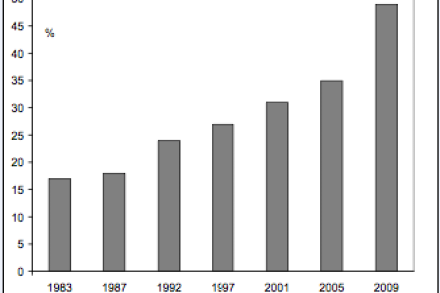
Why is predicting this election so difficult? Because voters themselves don’t know what to do. Before each of the last seven elections, Ipsos/Mori ask voters if they might change their minds. In 1983 and 1987, about one in seven said yes. This time, almost half of the British electorate may change their minds. This explains why 2010 has been the most volatile election in recent memory – with all thee parties having been ahead, in some way, during the campaign. And it also explains why prediction is a fool’s game. My gut still tells me ‘small Tory majority’ but I have learned never to bet on my gut. The press consensus is that Cameron will win over 300 seats, but no poll points to this result. And the bookies?

Niall Ferguson: Britain should call the IMF now

Should David Cameron just call the IMF immediately? Like, on Monday? This argument has been doing the rounds in Tory circles and tomorrow's Spectator has an important contribution from Niall Ferguson. He advises that Cameron takes a two-pronged approach. Prong one is to 'axe ruthlessly' and prong two is to call the IMF. He says: 'There is a very real danger that [things] could now spiral, Greek style, out of all control if foreign confidence in sterling slumps and long-term interest rates rise. Mr Cameron needs to do two things right away. He must instruct George Osborne to wield the axe ruthlessly with the aim of returning to a balanced budget over a credible eight- to ten-year timeframe.

Cameron will walk the line

"Don't fall for it, Dave!" implores the front cover of this week's The Spectator - together with a leader (precis here) urging him to form a minority government rather than enter any pact with the LibDems. It looks like he will not disappoint us. The Telegraph today discloses that: 'Even if he fails to secure an outright majority, it is understood Mr Cameron is preparing to “go it alone” and form a minority government. The Tories are confident an informal understanding with unionist MPs from Ulster could secure Mr Cameron a safe passage with his key early Commons battles, including getting a first Queen’s Speech and Budget passed. Last night, the Conservative leader said that, with three days before polling day, the momentum was now with him.

Cameron must avoid making deals with the Lib Dems

Even after the Gillian Duffy incident, tonight's polls either point to a hung parliament or a gossamer Tory majority. So the prospect of a Con-LibDem alliance, being forged next weekend, remains all too real. In the leading article of this week's Spectator, we urge Cameron to go it alone with a minority government - rather than enter into a pact, of any sort, with the LibDems. If Cameron fails to win a majority, he must form a minority government, do the best he can and then, when the time comes, ask the Queen for a dissolution of Parliament so he can ask the country for a majority. There are five reasons why this is the only sensible course of action. 1. Euro-style coalitions don’t work in Britain.

Why the Guardian should have backed the Tories

The Guardian missed a trick today. It should have endorsed the Conservatives. As a regular reader of that great newspaper, I can diagnose the ailment: it is confusing intentions with outcomes. It wishes for a more progressive society, greater equality and the betterment of the most vulnerable. But it has not quite worked out that these aims cannot be achieved by a powerful government: and that state-directed attempts at promoting a "progressive" society actually make it less equal, more regressive and end up empowering a bureaucratic elite. The Guardian lets itself down here: it has focused on what is said – not what is done. In doing so, it does a disservice to its own progressive values.

‘The manifesto is what we believe in, that is what matters’

As election day approaches, David Cameron talks to Fraser Nelson and James Forsyth about Tory principles, where his campaign went wrong, and what might happen if he doesn’t win To gauge how much trouble David Cameron is in, one need only check his smile. In the days when he enjoyed a seemingly impregnable lead over Labour, he appeared fretful and inactive. But when he meets The Spectator on a train to Southampton, he is wearing a grin. This can only mean one thing: he is, once again, fighting for his political life. The polls are no longer predicting a Tory victory but a hung parliament — and senior Conservatives wonder if their leader will have to do a deal with the Lib Dems. Defeat seems to have been snatched from the jaws of victory.

Darling socks it to Balls

The election is six days away, Labour civil war is seven days away. And Alistair Darling has today delivered a rather nice put-down to Ed Balls for BBC Campaign Straight Talk. Here is his conversation earlier today with Andrew Neil: Andrew Neil: Has Mr Brown given you any indication that you’d stay as Chancellor if he wins? Alistair Darling: Yes he has, and I would. AN: You would? AD: Yes. AN: And you’d be happy to do so? AD: Very happy. AN: So Ed Balls should not be packing his bags to move into Number 11? AD: I don’t think Ed has got any intention of doing that. AN: Well he did it once, but he had to unpack them again. AD: There’s nothing wrong with having ambition. Wonderful.

Yet another Brown disaster

Word reaches me of another Brown live mic incident, breaking now. Our Dear Leader has just been at Blidworth Oaks Primary School in Mansfield, talking to eight year olds about NICE and drug rationing - boring the bejesus out of them. The teacher, sensing impending classroom unrest, tried to shut Brown up by thanking him for his contribution. Brown says: "Am I being thrown out?" Reply: "Um... Yes". And in more ways than one.

Cameron shines, Clegg wobbles and Brown sinks

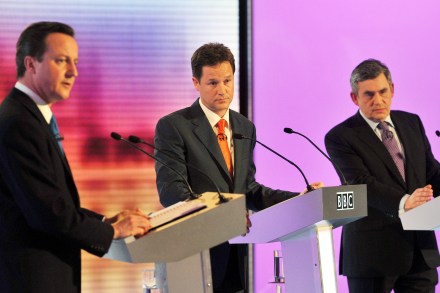
Well, Cameron saved the best till last. His aides are even joking that they could do with a fourth debate because their man is really getting in the swing of it. He looked more confident, assured – and spoke convincingly about immigration at last, a subject he fluffed last time. I’d place Clegg second. Brown was worse than awful: third in this debate, and will probably be third next week’s election too. Clegg was his usual telegenic self – in thespian terms, an accomplished performance. But he ran away from his own asylum policy, and was comically inept with the facts. He screamed at Cameron: “Will you admit that 80 percent of immigrants come from the EU?” Cameron did not: because the real figure is a third.

Ten questions for Gordon Brown tonight

By rights, Gordon Brown should fear this debate on the economy more than any other. Here are ten questions I would like to hear him answer:   1. You told Gillian Duffy yesterday that you have a "deficit plan to cut the debt in half over four years." This was a lie, wasn't it? Our debt is £771bn now. Your deficit plan ­- ie, to run huge deficits for years - will actually double it to £1,406 billion within four years according to the Treasury. The debt for which Mrs Duffy and other taxpayers are liable would double under your plans ­- yet you told her it would halve. How can you tell a lie of that magnitude, to the very sort of women whose taxes you intend to use to service this extra debt? 2.

Ten reasons why this is a catastrophe for Brown and Labour

Every politician will be thinking "there but for the grace of God..." today - but the Gillian Duffy incident is not just a gaffe. It is bad for Gordon Brown and Labour on very many levels. Here are ten of them.   1. The image of the Politburo pulling away in the Jag, slagging off the proles. This confirms the idea of an elite, who sneer at voters in private but try to charm them in public. And the idea that politicians (of all parties) say one thing on camera, and another when they think no one is listening. 2. The is not just a gaffe, but the PM on tape insulting the voters. It's the worst thing you can do in an election campaign (ie Obama¹s "cling to guns and religion" remark). Far worse than if Brown were, say, caught swearing, Nixon-style.

Brown v The Voters

We have just witnessed the biggest moment of the 2010 election campaign. It wasn't that Brown let off steam: it was that he instinctively described as "bigoted" a woman who represents what should be Labour's core vote. Sure, she mentioned immigration - but just said "where are they coming from"? Her main concern was the national debt, and what her grandchildren will have to pay. Neither Cameron or Clegg would have thought these points bigoted - and neither would Tony Blair. The thought would not have crossed his mind. Nor that of Kinnock, Foot or Callaghan. Labour's campaign is led by a man who dislikes campaigning, having to get down and dirty with ordinary voters. He doesn't like standing for election. "Whose idea was that?" He asked when inside the car. Whose idea was what?

Cameron’s secret weapon is amiability

David Cameron has just taken his first real “kicking” of the campaign from a parent of a disabled child. Handled it brilliantly, I think. The parent is angry, understandably, about the problems he has finding a normal school for his wheelchair-bound son. The Tories are suspicious of the “inclusion” agenda – often a code for denying special-needs children the extra tuition that they deserve. But, as the father of a severely disabled son, Cameron knows more about this subject than almost anyone else in Westminster.   “It should be your choice, sir” he said: and he’s right. The voucher system would make a disabled child worth north of £22,000 a year to teach – four times more than an able-bodied pupil.

Labour’s disintegrating campaign

Fireworks at Labour's press conference this morning, thanks to some brilliant questioning of Mandelson and Balls about the cuts which Labour is concealing from the public. A while ago, the FT did its own version of a table that Coffee House ran in February: the implied cuts that departments will make under HM Treasury forecasts. I reprint it below. The IFS has sought to quantify these cuts. So Sky's Adam Boulton read out this list and confronted Mandelson: which of these would Labour not do? Freezing benefits? Cutting public sector pay? Halving the spend on teaching assistants? Cutting funding to Wales and Scotland? Nick Robinson from the BBC piled in too: Labour has asked broadcasters to focus on the issues, so why can't it discuss this issue?