Fraser Nelson

Fraser Nelson

Fraser Nelson is a Times columnist and a former editor of The Spectator.

Hammond fills Fox’s shoes

From our UK edition

It's official: Philip Hammond is the new Defence Secretary and it’s a wise choice. The tough work: making the cuts, axing Nimrod, leaving the east coast undefended etc.: has been done. I doubt Cameron would have been able to get that little lot past his party as easily had it not been done by Liam Fox. Now, the task is implementation. It requires mastery of detail and a sharp eye for financial irregularities, and Philip Hammond is the man for that. As Osborne's number two in Opposition, he will, like Des Browne, approach defence from the perspective of fiscal management. The future of Trident is less assured: Hammond will not threaten to quit over its abolition (as Fox quietly did in Opposition).

Personal loyalty brings down Fox

From our UK edition

When Liam Fox celebrated his 50th birthday, he invited friends - those who would be likely to turn up for his 60th no matter what political fate befell him. Political allies fall away, ran his argument, but not friends. No one would have imagined that he'd be able to test this theory within just three weeks. On Monday, it looked more likely than not he would survive: he gave what seemed like a full apology and made full disclosure. The Tory tribe had rallied behind him. It was embarrassing that his best man had turned up to share vodka martinis with him in various parts of the globe, but where was the wrongdoing? But, as we now know, that was not the whole story. There was a missing part, the saga of Adam Werritty and his unusual sources of finance.

Lansley’s historic debacle

From our UK edition

I've just come back from a Health Service Journal conference of medics, where all manner of subjects came up. One audience member asked what historical event stood comparison to Lansley's mishandling of the Health Bill. What else has caused so much controversy, to such little purpose? No one knew. Many of those present — senior doctors, NHS executives, etc — knew Lansley, and everyone seemed to agree that he is a policy wonk fatally miscast as Health Secretary. Politics is about making and winning arguments; whereas Lansley wanted to work on details so complex that, even now, almost no one in government can explain what is being done.

Time to scrap the minimum wage?

From our UK edition

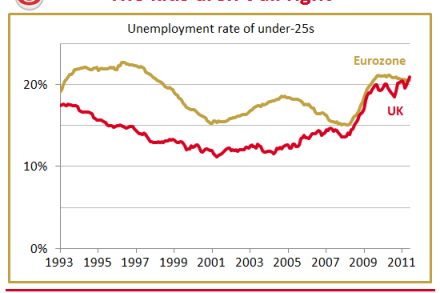
Today’s youth unemployment figures are simply appalling. It’s now 21 per cent amongst the under-25s, above the peak of 18 per cent seen under the 1990s recession. For the first time since then, Britain’s youth joblessness is worse than the European average. This is a tragedy, and not one we should accept as being a grimly inevitable aspect of the recession. Ed Miliband said in PMQs that a million young people are on the dole: a statistic everyone should get angry about. And we can think of what has gone wrong. The above graph shows how Britain has nothing left to boast about in unemployment. Blair used to love heading to Brussels and saying the real 'social model' was lower regulation which meant higher employment. What’s changed over the last 20 years?

Werritty’s donors

From our UK edition

So, who paid for Adam Werritty's air miles? This is the question going around Westminster this afternoon. James blogged yesterday that No10 has set two tests: was Werritty being paid by defence companies, and did Fox know about it?   From what I understand, the answers to both are "no". Werritty was not paid by any defence company — or, indeed, any company at all. His funds were provided by individual donors, who do not have even a tangential interest in the defence industry. His job was to network and provide updates about politics in general. His donors are interested in affairs in the Gulf and the Middle East, about energy security and other such issues — so this involved going to a lot of conferences, and a lot of travel.

The poverty of the poverty measure

From our UK edition

‘400,000 children will fall into relative poverty by 2015, says IFS’ we read on The Guardian’s front page today — yes, one of the most pernicious ideas of recent years is back. It’s the definition of ‘poverty’ as being figures on a spreadsheet, households deemed to fall beneath an arbitrary threshold. It’s almost entirely meaningless, and diverts energy and resources away from a real fight against poverty. I really do believe that, as ideas go, this one has damaged Britain more than almost any other over the last two decades — and it’s high time it was confronted.

Fox in the clear?

From our UK edition

Liam Fox demonstrated today why he'll be staying in Cabinet. He's a tough, eloquent and effective Commons performer who does not fall to pieces when the going gets tough. George Osborne and Michael Gove were both on the front bench with him. One MP told me he saw Eric Pickles in the corridors, giving Fox a hug that almost killed him. All this reflects well on them: in politics, it's always worth noting who stands by colleagues, and who scarpers, when it hits the fan. Fox has, finally, made the two steps required to get on top of this scandal: an apology, and full disclosure to stop the drip, drip of allegations which was giving this story such lethal momentum.

Boulter vs Fox

From our UK edition

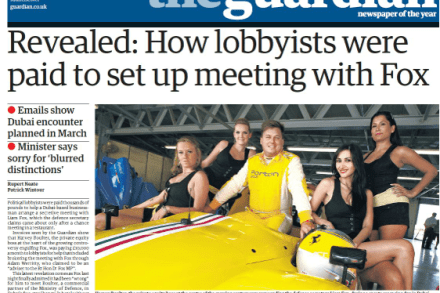
The Liam Fox imbroglio has just started to make more sense. The original story was broken by The Guardian (of whom more later) and the main source appears to have been one Harvey Boulter, an American mogul whom Fox fatally agreed to meet in June at the suggestion of his friend Adam Werrity. It was the kind of meeting that a civil servant would never have arranged. Boulter was, to use a political term, toxic. He was being sued for blackmail by 3M, in a court case being fought in London, and after landing this meeting with the UK Defence Secretary he tried to use it as ammo.

Chris Huhne: an apology

From our UK edition

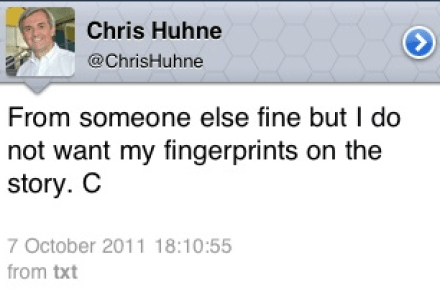
I have apology to make. I wrote on Friday that I suspected Chris Huhne's mistweet “fine, but I don’t want my fingerprints on the story” was the Climate Change Secretary briefing against a Cabinet colleague to a Sunday newspaper. This was a horrid allegation to make, suggesting that a member of Her Majesty's Government would spend his time and energy trying to ridicule a colleague for the benefit of a Sunday newspaper. I now accept that he was not. It was for the Saturday edition of The Guardian. Huhne has just fessed up to Jon Sopel the Politics Show on BBC One: “In the Eastleigh News website is a recording of Theresa May, a recording from a few months previously of the leader of UKIP, Nigel Farage and it’s exactly the same.

Chris Huhne makes a Tweet of himself

From our UK edition

Chris Huhne has fallen into the Twitter direct message trap. I've done it myself.* When you think you're privately messaging someone then — horror! — it is broadcast to the world. In his case "From someone else fine but I do not want my fingerprints on the story C'" He deleted the tweet but — sorry, Chris! — that doesn't work on Twitter either because you can be retweeted. What's he up to? As a former Sunday newspaper journalist I have a fair idea. It's Friday night, 6pm — witching hour for MPs briefing a Sunday hack, with the intention of damaging a colleague or the government. "From someone else, fine" might well indicate asking the journalist to suggest the leak or quote came from someone else — so he could then deny all knowledge.

Brendan Barber’s champagne habit, and other stories

From our UK edition

The Tory conference was so forgettable that it’s hard now to remember it took place earlier in the week. But, for what it’s worth, here are my conclusions from the whole conference season: 1. The search for Osborne’s growth strategy has been called off. This ‘leadership’ theme was short for ‘leadership in the crisis, which we’ve now decided is inevitable’. Printing £75 billion will be  prelude to printing £400 billion, the inflation tax is back. Osborne perhaps thinks this new magic gold will bring economic recovery. So did the Emperor in Faust, when the devil suggested that printing money would avert fiscal crisis.

Tory Party Conference, Inc.

From our UK edition

The empty chairs for David Cameron’s speech said it all: the party conference is no longer a political event. This was my eleventh Tory conference, and, even in this short time, I’ve noticed a creeping corporate takeover.  The difference struck me yesterday, when I attended a packed fringe meeting in something called the ‘Freedom Zone’. It was set up to discuss banned topics: how to cut taxes, the case for a referendum on EU membership, etc. The crowd was younger, of a libertarian bent — all activists and enthusiasts of some kind, a refreshing change from the sanitised and often lifeless feel of the rest of the official conference.

Explaining Cameron’s debt u-turn

From our UK edition

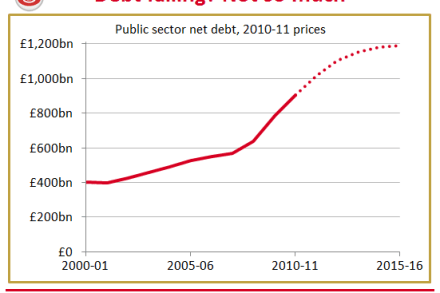
“Millionaire David Cameron wants you to pay off your credit card – are you going to obey the Prime Minister?” asked one local BBC radio station phone-in this morning. This is not what No. 10 had in mind when releasing selective quotes from his speech last night. “The only way out of a debt crisis is to deal with your debts. That means households - all of us - paying off the credit card and store card bills.” This line in his speech is now being rapidly rewritten – and for good reason. Because the Prime Minister was in danger of making a major mistake.   The premise of the now-never-to-be-delivered quote is incorrect. The British public actually are paying down their debts, while the British government is vastly increasing its borrowing.

Good Boris

From our UK edition

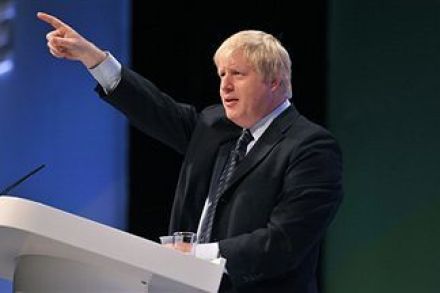
Boris Johnson must be one of the very few politicians in the world to make the audience laugh before they even start their speech. Just by walking on stage, he has the effect of a good comedian: the punters start to smile, in anticipation of some good one-liners. In today’s case, Boris got a standing ovation before he opened his mouth. Here is the man judged by Ladbrokes as the most likely next Conservative leader, but he had not come to stir. The Prime Minister – who lavished praise on the Mayor last night – was in the hall. It was all Big Society (BoJo division): affordable housing and a reprise of his January speech about restoring London’s identity as a union of villages.   But, he sounded several clear notes of defiance.

What Osborne got right

From our UK edition

After being mean about Osborne’s sub-prime corporate debt policy, I should say that he got a lot right in his speech earlier today. His delivery was the best I’ve seen: he looked relaxed, and sounded conversational. This suits him: he’s not a hell-and-brimstone kind of politician. He dealt with the dire subject matter in a confident way and was not in the least defensive. And he showed a glimpse of the sunlit uplands, so conspicuously absent from Vince Cable’s doom-laden speech a fortnight ago. That said, it seemed apparent from the rest of his speech that he is bracing himself – and us – for a downward surge on the economic rollercoaster.   “Leadership for a better future,” said the words on the podium.

Osborne’s next trick: sub-prime companies?

From our UK edition

About 15 years ago, Bill Clinton wanted to promote home ownership among the low-paid, but was annoyed that banks wouldn’t lend freely or cheaply to that group. So, the federal government intervened with Freddie Mac and Fannie Mae selling government-backed mortgages at knockdown rates. Nothing showed up on the national debt, because the loan would — in theory — be repaid. The seeds for the sub-prime crisis were sewn.   Today, George Osborne wants to promote recovery and is annoyed than banks won’t lend freely or cheaply enough to small businesses. So, the Treasury will intervene by lending money indirectly by backing a new bond market that lends cash to small companies.

Is the health budget falling or not?

From our UK edition

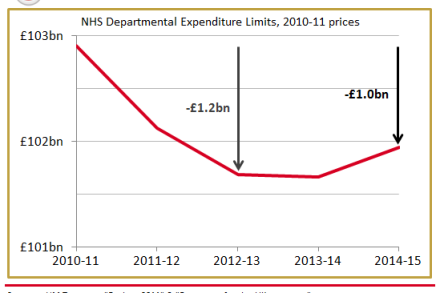
Before the election, the Conservatives promised they'd "protect" the NHS, which they defined as increasing its real-terms budget year-on-year. This is a rather dangerous promise because it makes ministers hostage to inflation. Now that inflation has surged, expectations have been revised upwards, and it looks like the NHS budget will suffer a real-terms cut. In its monthly update of City consensus forecasts, the Treasury has released new figures for inflation over the next five years.Apply the latest inflation figures to health spending in the last budget and it implies a £1bn shortfall . The graph below shows the change over five years: Back in March, the IFS said that the government was in danger of breaking that pledge.

Any questions for IDS?

From our UK edition

At 6pm this evening, I'm interviewing Iain Duncan Smith at a Conservative Party conference fringe meeting. He is fighting a war on at least three fronts: the welfare-to-work programme, the creation of his Universal Credit (ie, rewriting the benefits system), and producing a government response to the riots and the conditions behind them. I may put questions to him from CoffeeHousers, so if you have any please leave them below. IDS is surprisingly candid for a Cabinet member, perhaps because he wants this to be his last job in government. He isn't watching his words, worried that he'll say something to damage his promotion chances.

Osborne and tax cuts

From our UK edition

“Top Conservative despairs of Cameron growth plan,” says The Times’ front page today. While The Daily Telegraph’s reads: “No tax cuts before the next election, says Osborne”. The two stories are related. British economic growth is evaporating, and more than a few Tory MPs are worried that the Chancellor doesn’t have a coherent growth strategy and that he doesn’t seem to care. Osborne’s cheery interview with Robert Winnett and Ben Brogan will do nothing to allay such fears. He repeats his position on tax cuts: that, while desirable, they are likedessert once the nation has eaten its main course of cuts and tax rises. He appears to rule out using tax cuts as a tool to stimulate growth.

Ed Miliband, closet Glee fan?

From our UK edition

  What to make of Ed Miliband’s disclosure yesterday that Journey’s Don’t Stop Believin’ is his favourite song? Ben Brogan smells a rat: “If he's a Journey fan, then I'm a football expert”. But here’s the thing: you don’t have to be a Journey fan to like Don’t Stop Believin’. You just need to be a fan of Glee. For the uninitiated, Glee is an American musical TV series about (impossibly glamorous) nerds in an Ohio high school, who join an after-school music club and are intensely bullied by the cool, sporty kids in the school. But they stick to what they believe in, overcoming the bullies. Don’t Stop Believin’ (here) is the anthem of the series: the first and arguably best Glee cover song.