Fraser Nelson

Fraser Nelson

Fraser Nelson is a Times columnist and a former editor of The Spectator.

Obama’s plan B: tax cuts

From our UK edition

Washington, DC The clue is in the name. A stimulus is supposed to stimulate, and Obama's first attempt stimulated nothing more than the American national debt. So he's trying again, with a $447 billion package (he's careful not to call it a "stimulus") in what will probably be his last roll of the pre-election dice. But $245 billion of it would be debt-financed tax cuts.  Not sales tax cuts, the type of which Ed Balls is prescribing for Britain. It's all payroll tax cuts: reducing the tax on jobs in the hope of encouraging more hiring. Given the temporary nature of the tax cuts, I doubt this will be the pre-election silver bullet.

50p tax isn’t just hurting the economy, but Treasury revenues too

From our UK edition

So where were these 20 economists when Gordon Brown first set the 50p trap for George Osborne? Then, Brown's gamble was that the Shadow Chancellor was a political strategist with little interest or expertise in economics, so he'd be unlikely to work out just how much the 50p tax would lose the Exchequer, or guess it could be more than £3 billion a year – with further, less calculable damage on Britain's reputation as a home for entrepreneurs. This was when we needed those economists. At the time, all Osborne had to go on was the IFS which calculated it would cost £800m - assuming the rich were no more mobile now than they were in the 1980s. A ludicrous assumption, of course. What proportion of Britain's super rich are immigrants?

Who were the rioters?

From our UK edition

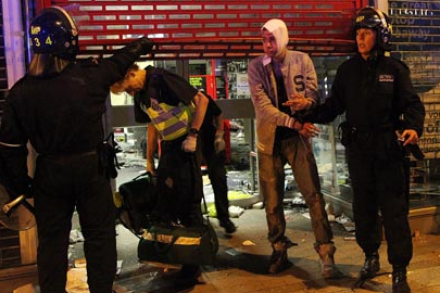
Ken Clarke reveals today that three-quarters of convicted rioters aged 18 and over had previous convictions. Hence his term about a "feral underclass" – strong language, which politicians usually reserve for describing the media. But is this the whole story? One of the reasons that I wanted an inquiry into the riots, as Ed Miliband suggested, is that we could learn more. How many of those convicted finished school? How many were brought up in a workless household, how many by a lone parent, how many in one of London's welfare ghettoes? Did their racial composition match that of their neighbourhoods (I suspect it did, and that race is not a factor in the riots). How many are deemed to have belonged to a hardcore, and how many swept along with the mood?

Clegg vs Clegg

From our UK edition

As the Lib Dem conference approaches, we can expect some briefing from their spin doctors claiming to have "wrecked" all manner of Tory policies. It's a petty and ugly phase of the coalition. Last year: nuptial bliss. This year: one partner throwing china at the other. The next phase is divorce, which is why I'm surprised to see the Lib Dems accelerating the process by today's divisive briefings. Especially on something as self-defeating as school reform. We are told that "Nick Clegg defeats bid by Michael Gove to let free schools make profits". This is nonsense. As I write in this week's Spectator, Gove is not pushing for profit-seeking schools, to the disappointment of some inside Number 10.

Scottish Conservatives, 1965–2011

From our UK edition

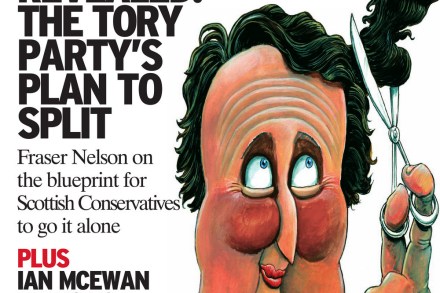
You read it here first – four years ago. The Conservative Party looks like it will finally enact its plans to split, and the Scottish Conservatives will dissolve – at least if Murdo Fraser wins the leadership. The Sunday Telegraph has the news tomorrow: "Murdo Fraser, who is favourite to become leader of the Scottish Conservative and Unionist Party, will announce that he plans to wind up the party if he wins a ballot of members next month. He would follow disbanding the party by launching a new Right-of-centre party that would contest all Scottish elections — council, Scottish Parliament and Westminster.

Your Coffee House

From our UK edition

At Coffee House, we do our best to serve up robust debate and solid ammo alongside it. So I'm delighted that Matt Cavanagh and Jonathan Portes were able to post their critiques of my posts on immigration. It is, we hope, the first of many high-calibre, well-argued and fact-rich outside replies we will run. Coffee House is, of course, here for the benefit of our customers, so we'd be interested to hear your thoughts on this. We promise not to do this too much, and we'll keep up our mix of breaking views, behind-the-scenes political insight and meaty policy analysis. But are we getting the mix right? Is there anything you'd like to read more of? Do let us know.

Primary contest

From our UK edition

The independent advantage starts early – frighteningly early, if you’re a parent, says Fraser Nelson  Fifty per cent of children are of below-average intelligence, but try telling that obvious fact to their parents. Humans are programmed to find their offspring mesmerisingly delightful, and to consider them strikingly quick learners and budding geniuses. I know I do. But like many parents, I promised myself I would not let it drive me to delusional paranoia or make me project on the poor lad my own ambitions. Certainly, when it came to primary school, I was going to relax. How much can they learn at that age, anyway?

Michael Gove’s free schools are a triumph – but can they keep up with the baby boom?

From our UK edition

When Michael Gove first proposed ‘free schools’ four years ago, he could have been written off as another Tory daydreamer. The idea of creating an education market, with independent state schools competing for pupils, was considered by Keith Joseph in 1980, then dropped when the depth of his department’s hostility became clear. English schooling was controlled by bureaucrats and unions, and sporadic ministerial attempts to change that always ended in failure. So Gove’s friends and enemies concluded that, as Education Secretary, his radical reforms were doomed. How wrong they were. This month 24 new ‘free schools’ will open, admitting about 10,000 pupils. Behind each school is a group of teachers acting on parental demand for something better.

The Swedish case for school profits

From our UK edition

Should state schools be able to make a profit? We asked this of you on our Coffee House poll this week. 71 per cent of you said yes, and with good reason. Profit-seeking companies expand when demand is strong: that’s what you want good schools to do. But successful schools not seeking profit have no incentive to expand: it’s an easier life just to let the waiting list grow and jack up the fees. This month, 24 new ‘free schools’ will open – eventually able to educate 10,000 pupils. But to keep pace with the boom in primary school pupils, we’d need an extra 400 primaries alone. Will the ‘free school’ model be enough – depending, as it does, on charities? It’s a live debate in government.

The dangers of home ownership

From our UK edition

The slump in home ownership is reported today as a bad thing. Many Conservatives, who believe that home ownership releases what the late Shirley Letwin called "vigorous virtues", may agree. So might Labour, which came to regret its opposition to the Thatcher policy of allowing council tenants to buy their home. Like inflation targeting, home ownership was a solution that worked so well in the 1990s that it was vigorously pursued in the next decade. But here's the rub: it had disastrous effects. In this case, the disaster was governments pursuing greater home ownership as a policy goal. This meant cheap loans, which meant subprime mortgages, which meant a credit bubble.

Exclusive: Osborne’s jobless recovery

From our UK edition

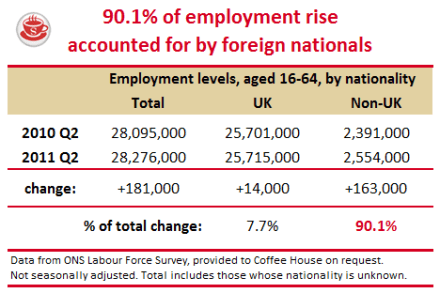
George Osborne was right to boast in the Commons that Britain has the “second highest rate of net job creation in the G7”. Coffee House recently pointed out that all of the increase is accounted for by foreign-born workers. But what if you narrow the definition to foreign nationals? We put in an information request to the Office for National Statistics and the below information came back. It is quite striking. Over the 12-month period to which Osborne refers, 90.1 per cent of the extra employment amongst the working-age population can be accounted for by an increase in foreign nationals working in the UK. Here are the figures. The phenomenon of pensioners returning to work is fascinating, but separate.

British jobs for whom? | 28 August 2011

From our UK edition

“More than 400,000 people have been out of work for more than two years, according to analysis of the latest Government data by think tank IPPR.” So runs its press release today, trailed in the Sunday press and the wires. I hope the IPPR didn’t spend too much of their donors’ money on this research, as the figure is updated quarterly and freely available from the DWP website (click here). Add up only three categories: lone parents, jobseekers allowance and incapacity benefit the figure stands at 2.4 million, certainly “more than 400,000”. Worse, at the peak of the boom (Feb07), this figure was even higher at 2.5 million. And yes, it’s a real problem. As the IPPR goes on to say, unemployment is self-reinforcing.

Cameron’s immigration problem

From our UK edition

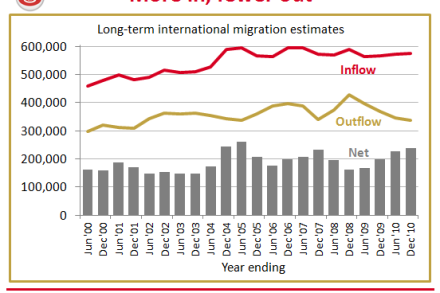
Poor David Cameron. He pledged to reduce annual net migration from the current 240,000 to the "tens of thousands" and what happens? Net migration in 2010 was up by 21 per cent from 2009. In a way, he deserves the flak he'll get because this was a daft target that could only have been set by someone poorly-advised about the nature of immigration. And the target allows success to be presented as failure. The inflow to Britain has stayed steady (see graph below), but the number emigrating from Britain has fallen. This is a compliment to Cameron: the most sincere vote people can make is with their feet. And in our globalised world, countries have to compete for people. Britain is as attractive as ever it was to immigrants, and more natives are staying put.

The schools revolution in action

From our UK edition

Harris Academies, one of the best-known new chains of state secondaries, have today posted an  extraordinary set of results. It's worth studying because it shows how a change of management can transform education for pupils in deprived areas. Pour in money if you like, but the way a school is run is the key determinant. This is the idea behind City Academies, perhaps Labour's single best (and most rapidly-vindicated) policy. The notion is rejected by teaching unions, who loathe the idea that some teachers are better than others. Bad schools are kept bad by the idea that their performance is due to deeply-ingrained social problems, etc. Harris has produced a table showing the results of their schools when they were last run by the council, and this year's results.

Libya: mission accomplished?

From our UK edition

If David Cameron breaks his holidays yet again, you'll know it's because he expects Gaddafi to be a goner pretty soon. It's been a busy old night in Tripoli, with Twitter reports suggesting that Gaddafi is already dead. Mind you, William Hague et al have learned to treat Twitter reports with a mountain of salt. Let there be no doubt: Cameron pushed for the Libyan intervention, averting what looked certain to be a massacre in Benghazi. The Prime Minister took a principled stand. In so doing, he reminded the world that the West can still intervene when it so chooses and will not stand by to watch slaughter. This was a decisive moment. Averting a Benghazi massacre was in itself a victory.

070, licensed to rebel

From our UK edition

It's no surprise that 70 Tory MPs have formed a Eurosceptic group, as the Sunday Telegraph reveals today. They are the modernisers now. The new Tory intake are strikingly robust on all this: by and large, their idea of political balance is a picture of Thatcher on the wall and Jacques Delors on the dartboard. The impending boundary review and thinner-than-they-expected majorities mean they worry more about their constituency (and constituency associations) than the whips. But I'm told today that this rebellion isn't quite as fierce as it may seem. One Tory backbencher tells me the Tory whips have actually encouraged this group to call for renegotiation of the UK terms of EU membership.

Tackling the far right

From our UK edition

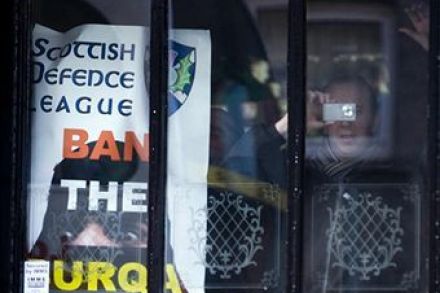
The English Defence League marches are heinous, but tolerated by the English authorities. Not so in my homeland, where the Scottish Defence League have been told by Edinburgh council that they cannot hold a march where they'd hoped to be joined by 200. Part of me welcomes this news: Scotland has its social ills (mainly sectarianism) but racial tension has never really flared. As Alex Salmond says, there are many colours in the tartan. Then again, banning the march may serve to give credibility and a cause to the crackpots who call themselves the Scottish Defence League. Their march would probably have been a tragicomic affair, and they'd have disappeared into the black hole of public ridicule. But a ban is just what these agitators want.

Gang war

From our UK edition

There’s a social crisis coming, says Iain Duncan Smith, and we must act now to avert it Most politicians who hang pictures of battle scenes in their office do so from a sense of nostalgia. For Iain Duncan Smith, it is about militaristic feng shui. Since becoming Secretary of State for Work and Pensions, the former soldier has approached his job as he would a battle. The abstract pictures he inherited from his predecessor, Yvette Cooper, have been replaced with scenes of the Duke of Malborough’s victories. When a group of officials came to visit him just after he changed the decor, they told him it felt like the Ministry of Defence. ‘That’s right,’ he replied. ‘I want you to know that from now on, this is the war room.

The Spectator, redux

From our UK edition

There’s a lot of bad news around, but some things are going right in Britain. Sales of The Spectator are on the rise again, for the first time in four years. Pretty soon, if the trend (and our luck) holds, more people will be buying the magazine than at any point in our 183-year history. I thought CoffeeHousers might like to know a bit more about the forces behind this, and what we at The Spectator are up too. The market for print is murderous right now. We’re mid-way through what is, for the media, an industrial revolution. A massive migration is underway, from print to online.

WEB EXCLUSIVE: Full-length interview with IDS

From our UK edition

I have interviewed Iain Duncan Smith for tomorrow’s Spectator. In print, space is always tight and we kept it to 1,500 words. One of the beauties of online is that you can go into detail in political debate that you never could with print: facts, graphs (my guilty pleasure) and quotes. Here is a 2,300-word version of the IDS interview, with subheadings so CoffeeHousers can skip the parts that don’t interest them. I’ve known him for years, and remember how hard it was to get out of his room four years ago when he started on the subject of gang culture and the merits early intervention. Now, he’s in the DWP, able to enact all he spoke about. He believes the riots will transform Cameron’s premiership in the same way that 9-11 did Blair’s.