Douglas Murray

Douglas Murray

Douglas Murray is associate editor of The Spectator and author of The War on the West: How to Prevail in the Age of Unreason, among other books.

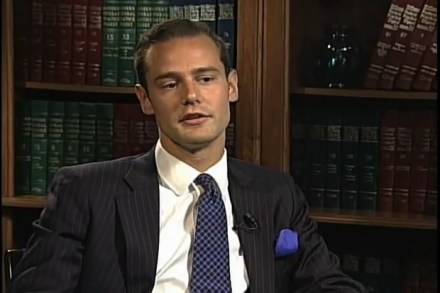
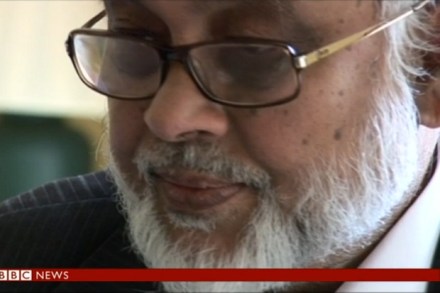
Would you trust this man?

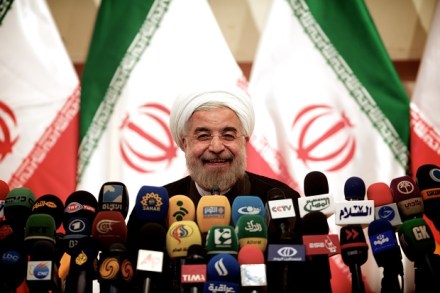
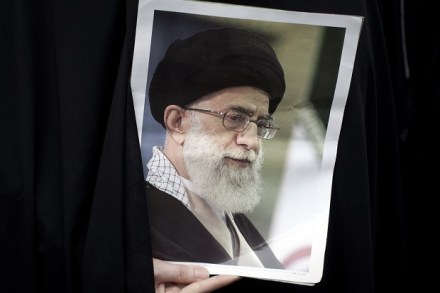
In Geneva, America and her allies are limbering up for another round of negotiations over Iran's nuclear project. In a sign of the thaw Barack Obama and our own Prime Minister seem desperate to declare, David Cameron has spoken directly with President Rouhani for the first time. According to a Downing Street spokesman, the two men ‘agreed to continue efforts to improve the relationship’. Meantime, ahead of the Geneva talks, the man with the power in Iran, the Supreme Leader, has just given a speech to 50,000 Baseejis (government militia).  Here is some of what he said: ‘Is the Islamic regime after war with others? This is the statement that is heard from the mouth of the region's dog with rabies, i.e. the Zionist regime, that 'Iran is a threat to the world'.

The Muslim Brotherhood thrives in Britain

The Muslim Brotherhood aren't doing so well in Egypt at the moment. Happily they are making some gains in Britain. On Tuesday the organisation's dauphin - Tariq Ramadan, famous Islamist ideas man, grandson of the Brotherhood's founder and prominent double-speaker gave the Orwell prize's annual 'Orwell lecture'. I wonder which direction Orwell's body is spinning in? And elsewhere, at London's SOAS (the School of Oriental and African Studies, better known as the School of Organised Anti-Semitism) a speaker who is opposed to the Muslim Brotherhood was chased from the stage by Muslim Brotherhoood supporters. It is worth watching the video of what turned into an Islamist rally just to remind yourself of how well spent our taxpayer money is.

Rather than apologising for immigration, let’s keep our borders tighter in the first place

What is wrong with the now almost daily apologies about mass immigration? Today it is the turn of Jack Straw.  The former Home Secretary has just admitted that opening Britain’s borders to Eastern European migrants was a ‘spectacular mistake.’  He acknowledges that his party's 2004 decision to allow migrants from Poland and Hungary to work in Britain was a ‘well-intentioned policy we messed up'.  The Labour government famously predicted that a few thousand people would come, while the actual figure ended up being closer to a million. Of course apologies are normally intended to draw a line under a matter.  But how could that possibly occur when all three main parties are currently committed to making the exact same mistake again?

What will history make of Britain’s treatment of Chowdhury Mueen-Uddin?

‘A historic catastrophe’ is how Martin Bright describes it. He is referring to the policy by which successive governments in the UK, Conservative, Labour and coalition, are accused of having promoted the worst people into the positions of Muslim community leaders. The specific case that sparks this reflection is the case of Chowdhury Mueen-Uddin. Since leaving Bangladesh and becoming a British citizen he has been at the very pinnacle of Britain’s interfaith and moderate Muslim industry. Here he is with Prince Charles at the Islamic Foundation in Leicester. Major politicians of all parties as well as numerous ‘faith leaders’ have rubbed shoulders with him.

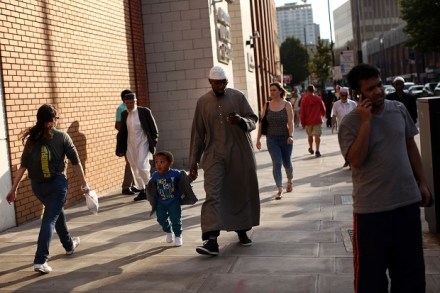
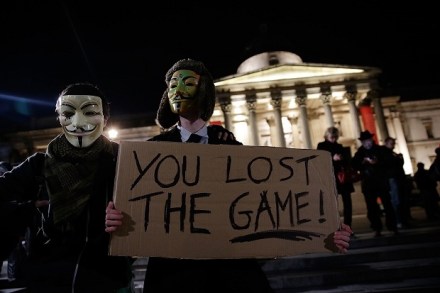
What would you call these people?

One of the most amusing ideas of the dim (as opposed to decent) left is that fascism is a force from the right at constant risk of re-eruption. So widespread has this idea become that even members of the Conservative party often feel forced to describe themselves as ‘centre right’ just so as to make clear they aren’t ‘right wing’ because ‘right wing’ is just in from ‘far right’ and ‘far right’ basically means fascist. However, one of the strange things about these so-called ‘anti-fascists’ is that their fascist sensors seem completely befuddled whenever they meet anybody who behaves distinctly fascistically yet is thought to come from ‘the left’. For instance, here is an interesting one.

‘When Tommy met Mo’ revealed how far we have to travel before Islamism is uprooted

Last night the BBC screened a documentary called ‘When Tommy met Mo’. It was good television, challenging and thought-provoking in a way that public broadcasting ought to be, is often said to be, but too rarely is. I would urge you to watch it. The programme followed Tommy Robinson during the period in which he was stepping away from the organisation – the English Defence League (EDL) – which he founded. It showed Robinson travelling around the country with a Muslim ‘spokesman’ called Mohammed Ansar.

Is Sunny Hundal the best person to lecture on journalism?

Farewell then Sunny Hundal. The libellous blogger and tweeter has announced that he is no longer going to keep up his self-published website ‘Liberal Conspiracy’. One reason – far beyond satire – is that he is going to go to the University of Kingston to lecture on journalism. Sunny is perhaps not best placed to inform them on basic journalistic standards. As I have written here before, some years ago Sunny had to pay out and publish a wholesale apology to me after libelling me on his website. On that occasion he published outright falsehoods, though his more typical style has been to settle for selective quotation, misquotation and misrepresentation.

Veiled differences

Last night I took part in an interesting debate for Channel 4 News. It was on the wearing of the niqab - or full face veil - in the UK. I think it was my first speaking appearance at the East London Mosque - and certainly the first time I have addressed an audience almost entirely consisting of women whose faces I could not see. Yasmin Alibhai-Brown was, like me, arguing against the wearing of the full-face veil and she made some excellent points. I stayed around afterwards talking to some of the niqabis, and polite and pleasant though most of them were I suppose it reinforced one of the things I tried to point out during the show. Most of these women had London accents and had adopted much of the 'rights' and grievance culture of our society.

This is no time to prosecute the perpetrators of ‘Bloody Sunday’

The front-page of yesterday’s Sunday Times carried the news that up to 20 retired members of the British Armed forces are likely to be taken in for questioning in relation to the deaths of 30th January 1972, known as ‘Bloody Sunday’. Some readers will know that I have taken a great interest in this case and have written a book which I don’t think spares many details on what specific soldiers of 1st Battalion of the Parachute Regiment, among others, did that day. In certain cases – including that of at least one soldier who is still alive (‘Soldier F’) – I do not hesitate to call what they did ‘murder’. But the process from here is fraught with difficulty.

A letter to the Editor of the New Statesman

I have a letter in this week’s New Statesman. It is a response to an article in last week’s magazine by Mehdi Hasan. As NS Letters appear not to be published online I am pasting it here: Sir, The piece by Mehdi Hasan in last week’s magazine (‘Who needs Tommy Robinson and the EDL, when Islamophobia has gone mainstream?’) tries to infer that statements by various writers, including myself, are identical to those on show at some EDL demonstrations.   For instance he quotes some EDL supporters caught on camera chanting: “Burn the mosque!” and then quotes me as calling for ‘mosques accused of spreading “hate” to be “pulled down”.’  Mehdi then says ‘Spot the difference?

Tommy Robinson: Double standards, not fear of diversity, provoked the EDL

The first time I met Tommy Robinson I told him to fuck off. The English Defence League (EDL) had just formed and Robinson came up to me after a public interview I was doing in London. Without knowing anything much about them, I am afraid I assumed (white, working-class, Cross of St George at demos) that the EDL were a British National Party front. Which was why I ended up advising him of the procreative way in which to travel. He took it very politely, said he understood that I didn’t know their views and then said, ‘We’re not racists — we’re just working-class guys who are losing our country and can’t bear it.’ Last week, four-and-a-half-years on, we met again.

Edward Snowden and the Guardian have started a debate…in the Kremlin and Beijing

I was on the Daily Politics earlier, discussing the Guardian / Snowden leaks and debating against a representative from the campaign group 'Liberty'. The 'Liberty' representative kept saying what a lot of apologists for the actions of the Guardian (now including Vince Cable) have been saying - that Snowden and the Guardian should in some way be respected because they have started 'a debate'. They appear incapable of realising that while such leaks may be simply fascinating to them, they are infinitely more fascinating to the Kremlin, Chinese Communist Party, al-Shabaab et al. One other thought.

A deliciously crooked morsel from Azerbaijan

Aficionados of corruption will find much to admire in this story from Azerbaijan. Nobody expected the country’s Presidential election to be free and fair.  An increased majority for the incumbent is the usual arrangement in such circumstances, heading to 100% approval and sometimes a little over. But the Azerbaijan authorities have managed something even more ineptly crooked.  They appear to have released the election results a day before voting had even started.

Spies spy – get over it

In the whole panoply of human idiocy is there anything so ridiculous as the outrage that occurs whenever people are reminded that spies spy? There was just such an outburst recently when Edward Snowden left his job as a contractor to the CIA and NSA, repelled, he said, by the discovery that surveillance programmes carry out surveillance. Snowden discovered that American and British intelligence agencies were involved in data trawling and was so horrified that he found it necessary to flee — first to the freedom-loving People’s Republic of China and then, to seek asylum, to Moscow. On the left of the political spectrum he is the new Julian Assange — though without the sex-crime charges.

The LSE and the notorious t-shirt of hate

The London School of Economics (LSE) has been in the news recently thanks to a certain ex-lecturer who was a Marxist. But while Marxism retains some grip at faculty level in the LSE, it is — like many other universities — another variety of extremism that increasingly dictates events at student level. At last week’s LSE Freshers’ Fair — as Student Rights document here — the Atheist, Secularist and Humanist society were threatened with physical removal after being discovered to have t-shirts deemed to be — wait for it — ‘offensive’. Told to cover themselves up or face removal, the atheists were informed that their t-shirts might even be considered ‘harassment’. So what was the nature of the t-shirts?

Why are Marxists and Soviet apologists regarded as harmless jokers?

I rather like Ed Miliband, and for what it’s worth I don’t think he has inherited much, if any, of his father’s rancid political views. Nevertheless the fact that Ed Miliband has often referred to his father’s thought makes Miliband Snr fair game in a way that other politicians’ parents might not be. But in the row over the Daily Mail / Ralph Miliband affair two things remain to be pointed out. The first relates to war service. Contra Emily Maitlis (among others) on last night’s Newsnight, it is perfectly possible to fight for a country in a world war and still hold values (then or subsequently) inimical to the country you fought for. After all, Sir Oswald Mosley fought for Britain, and was injured, in the First World War.

Samuel Huntington’s ‘Clash of Civilizations’ is still upsetting the complacent

It is twenty years since Samuel Huntington’s essay ‘The Clash of Civilizations?’ was first published in Foreign Affairs. On Monday night I took part in a discussion on BBC Radio 3’s Nightwaves about the article (and the resulting book) which turned oddly nasty. I have always been a qualified admirer of Huntington’s most famous work (‘qualified’ because like most people who have read the book I admire its range and grasp while disagreeing with certain of its conclusions). But broadly admire it or not, it appears to be a difficult work to discuss. This is largely because it suffers the double-bind of being misunderstood by people who have not read it.

Is President Rouhani’s Iran serious?

Is Iran serious? That is the question everybody has been asking for the last 24 hours since the new Iranian President went to the UN in New York and gave an interview to CNN. A colossal outbreak of wilful optimism has followed from policy makers, ex-policy makers and media. This has been based largely on the fact that an Iranian President may have just acknowledged that the Holocaust of European Jewry occurred. Well huzzah. For what it’s worth, President Rouhani didn’t quite say that. In the CNN interview he said that it was the job of historians to look at such things. And to the extent that he acknowledged that a ‘crime’ had occurred, Rouhani did so in order to put the Holocaust on an even pegging with the creation of the state of Israel.

No, Mr Cameron. The Kenyan massacre is all about Islamism

Here we go again. A group of Islamist terrorists armed with guns and grenades head into a shopping mall in Kenya. They separate out the Muslims from the non-Muslims, let the former go free and massacre the latter. Cue the usual responses. The British Prime Minister, David Cameron, says: ‘These appalling terrorist attacks that take place where the perpetrators claim they do it in the name of a religion – they don’t.  They do it in the name of terror, violence and extremism and their warped view of the world. They don't represent Islam or Muslims in Britain or anywhere else in the world.’  I don’t think any sensible person would argue that the perpetrators represent all Muslims.

Life would be better if the Lib Dems ceased to exist

Steerpike’s photos from the Lib Dem conference make the affair look far more interesting than it could possibly have been. As I have written here before, the terms ‘Liberal Democrat’ and ‘party conference’, when put together, constitute probably the most soporific words in the English language. There are few ways to adequately summarise the pointlessness of this annual fandango of positioning and lies. Granted the other party conferences aren’t much better. But at least people broadly know — largely for historical reasons — why the Conservative and Labour parties exist. There is simply no point in the Lib Dems. They may once have been a useful outlet for a protest vote; now we have UKIP and the Greens for that.