Douglas Murray

Douglas Murray

Douglas Murray is associate editor of The Spectator and author of The War on the West: How to Prevail in the Age of Unreason, among other books.

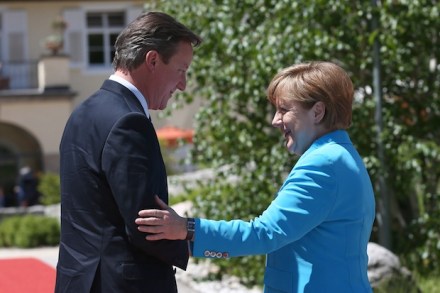
Merkel says Brexit would bring “instability” to Europe. A bit like her migrant crisis

Each week before June 23, I would like to nominate a ridiculous comment of the week. With the amount of folk around claiming that Britain’s exit from the EU would herald World War III, pestilence, famine and every other horseman of the apocalypse, there is no shortage of candidates. At the beginning of last week I rather assumed that David Cameron would win for attempting to posthumously recruit the British dead of Two World Wars to  the cause of the EU, claiming that the fallen had laid down their lives solely in order that Britain should not to be sovereign.  But then the PM’s predecessor, Gordon Brown, stepped up in the middle of the week and pronounced that voting to ‘Leave’ the EU would be ‘not British’.

Does anybody actually think the EU guarantees ‘peace and stability’?

According to David Cameron this morning, if Britain votes to ‘Leave’ the EU on 23 June, the Germans will invade Belgium, the Russians will invade Crimea (again), and we’ll all have to spend the coming years re-learning the finer details of the Schleswig-Holstein question. The Prime Minister’s latest attempt to warn of apocalypse in the case of Brexit has one huge flaw.  In his latest scare-speech this morning he said: ‘Can we be so sure that peace and stability on our continent are assured beyond any shadow of doubt? Is that a risk worth taking? I would never be so rash as to make that assumption.’ Well nothing is ever assured.  But how could anybody still think that peace and stability in Europe are remotely assured by the EU?

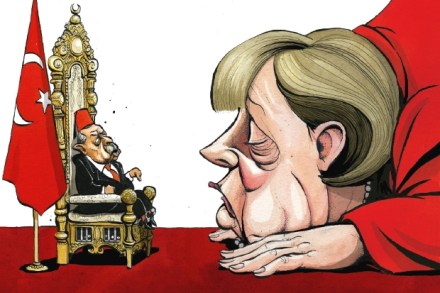
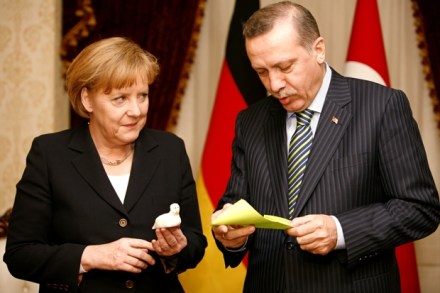
President Erdogan won’t let anyone stand in his way – including Turkey’s Prime Minister

Is Turkey part of Europe? For most of our civilisation’s history, to have even asked such a question would have been to invite derision. The Ottomans were kept out of Europe not by some early-onset prejudice, but by the armies of Europe having to beat back their repeated invasions. The question became slightly more plausible a century ago with the rise of Ataturk and the modern Turkish state (one of the only successful efforts to reconcile the Islamic religion with state power). For a brief period around the turn of the millennium, some serious people (including the British government) supported Turkey joining the EU. But today, the question has become academic — first because Turkey’s liberal trajectory long ago halted and began rolling backwards.

Turkey’s triumph

Update: Since this article was published Ahmet Davutoglu has resigned as Turkey’s Prime Minister. Reports suggest this comes as a result of a rift with President Erdogan caused by the increasingly ‘Presidential’ nature of Turkey’s politics. Is Turkey part of Europe? For most of our civilisation’s history, to have even asked such a question would have been to invite derision. The Ottomans were kept out of Europe not by some early-onset prejudice, but by the armies of Europe having to beat back their repeated invasions. The question became slightly more plausible a century ago with the rise of Ataturk and the modern Turkish state (one of the only successful efforts to reconcile the Islamic religion with state power).

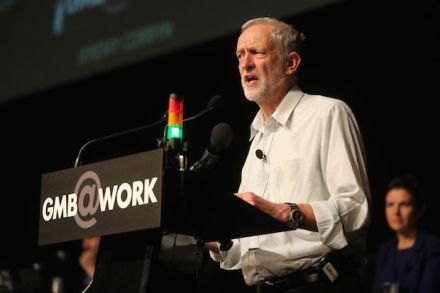
Labour’s anti-Semitism problem stems from its grassroots

If I were the Conservative party I’d be getting worried: Labour’s implosion is happening too fast. At this rate they could fall apart and regroup in time to go into the next election with a respectable leader. Everybody knows the latest developments. Naz Shah MP was found to have said some anti-Semitic things on social media. After some bitter internal wrangling she was suspended from the party. Fellow MP Rupa Huq tried to come to her defence and compared anti-Semitism to any old mishap. And then Ken Livingstone smoothed it all over by talking about which of Hitler’s policies he thinks Zionists agree with.

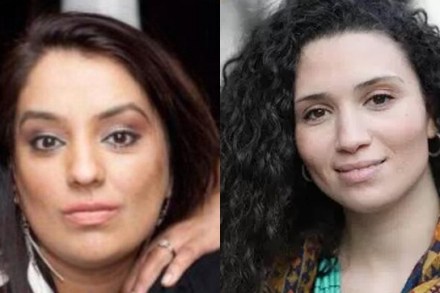
What a week for integration Britain!

It’s been a terrific week for integration Britain.  First the National Union of Students (NUS) elected what the BBC joyously headlined as its ‘First black Muslim woman president.’ Wahey!  Another victory for diverse Britain.  But amid the preliminary bunting some people still remembered that Malia Bouattia is principally known for two things: a reportedly extreme opposition to some things Jewish, and an equal opposition to measures which protect the country which gave her and her family sanctuary when they fled from Algeria.  Ms Bouattia denies being an anti-Semite and insists she is, instead, simply anti-Zionist.

Nice try President Erdogan, but you can’t prosecute all Europeans who insult you

Well the entries have been flooding in for the ‘Insult Erdogan Poetry Contest’. Thousands and thousands of them in fact, with entries from all over the world. The volume is quite extraordinary, particularly the number that are being submitted in Arabic. Next week there is going to be a major development as I unveil the international prize jury who are going to help judge the event. I am proud to say that we already have an extraordinary array of international literary stars who are going to help adjudicate what is now the world’s highest paying poetry prize. But there is one negative development to report too. It appears that President Erdogan’s famously untrustworthy hands are trying to extend as far into Europe as the Netherlands.

A poem for Erdogan

At the end of last month, a German comedian appeared on German television and read a poem mocking Recep Tayyip Erdogan, the president of Turkey. Jan Böhmermann’s satire was directed, among other things, at the laws President Erdogan has been using to lock up his critics. Turkey — which David Cameron is still fighting to bring into the EU — now has some of the world’s most repressive speech laws. Numerous journalists have been arrested for ‘insulting’ President Erdogan and he has even been known to ban Twitter in the country when corruption allegations against him and his family have surfaced online. Yet until Mr Böhmermann came on the scene, one might have expected these lèse-majesté laws to remain in Turkey. Not so.

Introducing ‘The President Erdogan Offensive Poetry Competition’

Nobody should be surprised that Turkey’s President Recep Tayyip Erdogan has instituted effective blasphemy laws to defend himself from criticism in Turkey.  But many of us had assumed that these lèse-majesté laws would not yet be put in place inside Europe.  At least not until David Cameron succeeds in his long-held ambition to bring Turkey fully into the EU. Yet here we are.  Erdogan’s rule now already extends to Europe. At the end of last month, during a late-night comedy programme, a young German comedian called Jan Böhmermann included a poem that was rude about Erdogan.  Incidentally the point of Mr Böhmermann’s skit was to highlight the obscenity of Turkey already trying to censor satire in Germany.

Trevor Phillips is finally discovering the pitfalls of the term ‘Islamophobia’

The former head of the UK Equality and Human Rights Commission has once again said the ‘unsayable’.  In a piece for the Sunday Times (ahead of a Channel 4 documentary to go out on Wednesday) Trevor Phillips unveils an in-depth new poll carried out by ICM (which can be viewed here). The findings include the facts that: 23 percent of British Muslims polled support the idea of there being areas of the UK where sharia law is introduced instead of British law. 39 percent believe wives should always obey their husbands. 31 percent believe it is acceptable for British Muslims to keep more than one wife. 52 percent think homosexuality should be illegal in the UK. The usual people are trying to find ways to quibble with the authority or depth of this poll.

Norway syndrome: a new condition for Western victims of rape

Here is a story that needs little extrapolation. A male left-wing politician in Norway – Karsten Nordal Hauken – has spoken out about his rape, a few years ago, at the hands of a Somali refugee.  The self-professed feminist and ‘anti-racist’ was subjected to a brutal anal attack in his own home. The culprit was subsequently caught and sentenced to more than four years in prison, though he is now free and due to be deported back to his native Somalia. All of which has occasioned Hauken to speak out about how guilty he himself feels.  Guilty because he says that he is ‘responsible’ for the Somali rapist being returned to Somalia. He explains that ‘[I] had a strong feeling of guilt and responsibility.

No, Simon Schama, people worried about gang rape and FGM aren’t ‘obsessed with sex’

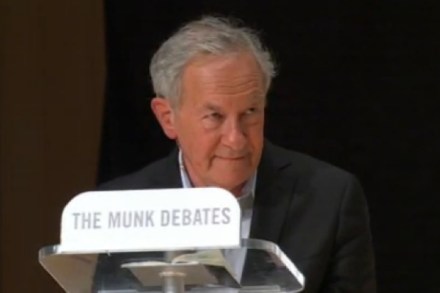
Hardly anything is less likely to keep people reading than to mention an exciting evening in Toronto.  But stick with me. Because last Friday night in Toronto there was a debate (organised by the Munk debates, which can be watched in full here) on the great migration crisis which pitted Louise Arbour and Simon Schama against Nigel Farage and Mark Steyn.  Regular readers will know my views of Simon Schama on this matter, so I was looking forward to watching this exchange in the hope of seeing him get what in technical debate-speak is known as his ‘arse handed to him on a plate’.

The questions nobody wants to ask about Asad Shah’s murder | 29 March 2016

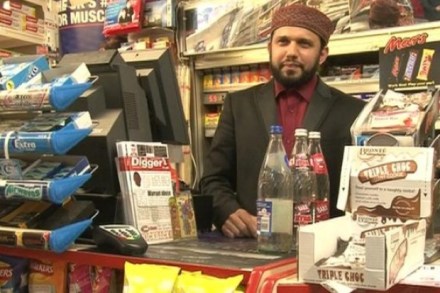
On Maundy Thursday a Muslim shopkeeper in Glasgow was brutally murdered. Forty-year-old Asad Shah was allegedly stabbed in the head with a kitchen knife and then stamped upon. Most of the UK press began by going big on this story and referring to it as an act of ‘religious hatred’, comfortably leaving readers with the distinct feeling that – post-Brussels – the Muslim shopkeeper must have been killed by an 'Islamophobe'. Had that been the case, by now the press would be crawling over every view the killer had ever held and every Facebook connection he had ever made. They would be asking why he had done it and investigating every one of his associates.

The questions nobody wants to ask about Asad Shah’s murder

On Maundy Thursday a Muslim shopkeeper in Glasgow was brutally murdered.  Forty-year-old Asad Shah was allegedly stabbed in the head with a kitchen knife and then stamped upon.  Most of the UK press began by going big on this story and referring to it as an act of ‘religious hatred’, comfortably leaving readers with the distinct feeling that – post-Brussels – the Muslim shopkeeper must have been killed by an 'Islamophobe'.  Had that been the case, by now the press would be crawling over every view the killer had ever held and every Facebook connection he had ever made.  They would be asking why he had done it and investigating every one of his associates.

A terrorist attack has happened in Europe. Let the standard response begin…

Well at least we all know the form by now.  This morning Islamist suicide-bombers struck one of the few European capitals they haven't previously hit in a mass-casualty terrorist attack. The standard response now goes as follows.  First the body parts of innocent people are flung across airport check-ins or underground trains.  Briefly there is some shock.  On social media the sentimentalists await the arrival of this atrocity’s cutesy hashtag or motif and hope it will tide them over until the piano man arrives at the scene of the attack to sing 'Imagine there's no countries’.  Meantime someone will hopefully have said something which a lot of people can condemn as ‘inappropriate’.

Finally: proof that the ‘Clarkson’ persona was all just an act

To the extent I have ever thought about him, I have always viewed Jeremy Clarkson as a slight irritant. This is largely because he personifies what a type of lazy leftist believes right-wingers to be like (uninterested in culture, cultivatedly thick, casually racist). But this weekend we learnt what some of us had long-suspected: that rather than being a scourge of our dishonest, molly-coddled, excuse-ridden culture, Clarkson may be one of its happiest and most comfortable creatures. Saturday’s Times carried a long interview with him. It is worth reading not because of Clarkson, but because of what it says about our culture.

Prime suspect for Paris attacks arrested in Molenbeek, terror capital of Europe

The prime suspect for the Paris terrorist attacks has just been captured in a police raid in (you guessed it) Brussels. Salah Abdeslam has been shot in the leg by police commandos, we're told, and has been taken for questioning. Where did they find him? In Molenbeek, the district that has quickly become known as the terrorist hub of Europe. "We got him," the Belgian Justice minister has declared. But what he should worry about is how Belgium came to get so many Islamic hardliners in the first place. For months, now, Molenbeek has been under intense scrutiny. Investigators believe that at least two of the terrorists who carried out the Bataclan attacks had been living there.

Cameron’s support for Turkey’s EU membership should worry us all

David Cameron this morning claimed that people who wish to leave the EU are 'taking a risk with people's jobs, taking a risk with families' finances.' Well then let us consider an even bigger risk that David Cameron is taking. In a visit to Turkey in 2010 our own Prime Minister announced that he would do everything he could to ensure Turkey entered the EU. Speaking as a guest of the country's Islamist Prime Minister, Recep Tayyip Erdogan, our own PM said, 'Turkey deserves its place at the top table of European politics - and that is what I will fight for.' Since then he has indeed been fighting to get Turkey into the EU.  This is despite Turkey doing everything it can to demonstrate that it has no place in the EU.

A civilisation under siege

[audioplayer src="http://rss.acast.com/viewfrom22/thedeportationgame/media.mp3" title="Douglas Murray and Don Flynn from the Migrants' Rights Network discuss deportation"] Listen [/audioplayer]There are two great deportation games. One is the carousel which Rod Liddle describes — but even this, for all its madness, pales alongside the border-security catastrophe unfolding on the continent. Thanks to geography and a few sensible decisions by our government, Britain has so far been spared the worst of the migrant crisis. But we should pity most of the other European countries, because they are losing control not just of their borders but of their civilisation and culture — the whole caboodle.

Receiving online abuse has now become a badge of honour

On Monday night I took part in a discussion on free speech in London for the think-tank Policy Exchange. The other speakers were ‘feminist comedienne’ Kate Smurthwaite, a student called Kitty Parker Brooks and the wonderful Munira Mirza.  Jess Phillips MP failed to show up, which was a shame because I wanted to decide for myself whether she is the free-thinking future-leader acclaimed by Julie Burchill or the PC-party-line clutz who recently compared New Year’s Eve in Cologne to any night in Birmingham. Anyhow, the argument I made was that two things are putting huge pressure on free speech and giving enormous impetus to the censors on campuses and elsewhere.  These are social media and mass migration.