David Shipley

David Shipley is a former prisoner who writes, speaks and researches on prison and justice issues.

Reform’s trans prisoner policy is a mess

Reform are in the headlines again, this time over confusion about their policy on trans prisoners. Yesterday Vanessa Frake, former prison governor and Reform’s UK justice adviser, said that trans women should not automatically be removed from women’s prisons, preferring an individual risk assessment. Nigel Farage seemed to echo this view, deferring to her experience and saying ‘it’s basically about risk assessment’.  This announcement put the party at odds with the recent Supreme Court ruling on the meaning of ‘sex’. It also put it at odds with reality.

Can AI prevent prison violence?

The government desperately needs to save the justice system, and it believes that technology might be part of the solution. The Ministry of Justice has announced that it will be using AI to ‘stop prison violence before it happens’. The need is urgent. There were over 30,000 assaults in prisons during the 12 months to the end of March 2025, a 9 per cent increase on the previous year. The reality is that this will all rely on the data provided by prison staff, which is often of very low quality This is now Labour’s problem. As Andrew Neilson, Director of Campaigns at the Howard League said yesterday, ‘these statistics cover most of the government’s first year in power.

The horror of police involvement in the grooming gangs

However bad you think the rape gang scandal is, it keeps getting worse. Yesterday, the BBC published a detailed investigation which stated that ‘five women who were exploited by grooming gangs in Rotherham as children say they were also abused by police officers in the town at the time.’ The report, based on interviews with the five women, along with testimony from 25 other victims, says that ‘corrupt police officers worked alongside the gangs or failed to act on child sexual exploitation.’  Most of the alleged victims were ‘in their teens but some were as young as 11’.

The women of Epping don’t need Tommy Robinson’s help

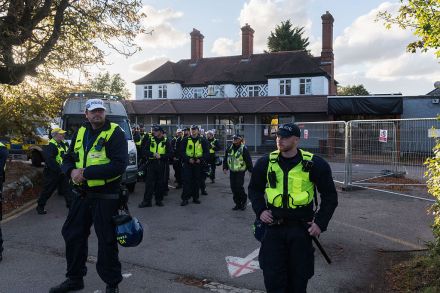
The people of Epping have a message for Tommy Robinson: stay away. The far-right activist is currently mulling joining protestors in Essex who have taken to the street outside a hotel used to house asylum seekers. While there have been violent clashes between police and demonstrators – and a number of arrests – many of those who have gathered have done so peacefully. They deserve to be listened to. Yet the arrival of Robinson would make it easy for politicians to cast these locals as far right – and ignore them. The people of Epping have a message for Tommy Robinson: stay away Even Robinson doesn't seem able to make his mind up about what to do. On Sunday, he tweeted: ‘Hear you loud and clear, I’m coming to Epping next Sunday ladies and bringing thousands more with me’.

Will Reform’s crime crackdown work?

It's hard to disagree with Nigel Farage's diagnosis that ‘Britain is lawless’. The Reform leader painted a bleak image of London in particular, as he unveiled his party's crime crackdown in Westminster. Farage’s message for criminals is that a Reform government would have ‘zero tolerance’ Farage spoke of a city where ‘moped gangs [are] running amok’ and shoplifting has soared. ‘We are facing nothing short of societal collapse,’ he said. He's right: even the Home Office has acknowledged there has been a ‘44 per cent rise in street crime, record levels of shop theft and a million incidents of antisocial behaviour’. But it's debatable whether Reform's proposed remedies for restoring law and order to Britain's streets are the right ones.

The ‘morons’ who chopped down the Sycamore Gap tree don’t deserve prison

Our trees – oak and beech, soft and ancient, sycamores, whose seeds spin and tumble away every autumn – are one of the most beautiful things about England. I love them all – and have nothing but contempt for someone who needlessly destroys a tree which has taken decades, or centuries, to grow and might live for decades, or centuries, more. Despite this, I am deeply concerned by the way our justice system has treated Daniel Graham and Adam Carruthers, the two men from Cumbria who hacked down the famous Sycamore Gap tree in September 2023. At Newcastle Crown Court yesterday, the pair were sentenced to four years and three months in prison. How do these sentences compare to recent, high-profile crimes? How do these sentences compare to recent, high-profile crimes?

The UK should not have to ration water

The UK’s steady decline continued today with reports that water companies are looking to introduce ‘surge pricing’ in order to ration demand. Trials are being introduced by 15 water companies across the country this summer, with customers either paying more for water as they use more, or charged more at certain times of year.  Higher prices, the water companies say, will ‘reduce discretionary water usage’. What this actually means is making every shower or load of laundry more expensive in the summer months. In a wet, temperate climate like ours there is absolutely no reason we should have to ration water This shouldn’t be necessary, of course. It rains a lot in Britain, particularly in Wales and Scotland, and especially in the winter.

What Richard Hermer gets wrong about international law

Our two-tier Attorney General, Lord Richard Hermer, is in the news again. The controversial lawyer and ‘old friend’ of the Prime Minister, has issued new instructions to government lawyers which give him an ‘effective veto’ over all government policy and which also create a network of legal spies within government departments. The Hermer doctrine revealed by these instructions relies on an extreme view of international law, which seeks to limit the power of ministers to govern and parliament to legislate.

Would scrapping jury trials save Britain’s broken courts?

The Sentencing Review, published in May, may not have had much to say about sentence length. But now we have the Courts Review, which does. Brian Leveson’s report, published today, is hefty, at 380 pages, with 42 recommendations, many of them sensible. But it is his proposal to reduce sentences for crimes which particularly affect women which are likely to prove most controversial. The problem Leveson is trying to solve is that the courts, like the prison and probation systems, are broken. As of December 2024, there were more than 75,000 outstanding cases awaiting trial in our crown courts, which is double the level pre-pandemic. Last year the crown court system received almost 122,000 new cases, but only managed to conclude, or ‘dispose’ of, around 114,000 cases.

Organised criminals have conquered Britain’s prisons

Charlie Taylor, HM Chief Inspector of Prisons, has published his first annual report since Labour took office. It will make grim, embarrassing reading for the government. The report shows that despite a year of efforts to control drugs, violence and crime in prison, our jails have become even worse under Labour. The report says they found that ‘in many jails, there were seemingly uncontrolled levels of criminality that hard-pressed and often inexperienced staff were unable to contain’. Even in open jails like HMP Kirkham, whose former governor was recently jailed for a relationship with an inmate, ‘drugs had become a major problem with inspectors regularly smelling cannabis as they walked around’. This is a failure of leadership.

Why does Lord Hermer think two-tier justice claims are disgusting?

Lord Hermer, the Attorney General who personally authorised the prosecution of Lucy Connolly for a tweet, has broken his silence on the claims that we have a two-tier justice system, and he’s angry. Hemer is also very wrong, as an investigation into Palestine Action demonstrates. Hermer, like much of the British regime, prefers convenient pretence over honesty The Attorney General was interviewed for Starmer’s Stormy Year, a new Radio 4 programme assessing how the government’s first year has gone. When the discussion turned to last August’s riots, Hermer became audibly angry, describing the two-tier claim as ‘frankly disgusting’.

Baroness Casey has not held back

Baroness Casey’s ‘national audit’ of child sexual exploitation was published this afternoon, and it’s now clear why the government changed course so quickly over the weekend, and why they’ve immediately accepted all of Casey’s recommendations. She doesn’t hold back. She identifies the scale of the rape gangs, the specific ethnic groups who make up the majority of perpetrators, and makes it clear how much the state has failed victims over decades. Of the 51 local child safeguarding reviews listed by Casey ‘where perpetrator ethnicity and/or nationality is identified’, just one describes the perpetrators as white, while nine mention Asian perpetrators of one kind or another. Another 35 of these reviews didn’t report ethnicity or nationality at all.

Head of the prison officers’ union: we should halve the prison population

The Prison Officers’ Association (POA) and its national chair Mark Fairhurst have a reputation for always wanting prisons to be more secure and more punitive. So it was a surprise when Fairhurst told me he opposes the government’s new prison building programme, and went on to describe his ideal justice system in terms which the most soft-hearted prison reform charities would struggle to disagree with. ‘All we’re going to do…is spend £4.7 billion building 14,000 new prison spaces. And if you build new prisons you’ll always fill them’ I met with Fairhurst a few days after the POA’s annual conference in Eastbourne, a busy time for him because ‘everybody wants a piece of me’. I attended the annual gathering for the union which represents frontline prison staff.

Starmer’s plan to ‘smash the gangs’ isn’t serious

Keir Starmer has repeatedly promised to smash the gangs to secure our borders. But the reality is rather different. Yesterday, the Prime Minister tweeted a short clip once again attempting to reassure British voters that the government is ‘going to the source to smash the people smuggling gangs'. The video is an odd, cheap thing. Set to possibly the most generic soundtrack available and voiced over by an utterly bored-sounding young man, it shows images of small boats full of migrants, foreign police, and open water. Eye-catchingly, it promises to reveal just 'how we’re controlling our borders’. Unfortunately, almost every single claim it makes is misleading or laughable.

England now has a blasphemy law

Officially, blasphemy was abolished by New Labour in the 2008 Criminal Justice Act. But today, with the conviction of Hamit Coskun, blasphemy laws now exist in England.  This law has been created by the Crown Prosecution Service (CPS) and District Judge John McGarva. Between them they have prosecuted and found a man guilty of a ‘religiously aggravated public order offence’ because he burned a Quran outside the Turkish consulate. The CPS mounted a prosecution conflating the religious institution of Islam, with Muslims as people, and a British judge has accepted this. Islamic blasphemy codes are now being enforced by arms of the British state, via what the National Secular Society describes as ‘a troubling repurposing of public order laws as a proxy for blasphemy laws’.

Tommy Robinson and the truth about jail beards

When Tommy Robinson walked out of prison this week, he was unrecognisable. The far-right activist, who was jailed for contempt of court, was sporting a huge bushy beard as he emerged from HMP Woodhill. Robinson looked more like a man who had been marooned on a desert island, or lost in the mountains, than someone who had spent a few months in a Category B prison in Milton Keynes. Robinson’s prison beard made me think of my own. When I was locked up at HMP Wandsworth, I grew a beard even wilder than Robinson’s. For the first six months in prison, I didn’t touch my facial hair, letting it grow and grow as the fat fell off me, until I looked nothing like my prison ID photo. Eventually I looked so different that I had to ask the prison officers for a new ID card.

Why do police accept criminal drug use?

Another day, another sign of the British state’s acceptance of criminality. This time it’s the news that almost half of people caught in possession of Class A drugs avoid criminal sanction, with the police either issuing a ‘community resolution’, which does not create a criminal record, or avoid any action at all ‘in the public interest’. This represents a dramatic change since 2016, when only 7.5 per cent of those caught in possession of hard drugs avoided prosecution. Why has this happened? And what does it mean for the drugs trade in Britain?

Robert Jenrick is right to confront tube fare evaders

Robert Jenrick tweeted a 60 second video this morning, showing him confronting suspected fare dodgers at Stratford London Underground station. He watches people reportedly forcing their way through the barriers while TfL staff seemingly do nothing to stop them. Jenrick then follows the suspected freeloaders down escalators, challenging them on why they haven’t paid. They’re not apologetic of course and none seem to show the slightest shame. One seems to threaten the shadow justice secretary, with Jenrick responding ‘you're carrying a knife, did you say?’. In his narration, Jenrick says 4 per cent of travellers on the London Underground haven’t paid for their fare – I checked with TfL and the number they quote is 3.5 per cent across the whole TfL network.

Decriminalising cannabis would be bad for black Londoners

Sadiq Khan, London’s mayor, has called for the possession of cannabis to be decriminalised, because he believes that the police disproportionately target black Londoners when policing drug possession. This announcement by Khan is in response to a report by the ‘London Drugs Commission’ (LDC), a body set-up by City Hall, chaired by Tony Blair’s old flatmate, Lord Charlie Falconer, and with an ‘Expert Reference Group’ including David Gauke, whose Sentencing Review reported just last week. Amongst other topics, the lengthy report reviews cannabis policies across the world, and identifies that black people in London are more likely to be searched for cannabis, although those searches are no more likely to find cannabis than when white people are searched.

My friend the people smuggler

Usually when I start listening to a true-life podcast, I don’t know how it ends. That’s not the case with The Smuggler, BBC Radio 4’s new investigation into people smuggling. Across ten episodes, its Orwell Prize-winning presenter, Annabel Deas, tells the story of ‘Nick’, on the face of it an unlikely protagonist. Nick is white, English and a former soldier in the British Army. He’s also a friend of mine. We met in jail in 2021 and have stayed in contact ever since. So I know Nick’s story. I even know how it ends. Despite all this, I found myself absolutely gripped by The Smuggler. This is partly because it’s such a fascinating, and timely, topic. Migration is rarely out of the news. Keir Starmer keeps promising to ‘smash the gangs’ and ‘stop the boats’.