David Blackburn

Sense in Balls

From our UK edition

Ed Balls has a reputation as a master of subterfuge and vicious smear – undeserved I’m sure. But the Shadow Home Secretary is right, incontrovertibly so, when he says that Andy Coulson is innocent until proved guilty. One can understand Chris Bryant’s fury that his phone was tapped by one of Coulson’s more furtive underlings. But the law does not presume guilt without evidence and before due process, and neither should he.

The Coulson saga rumbles on

From our UK edition

Andy Coulson had a chat and a Bath Oliver with the Met recently. Rejoice! The News of the World phone tapping story continues. The allegations against Coulson do the government no favours. But, even if, in a hypothetical drama, Coulson were to be charged I doubt many would care. I don’t deny the seriousness of the offences already committed by employees of News International, but it’s a very tiresome story and saturation point has been reached. So the usual suspects make little impact when they call for Coulson to resign, fall on his sword, take the rap or whatever cliché they happen to adopt. Coulson needn’t resign because there is no case against him. The government’s inability to communicate a growth strategy is another matter.

Waiting for welfare reform

From our UK edition

After a summer of sporadic announcements, IDS’ welfare reforms will be published in a white paper next week. As in 1997, when Tony Blair urged Frank Field to think the unthinkable, there is consensus on the need for radical welfare change. IDS has earned respect as a moral and pragmatic reformer, and he attracts goodwill from across the House. The Liberal Democrats, Nick Clegg and Steve Webb particularly, were ‘vital’ in securing a spending concession from George Osborne, whilst Douglas Alexander has described IDS’ plans and ‘noble’ and pledges to support principle that welfare should be a safety net, not a vocation. He warms to the theme in today’s Guardian.

Transparency: the government’s self-protection aid

From our UK edition

Monday is eagle day for the overhaul of government machinery. Ben Brogan explains how the publication of 20 departmental business plans will enable the public to chart the progress of government reform – inaugurating a revolution is transparency, that meme of the moment. I’ve always wondered why the Tories are so keen on touting ‘transparency’. One answer, it seems, is to expose those ministers and departments who are dragging their feet. This instrument of New Politics doubles as a self-protection mechanism, which is especially useful with those dastardly Lib Dems and the odd pugilistic right winger scurrying about. Brogan writes: ‘The plans will spell out the timetables for implementing every stage of the reforms promised this summer.

Toughening up on Home Affairs

From our UK edition

An intriguing argument from the Economist’s Bagehot this week: the government’s liberal prisons policy will force Coalition 2.0 to tack to the right on Home Affairs. ‘If the Lib Dems’ sway on these issues was foreseeable, so are its political dangers. One is Tory anger. Even some of the Conservative MPs who agree with the Lib Dems on control orders worry about their liberal line on crime. Behind the scenes, figures from both parties are coming together to plan “coalition 2.0”—a policy programme for the second half of the parliament. Among the rumoured Tory representatives are confirmed hawks such as Michael Gove, the education secretary, Owen Paterson, the Northern Ireland secretary, and Tim Montgomerie, a well-known blogger.

From the archives – striking matters

From our UK edition

This week, there have been calls for certain public sector strikes to be made unlawful, Tube strikes and, today, the firemen have called off their strike having ‘listened to the concerns of the public’. It is all so 2002. Go To Blazes, The Spectator, 26 October 2002 Any public sector union contemplating a strike is best advised to start by targeting children’s bookshops. It is remarkable how groups of workers who first impinge on the consciousness through the pages of nursery books manage to command greater public affection and higher wage settlements than those who do not. Nurses and train-drivers have done particularly well out of recent pay disputes.

Miliband’s colossal misjudgement

From our UK edition

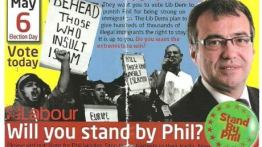
The question at the bottom of this shoddy leaflet must surely join John Rentoul’s famous list. Who on earth will stand by the egregious Phil Woolas now? As with the Tower Hamlets debacle, Ed Miliband is taking eons to make a straight forward statement: the Labour leadership condemns the actions of Phil Woolas and hopes that he will not be selected to stand again. George Eaton gives a reason for Miliband’s reticence: in a colossal error of judgement, Miliband selected Woolas as a shadow Home Office minister, reward no doubt for his deft expertise in race relations. The Oldham East by-election is a test for the coalition, but it is also the first major test of Miliband’s leadership qualities and his ability to fire-fight.

Victory, but there’s little triumphalism as Republicans look to court America

From our UK edition

Hysteria has lapsed into disaffection: it was a bleak night for President Obama. But, despite the apparent immediacy of a ‘conservative moment’, there is caution in Republican circles this morning: both Clinton and Reagan won from similar positions in 1982 and 1994. The G.O.P's leadership knows that elections are not won from the extremes, as Barack Obama has discovered to his cost, and it is trying to calm the party’s often excitable fringe, which will be no easy task if Rand Paul's 'Tea Party tidal wave' is anything to go by. Ben Brogan recently highlighted the G.O.P’s growing ‘Stop Palin’ campaign, and David Frum adds his voice again.

Entente très cordiale

From our UK edition

When it comes to pomp, Britain and France are still superpowers. The entente très cordiale has brought out all the plumage of 400 years of professional soldiering - bearskins, ostrich feathers, mink, gold leaf, thorough-bred horses, billowing capes and vibrant shades of scarlet and blue. Waterloo must have been a hell of a fashion show, before the guns inaugurated spectacle of a different kind.    As Liam Fox explained on the Today programme, this agreement enables two ailing but still ambitious powers to project force overseas beyond their specific territorial interests.

The inviolable right of prisoners

From our UK edition

After 6 years of resistance, the British government has submitted to the European Court of Human Right’s judgement that prisoners have the right to vote. It will use a case in the Court of Appeal to make the announcement and then prepare itself for compensation suits. Understandably, the government is furious that it has been forced to make a concession on law and order, an area where they are weak enough already. Even Dominic Grieve, a firm supporter of the ECHR, is understood to be exasperated. Straining to limit the political damage, Ken Clark hopes to limit the franchise to those prisoners sentenced to less than four years; judges may also be able to decide who to exclude.

Out of Control Orders

From our UK edition

The government’s developing a tension headache over Control Orders, and there have been two noteworthy interventions. First, Theresa May lambasted Ken Macdonald. The former Director of Public Prosecutions, who is a now a Lib Dem peer overseeing an independent inquiry into counter-terror legislation, has made clear that he ‘will go ballistic’ if the Home Office retains Control Orders, which it is expected to recommend, in line with the advice of another Lib Dem peer, Lord Carlile. Second, David Davis has described Control Orders as ‘Kafka-esque’, the term used by Chris Huhne on the Politics Show yesterday, and has also said that he will vote against the government if Control Orders are to be maintained.

All is not quiet of the welfare front

From our UK edition

Welfare is fast becoming this parliament’s Ypres Salient - strategically critical, it is constantly contested. £20bn on social housing, £100bn on out of work benefits and £billions on universal benefits: welfare reform is where spending cuts are most conspicuous. A rhetorical confrontation is building and various tactical dispositions are being made. The Staggers’ George Eaton has an analysis that assumes that Labour’s current wedge-strategy (which I critiqued here) is not working because it is avowedly sectional, privileging those who might be caricatured as ‘undeserving’. Eaton argues that Labour must ‘launch a defence of the hard pressed majority’; those who work but still stand to lose, particularly families.

Confronting terror at home

From our UK edition

As Julian Glover notes, Jack Straw let the cat out of the bag. ‘Never, ever, downplay the possible consequences,’ he says. The coverage of the recent bomb plot has largely ignored that it was foiled. That, by any definition, is a success, a vindication of our security services. Independent inspector Lord Carlile is right that improvements can be made to the bomb detection apparatus in airports and targeting security at the source of a threat – i.e. packages from the Yemen rather than package holidays. The previous government would have used this plot to introduce another wave of invasive legislation – never, ever, downplay the possible consequences to justify I.D. cards, deeper control orders and further suspension of Habeas Corpus.

The ginger rodent

From our UK edition

I wonder what they'll come up with for Uncle Vince? Nick Clegg is a closet Tory (nice homophobic overtone there), and Danny Alexander reminds anti-persecution supremo Harriet Harman of a ginger rodent. Alexander deigned to respond, saying:  'I am proud to be ginger and rodents do valuable work cleaning up the mess others lead behind. Red Squirrel deserves to survive, unlike Labour.'   Aside from being witless, the problem with Labour's assault  on senior Lib Dem politicians is that each one makes a future Lib-Lab pact ever more unlikely. After all, there aren't so many Lib Dems to insult.

Cameron’s euro battle is just beginning

From our UK edition

David Cameron sold himself a hospital pass in Europe this week. His failure to secure a budget freeze has revealed that Britain's clout has been wildly exaggerated. The likely 2.9 percent budget increase is mildly inconvenient for Cameron politically, but it is immaterial in the grand scheme of the next round of budget discussions and the mounting wrangle about the Lisbon treaty. He will have to compromise, as he did this week. He made some ground, finding allies to resist an untrammelled treaty change - the Irish, the Dutch, the Danes, the Czechs and the Poles. The biggest prize will be Sarkozy, whose antipathy towards Merkel is arch - the ongoing diplomatic and military discussions between Britain and France must be about more than sharing aircraftless carriers.

Housing benefit reform is a Good Thing

From our UK edition

Dressed with his effortless prose, Matthew Parris has a point (£) that proves why he is the leading commentator of the last two decades. Housing benefit reform is his subject and he urges his readers reject the legends that have accrued around the issue - not Boris, not Polly Toynbee, not shrill councils, not rapacious landlords and definitely not the government. No one, he says, has the numbers but there are several certainties: ‘The outcomes may not prove nearly as brutal as this week’s predictions. What (as I asked above) can we know? We know that comparisons with Paris are ludicrous. All of our big cities are speckled with very large-scale “social” housing of a type that is suited only to the income groups for which it was constructed.

Labour’s hypocrisy on the EU budget

From our UK edition

Labour’s Shadow Europe Minister, Wayne David, has been busy castigating David Cameron for his apparent failure to secure an EU Budget freeze. He says, ‘It is imperative that we do have a freeze on the EU budget’. Quite so, why then did Labour MEPs vote against an amendement to freeze it?

The Big Society in action

From our UK edition

The Big Society, in so far as it can be defined at all, envisages an empowered people taking responsibility for their local communities. The little platoons’ efforts could determine the atmosphere of a place, by helping to deliver public services, founding employment schemes, running activities that unite the rich and the dispossessed, and exercising more influence over planning authorities. It is, in effect, an assault on adamantine local government, overbearing central government and predominant corporatism.

Eat your heart out, Fukuyama

From our UK edition

Russia and Nato are now allies, or birds of a feather at least. The Independent reports that the twentieth century’s opposed spheres will work together for stability in Afghanistan. The attendant irony is blissful. Two years ago, machismo raged between Nato and Russia over Georgia. Why the sudden accord? There are two schools of thought, both relating to the East’s inexorable rise. Russia can no longer determine Central Asia of its own accord: China co-opted the Shanghai Cooperation Organization, a long-time pillar of Russian power in Asia, to condemn Russia’s recognition of South Ossetia and Abkhazia - a sign, to Russian eyes at least, of China's creeping influence in Central Asian politics.