David Blackburn

Cameron’s Eric Morecambe problem calls for the wisdom of Corporal Jones

From our UK edition

It looks like the most almighty mess. The government’s communications are tongued-tied, the Big Society is flightless and the reform agenda is being neutered by inertia. The political will has been met by the administrative won’t. But, despite the gloom, the government should pay heed to Corporal Jones: don’t panic. The slow progress of public service reform is a positive. Haunted by the memory of Blair’s paralysis, the government embarked on its programme in fevered delirium. Its ambitions were much too great. It is now time to halt and concentrate on delivering cuts. Rome was not built in a day and it certainly cost more than Britain can currently spare.


Mubarak vows to fight on

From our UK edition

Despite today’s ruptures, Hosni Mubarak has vowed to stay on until there can be an ordered transfer of power.   His defiance will sound familiar to western ears: a lame duck politician determined to cling to the final vestiges of office. But, of course, in Egypt, Mubarak’s intransigence poses far more serious questions. It is hard to see how the optimistic tension that has built over the past three weeks will not now spoil into violence. The army has sustained the Egyptian regime for close to sixty years; but its responsibilities have now become much more complicated.

And Ilsley goes too

From our UK edition

Following the jury’s decision in the Jim Devine case, Eric Ilsley has been sentenced to 12 months in jail having pleaded guilty to charges of false accounting.   As I wrote this morning, prison sentences for expenses offenders are both appropriate and constructive. They dictate that parliament should conduct itself with dignity and probity; and they express the absolute supremacy of the rule of law. It is right that those whose abuse of the expenses system was criminal are being incarcerated.

Looks like Devine’s going down

From our UK edition

Twitter has exploded at the news that former Labour MP Jim Devine has been found guilty on two counts of false accounting, and is likely follow to David Chaytor to the slammer - another argument against votes for lags. Sentence will be passed in four weeks As James Kirkup wrote at the time of Chaytor’s sentencing, this is a victory for the British justice system; proof that those who make our laws and subject to them also. The purge on the most heinous expenses cheats is a painful but necessary passage for restoring dignity to parliament and probity to public life. And the process is far from over. News of Devine's imminent fate will make several MPs shift uncomfortably in their seats.

Lib Dem grassroots turn on the government

From our UK edition

More so than other parties, the Liberal Democrats depend on their grassroots’ presence in local government. The foot soldiers’ importance has increased as the party’s polling strength wanes. So, Nick Clegg will be aghast that 88 leading Liberal Democrats have written to the Times (£) to castigate the government’s ‘front-loaded’ cuts to local government. Tuition fees were thought to be the toughest possible battle for Clegg, but this will run them close. Government MPs have been cast into a black mood. The coalition’s unity has been rocked; its long-term prospects weakened. Now Clegg and Cameron face a tactical dilemma: do they conciliate or do they fight? The indications tend to fighting.

In their own words…

From our UK edition

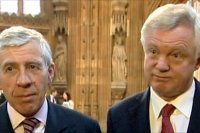
Parliament will debate a prisoner’s right to vote tonight, to satisfy the ECHR’s now infamous judgement. Jack Straw and David Davis, the progenitors of tonight’s discussion, have taken time to explain why they believe the ECHR does not have the right to dictate to sovereign states on such matters. Writing for Con Home, Davis has constructed an impassioned polemic, decrying the British government’s ‘pusillanimous culture of concession’. Essentially, Jack Straw is making the same argument, albeit with precise procedural insight. He writes (£): ‘But is there some contradiction between my support for the HRA and my criticism of the Strasbourg court’s judgment in this case? Not at all.

Writing of revolution

From our UK edition

Writers seldom cause revolutions, especially novelists. Even the greatest and most visionary political authors – Solzhenitsyn, Orwell and Hugo – were bound to the task of reflecting a society in turmoil. But, in doing so, fiction can have a more profound impact than the frenzied efforts of photographers and news editors to explain violent political movement. Disparate sweeps of disaffection can take clear form in the mind of a skilled novelist, and change can be presented beyond the myopia of newsreel. Ben Macintyre has found the novel that charts the character of the Egyptian dissenters. The Yacoubian Building was written by Alaa Al Aswany, a Cairo dentist, in 2002. It is a story of power, pessimism and resentment, and how they build towards violence.

PMQS live blog

From our UK edition

VERDICT: A rowdy session, but constructive. Miliband went for the Big Society, which is in severe difficulty at present. He was very effective, but his attacks lacked absolute coherence. He failed to establish a link between his examples and his wider political point that the agenda is mere packaging for latent libertarianism. So, Cameron had enough wriggle room to repulse Miliband and was able to launch his own attacks on the Labour leader's irresponsible opportunism, and he also savaged Liverpool Council's reactionary politicking. Both leaders had good lines and were deft on their feet, as point was met by counter-point. Their supporters were in full voice too, sufficient to allow the quibbling Speaker to intervene and re-assert himself after last week's wife-related incident.

More bad economic news for the government

From our UK edition

Presently, the waves of bad news are as relentless as biblical plagues. The latest trade figures show that Britain’s trade gap opened in December; the seasonally adjusted deficit stood at £9.2bn, a rise from £8.5bn in November. There are plenty of explanations as to why the export-led recovery failed to jump customs, despite the comparatively weak pound. The various acts of God couldn’t have helped and the continuing financial crisis on the continent will have further eroded demand.   However, the government will realise that these figures indict its growth strategy. As the ONS graph below indicates, the trade deficit is a persistent problem and one feared by the British Chambers of Commerce.

Parliament is expected to deny prisoners the right to vote

From our UK edition

These are hard times for the government and there is no respite. Today, parliament will debate a prisoner’s right to vote, in accordance with the wishes of the resented European Court of Human Rights. The Guardian’s Patrick Wintour writes what many suspect: on the back of a free vote, the House will deny prisoners the right to vote in all cases and outlaw compensation claims. Such a result would seem a set-back for the government, which was thought to favour a limited franchise on prisoner voting. If it became law, then the government would apparently be at odds with the ECHR - precipitating an ignominious procession of grasping lags, searching for compensation at Strasbourg.

The Big Society in crisis?

From our UK edition

An ungodly alliance has converged on the Big Society. From the left, The Voice of the Mirror, the Unions and Steve Richards have published diverse critiques; from the right, Philip Johnston has joined Peter Oborne in suggesting that the policy is suffering a near-death experience. The Local Government Association and councillors have added their disgruntled voices as the day has progressed. All in all, it’s quite a circus and the government’s gentle response has been totally inadequate. Francis Maude penned an article for today’s Times (£), which, despite being commended by Tim Montgomerie, couldn’t really distract from the mauling Maude received on Newsnight last night.

Save your local library

From our UK edition

Increasingly, this is an age of revolution. Disaffection has even reached England’s green and apathetic land. Libraries are to close and campaign groups have formed online around books blogs and community forums. Slogans are shouted, ministers harangued and the Culture Select Committee petitioned – all to no immediate avail. The dissenters are not above direct action, albeit confined to the sleepily donnish variety of protest. A wave of sit-ins, or read-ins as they are termed, was coordinated last Saturday and I went to watch the tenor of these demonstrations. First impressions of New Cross Library are thwarted by the pervasive must. The air is coarse: dehydrated by the aggressive central heating, straining with a pained hum.

Osborne quells some dissent with his latest ruse

From our UK edition

This morning’s newspapers would have made grim reading for the government. The Department for Transport has been forced to reverse its helicopter privatisation plan, there are doubts that the baccalaureate will suit Michael Gove’s education reforms and diverse packs of hounds have converged on the Big Society fox – and this is a cruel bloodsport.  But, the master tactician has struck again. George Osborne’s sudden decision to raise an extra £800m through this year's banking levy has relieved some pressure from the government. This is a minor operation by the standards of Osborne’s previous political coups, but it diverts attention and illustrates that the government is making some progress in the arduous slog against the banks.

Across the literary pages | 7 February 2011

From our UK edition

Edna O’Brien at 80. The grand dame of Irish fiction talks to the Observer about religion, hedonism and conscience. "Someone said to me in Dublin: masses are down, confessions are down, but funerals are up! Religion. You see, I rebelled against the coercive and stifling religion into which I was born and bred. It was very frightening, and all pervasive. I'm glad it has gone. But when you remove spirituality, or the quest for it, from people's lives, you remove something very precious. Ireland is more secular, but it went to their heads: a kind of hedonism. They're free, yes, but questions come with freedom. What about conscience? Conscience is an essential thing. It (moral collapse) generated an ethos of envy.

Put a sock in her

From our UK edition

For once, I am in total agreement with Nigel Farage: the best way for Sally Bercow to help her husband is to take a vow of silence. Her recent Cleopatra act diverted attention from the persistent indignity of parliament’s relationship with IPSA, but it has done little to raise the diminutive Speaker’s diminutive reputation.   Flushed with embarrassment, Mrs Bercow spent most of Friday afternoon insisting that the Evening Standard had distorted her. She went into yummy mummy mode, confiding to Twitter that she was baking cakes for her son’s lunch box – nice rather than naughty.

Dirty ditties

From our UK edition

Claudine Van Hensbergen, an Oxford Don, has disinterred some early Georgian smut from a 1714 edition of The Works of the Earls of Rochester and Roscommon. The poems, found in a sub-section titled 'The Cabinet of Love', were added by the publisher, Edmund Curll, and are definitely not by John Wilmot, although I imagine he would have cackled along to the bawdy rhymes. Van Hensbergen told the Times (£): “To my surprise, The Cabinet turned out to be a collection of pornographic verse about dildos.

Body blow for the Big Society

From our UK edition

A major setback has befallen David Cameron’s Big Society. One of the four pilot schemes opened by Cameron as the ‘vanguard of the Big Society’ last autumn has fallen under a barrage of government cuts. Using unaffordable start-up costs as an excuse (although unidentified structural impediments were also mentioned), senior councillors of Labour controlled Liverpool Council have insisted that the scheme be curtailed immediately. Courtesy of Andrew Sparrow, the Liverpool Echo has the story. To dismiss the council’s decision as politically motivated would be transparent. Naturally, politics lurks behind the scenes; but this is an acute embarrassment for the Prime Minister.

Discovering poetry – bloody men and Wendy Cope

From our UK edition

Wendy Cope is a household name, a force in light but cutting verse to match Betjeman and Larkin. So it’s somewhat surprising that she has produced so little since in a career spanning 30 years. Anyway, I wish she’d write more because few things give such simple and sustained pleasure as her rueful stanzas: Bloody Christmas, here again, Let us raise a loving cup, Peace on earth, goodwill to men, And make them do the washing up.                   Or curt two-liners: 1. Don't see him. Don't phone or write a letter. 2. The easy way: get to know him better. Her poetry has an understated wit and barely worn insight, skipping to gentle rhymes.