David Blackburn

The case for retaining Harrier in Afghanistan

From our UK edition

Lord Owen, among others, has responded to Colonel Gaddafi’s bloodcurdling lunacy by insisting that a no-fly zone be imposed over Libya. But, as Con Coughlin has suggested, it is unlikely that Britain could support such an operation without a fixed-wing attached to an aircraft carrier. The debate about the Strategic Defence Review and Britain’s military capability has reopened. The SDSR put Afghanistan first. As armed Forces Minister Nick Harvey explained in a recent speech to RUSI: ‘Throughout the next few years, the mission in Afghanistan remains our main effort. Having made this commitment in the SDSR, this shaped many of our other decisions: the proposed changes to the Army, for example; and the preference for Tornado over Harrier.

Mandelson casts doubt on Miliband’s vision

From our UK edition

The Kindly Pussycat has returned to the fray with a revised version of his memoirs. The FT's Jim Pickard has highlighted an arresting passage about Ed Miliband’s decision to execute New Labour. 'When Ed pronounced New Labour ‘dead’, he was not only being more categorical than was wise, but quite possibly more than he really intended. (xxi) …Even allowing for the tactical choices he had made in his bid to become leader, however, I was struck by the fact that he had given no strong clue during the campaign as to what alternative to New Labour he envisaged. He was quick to say what he was against: essentially, Tory policies and Tony’s policies.

Le Carre’s genius for hard work

From our UK edition

https://www.youtube.com/watch?v=5h1XZ0LzVg4 ‘The more identities a man has, the more they express the man they conceal.’ For me, that sentence indicates why John Le Carré is one of Britain’s greatest living writers. It’s elegant, profound and accessible. It comes from Tinker, Tailor, Soldier, Spy; and that story of betrayals is contained in that one sentence. In fact, it expresses concisely the broad theme of the Smiley books. I wonder how long it took Le Carré to sculpt that sentence. How many emendations? How many different combinations and sequences? How much effort is needed to fashion something so precise? By his own admission, Le Carré is an exhaustive self-editor.

Chaos thy name is Libya

From our UK edition

Colonel Gaddafi’s strength appears to be diminishing: Foreign Office sources suggest that the latest YouTube footage suggests that the rebels are now 30 miles from Tripoli, there are reports of Libyan servicemen spiking their guns rather than fire on their compatriots and members of the Gaddafi family have failed to present a united front to the dissent that intends to depose them. But, chaos thy name is Libya. Communications have long been silent, except for the savage drone of state radio, conduit for Gaddafi’s prophesies of victory or martyrdom. Evacuees from Tripoli’s now hellish airport relate a city bristling with arms and testosterone – the fear is that Gaddafi and his dogs of war are sufficiently mad to fight to the last bullet.

50,000 NHS jobs to go, apparently

From our UK edition

An anti-cuts campaign website, False Economy, claims that 50,000 NHS jobs will be lost over the next four years. It’s a bald, headline grabbing figure and the response has been predictably feverish.   But tug a little, and the numbers unravel. One of the key points is made by False Economy themselves: that "most of the cuts are likely to be achieved through natural wastage" – in other words, by people moving on, or retiring, of their own accord. In figures highlighted by the Department of Health, for instance, one foundation trust expects to shed 14 per cent of its workforce through natural wastage by 2013. The health service may choose not to fill the vacancies that result, but this is hardly a wave of mass sackings.

The emergence of a Cameron doctrine

From our UK edition

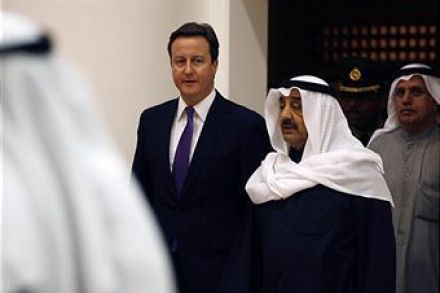
Daniel Finkelstein makes a simple but important point in the Times today (£): a Prime Minister’s foreign policy is determined by events more than by instincts. The revolts in the Middle East are defining David Cameron’s diplomacy. The emerging policy is a realistic expression of Britain’s current domestic and international capabilities. Cameron’s speech to the Kuwaiti parliament did not match Harold Macmillan’s ‘winds of change’ speech because Britain no longer disposes of continents. Likewise, Tony Blair’s messianic tendencies belong to a past era. Colonel Gaddafi’s murderous stream of conscious could have given cause to evoke the moral certainty of an 'ethical foreign policy'.

A bridge too far for Niall Ferguson?

From our UK edition

Niall Ferguson is among Britain’s most valuable exports – a feted international academic with seats at Harvard, Stanford, the Harvard Business School and the LSE; he has also had spells at Oxford and Cambridge. His tomes sell in their millions; his TV shows are an engaging mix of self-confidence and charm. He is a credible talking head and he is consistently placed on lists of 'influential people’. Across the globe then, Ferguson 'matters'. Everywhere save British academic circles, where he's seen as a neo-conservative oddity. It's sometimes said that the British, unlike the French and the Americans, mistrust public intellectuals. But the careers of Richard Dawkins, A. J. Ayer, Bertrand Russell and A.J.P. Taylor say otherwise.

Across the literary pages | 21 February 2011

From our UK edition

Ian McEwan accepted the Jerusalem Prize from Israeli President Shimon Peres and the Guardian reports that he used the ceremony to launch an incisive critique of Israel’s domestic policy, branding it a ‘great injustice’. In fact that’s barely half the story. McEwan was balanced: he unequivocally denigrated the ‘nihilism of the suicide bomber and the nihilism of the extinctionist policies of Israel’. He acknowledged and praised the ‘precious tradition of the democracy of ideas in Israel’ and attacked the captive minds on both sides that are perpetuating ‘a great and self-evident injustice’.

Uproar on Arab Street

From our UK edition

Deaths continue to mark the protests in Bahrain and Libya. Reports are inaccurate because communications have been broken, especially in Libya. YouTube is, again, invaluable. https://www.youtube.com/watch?v=4fP387pzEAA https://www.youtube.com/watch?

Cuddly Ken comes out snarling, and sneering

From our UK edition

Another Saturday, another interview with Ken Clarke. This time, the bruised bruiser has been talking to the FT and the remarkable thing is that he has managed to say nothing. Not a sausage. Colleagues were not insulted, Middle England escaped unscathed and the European Court of Human Rights wasn’t even mentioned.  But Clarke conveys his determination to fight. He defends his prison reforms and community sentences, to which the right has now applied the grave term ‘misconceived’. Clarke retorts: ‘We are trying to take 23 per cent out of the budget. I don’t recall any government that’s ever tried to make any spending reductions on law and order – let alone 23 per cent.

Bad banking

From our UK edition

No wonder the banks like Britain's corporation tax regime. This morning’s newspapers all tell that Barclays paid just £113m in corporation tax in 2009, despite making profits of more than £11bn. In a rare instance of justified anger, Labour’s chosen men have launched an attack on the government’s failure to ‘take the robust action needed to make sure that the banks which caused the crash pay their fair share, and will stick in the stomachs of small businesses struggling to borrow and ordinary people feeling the pinch of the government's austerity measures.’ Whatever the absurdities of Labour’s position, this news will ‘stick in the stomachs’ of the little people, whose wealth is withering before their eyes.

From the archives: government for the Lib Dems, not the people

From our UK edition

The AV referendum campaign began in earnest today. Not without justification, the No campaign argue that AV is a Lib Dem cause, an innovation designed to make ensure they are always the power-brokers. The alternative vote, so the No camp’s argument runs, obscures political transparency and weakens the voice of the people. The argument originates from the preludes to the formation of the Jenkins Commission in 1997. Not so bad for the Tories – leading article, The Spectator, 6 December 1997 Proportional representation is a political gamble with lasting office as the stake and the prize. Mr. Ashdown supports a change in the voting system because he thinks it would give the Liberal Democrats more seats in parliament.

Cameron and Clegg, head to head

From our UK edition

Now here’s a shock: something to trump the relentless tedium of the Cricket World Cup. The AV referendum. Labour MP Jim Murphy held his constituency surgery in a large supermarket today and it was well attended, but no one asked about the referendum. Murphy ruefully tweeted: ‘the public are so out of touch with today’s politicians.’ But it is odd, or at least it should be, that the nation’s second ever plebiscite has inspired only indifference; then again, electoral reform is not a subject to quicken the pulse. Even the campaigners are resigned to expect scant enthusiasm for their cause. The campaign is days old and already its emphasis has shifted from principle to personality.

On the basis of this legal advice, the government is not planning to defy the ECHR

From our UK edition

As I wrote this morning, the Times has obtained a copy of a government legal memo (written before last week’s prisoners’ debate in parliament) examining non-compliance with the ECHR’s infamous judgment. The newspaper argues that the government plans to defy the Court; and there are plenty rumours swirling around Westminster to that effect, which is hardly surprising given that the Times chanced upon this document. But it’s mostly hot air. The government lawyers actually advised against non-compliance on four separate grounds and revealed that British officials are working towards compliance. First, here are the recommendations of the advice: 1).

It’s a knock out: judicial activism versus the sovereignty of parliament

From our UK edition

The prisoner voting debate is coming to a head, and Dave has turned once too often. The Times has received (£) what it describes as a government legal memo, urging the government to defy the demands of the European Court of Human Rights. After last week’s parliamentary debate, the government’s lawyers calculate that the ECHR can only put ‘political pressure rather than judicial pressure’ on British institutions. This is a seminal moment: political will has not been met by administrative won’t. But would non-compliance succeed?

IDS vows to tackle Britain’s welfare addiction

From our UK edition

IDS and David Cameron have been evangelising. An insistent newspaper article and pugnacious speeches herald the latest welfare reform drive. There has been one significant u-turn: the threat to decimate housing benefit for those who have been unemployed for more than a year has been dropped. There is debate about the origins of this sudden decision, but Nick Clegg has been apportioned some credit. He is understood to have expressed private concerns about ‘hammering the poor’ and also argued that private sector landlords in areas of high unemployment would be reluctant to rent to claimants, which would impede reform. IDS agrees with Nick, confiding to the Today programme that the proposal would be hamper the wider aim of breaking the benefits trap.

The Mad Dog lies in wait

From our UK edition

The Bahraini regime will not yield peaceably before protest, as Hosni Mubarak did. This morning, Bahraini police opened fire on demonstrators with live rounds; four people were killed. There were also reports that Saudi Arabian troops were involved, which would mark a clear change in the Arab establishment's tactics following Mubarak's fall. In the uncertain atmosphere, Twitter resounded to claims that Shiites were seeking reprisals and that the military was ‘taking control of parts of the capital’. The agony of choice: a military coup or a religious massacre?   This morning's news has forced Western powers to drop their hesitant approach.

Cameron fells the forestry consultation

From our UK edition

Despite his easy charm, David Cameron is unsentimental. His dismemberment of Caroline Spelman’s sagging forestry policy at yesterday’s PMQs was as ruthless as it was abrupt. The Prime Minister cannot be an enemy of Judy Dench and other doughty dames, so the hapless environment minister had to be shafted. Cameron’s strategic withdrawal did not end there. Several newspapers report that the 12-week consultation will be curtailed by the end of the week, on the simple grounds that the public does not like it. Spelman is expected to pronounce the project dead in the Commons at lunchtime today, and the chamber will ring with the noise of Labour’s braying benches.

Laws’ return is imminent

From our UK edition

Tomorrow’s New Statesman speculates that David Laws is about to return to government. Kevin Maguire reckons that it is significant that Laws is turning down invitations to events after an unidentified date in mid-March. Laws is still awaiting the verdict of the Parliamentary Standards Commissioner, but he is expected to be exonerated. Preparing for a return to government, he has been writing sharp columns in defence of the coalition’s economic policy and expanding into future policy areas like the 50p rate and increased spending on the pupil premium. But Laws has also been keeping close to Clegg in recent months, tasked with building a strategy for the next election – the so called ‘Alarm Clock Unit’.

The top ten dirty literary men

From our UK edition

American website Flavorwire has compiled a jolly list for a Wednesday afternoon: the top ten dirtiest male writers. It’s not for the faint-hearted, not least because the Marquis de Sade and John Wilmot, earl of Rochester, have not made the cut. Here is the list, with my thoughts on the selection and links to relevant reviews and articles. 10). Philip Roth. I’m too delicate to contemplate Portnoy’s Complaint and The Humbling at once. 9). William Shakespeare. I recall this line in Brett Easton Ellis’ Rules of Attraction: ‘You’d be on your back if you knew’. If so it’s pinched from Shakespeare: ‘Thou wilt fall backwards when thou hast more wit.