David Blackburn

Cheap slogans and funding scandals

From our UK edition

This week, Bagehot has devoted his column in the Economist to a popular theme: the 'shockingly low quality of the national campaigns' in the AV referendum, typified perhaps by the Yes campaign's latest funding scandal and the No poster pictured above. Bagehot writes: 'I came away from a whistle-stop tour of the country pretty impressed by the diligence of local activists, as they try to explain the intricacies of the alternative vote (AV) to members of the public. The national Yes and No campaigns are a different matter, I argue: they have blown a chance to have a proper debate about the nature of British democracy.


Soft on crime, me?

From our UK edition

The name ‘Ken Clarke’ and the word ‘sacking’ are inseparable to the chattering classes at the moment, but so was it ever thus. There are signs though that the normally insouciant Clarke has been shaken on this occasion. He has given an interview in defence of his contentious prison reforms to the Times this morning (£). In a clear message to concerned voters, Tory backbenchers and sceptical government colleagues, he denies that he is ‘soft on crime’. For example, he will tighten community sentences: “I want them to be more punitive, effective and organised. Unpaid work should require offenders to work at a proper pace in a disciplined manner rather than youths just hanging around doing odd bits tidying up derelict sites.

From the archives – the Khmers Rouge’s debt to 1950s France

From our UK edition

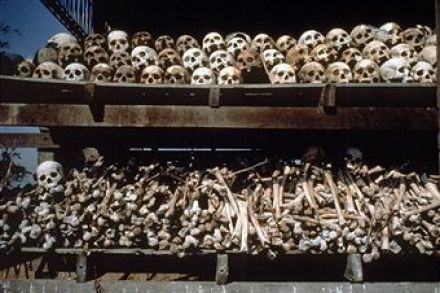
It is 13 years to the day since Pol Pot died in mysterious circumstances while in exile on Cambodia’s remote western border with Thailand. Where did Pot and his maniacal fellow travellers acquire their politics. There are a number of candidates from the megalomania of the 20th Century, but Michael Sheridan, the Sunday Times’ former Asia Editor, notes that France, or more exactly aspects of French culture at the end of the colonial era, played its part. He explained why to the Spectator. Pol Pot and Chardonnay, Michael Sheridan, 21 September 1996 Not long ago, the Americans found in their archives in Washington a long-forgotten film about Cambodia, made by the United States Information Service at the beginning of the 1960s.

Charting Labour’s future

From our UK edition

The Labour Party is still ambling in the wilderness – sure of its destination, but uncertain of the route. Its response to last year’s general election defeat has been silence, publicly at least. In the privacy of debating chambers however, the party is charting its potential renewal. These circles murmur that ‘the state has reached its limits’; or, in other words, that Fabianism, the dominant force in the post-war Labour movement, has been tested to destruction.

Oh what a lovely war

From our UK edition

The triumvirate of Obama, Cameron and Sarkozy have presented a united front to NATO and the Arab League and said there will be no respite in Libya. Writing to the Times (£), they say: ‘Britain, France and the United States will not rest until the United Nations Security Council resolutions have been implemented and the Libyan people can choose their own future.’ They also add that to leave Gaddafi in power would be an ‘unconscionable betrayal’, a marked shift in emphasis. It’s rousing stuff, designed to twist reluctant arms at the NATO summit in Berlin.

Pickles’ many enemies

From our UK edition

Eric Pickles was on Newsnight last night, in what looked suspiciously like an attempted ambush. Pickles repelled boarders, illustrating why he is one of the government's star performers. He was clear, answered questions directly and has total mastery of his brief. However, the clip gives a sense of the manifold political forces arraigned against Pickles: from Neolithic obscurantists to crazed localists to wary conservatives. The Communities Secretary needs all of his renowned pugilism to overcome these very diverse foes, but some of his supporters in town halls doubt he can last the course, such is the weight of opposition. Anyway, Pickles arrives on the scene at 8:40, after Iain Watson's excellent report.

Cameron can make common cause to solve Europe’s immigration concerns

From our UK edition

Vince, it seems, is Vince. But Britain is not alone in struggling to arrest immigration. A mass of displaced North Africans is descending on Malta and Italy. The United Nations estimate that more than 20,000 people have already landed this year and many more expected. Neither Malta nor Italy can cope alone. On Monday, Malta called for the EU to invoke a 2001 directive that grants migrants temporary protection in cases of ‘mass influx’. Italy also petitioned Brussels to spread the physical burden. The EU did not acquiesce in either case, which especially outraged the Italian government: both Berlusconi and immigration minister Maroni said that the European Union stands and falls together, and they threatened to withdraw.

Not for the faint hearted

From our UK edition

‘Atlas shrugged. And so did I.’ I’ve always wanted to write that, but the incomparable P.J. O’Rourke has got there first in this summary-cum-review of the new film of Ayn Rand’s magnum opus. By all accounts the book has been reverentially adapted to the screen, and O’Rourke warns that the ‘uninitiated will feel they’ve wandered without a guide into the midst of the elaborate and interminable rituals of some obscure exotic tribe.’ Rand’s exhaustive and exhausting book has long divided critics, a trait that seems not to have been inherited by Paul Johannson’s movie. With the predictable exception of the Atlas Society, critics are panning this film.

Saif Gaddafi: victim of circumstance…

From our UK edition

There’s truth in the cliché that actions speak louder than words. Benjamin Barber, once a board member of the Saif Gaddafi Foundation, has defended his former patron in today’s Guardian. He declares: ‘I still believe that among the conflicting voices that vie for Saif's tortured soul there is the voice of a genuine democrat and a Libyan patriot.’        Barber condemns Saif’s ‘abominable actions in the current crisis’, but remains convinced that his dalliance with democracy was genuine.

Two defining coalition reforms clash

From our UK edition

The big society is crossing swords with the localism agenda in Brent, north London. You may recall the Friends of Kensal Rise Library, a voluntary group that was being frustrated by Labour-led Brent Council. They are one of six community organisations in the borough who are unsuccessfully resisting the council’s decision to close 6 libraries. The council is adamant that the campaigners cannot succeed unless they raise sufficient funds independent of the council; the council leader, Labour’s Ann John, told the Kilburn Times: ‘If they can come up with a plan at no cost to the council then we will listen.

Is a hard rain gonna fall?

From our UK edition

At 5pm today, the doors will close on this year's London Book Fair. What have we learned from the publishing industry’s major annual conference? First, most publishers and agents agree that the e-book will soon outstrip the paperback. This, insiders claim, is an opportunity. Speaking at an event on Tuesday, Corrine Turner of Ian Fleming Publications argued that the e-book was more flexible than the strict format of the paperback, which means that publishers can reach a more diverse range of customers. Production costs are also significantly less, so an ever greater number of books can be published to exploit niche markets across the globe.

Underneath the arches | 9 April 2011

From our UK edition

The Elephant and Castle shopping centre is more of an oddity than an eyesore. It lies like a stricken container ship opposite the dignified columns of the Metropolitan Tabernacle and the sweep of porticos leading to Kennington on the other side of the gyratory system. It was to be demolished as part of a redevelopment plan, but the recession has given it a stay of execution. Retailers have stayed away, which has created an opportunity for Corsica Studios, an organisation that uses dilapidated buildings and dead urban space to host art exhibitions, live album launches and club nights. Corsica Studios adapted some former loading bays behind the shopping centre and two arches beneath the adjacent railway to create a flexible stage for performance or entertainment.

How might the MoD get round its spending settlement?

From our UK edition

The Ministry of Defence is Whitehall’s last monolith. Charged with the nation’s defence, it is powerful enough to challenge the Treasury. As Pete notes, there are signs that it’s trying to defer (if not avoid) the cuts laid out the punishing strategic defence and security review. It has many ways of doing this. Obviously it can use political pressure because troops are deployed in Afghanistan and Libya. But there’s also a neat accounting step that allows the MoD can transfer costs directly to the Treasury. You may recall that the Budget contained a £700m increase for ‘single use military expenditure’ (SUME) in 2011-2012.

Dylan urged to stop blowing with the wind

From our UK edition

As one famous artist vanished in Beijing, another appeared. Bob Dylan has begun a tour of China in the same week as Ai Weiwei became the most prominent victim of Beijing’s current repression drive. Ai has been unlawfully incarcerated for what the authorities describe as ‘economic crimes’, and the cry has gone out for his release. Except that the cry has been more of a whimper. Western governments have largely ignored Beijing’s clampdown, which began in February as democratic activism spread from Cairo to Chinese websites. No trade sanctions or UN Resolutions are being issued here, just stern communiqués. Some human rights activists have called on Bob Dylan’s celebrity to condemn the Chinese government outright.

Labour fights back in Pickles’ war on propaganda sheets

From our UK edition

Most councils publish a newspaper – usually delivered to your door and instantly discarded. The government has decided that these freesheets are both a waste of public money and detrimental to local newspapers competing in the open market; the accusation that they are predominantly used for propaganda purposes has also been made. Labour opposed the revisions to the Code of Recommended Practice on Local Authority Publicity, which might suggest that these publications are too valuable to their councils. However, some of the red camp’s objections were valid.

A riot act

From our UK edition

Jonathan Coe is surprised by his eminence. ‘I’m just a comic Agatha Christie,’ he says. Coe was at the Guardian last night in King’s Cross – the newspaper’s book club has been reading What A Carve Up, Coe’s satire of the Thatcher years. Coe understands the book’s continued popularity and relevance. ‘The political mood has not changed in that time, arguably it’s got worse.’ He welcomes the book’s success; but regrets that society has not rejected the apostles of greed and laments that even the Labour party now dallies with the filthy rich. Coe conceived of writing a political-satire-cum-social-panorama in the mid-eighties, but took several years to complete the project.

Book of the Month

From our UK edition

Tessa Hadley’s The London Train is the dark horse in the race for the Orange prize for women fiction writers. And it is this month’s Spectator book of the month. The novel has an understated, almost kitchen sink quality to it. Austen Saunders reviewed the book for this blog, and wrote: ‘The London Train is really two associated novellas connected by the themes of love, infidelity, and Bristol Parkway…Hadley’s loosely connected stories attempt a low-key exploration of how even people who have shared a home for years can be very much alone. No myths, just microwave dinners.

Burying the dead

From our UK edition

Lockerbie is back in vogue. The Telegraph reports that Mi5 has ‘conclusive evidence’ that Moussa Koussa was ‘directing operational and intelligence gathering activities against Libyan dissidents’ and organising support for terror groups. Koussa is expected to meet with Scottish prosecutors later this week to discuss the Lockerbie bombing. Also, the Libyan rebels have pledged to assist British security services investigate Gaddafi’s sponsorship of terrorism, particularly the IRA. Anything that brings Gaddafi and his most murderous henchmen to justice will give solace to victims. But no amount of water can wash away the grubby circumstances of al-Megrahi’s release.

Monbiot’s mission

From our UK edition

George Monbiot is undergoing an astounding and very public transformation. Last week he overcame the habit of a lifetime and fully endorsed nuclear power as a safe energy source. He went further this week, attacking the anti-nuclear movement for perpetuating lies and ignoring the consensus around scientific facts. He levels special criticism at the allegedly lax scholarship of Dr Helen Caldicott, a decorated primate of the anti-nuclear communion.  He also debunks the myths surrounding the disaster at Chernobyl and laments that campaigners have abused that tragedy by exaggerating its consequences. Monbiot’s tone is neither arch nor righteous. Rather, he’s disappointed and the piece has a dignified poignancy.

Poetry ‘dealt with in fell swoop’ by the Arts Council

From our UK edition

The Arts Council (ACE) has not one ounce of sentiment. Faced with a tight spending settlement, ACE has withdrawn £111,000 funding from the Poetry Book Society (PBS), founded by T.S. Eliot to promote poetry. In consequence, the PBS is threatened with closure, along with the prestigious T.S. Eliot prize. This has inspired a furious reaction in the mainstream media and the blogosphere. A petition has been established and PBS board have written to the Times today threatening to challenge ACE’s decision. This follows separate interventions from 9 poets and Carol Ann Duffy, each expressing their concern and, in Duffy’s case, disgust that so much funding is to be withdrawn from such a 'worthy and influential organisation'.