David Blackburn

From the archives: “The bugger’s bugle”

From our UK edition

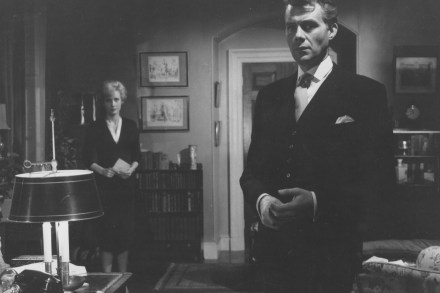
Today marks 50 years since the release of Victim, a ground-breaking film about homosexuality that was granted an X-certificate. Writing in the latest issue of the Spectator (subscribers click here), John Coldstream explains the significance of this frank and truthful film and its contribution to the national debate about decriminalising homosexuality. It was made four years after the publication of Sir John Wolfenden’s report into ‘Homosexual Offences and Prostitution’, which recommended that homosexual acts between consenting adults in private should be decriminalised. This contentious reform was not secured until 1967.

More banking worries

From our UK edition

George Osborne wrote a strident article for the Observer last weekend, in which he called rich tax evaders “leeches”. As James Forsyth reveals in the cover story of this week’s magazine, Osborne is not alone among Tories in hounding the ‘undeserving rich’ at present. James goes on to argue that the Tories are ‘becoming particularly worried’ about the callous rich because the Vickers commission is poised to bring the emotive issue of banks back to the ‘political frontline’. The Vickers report has already irritated the coalition’s sore points, with disagreement allegedly rife between George Osborne and Vince Cable. Today’s FT offers a fresh angle.

Cameron: I’m a common sense Conservative

From our UK edition

David Cameron weathered an awkward interview on the Today programme earlier this morning, in which the Strategic Defence Review was savaged and the recent riots were compared to the Bullingdon Club, of which Cameron was once a member. He stood by the defence review, with reference to the successful British contribution to the Libyan intervention, and he blithely ignored the Bullingdon Club question. He reiterated his belief that parts of society have undergone ‘a slow motion moral collapse’.  His gruff tone might have surprised some listeners. The interviewer, Evan Davis, offered Cameron the chance to retreat from the firm, almost draconian line he took at the height of the riots.

The death of books?

From our UK edition

"The death of books has been greatly exaggerated," says novelist Lloyd Shepherd in the Guardian. He has written a detailed statistical analysis of the long-term trends in the trade and presents a positive outlook, perhaps too positive. His case hinges on two standout facts. Book sales in the UK have increased by 42 per cent over the last ten years and UK publishing sales have increased by 36 per cent during the same period. The industry yielded £1.7 billion last year. “Why the gloom?” Shepherd asks. The answer, it seems, is simple. As this blog illustrated here and here, retailers haven't been able to compete with Amazon on either price or overheads.

A million ways to read a book

From our UK edition

“Dickens with magic! How much better can it get!” “Don’t be put off by the slightly old-fashioned style or by the dire films that have been made! This is a really exciting, rip-roaring adventure. Funny, scarry, brilliant book.” "Tremendously rich, delectably slow in pace, and packed to the binding with much to make you think.” “I loved the strange yet compelling world created in this book. It was one of those ones that I slowed down towards the end because I didn’t want it to finish." Odd though it may seem, those superlatives are for the same book, Jonathan Strange and Mr Norrell by Susanna Clarke.

Miliband re-opens campaign with same old weapons

From our UK edition

Party politics is back from the summer and the summer’s events are defining the strategic dividing lines. Ed Miliband reopened hostilities by threatening to force a vote on police cuts. The Standard reports: ‘The Labour leader said ministers were being "reckless" in refusing to rethink planned 20 per cent savings following the worst rioting in living memory. Launching a new campaign during a visit to Lewisham, Mr Miliband claimed the cuts, reducing officer numbers by 16,000, would "weaken the forces of law and order on our streets".

Noddy in trouble

From our UK edition

It seemed wrong, somehow, to include a story about the travails of Chorion, the company that owns Mr Men, Noddy, Poirot and Raymond Chandler, in the round-up of the weekend’s literary pages. But the news that the firm is close to entering administration made its way into both the Sunday Times and the Telegraph. Were it not for the boom of interest around Michael Ondaatje’s latest novel, The Cat’s Table, Chorion might have been the leading literary story of the weekend. The outlook is pretty bleak. The Bookseller reports that Chorion has debts of £70m, annual interest payments of £35m and £16m of earnings, according to its annual accounts. The form has also been mired in internal squabbles.

Across the literary pages | 30 August 2011

From our UK edition

Robert McCrum profiles Michael Ondaatje to coincide with the publication of Ondaatje’s latest novel, The Cat’s Table. ‘The eyes of Michael Ondaatje, prize-winning author of The English Patient, are a baffling window on the inner man: the brilliant, pale sapphires of a witty Dutch burgher set in a 68-year-old Tamil frame. As he says of himself and his work, "I am a mongrel of place. Of race. Of cultures. Of many genres." An interview with Ondaatje is a playful compendium of anecdote, on-the-hoof cultural criticism and crafty conversational shape-shifting. "Charm" is a dangerous word, but an hour or two with Michael Ondaatje is a beguiling experience.

Housing crisis on the horizon

From our UK edition

There is grim news on the housing front this morning: the National Housing Federation (NHF) reports that the housing market will descend into “crisis” unless the supply of houses is dramatically increased. It points out that only 105,000 new homes were built last year, the smallest amount since the 1920s. This is a long-term trend, as demand has consistently outstripped supply.  The NHF thinks that those facts will not change and predicts homeownership will fall to the level of the mid-1980s, when Margaret Thatcher announced that her goal was to help “more and more people to own property.” The conclusion is obvious if those are the premises: average property prices will swell beyond the means of ordinary people.

Merkel’s hard game

From our UK edition

As James noted earlier, Angela Merkel’s response to the Eurozone crisis is hampered by the awkward arithmetic in the Bundestag. Merkel has been faced with these difficulties throughout the crisis. Her answer has been to oppose initial proposals to solve the Eurozone crisis, only to relent later in the day. This has been the pattern from the first Greek bailout to the expansion of the EFSF, which is currently before the Bundestag. Might her apparently determined opposition to Eurobonds (which, of course, would require a huge transfer of power and cash from Berlin to the Med and Brussels) go the same way? Wolfgang Münchau has a comprehensive piece on the subject in today’s FT.

Salmond rules out move for Megrahi

From our UK edition

Alex Salmond has just been on Sky News and he ruled out extraditing the Lockerbie bomber. He said that the Scottish government has no intention of asking for al-Megrahi to be extradited and the Libyan National Transitional Council appears to have no intention of granting extradition. He also added that there was no scope for further interviews with al-Megrahi, such was the prisoner's condition. Although he reiterated that the Lockerbie case would be re-opened should further evidence emerge. He also defended the Scottish government’s decision to transfer al-Megrahi to Libya, saying that the original medical judgement of three months life expectancy was never definitive and therefore it had been impossible to determine how long al-Megrahi would live.

More questions for UKBA

From our UK edition

The Home Office and the UK Border Agency (UKBA) completed the review into the asylum seekers legacy backlog ahead of schedule at the end of last month. 450,000 case files have now been closed and the government is as pleased as punch. Earlier in the summer, Damian Green heralded the achievement as one of “three fundamental changes to the asylum system.” Not everyone shares his enthusiasm and serious concerns about UKBA remain. First, the review is incomplete. An as yet unidentified number of cases have been granted ‘temporary leave to remain’ for up to 3 years, which merely defers the decision to grant asylum or deport.

The government turns its attention to the Fletcher case

From our UK edition

The Lockerbie bomber, Abdel Basset al-Megrahi, is at death’s door. His relatives told journalists that he is ‘comatose’ at a family house in Tripoli. There have been calls to extradite Megrahi in recent days; last week, the ubiquitous William Hague said that he hoped the Scottish authorities were considering the matter. The Libyan National Transitional has since indicated that Megrahi will remain in the country to die. Mohammed al-Alagi, the NTC justice minister, said: “We will not give any Libyan citizen to the West. Al-Megrahi has already been judged once and he will not be judged again … We do not hand over Libyan citizens, (Muammar) Gaddafi does.

A weekend in Libya

From our UK edition

There’s no respite in Libya, where there have been significant developments this weekend. There have been reports (and harrowing images) of mass graves being uncovered in Tripoli, the latest suggestion that pro-Gaddafi forces have committed appalling atrocities in what is now a purely callous struggle. The National Transitional Council says it has evidence of further crimes. On the other hand, Channel 4 has found a handful of Nigerians (presumably mercenaries) in captivity, who are terrified that they will be shot by their rebel captors. Meanwhile, rebel forces have taken control of most of Tripoli and are now setting up a civil administration there.

Labour’s new attack strategy: Cameron’s a right-winger

From our UK edition

The Observer has a cracking scoop: a brief document detailing a new Labour plan to attack Cameron. The memo has been written by Shaun Woodward, the former Tory MP and Labour cabinet minister who now heads Labour’s anti-Tory unit. He will report to the shadow cabinet in the next few weeks. He says: ‘At the last election we faced a Conservative party (and a Conservative leader in David Cameron) whose strategic goal was to decontaminate their brand, intending to present themselves as reformed, modern, centrist and pragmatic. Cameron was effective in promoting a perception [that] his party had changed.

Osborne’s crusade

From our UK edition

‘Tax evasion is morally repugnant. It's stealing from law-abiding people who face higher taxes to make good the lost revenue. Those who evade taxes, like benefit cheats, are leeches on society. And my message to those who try to hide their incomes from the Revenue in offshore bank accounts and false declarations is simple: we will find you and your money.’ That was written by George Osborne in today’s Observer. He promises that the deal with Switzerland is “just the start” of his campaign to close tax havens. The rest of the article then relates the coalition’s achievements at reducing tax avoidance by increasing charges on capital gains and non-domiciled taxpayers working in Britain.

An unfolding tragedy in America

From our UK edition

Hurricane Irene hit the North Carolinian coast earlier this morning. Tragically, it has already caused injuries and claimed one fatality. The pictures on news channels are terrifying; few things are more horrendous and awesome than nature. America has battened down the hatches and many international flights to the States have been cancelled. New York Mayor Michael Bloomberg has been a constant presence as this storm has neared, and Barack Obama has returned to Washington to weather the storm. A cynic might slam the President’s decision as a hollow gesture. But, after Bush’s mauling post-Katrina, even the weather is political these days.

Willetts’ musings

From our UK edition

Coffee House has already touched on David Willetts’ interview with the Times (£), highlighting his view that the 50p tax rate is important to prove that "we’re all in this together". Willetts does not limit his words to the top rate of tax. In addition to his universities brief, he discusses equal pay issues, social reform and the recent riots. Willetts confesses to being a “muser”, never happier than when applying his renowned brain to the broad sweep of government policy. “I wouldn’t be able to function properly as a politician unless I was able to range across some of these wider issues. It just wouldn’t be worth it,” he says.

Clegg at odds with many Lib Dems over 50p rate

From our UK edition

The future of the 50 per cent tax rate is growing issue within the coalition. Unlike most government wrangles, this one doesn’t split on partisan lines, with the yellows on one hand and the blues on the other. The debate is largely being forged by personalities. George Osborne is well entrenched; Eric Pickles weighed-in for the race last weekend, saying that he wanted people “to keep more money in their pockets”, indicating that he hopes the rate is temporary. (He went take a swipe at Vince Cable's mansions tax, which he described as a "big mistake".)   It’s David Willetts’ turn this weekend. The Times reports (£) that Willetts believes the tax must stay for the time being.