Daniel DePetris

Daniel DePetris is a fellow at Defense Priorities, a syndicated foreign affairs columnist at the Chicago Tribune and a foreign affairs writer for Newsweek.

Britain must follow Germany’s example to help end Yemen’s civil war

There is no civil war in the world today whose effects are so detrimental to civilians as the conflict engulfing Yemen. The war, pitting a Houthi rebellion in control of the Yemeni capital against the nominal Yemeni government in the south, just crossed its four-year anniversary last week. The United Nations is trying its best to end the fighting, with little to show for it other than a ceasefire in the Yemeni port city of Hodeida which may or (more likely) may not get peace talks off the ground. Unlike the United Kingdom, which has exported £5.7 billion of arms to the Saudi-led military coalition bombing Yemen to smithereens, Germany has largely been a passive spectator to the conflict.

Emmanuel Macron has saved himself from political crisis – for now

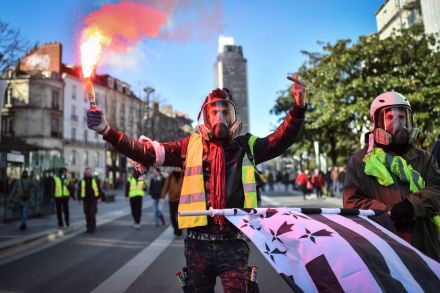
Back in December, Emmanuel Macron was a man on edge. His poll numbers were spiralling down the toilet; hundreds of thousands of French who felt alienated from their government were taking to the streets to shout down the French elite in cities and towns across the country; and fires were burning all around Paris. Police officers and protesters-turned-rioters were on the frontlines trading rocks and rubber bullets, resulting in hundreds (if not thousands) of arrests. Macron, the blue-eyed, fresh-faced technocratic politician who marketed himself during the 2017 presidential contest as the Fifth French Republic’s aspiring saviour, was left twiddling his thumbs in the presidential mansion wondering how to address the turmoil around him.

How Steve Bannon tried – and failed – to crack Europe

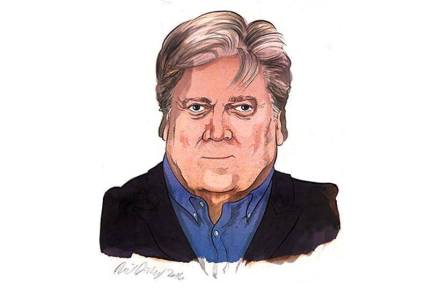
When Steve Bannon was ousted from the White House as president Donald Trump’s chief strategist, the populist provocateur and former Hollywood executive was back running staff meetings at Breitbart less than 24 hours later. The rumpled, grizzled, grey-haired Bannon – who has a fondness for philosophy, history, political bloodsport and green camo jackets – is constantly on the move for a new project. In the United States, the big project was getting Trump elected and ensuring the New York billionaire never forgot about the part of America that loved him and the part that cringed at the mention of his name.

How Steve Bannon tried – and failed – to crack Europe | 6 March 2019

When Steve Bannon was ousted from the White House as president Donald Trump’s chief strategist, the populist provocateur and former Hollywood executive was back running staff meetings at Breitbart less than 24 hours later. The rumpled, grizzled, grey-haired Bannon – who has a fondness for philosophy, history, political bloodsport and green camo jackets – is constantly on the move for a new project. In the United States, the big project was getting Trump elected and ensuring the New York billionaire never forgot about the part of America that loved him and the part that cringed at the mention of his name.

Why didn’t Europe do more to help Trump strike a deal with Kim?

'Sometimes you have to walk', said Donald Trump this morning as talks between him and Kim Jong-un broke down. With no new summit planned, the prospects for a denuclearisation deal with North Korea are not good. Yet South Korea was still keen to look on the bright side: the two leaders had made "more meaningful progress than at any time prior", a spokesperson for president Moon said. For all the criticism chucked at Trump, this progress (albeit limited) is worth remembering. At least he is trying, after all. But can the same be said for Europe? It's certainly striking that while Trump and Kim were at the centre of festivities this week, Europe wasn't even in the building.

Isis’s collapse has sparked a new rift between Trump and Europe

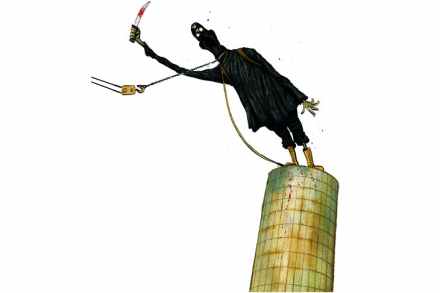
The days of black-clad militants rampaging through cities, parading captives as war trophies and doing wheelies in U.S.-made Humvees are over. The Islamic State – which once presided over eight million people in a reign of terror across territory as large as the United Kingdom – is now confined to an orchard in the dusty Syrian village of Baghouz. The so-called caliphate is now just 700 square metres. Within days— certainly weeks —all of Isis' territory will be retaken, the stragglers either killed in a barrage of US airstrikes or sent to Syrian Kurdish-run prison camps to the north. The demise of the caliphate, however, has given way to a new question: what to do with Isis foreign fighters? Donald Trump's answer is to make sure that Europe pulls its weight.

How the Democrats plan to revive the special relationship after Trump

Last weekend’s Munich Security Conference could perhaps best be summarised by two sentences in the 102-page report produced by a group of Western luminaries, politicians, military officials, and ex-statesmen (and stateswomen): After 'two years in office, the Trump administration has triggered a reassessment of transatlantic relations in Europe,' the report somberly declared. And 'with President Trump under increasing domestic pressure and a national security team that is much closer to his views, there is reason to expect even more turmoil in the second part of his term.

How the relationship between France and Italy reached its breaking point

When we think of frosty diplomatic relations between states, members of the European Union don’t typically come to mind. And yet the word 'frosty' is exactly what the relationship between Italy and France has become. In fact, 'frosty' may too tepid of a description. The Italians can be stubborn people. But so can the French. And for the first time many Europeans can remember, the stubbornness is compounded by two governments in Rome and Paris that are at each other’s throats on some of the biggest issues of the day. On one side is Italian deputy prime ministers Matteo Salvini and Luigi Di Maio, two fierce nationalists who consider the French government to be a collection of anti-Italian snobs.

Donald Trump’s State of the Union speech changes nothing

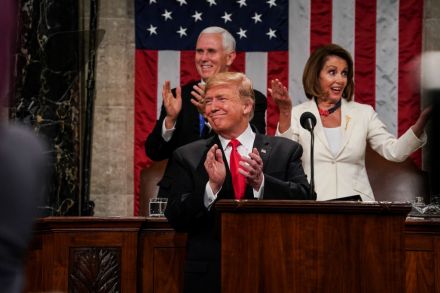
Donald Trump takes no punches. He prides himself on being a counter-puncher, a person who won’t think twice about hitting an opponent in the teeth. It only took a few days for those who hoped the Oval Office and the nuclear button would smooth the edges of his boisterousness, combativeness, and unbounded egotism to learn that Trump wasn’t going to change his personality for the sake of high-powered, politically correct Washingtonians.   Halfway through his first term, however, Trump has learned the hard way how tough it is to enact a legislative agenda when you get on everyone’s bad side.

Can Macron divide and conquer the gilets jaunes?

Emmanuel Macron, the young, dashing president of the Fifth French Republic, is the epitome of what it means to be a card-carrying member of the Paris political elite. The 41 year-old president was ushered through Sciences Po, France's premier centre of political education and a near requirement for youngsters who aspire to become politicians and policymakers. Upon graduating, he took an inspector job at the finance ministry before jumping into the investment world. Macron’s decision to hitch his stardom to Socialist Party boss Francois Hollande paid off when he was tapped to be the Deputy Secretary-General and then the Minister of Finance.

Why relations between the EU and US are about to get worse

If you thought the last two years of transatlantic relations were bad, things are about to get even worse. Donald Trump and his hard-charging secretary of state, Mike Pompeo, have scheduled a Middle East security conference for February 13th and 14th. Poland, perhaps the only country in Europe that looks fondly upon Trump as a world leader, will be hosting the two-day affair. Normally, this is the kind of multilateral event European heads-of-state are more than happy to participate in. Not so this one. Trump plan to elevate Iran’s destabilising actions in the region as a principle – perhaps the principle – topic during the conference is giving senior European officials cold feet about turning up.

Why relations between the EU and US are about to get worse | 22 January 2019

If you thought the last two years of transatlantic relations were bad, things are about to get even worse. Donald Trump and his hard-charging secretary of state, Mike Pompeo, have scheduled a Middle East security conference for February 13th and 14th. Poland, perhaps the only country in Europe that looks fondly upon Trump as a world leader, will be hosting the two-day affair. Normally, this is the kind of multilateral event European heads-of-state are more than happy to participate in. Not so this one. Trump plan to elevate Iran’s destabilising actions in the region as a principle – perhaps the principle – topic during the conference is giving senior European officials cold feet about turning up.

Matteo Salvini is doing Brussels a favour with his harsh migration policy

Matteo Salvini, Italy’s deputy prime minister and interior minister, is one of the most controversial politicians in Europe. The 45-year old chief of the League party exudes a down-to-earth demeanour with his common-man social media posts, in which he shares pictures of himself eating Barilla pasta and Nutella. To his many opponents, Salvini is a thick-headed, semi-fascist ideologue who wants to turn back the clock and return Europe to a dangerous form of nationalism. But to his supporters, in and out of Italy, he is a straight-talking, no-nonsense defender of his country's sovereignty against the northern elites in Berlin and Brussels.

Why Donald Trump will step up his feud with the EU this year

For Angela Merkel, the chief guardian of Europe’s centrist politics, 2018 was a year of tribulation – and she admits it. In her New Year's speech, the German chancellor acknowledged the hardship of the last twelve months while begging her countrymen to unite in the year ahead. “We will only master the challenges of our times if we stick together and collaborate with others across borders,” Merkel told the German people in what can only viewed as a call for the country to come together. Merkel’s words, however, don’t only apply to Germany.

Why Europe is now top dog in the Israeli-Palestinian peace process

About this time every month, diplomats, UN delegates, and humanitarian officials sit around the circular table in the UN Security Council chamber to take stock of the Israeli-Palestinian conflict. The meetings are a constant fixture on the Security Council’s agenda, yet the lack of any tangible diplomatic progress in the Middle East’s oldest dispute means that the sessions usually adjourn in much the same way.  The UN special envoy warns the chamber about the violence hovering just around the corner; the United States blames the Palestinian Authority for obstructing the process; and the rest of the Security Council reiterates stale talking points about a two-state solution. Yesterday’s meeting carried on much the same.

Relations between the US and EU have gone from bad to worse

One of the most important duties of being an ambassador is serving as a counsellor of sorts. When relations between two countries are on the rocks – or a president or prime minister says or does something another nation regards as hostile – the ambassador is often called on to ensure that any diplomatic fallout can be contained and the relationship itself can be repaired. Apparently Gordon Sondland, the US ambassador to the European Union, didn’t get the memo.   In an extraordinarily frank interview with Politico Europe this week, ambassador Sondland blasted the EU as an archaic, obstructionist, elitist European superstructure whose primary objective is to keep itself in business.

Mike Pompeo’s unwelcome warning to Brussels’ bureaucrats

The US secretary of state Mike Pompeo strutted into Brussels yesterday like a man on a mission. His task was almost impossible from the start: to convince America’s friends and allies in Europe that the United States under Donald Trump is still the leader of the liberal world order European politicians care so deeply about. It’s difficult to believe Pompeo convinced anyone. America’s top diplomat could have done what many of his predecessors have chosen to do: tell the European foreign policy community to relax and take a deep breath, America won’t be throwing you to the wolves. Instead, Pompeo was far more confrontational, channeling the fire and brimstone of his egotistical boss.

The decline of the US-German relationship is not just about Trump

It would be the understatement of the century to say that the normally constructive and cordial relationship between the United States and Germany was experiencing a few hiccups in the age of Donald Trump. Notwithstanding talk about mutual respect and friendship during shared photo sessions, Trump and German Chancellor Angela Merkel are not exactly two peas in a pod. In fact, the two leaders are polar opposites in temperament, experience, and worldview: Trump is the loud-mouth, condescending, bull-in-a-china shop from New York who campaigned on burning America’s political system to the ground; Merkel is the consummate European politician deeply attached to multilateralism and extremely devoted to the rules-based international order.

The rivalry between Macron and Salvini is a battle for Europe’s soul

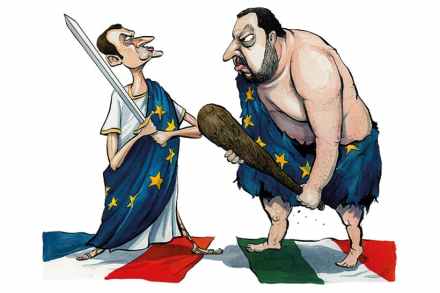
When Emmanuel Macron won a resounding victory over far-right nationalist Marine Le Pen in the 2017 French presidential elections – claiming 66 per cent of the vote – Matteo Salvini was a little known Italian politician largely scoffed at as a clown by the status-quo parties. While Salvini was posting selfies on Facebook and making outlandish comments about North African migrants, the eurozone, the European Union, and the Italian political establishment, Macron was in Paris measuring drapes in the Élysée Palace. Stories in the Washington Post, the New York Times, and the Guardian gushing about Macron being Europe’s saviour from the dark forces of populism were as prevalent as stories deriding Salvini as a buffoon.

The Democratic hype around Beto O’Rourke 2020 smacks of desperation

From our US edition

Democrats had a good night last Tuesday, flipping dozens of seats to recapture the House of Representatives for the first time in eight years. On the surface, the party looks confident and newly ascendant. It seems to have shaken off the 2016 jitters, which gave liberals around the country a mild form of PTSD. Yet, underneath the veneer, Democrats are still their usual listless selves. They may seem unified and ready to do battle against President Donald Trump, but the party remains divided about which course to take, how to bring the white working class back into their corner, and which candidate would be their best hope in 2020 to make Trump the first one-term president since 1992. The Democrats are desperately searching for their own white whale.

beto O’Rourke 2020