Damian Thompson

Damian Thompson

Damian Thompson is an associate editor of The Spectator and presenter of The Spectator’s Holy Smoke podcast

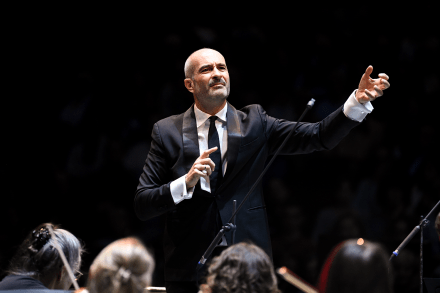
Manacorda’s thrills and spills at Prom 72

At a Hollywood party in the 1940s, the garrulous socialite Elsa Maxwell spotted Arnold Schoenberg, then teaching music at UCLA, looking miserable. So she pushed him towards the piano with the words: ‘Come on, Professor, give us a tune!’ I couldn’t help thinking of those words on Friday night, when we heard the first Proms performance of a symphony written in 1847 by a professor at the Paris Conservatoire. The Third Symphony of Louise Farrenc is full of well-crafted melodic lines, neatly configured to fit maddeningly predictable textbook chord progressions. It’s delicately orchestrated, but even the feathery flutes of the Orchestra of the Age of Enlightenment couldn’t disguise the professor’s failure to give us a single memorable tune. This is not a popular opinion.

Losing faith: will Labour’s VAT policy hit religious schools hardest?

25 min listen

In this week’s copy of The Spectator, Dan Hitchens argues that a lesser reported aspect of Labour’s decision to impose VAT on private schools is who it could hit hardest: faith schools. Hundreds of independent religious schools charge modest, means-tested fees. Could a hike in costs make these schools unviable? And, with uncertainty about how ideological a decision this is, does the government even care? Dan joins Damian on the podcast to discuss.  Raisel Freedman from the Partnerships for Jewish Schools also joins later, to discuss how the measure could threaten Jewish independent schools, when they provide a haven for students from a climate of rising antisemitism. Produced by Patrick Gibbons.

From the archives: An atheist goes on a Christian pilgrimage. Why?

23 min listen

Writer Guy Stagg threw in his job to undertake a pilgrimage to Jerusalem via Rome - choosing a hazardous medieval route across the Alps. It nearly killed him: at one stage, trying to cross a broken bridge in Switzerland, he ended up partially submerged in the water, held up only by his rucksack.  On this episode of Holy Smoke, from the archives, Guy explains why his journey was a pilgrimage, not just travels. And Damian Thompson talks to Harry Mount, editor of The Oldie, about why he’s irresistibly drawn to church buildings while remaining an unbeliever - albeit an agnostic rather than an atheist.

The Stockhausen work that is worth braving

Grade: A- One of the best one-liners attributed to Sir Thomas Beecham refers to the stridently avant-garde Karlheinz Stockhausen: ‘I’ve never conducted his music, but I once trod in some.’ It’s almost certainly apocryphal, but the implied verdict is widely shared. Stockhausen played up to the caricature of the self-obsessed ‘squeaky gate’ composer, though his capacity to create painful noises went way beyond squeaks: only he could have written a string quartet in which each player is recorded in a separate helicopter. So I’m sticking my neck out when I suggest that some of Stockhausen’s works are masterpieces that can be enjoyed even – or especially – if you steer clear of the thicket of mathematics, physics and astrology that surrounds them.

The most exhilarating ‘authentic’ Mozart I’ve ever heard

Grade: A+ Yet another double bill of Mozart’s Piano Concertos 20 and 23! There’s an online database of 185 recordings of the first of these, the brooding K466 in D minor, and the classically perfect K488 in A major isn’t far behind. Can there really be anything new to say about either of them? The answer is yes, and in virtually every bar. Olga Pashchenko, a Russian-born pianist based in the Netherlands, here directs the top-flight period ensemble Il Gardellino in her second album of Mozart concertos. She’s playing a fortepiano, but don’t let that put you off: it’s a sweet-toned instrument whose soft action helps Pashchenko deliver cheeky ornaments at lightning speed. And cheeky is definitely the word.

Damian Thompson, Paola Romero, Stuart Jeffries, Ysenda Maxtone Graham, and Nicholas Farrell

35 min listen

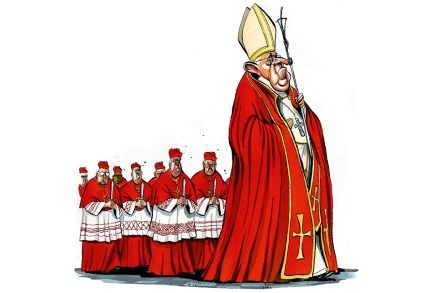
On this week’s Spectator Out Loud: Damian Thompson argues that Papal succession plotting is a case of life mirroring art (1:26); Paola Romero reports on Venezuela’s mix of Evita and Thatcher, Maria Corina Machado, and her chances of bringing down Nicolas Maduro (11:39); reviewing Richard Overy’s book ‘Why war?’, Stuart Jeffries reflects that war has as long a future as it has a past (17:38); Ysenda Maxtone Graham provides her notes on party bags (24:30); and, Nicholas Farrell ponders on the challenges of familial split-loyalties when watching the football in Italy (27:25).  Presented by Patrick Gibbons.

The plotting to find the next Pope

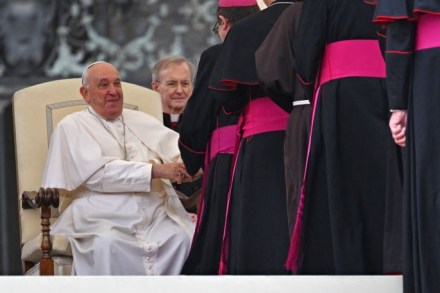
The Hollywood adaptation of Conclave, Robert Harris’s thriller about a conspiracy to rig a papal election, won’t be in cinemas until November. But judging by the trailer released last week, its starry cast, crafty plot and spectacular cinematography – jets of smoke scattering cardinals as an explosion shatters the Sistine Chapel – will instantly erase memories of The Two Popes, Netflix’s risible Oscar-nominated fantasy in which Benedict XVI secretly chooses Cardinal Bergoglio as his successor.

A Habsburg Archduke explains how not to be nasty on Twitter

25 min listen

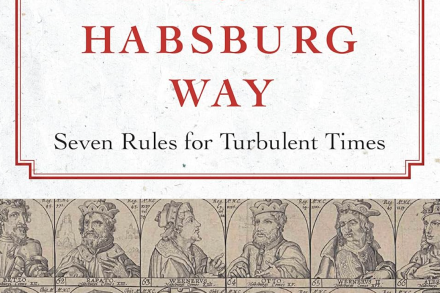
In this week's Holy Smoke episode Damian Thompson welcomes back Eduard Habsburg, Hungary's Ambassador to the Holy See and also, to give him his family title, Archduke Eduard of Austria. Last year he published The Habsburg Way: 7 Rules for Turbulent Times, which offered advice on how to live a good life based on the panoramic history of his dynasty.  One reason it was such a success is that Eduard has a cult following on X, formerly Twitter, made up of people who initially followed him because he's a Habsburg but stayed to absorb his spiritual wisdom and good cheer. In this episode, with Damian speaking as someone who frequently gets drawn into (or starts) catfights on that platform (his words!), he asks if Eduard has any advice for struggling social media sociopaths.

Buy this for Beethoven’s beguiling arrangements of British folk songs

Grade: B+ Beethoven was proud of his Triple Concerto for Violin, Cello, Piano, pointing out that no one else had attempted such an experiment. He was writing at the height of his youthful powers and the work is stuffed with earworms. Yet I can’t think of any later composers who copied that particular model, and you can’t blame them. This is essentially a concerto for piano trio and full orchestra – not an easy combination, because the soloists keep having to pass the baton to each other while bracing themselves for the next orchestral tutti. Nicola Benedetti, Sheku Kanneh-Mason and Benjamin Grosvenor make a really good job of it; Kanneh-Mason’s cello glows as memorably as it did in his Elgar Cello Concerto.

Walsingham and the musical grief of the Reformation

21 min listen

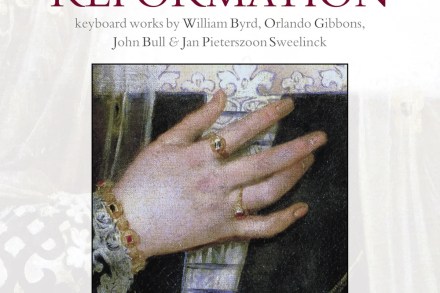
The other day I received a press release about an intriguing album of keyboard music by 16th- and early 17th-century composers, three Englishman and a Dutchman, played on the modern piano by Mishka Rushdie Momen, one of this country’s most gifted and intellectually curious young concert pianists. It’s called Reformation, and before I’d heard a note of the music – which is performed with thrilling exuberance and subtlety – I knew I wanted to interview Ms Rushdie Momen.

Thank goodness Busoni’s Piano Concerto is returning to the Proms

On 5 August, Ferruccio Busoni’s Piano Concerto will be performed at the Proms for only the second time. It should have been the third time, but a Musician’s Union strike in 1980 forced the cancellation of the concert at which Martin Jones had been booked to give the première. Jones is a fearless virtuoso, still recording in his eighties, but one can’t help wondering whether his disappointment back then was tinged with relief. In one place, the soloist’s fingers must wrap themselves around 128 notes in a single bar Garrick Ohlsson, a long-time champion of the work, describes its difficulties as ‘absolutely immense, and 25 per cent of this piece is the most cruelly difficult writing in any piano concerto’.

An exhilarating debut: Peltokoski’s Mozart Symphonies reviewed

Grade: A- Here’s an oddly structured album of Mozart’s symphonies 35, 40 and 36 from the world’s most fashionable young Finnish conductor – and, no, it isn’t Klaus Makela, the 28-year-old maestro of the Oslo Philharmonic and Orchestre de Paris who’s taking over in Amsterdam and Chicago. It’s Tarmo Peltokoski, 24, who hasn’t yet had to cope with iffy reviews hinting that he’s been overpromoted. Peltokoski is cute, clever and scarily self-assured. He’s already music director of the Latvian National Symphony Orchestra and is about to hold the same position in Toulouse. He’s principal guest conductor of the Rotterdam Philharmonic and also the Deutsche Kammerphilharmonie Bremen, the Mercedes-Benz of chamber orchestras.

Calm fire: the consolation of listening to Bruckner

31 min listen

Here's an episode of Holy Smoke to mark the 200th anniversary of the birth of Anton Bruckner later this year. This embarrassingly eccentric genius was, perhaps, the most devoutly Catholic of all the major composers – but you don't have to be religious to appreciate the unique consolation offered by his gigantic symphonies. On the other hand, it's hard to appreciate the unique flavour of Bruckner without taking into account the influence of the liturgy on his sublime slow movements and what the (atheist) composer and Bruckner scholar Robert Simpson called the 'calm fire' of his blazing finales. If you make it through to the end of this episode, you'll hear exactly what he meant.

Yunchan Lim’s Chopin isn’t as good as his Liszt or Rach

Grade: B- In 2022 the South Korean pianist Yunchan Lim became, at 18, the youngest winner of the Van Cliburn competition, displaying a virtuosity that stunned the judges. You could see conductor Marin Alsop’s astonishment as he bounded through the finale of Rach 3, combining accuracy and swirling fantasy at daredevil speed. It’s been viewed nearly 15 million times on YouTube. In truth, though, he’d have had to screw up badly not to win, because he’d already dispatched Liszt’s fiendish Transcendental Études with perfect articulation and mercurial wit; in places he out-dazzled even the current master of this repertoire, Daniil Trifonov. Decca snapped him up and here’s his first studio album: both sets of Chopin’s Études.

Sean Thomas, Kara Kennedy, Philip Hensher, Damian Thompson and Toby Young

35 min listen

On this week’s Spectator Out Loud: Sean Thomas worries that Paris has lost some of its charm (1:21); Kara Kennedy reports on US-style opioids arriving in Britain (8:43); Philip Hensher describes how an affair which ruined one woman would be the making of another (15:32); Damian Thompson reflects on his sobriety and his battle with British chemists (23:58); and, Toby Young argues a proposed law in Wales amounts to an assault on parliamentary sovereignty (29:26). Produced and presented by Patrick Gibbons.

The mutilation of Radio 3

On Saturday 12 December 1964, Harold Wilson addressed his first Labour party conference as prime minister, George Harrison was photographed with his new girlfriend in the Bahamas, Pope Paul VI told Catholics they could drink alcohol ‘in moderation’ before Midnight Mass and, according to the Mirror, ‘two strip-tease girls fought in the nude in their dressing room after finishing their fan dance at a night club’. The station has become little more than a Spotify playlist interrupted by the disc-jockey burbling It was also the day that Record Review arrived in its Saturday morning slot on the BBC’s Third Programme, now Radio 3. And there it remained.

The real reason I don’t drink

It’s been 30 years this month since I last touched alcohol and I still can’t face the prospect of a social event without drinking. Other people drinking, that is. I’m terrified by the thought of going back on the sauce again, but that doesn’t mean I want to hang around with teetotallers who’ve never had to apologise after a party or suffered an apocalyptic hangover. That’s what keeps me away from the drink: the biological penalty One of the leitmotifs of Anthony Powell’s Dance to the Music of Time is that you can’t trust teetotallers. They’re control freaks who love seeing other people make fools of themselves. They spend the whole evening gathering ammunition. The slimy Kenneth Widmerpool barely drinks, of course. Or they’re sex-obsessed.

The problem with cringe-making funerals

21 min listen

When did supposedly religious funerals turn into ‘celebrations of life’ that are more about entertaining the congregation than mourning the dead person – who, these days, hasn’t died but ‘passed’?  In this episode of Holy Smoke I’m joined by one of my favourite American priests, Fr Joe Krupp, a self-described ‘redneck’ from Michigan who reaches millions with his powerful ministry and wisecracking podcasts. He puts his finger on what’s gone wrong. Wait for the horror story at the end. He had me laughing so much that I could hardly get my questions out. Don’t miss this one!

The greatest British symphonist you’ve never heard of

Grade: A Rejoice! A glorious symphonic cycle by a British composer has been issued as a set for the first time. George Lloyd (1913-98) was treated with lofty condescension by the musical establishment because his twelve symphonies contain barely a single dissonance. They’re sprinkled with jaunty tunes that have the feel of an Ealing Comedy – heresy! Also, it didn’t help that for decades Lloyd made his living as a mushroom farmer in the West Country. But he was no amateur: he could write perfect fugues as a teenager and by his early twenties had a fine opera under his belt. Then in 1942, the ship on which he was serving as radio engineer was hit by a torpedo. Lloyd nearly drowned in oil; shell shock ruined his health and he and his wife retreated to their smallholding.

Stephen O’Leary, my brilliant friend

One afternoon in June 1995, I found myself trapped in the Bodhi Tree, a stucco-fronted bookstore on Melrose Avenue in West Hollywood where New Age wisdom-seekers sip herbal tea while discussing the latest ravings of Shirley MacLaine. I was freaking out because the professor I’d travelled 6,000 miles to meet had apparently stood me up. Stephen O’Leary, of the University of Southern California, had just published Arguing the Apocalypse, a prize-winning study of the rhetorical techniques of televangelists. I was researching my own book about the end of the world and was desperate to pick his brains. He was almost two hours late and the wind chimes were driving me nuts.