Daisy Dunn

Booze now has its own Rest is History-style podcast

Intoxicating History is the perfect title for drinks expert Henry Jeffreys and food critic Tom Parker Bowles’s new podcast. Its theme is alcohol, but its contents are predominantly historical, which is good news if, like me, you are quick to apply the word ‘bore’ to any man who talks about wine for more than eight minutes. The first episodes came out before Christmas but they have been gathering momentum since Dry January. Today’s drinking culture, which has spawned this bizarre annual group sacrifice, has an interesting pedigree. Europeans have apparently been on their guard against boozing Englishmen for nearly a millennium. The Portuguese were certainly left in no doubt as to our reputation when we aided them in their Reconquista.

Why I’m obsessed with Farming Today

Farming Today airs at an undignified hour each morning on Radio 4. On the few occasions I’ve caught it live I have felt, first of all, relief that I am not a farmer; second, inadequacy; and finally, a surge of evangelism for the farmer’s way of life. I am now reaching the conclusion that getting up early enough to listen to Farming Today is the very least we can all do. Listening to Farming Today helps dispel the romance of living off-grid By no means will everything discussed on the programme hold relevance for your life. One feature last week was dedicated to a project to preserve ten acres of salt marsh downstream from Totnes. Another recent episode explored the Lakeland barns being saved for cultural heritage.

Why space is the perfect subject for podcasts

The podcasts I’m recommending to everyone at the moment are Nasa’s Curious Universe and the Royal Astronomical Society’s The Supermassive Podcast. Both have me convinced there’s no topic better suited to the oral medium than space. Not even history. Unless you happen to be an astronaut, you’ll find much of what is described so alien, that your imagination will go into overdrive. What does a Brown dwarf look like? What is the ‘tadpole’ orbit of a quasi-moon? The icy surface of Europa has red furrows which make it look like ‘a giant dragged its fingernails’ across it. How did those furrows get there? You will probably find the images summoned in your head offset the urge to reach for Google.

Radio 4’s Lord Lucan series is rescued by a brilliant narrator

It was 50 years ago this week, on 7 November 1974, that Lord Lucan fled what was destined to become the most talked about crime scene of the 20th century. A coroner’s inquest jury named him as the killer of Sandra Rivett, his children’s nanny, but his disappearance ensured that he was never convicted of the crime – or of the attempted murder of his wife, Veronica. Stripping away the sensationalism of the story needn’t render it boring Understandably, given the mystery that still envelops his precise actions and whereabouts, Radio 4 has chosen to mark the anniversary with a soft question rather than to provide answers. Soft, but also ironic: what is it about this case that continues to obsess us?

They weren’t all scheming poisoners: the maligned women of imperial Rome

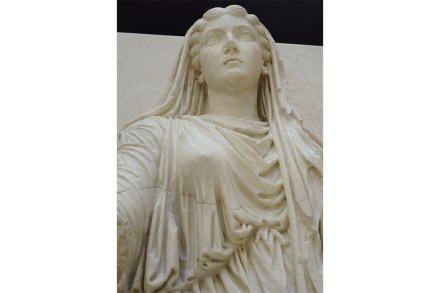
Unfortunately, She Was a Nymphomaniac must be one of the most eye-catching book titles of the year. I assumed it was just a riff on John Ford’s 17th-century tragedy ’Tis Pity She’s a Whore, but apparently it came directly from the mouth of a modern tour guide in a museum in Rome. The man was describing Julia, the daughter of the first Roman emperor Augustus, when Joan Smith stepped in. ‘Julia,’ she corrected him, ‘was not a nymphomaniac.’ The rattled guide, who conceded that he was merely following the (biased) ancient sources, may be relieved to learn that he has not been singled out. Smith, the author of the barnstorming Misogynies, takes many others to task for insensitivity in her new history of 23 women of the Julio-Claudian dynasty.

This UFO testimony had me hooked

In October 1964, a young man was driving to a dance in Hamburg, Pennsylvania, when his radio began to pick up a strange frequency. At first he thought it was just tuning in to a local channel, but then voices came through discussing some kind of nuclear war – and issuing bomb reports. Recalling the incident decades later, the driver described the simultaneous appearance of a star overhead followed by the sudden realisation that he could see through the floor of his car. ‘I hadn’t done any dope, I wasn’t doing any beer,’ he adds so casually that you feel inclined to believe him. And yet his body felt like jelly.

How Berlin nearly broke Bowie

This week’s Archive on 4 is a treat for David Bowie fans. Francis Whately, the producer behind several of the BBC’s Bowie films, including The Last Five Years, has patched together old recordings and new interviews with Bowie’s lovers and friends to examine his life in West Berlin between 1976 and 1978. It was a fraught, make-or-break time. Out of pocket, addicted and depressed, Bowie had grown ‘very, very worried’ for his life. It isn’t entirely clear why he chose Berlin as a place for recovery, other than that it was unstarry, cheap and a good distance from LA, where his troubles had spiralled. Unfortunately, it was also ‘the smack capital of Europe’, and Bowie was about to move in with Iggy Pop.

A fiery examination of the damage wrought by internet culture

Historically, when a woman was giving birth, she was attended by the women she trusted most, including her child’s prospective godmother. The word ‘gossip’ derives from the Old English ‘god-sibb’, meaning godparent, but came to refer to what went on around the childbed. As Erica Jong later put it: ‘Gossip is the opiate of the oppressed.’ Gossip has since moved online – see Mumsnet and the network of Facebook pages called ‘Are we dating the same guy?’. Women use the latter to post warnings to alert others to serial cheaters – and worse. Perhaps inevitably, it has become the focus of several lawsuits brought by men who have been publicly maligned. Is it possible to keep the old ‘whisper network’ alive without being sued in the process?

Do men and women need different podcasts?

Do men and women need different podcasts? The notion goes against the unisex, every-sex, what-is-sex-anyway culture we have come to inhabit. Yet this week we find, on the BBC no less, a podcast dedicated to men’s problems and one satirising women’s problems. Some would say the pushback has begun. Geoff Norcott’s Working Men’s Club is a recorded stand-up comedy act performed to a studio audience in Leeds. Norcott describes it as a place ‘to discuss proper bloke stuff’, by which he means beer, sport and masturbation (cue laughter), but much more than that, men’s physical, mental and emotional health (initial silence). He jibes at the male habit of squashing feelings and ignoring signs to visit the doctor.

Rushdie on how the best magical realism transcends fantasy

Ask the man in the street to quote a line from one of Salman Rushdie’s novels, and he might struggle. Ask him whether he’s heard the phrase, ‘Naughty but nice’, specifically in the context of cream cakes, and you will probably make his day. It was Salman Rushdie who came up with that slogan in his early career as an adman. Remember the ‘irresistibubble’ tag for Aero chocolate bars? He was responsible for that, too. ‘I feel at bottom that I’m still that boy from Bombay and everything else has been piled on top of that’ If there’s any embarrassment on Rushdie’s part (and why should there be?) that some of his best-known words are from the sides of buses, it was undetectable as he sat down with John Wilson on This Cultural Life last week.

The jaw-dropping story of the British Museum thefts

It’s August 2023 when news breaks that artefacts have gone missing, presumed stolen, from the British Museum. I’m about an hour into investigating the story for a feature when a suspect is named in the press. I know him. He’s the curator I was seated next to at a British Museum dinner nine months earlier. Listening this week to three preview episodes of Thief at the British Museum, an electrifying nine-part series on Radio 4, I kick myself for the second time for spending most of that evening talking to the professor on my left. What can I remember of the man on my right? He was quiet. Ruddy-faced. Nothing else remarkable springs to mind. What can I remember of the man? He was quiet. Ruddy-faced.

How to live off the land for a year

Could you live off the land for a year without buying a single thing to eat? This was the challenge a retired journalist set himself on Radio 4 this week. Max Cotton lives on a five-acre smallholding near Glastonbury in Somerset with his wife Maxine, two pigs, two dozen hens and a Jersey-Friesian cross named Brenda. He also has six adult sons who, as far as this project is concerned, ‘prefer to pontificate than help very much.’ Cotton’s hopes for peas by April were even less realistic than I thought Cotton conceded at the outset that he would allow himself to purchase salt as a necessity.

Easter special: how forgiveness was forgotten

36 min listen

This week: how forgiveness was forgotten, why the secular tide might be turning, and looking for romance at the British museum.  Up first: The case of Frank Hester points to something deep going on in our culture, writes Douglas Murray in the magazine this week. ‘We have never had to deal with anything like this before. Any mistake can rear up in front of you again – whether five years later (as with Hester) or decades on.’ American lawyer and author of Cancel Culture: the latest attack on free speech, Alan Dershowitz, joins the podcast to discuss whether forgiveness has been forgotten.

Don’t tell them but the French didn’t in fact invent etiquette

When dining in France, it is considered rude to finish the bread before the main course has been served, and ruder still to slice the bread with a knife, lest the crumbs land in a lady’s décolletage. In China, you should never place your chopsticks upright in a bowl of rice, and in Bangladesh you may eat with your fingers, but should avoid getting sauce above the knuckles. If you are guilty of any of the above, may I direct you, politely, to a new documentary on the World Service. The programme takes aim at many outdated traditions (including those that resign women to the kitchen), but the conversation is far more informative than censorious and more eye-opening than dour.

Why are there so few decent poetry podcasts?

The late John Berryman described A.E. Housman as ‘a detestable and miserable man. Arrogant, unspeakably lonely, cruel, and so on, but an absolutely marvellous minor poet… and a great scholar’. The Times obituarist went further, declaring Housman to have been, on occasion, ‘so unapproachable as to diffuse a frost’. That such a man could be so moved by a cherry tree in spring and by the dales of Shropshire in autumn says something about the separability of art and life. The greatest contradiction for Frank Skinner, whose poetry podcast has returned for a ninth series, lies between Housman’s work as a Cambridge classicist and his verse.

Ought we not have some shrine to the pips?

Next week marks the centenary of the pips. On Monday at 9 p.m. a documentary will be broadcast on Radio 4 debating whether the six little tones which ring in each hour ought to be axed as obsolete or preserved for tradition’s sake. Some contributors will speak of them as annoyances – ‘the cockroaches of broadcasting’ is a memorable phrase – and others will ask what could possibly replace them. By the end of the programme, whatever your view, you will have the pips lodged firmly between your teeth. If we so worship the pips, ought we not to have some worthy shrine to their existence as well? The first pips, which represent the Greenwich Time Signal, were transmitted at 9.30 p.m. on 5 February 1924.

Can Italy reverse its falling birth rate? 

Anne McElvoy is on the road again, exploring the state of modern Europe. Following her Radio 4 programme, The Reinvention of Germany in April, the Politico journalist has travelled to Padua, in northern Italy, where reactions to the rise of the right-wing populist Giorgia Meloni appear to vary. Is the 46-year-old PM a breath of fresh air – the best chance Italy has for a future – or a hypocritical dyed-in-the-wool traditionalist? The reinvention (or rather restoration) of Italy is very much Meloni’s goal. Clinging to the familiar principles of faith, flag and family, she has eschewed measures that would allow those born in Italy to define themselves as Italian, ostensibly believing that to be Italian is to have Italian blood.

A Radio 3 doc that contains some of the best insults I’ve ever heard

A recent Sunday Feature on Radio 3 contained some of the best insults I have ever heard. Contributors to the programme on the early music revolution were discussing the backlash they experienced in the 1970s while reviving period-style instruments and techniques. Soprano Dame Emma Kirkby remembered one critic complaining that listening to her performance was ‘as about as interesting as eating an entire meal of plain yoghurt’. Another critic, writing in Gramophone, pronounced the strings of the new ensembles ‘as beautiful as period dentistry’. Those strings were mostly made of animal guts. There was, as one of the musicians interviewed recalled, ‘a DIY atmosphere’ to the movement, which developed alongside a spate of others in 1973.

Enjoyable and informative but where’s the drama? Political Currency reviewed

The first episode of George Osborne and Ed Balls’s new podcast, Political Currency, opened with an old clip of the pair arguing across the despatch box. Osborne had described his latest Budget as ‘steady as she goes’ and Balls was having none of it. ‘What kind of ship does he think he’s on, the Titanic?’ If producers hoped that the duo would bring something of this, er, biting dynamic to their podcast, they were in for a surprise. The opening number saw little in the way of sparring between the former opponents. Seated in a studio in east London, they spent most of the time doing what so many in their milieu are doing at the moment, chummily sharing their views and frustrations and trying to squeeze some entertainment out of it.

The rise of vampirism in Silicon Valley

The Immortals, which begins on Radio 4 this week, is not for the faint-hearted. While it professes to be about the human quest for longevity and the elusive ‘cure’ for getting older, it focuses largely upon the transferral of blood plasma from healthy young people to reluctantly ageing people, or, as anyone with good sense might put it, the desperate descent from vanity to vampirism. I was on the verge of switching over to something more anodyne when a 46-year-old tech entrepreneur began talking about being injected with plasma from his 17-year-old son.