Christian Wolmar

Christian Wolmar is the author of British Rail, a new history published by Penguin, and writes a column for Rail magazine.

League of nations: guessing our way out of lockdown

38 min listen

European countries all seem to be doing something different, so what are the lessons from the continent (00:45)? Plus, how the West's lockdown impacts the developing world in a very real way (13:05). And last, rediscovering the joy of driving on the country's empty roads (24:55).With economist Fredrik Erixon, the Economist's Anne McElvoy, Stanford Professor Jayanta Bhattacharya, Indian economist Ashwini Deshpande, writer Alexander Pelling-Bruce, and transport journalist Christian Wolmar.

Nothing can beat the romance of luxury train travel between the wars

There may never have been a murder on the real Orient Express, but otherwise Agatha Christie’s depiction of luxury train travel was pretty accurate. Cordon Bleu cooking, accompanied by fine vintage wines and served by immaculately turned out waiters, was offered to the first class passengers, who often included members of the aristocracy and senior diplomats. The Orient Express was inaugurated in 1883, just as the railways, both in the UK and elsewhere, were starting to realise that their more affluent customers were not only a key source of revenue but also deserved special attention. As Martyn Pring puts it: ‘Higher society was on the move, requiring more opulent and spacious modes of transport.

A great track record

Monisha Rajesh wrote lovingly about the Indian railways in her previous book, Around India in 80 Trains; but her new one set her wondering whether the train journey had lost its allure elsewhere — for which there is a strong case to be made in Britain, at least. The constant outpouring of anger in the media about the horrors of modern travel seems to have captured the public mood: the delays, the cancellations, the overcrowding, the fatuous announcements, the garish logos of the privatised companies and the overspending on major projects all seem set to undermine our love of the railways. Rajesh, however, muses that the greater threat might in fact come from an unexpected direction — that the trains are now too good.

The great British train wreck

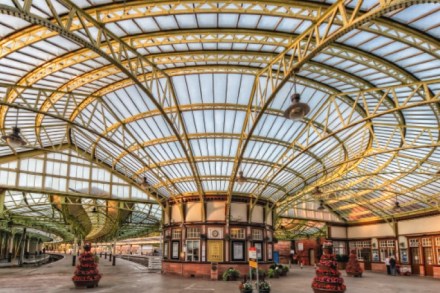
A couple of weeks ago I met David Grime and Alan Noble, members of the Lakes Line Rail User Group, over a very good dinner in the Brown Horse pub in Winster in the heart of the Lake District. They had contacted me in despair at the collapse of services on their beloved ten-mile Windermere branch line. This once reliable and well-used service is now a shadow of its former self: characterised by cancellations, rampant overcrowding, bus replacement services and — sometimes — an absence of any trains at all. The trouble started following an inexplicable government decision to take the service away from TransPennine Express and give it to Northern, part of the much larger Arriva Trains. It wasn’t long before services started to deteriorate.

False start | 5 July 2018

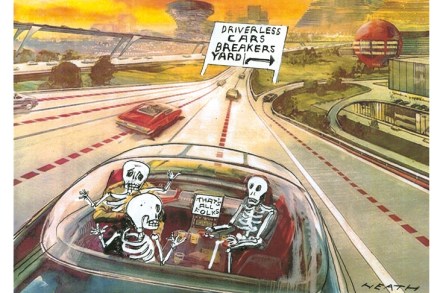
I was worried that going to the autonomous vehicle exhibition in Stuttgart would be tantamount to an atheist walking into St Peter’s while the Pope was conducting a mass. There is something religious about the fervour with which adherents to the driverless credo practise their faith and promise us a new kingdom. Their proselytising has indeed convinced many. Politicians are making outlandish statements, such as Jesse Norman’s two weeks ago, that ‘Our entire use of roads is to be revolutionised by autonomous vehicles’, and pouring large sums — a promised £180 million so far — into bizarre research projects such as the development of strange robot cars slower than a Reliant Robin and allowed only on pavements in Milton Keynes.

Are driverless cars the future?

  Philip Hammond’s last Budget focused on driverless cars as an example of the brave new technological world. But should we believe the hype? The Spectator arranged for Christian Wolmar, author of a new book on the subject, to meet Rory Sutherland, vice-chairman of Ogilvy & Mather and The Spectator’s Wiki Man columnist, to talk about the future of driving and transport.   Wolmar: Let’s face it: we’re talking about a technology that will never happen. There may be some driverless cars going round Phoenix in a very limited way but the owners, Waymo, which is part of Google, are very secretive about precisely what they’re doing.

Going places

Stations, according to Simon Jenkins, are the forgotten part of the railway experience. People love the trains, the journey, the passing countryside, the leisurely pace and the locomotives, especially steam ones. The stations, however, have been rather ignored. Sure, the ubiquity of Prêt, Upper Crust and all those coffee chains on station concourses has made the experience somewhat tawdry at times, but even the worst is better than an airport. Brief Encounter would not have worked in a departure lounge. As Jenkins discovers, there is still plenty to celebrate and enjoy, and the modern disdain of stations is partly borne of our reluctance to linger in the face of modern life’s myriad competing demands.

Let me take you through the night

As a child, I used to travel with my mother from London to Cannes, a journey that took slightly under 24 hours. The strangest part of the trip was the three or four hours in Paris, where the train trundled between the Gare du Nord and the Gare de Lyon along the Petite Ceinture, giving us a view of rundown parts of Paris which tourists never normally saw. Sometimes we would cheat and take a cab, giving us a couple of hours off the train, during which we enjoyed a relaxed steak frites in the Train Bleu restaurant with its elaborate belle époque decor. I often wondered why the train meandered so long in Paris, and Andrew Martin now provides the explanation.

A new track record

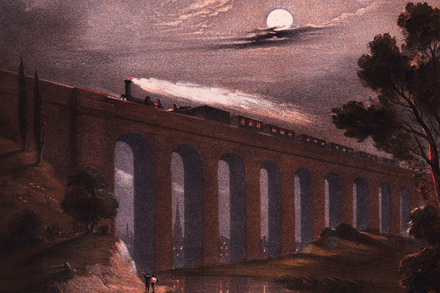
Simon Bradley dates the demise of the on-board meal service to 1962, when Pullman services no longer offered croutons with the soup course. That may be a touch fanciful— there were other reasons for the decline, such as faster trains, cost cutting and the growth of fast food. Nevertheless, it is the type of anecdote that illustrates the thoroughness and depth of Bradley’s research. It is indisputable that the railways were the most important invention of the early 19th century. Before their creation, travel between towns and cities was a desperately slow and difficult enterprise and moving goods around was even harder, given the terrible state of the roads.