Charles Moore

Charles Moore

Charles Moore is The Spectator’s chairman.

He is a former editor of the magazine, as well as the Sunday Telegraph and the Daily Telegraph. He became a non-affiliated peer in July 2020.

So where is the ‘ecosystem collapse’ that Prince Charles warned us about?

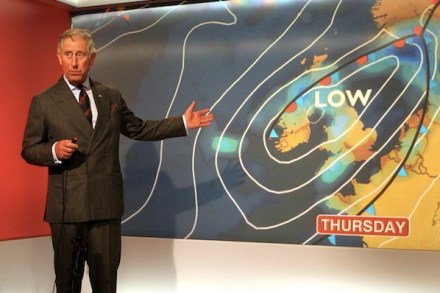
It is traditional for me, at this season, to remind readers of the Prince of Wales’s prophecy, spoken in Brazil in March 2009. His Royal Highness warned that the world had ‘only 100 months to avert irretrievable climate and ecosystem collapse’. So only four years now remain. But as I write, the Met Office is meeting in Exeter for an unprecedented summit to work out why it has predicted for the past 13 years that the British climate will get warmer only to find, in 12 out of the 13, that it has got colder. No one is admitting, of course, that the end of the world is not nigh, but one does notice much self-exculpatory talk of how weather is affected by ‘a host of other factors’.

The Spectator’s notes | 20 June 2013

When he arrived for the G8 in Co. Fermanagh, President Obama told the people of Northern Ireland that those living with conflict in far-flung places are ‘studying what you’re doing’ and that ‘You’re the blueprint to follow’. If they really were studying it, they would be less confident of the blueprint status. It is not true that the Belfast Agreement meant that, as the President put it, ‘clenched fists gave way to outstretched hands’. What happened was that the roughest major grouping on each side — the Paisleyites and Sinn Fein — saw that they could crowd out their more moderate rivals and divide the spoils of office between them. If hands are outstretched, it is more for public money than for peace.

Opposing gay marriage now is as brave as being openly gay was in 1970

Since one’s attitude to homosexual acts is now considered the main way of judging whether a person is civilised, one must salute those in public life who defy this. To oppose gay ‘equality’ today is roughly as brave as it was to be publicly homosexual in, say, 1970: your position is not absolutely illegal, but it is perilous. Given how wobbly many Anglicans are on the issue, the Archbishop of Canterbury and the Bishop of London should be commended for their courage in the House of Lords debate. The Chief Rabbi, Lords Sacks, should be reproved. Orthodox Judaism is absolutely clear on this issue, but Lord Sacks absented himself. Perhaps he feels that Jews should not intervene in secular society.

The Spectator’s Notes | 13 June 2013

Few things in history can be more worth thinking about than the first world war, so in a way one welcomes the government’s plan for extensive centenary commemorations. And I do not agree with the critics that part of the purpose should be to blame the Germans: such blame is not a task for government. The bigger worry is surely twofold. One is that, over the planned four years, the commemorations will dissipate their energies in cultural trench warfare and get muddled up with the normal (and excellent) patterns of Remembrance. The other is that they will resemble those semi-apologies about any violent death in our history which have become a cheap way for political leaders to show themselves more enlightened than their predecessors.

First Mercer, now Yeo – isn’t it time politicians tried to entrap journalists?

Now that it has become commonplace for the press to entrap MPs and peers, why don’t our legislators try to turn the tables? I suggest that ministers sidle up to journalists (secretly filming them the while) and offer them honours. They should hint that the honour is conditional on favourable coverage, and agree to meet again in six months. In between, they should track what the journalists write, and then, when they have trapped their victims, expose the pattern. Another trick would be for politicians to get friends to pretend to be businessmen offering journalists money or freebies to place products in their stories and features. These tactics would get interesting results. The latest Sunday Times sting can be read here (£).

The Spectator’s Notes | 6 June 2013

What a strange country this is. On the same day that we celebrated the 60th anniversary of the coronation, a mystical rite founded for the ancient kings of Israel and continuous here for a thousand years, our almost equally venerable House of Lords voted to undermine the basis of the oldest of all human relationships recognised in law. The new Archbishop of Canterbury spoke very well on both subjects. In Westminster Abbey, he praised the Queen’s ‘servant leadership’, and reminded the congregation that Jesus ‘did not count equality with God a thing to be grasped, but humbled Himself and took the form of a slave’. But in Parliament, equality was greedily grasped.

How Equality will do for the Right in the end

As the Same Sex Marriage result shows, the doctrine of Equality now carries all — family, religion, tradition, freedom — before it. Lots of Conservatives prate in favour of it without realising that Equality is the most essentially left-wing of all doctrines and will do for them in the end. Watching the Derby on television on Saturday, I found myself treated to ten minutes of how wonderful Emily Davison was for throwing herself under the King’s horse at Epsom 100 years ago. Dr Helen Pankhurst, of the suffragette dynasty, was interviewed at the racecourse by Clare Balding.

The Spectator’s Notes | 30 May 2013

The website of the Security Service (MI5) says that since the end of the Cold War, the threat of subversion is ‘now considered to be negligible’. Isn’t this a mistake? It seems likely that many Muslim organisations — university Islamic societies, for example — are subverted by jihadists. The infiltrators whip up hatred against the West and create networks, rudimentary but often powerful, of the like-minded. When they have done their work well, they do not need to give direct orders to people like the Woolwich murderers to kill: they have primed their human device, and left it to explode. Such subversion may not be backed by foreign state power, but it still resembles communism in its ability to infiltrate minds and organisations at the same time.

MI5 is wrong: subversion is still a threat

The website of the Security Service (MI5) says that since the end of the Cold War, the threat of subversion is ‘now considered to be negligible’. Isn’t this a mistake? It seems likely that many Muslim organisations — university Islamic societies, for example — are subverted by jihadists. The infiltrators whip up hatred against the West and create networks, rudimentary but often powerful, of the like-minded. When they have done their work well, they do not need to give direct orders to people like the Woolwich murderers to kill: they have primed their human device, and left it to explode. Such subversion may not be backed by foreign state power, but it still resembles communism in its ability to infiltrate minds and organisations at the same time.

The Spectator’s Notes | 16 May 2013

The BBC loves nothing better than a narrative in which Tory anti-European eccentrics split their party, and a bewildered public votes Labour. It is certainly the case that some of the Tory sceptics are half-crazed by dislike of David Cameron. But the reason the subject keeps coming up is because it matters, and it remains unresolved. The Tory rebels understand this in straightforward electoral terms: the rise of Ukip threatens their seats, so they must do something about it. What is maddening is not so much Mr Cameron’s actual policy on Europe, but his patent longing to avoid the subject. His refusal to ‘bang on’ about Europe has brought about more banging on than ever.

Refusing to bang on about Europe has brought about even more banging on than before

The BBC loves nothing better than a narrative in which Tory anti-European eccentrics split their party, and a bewildered public votes Labour. It is certainly the case that some of the Tory sceptics are half-crazed by dislike of David Cameron. But the reason the subject keeps coming up is because it matters, and it remains unresolved. The Tory rebels understand this in straightforward electoral terms: the rise of Ukip threatens their seats, so they must do something about it. What is maddening is not so much Mr Cameron’s actual policy on Europe, but his patent longing to avoid the subject. His refusal to ‘bang on’ about Europe has brought about more banging on than ever. This is an extract from Charles Moore's Spectator's Notes in this week's magazine.

If a policeman stops you, accuse him of raping you and force him to arrest himself.

Now that virtually any well-known male entertainer of a certain age is arrested for alleged sexual offences, it is becoming clear that this is more a culture war than a set of proper criminal investigations. This does not necessarily mean that all the allegations are false — look at Stuart Hall — but it does suggest that a new way has been found of ruining people’s reputations before anyone has established their guilt. The undeniable fact that so many of the men accused wore deplorable clothes in public all through the 1970s is not, in itself, proof of iniquity. Enraged by Leveson, the press argue that naming people being investigated for sex crimes is a brilliant way of smoking them out.

The Spectator’s Notes | 9 May 2013

On Tuesday night, at a Spectator readers’ evening, Andrew Neil interviewed me about my biography of Margaret Thatcher. He asked me if, after leaving office, Lady Thatcher had come to the view that Britain should leave the European Union. I said yes (I think it happened after the Maastricht Treaty in 1992), although advisers had persuaded her that she should not say this in public since it would have allowed her opponents to drive her to the fringes of public life. I had believed this was widely known, but according to Andrew, it is a story. My revelation, if such it was, came on the same day as Nigel Lawson’s piece in the Times saying that he would now vote for Britain to leave the EU. How things have changed. Even the BBC treats Lawson’s view as respectable.

After leaving office, Margaret Thatcher believed Britain should leave the EU

On Tuesday night, at a Spectator readers’ evening, Andrew Neil interviewed me about my biography of Margaret Thatcher. He asked me if, after leaving office, Lady Thatcher had come to the view that Britain should leave the European Union. I said yes (I think it happened after the Maastricht Treaty in 1992), although advisers had persuaded her that she should not say this in public since it would have allowed her opponents to drive her to the fringes of public life. I had believed this was widely known, but according to Andrew, it is a story. My revelation, if such it was, came on the same day as Nigel Lawson’s piece in the Times (£) saying that he would now vote for Britain to leave the EU. How things have changed. Even the BBC treats Lawson’s view as respectable.

The Spectator’s Notes | 2 May 2013

It is fascinating watching the great welfare debate as the universal credit starts its life. The ruling elites have very, very slowly caught up with public understanding. The simplest way to think about the question is this. At every level of society people tend to be acutely aware of what their approximate equals are paid, and usually unaware of what those richer or poorer receive. Therefore the people who best understand how welfare works are either its recipients or those who work on low wages and are scarcely better off for doing so. These people recognise that being on welfare is — in effect, though not morally — like having a job. There is a wage for it, plus various equivalents of overtime and fringe benefits, and the task is to get as much of these as you can.

When Michael Heseltine turned up at a Thatcher book signing

At the launch of my biography of Margaret Thatcher, I was flattered to see Michael and Anne Heseltine joining the signing queue. It was very sporting of him. When they reached me, Anne asked for my inscription, but Michael said he wished his copy to be blank so that he could quickly sell it. I think — unusually for him — that he misunderstands the way this strange market works. The most common question I am asked by audiences about Mrs Thatcher is something to do with Carol and Mark. Did she bring them up successfully? Was she a good mother? etc. The fact that this comes up so often is testimony to the point I make again and again: it was completely different — and very difficult — being the first woman prime minister.

‘Please don’t mention Margaret Thatcher when you write to me’

‘Arthur Negus’ — Tony Bray — is the only one of Margaret Thatcher’s early loves still alive, though sadly he is now in poor health. Once I had tracked him down, I found him happy to speak about those distant days at the end of the war when he danced with the future prime minister. But he was extremely anxious — 60 years later — that his wife (who is now dead) should not know of my inquiries. ‘If you ring up, please say nothing of your purpose,’ he said, ‘and if you write, please don’t do so in a Daily Telegraph envelope.’ When he married his wife, a couple of years after the relationship had ended, a similar sense of honour induced him to destroy all Margaret’s letters to him.

The Spectator’s Notes | 25 April 2013

The first volume of my biography of Margaret Thatcher was published on Tuesday. Since Lady Thatcher had stipulated that the book could appear only after her death, we were, in principle, ready. But it is still a huge undertaking to finish correcting a 900-page book on a Tuesday (the day before the funeral), and get back the printed book the following Monday. Reviewing my endnotes, I came across an interviewee called Rosie Cruikshank. She appeared in relation to Margaret Roberts’s most serious boyfriend. Who on earth was she? Just in time, I remembered. While writing all the ‘love interest’ passages, I had worried that they might fall into the wrong hands, and so I gave the characters pseudonyms. I chose names to fit the period.

Margaret Thatcher and the missing votes

There was a startling late entry for the first volume of my biography of Margaret Thatcher. On the day after she died, I received an email from Haden Blatch. Mr Blatch’s father, Bertie, was the chairman of the Finchley Conservative Association when it selected her in 1958. I had asked Haden for information before, but he had not got round to it. Now he revealed that his father had come home from the Finchley selection meeting and explained that Mrs Thatcher had not really won the vote. Her rival, Thomas Langton, had just pipped her. Blatch senior, however, was very keen on Mrs Thatcher, and thought that Langton, who ‘was born with a silver spoon in his mouth’, would easily get in somewhere else, whereas she, being a woman with young children, would not.

The Spectator’s Notes | 18 April 2013

When Winston Churchill died, Lady Violet Bonham Carter made her maiden speech in the House of Lords. ‘It is hard for us to realise,’ she said, ‘that that indomitable heart to which we all owe our freedom … has fought its last long battle and is still.’ Her words have application to Margaret Thatcher. But something else about them strikes me. Lady Violet was the daughter of a prime minister (Asquith). Before Churchill married, nearly 60 years earlier, she had been, more or less, his girlfriend. It is a reminder that Churchill was, from the first, in the circles of power and privilege. This does not lessen his achievement, but it points up what Mrs Thatcher had to fight for that he did not.